Gastric Sleeve vs. Gastric Bypass Cost in Mexico: A Line-Item Comparison
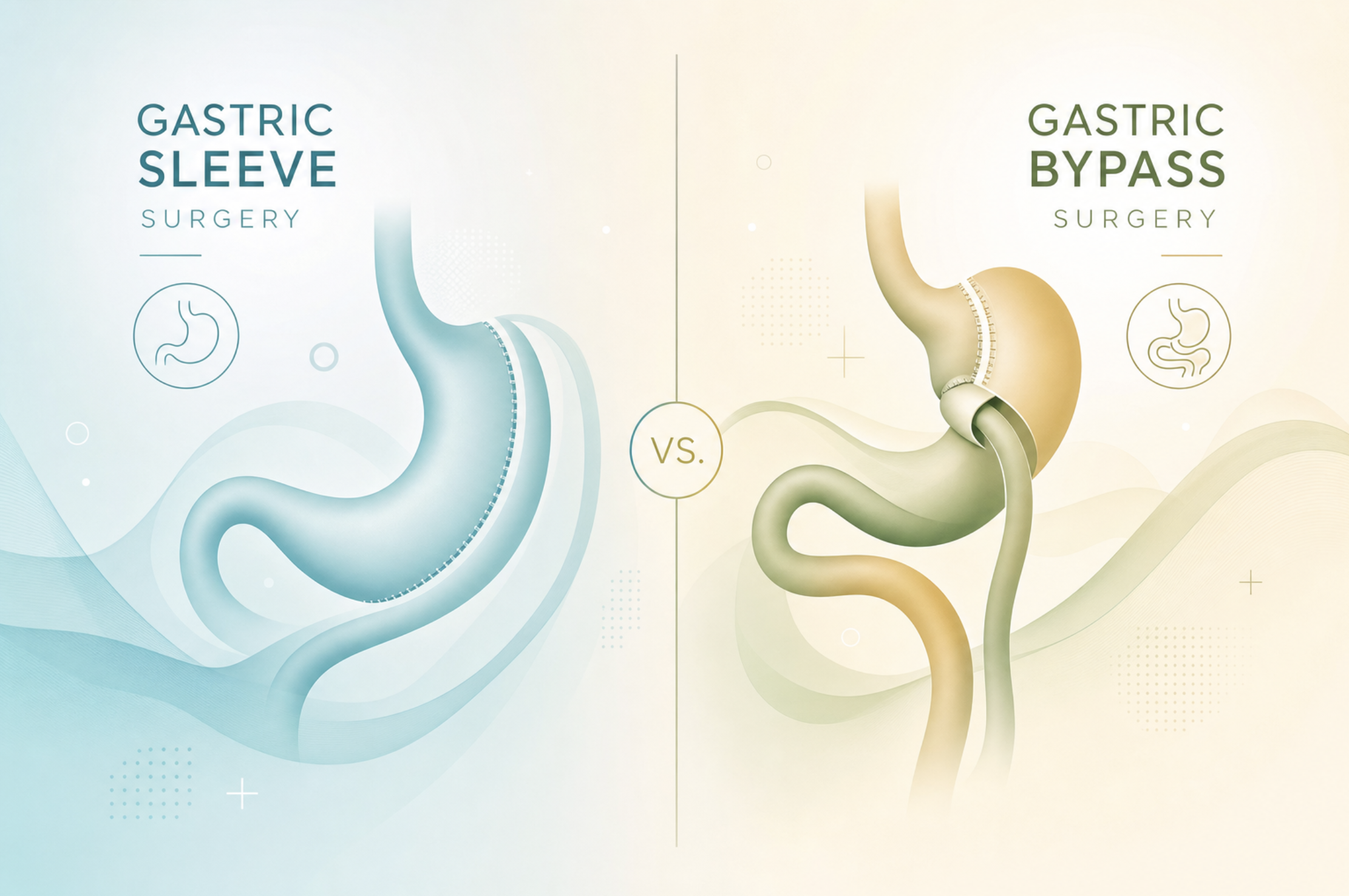
Sleeve gastrectomy packages are generally priced from $4,295 to $6,000 for all-inclusive packages, with the bypass surgery being around $5,495 to $7,500, based on typical Mexico package prices – source Renew Bariatrics. All-inclusive packages usually cover the cost of surgery including surgeon, hospital stay, anesthesia, and basic follow-up care. On the other hand, a peer reviewed paper published in the Journal of Surgical Endoscopy via PMC reported that in 2017 the average price of bariatric surgery in Mexico was $6,400 compared to $17,700 in the USA, which amounts to a difference of about $11,300 (Spurzem et al., Surgical Endoscopy via PMC).
Bypass procedures cost more than sleeves in most packages as they involve a longer procedure time as well as an additional night of hospital stay. This guide will show you where your money is going in terms of the cost of the hospital, surgeon, anesthesia, laboratories, medication, hotels, and transportation so that you can compare prices between sleeve and bypass item by item and not estimate the overall bundle of services. Renew Bariatrics collaborates with certified hospitals and board-certified surgeons in Mexico and you can view surgeon options on the surgeons page prior to requesting your individualized package price.
Key takeaways
- Published research reveals that the average cost of bariatric surgery in Mexico amounts to about $6,400, as opposed to $17,700 in the US, thus reducing the patient’s financial burden by about one-third (Spurzem et al., Surgical Endoscopy).
- Regular all-inclusive pricing fees generally vary from $4,295–$6,000 for a gastric sleeve to $5,495–$7,500 for the complete gastric bypass procedure.
- The high price of the gastric bypass procedure is caused by the longer operation time, complex reconstruction procedures, and prolonged hospital observation period.
- Common components of the bariatric surgery packages in Mexico usually include the hospital fee, surgeons’ labor fee, anesthesia, pre-surgery blood tests, accommodation, and ground transportation. Flight tickets and long-term supplement programs are not included.
- On average, in the US, the cost of gastric sleeve is $19,459, almost three times greater than the all-inclusive package in Mexico (CareCredit).
- Financial planning has to take into account the possibilities of hidden costs, such as future revision procedures, emergency management at home if any complications occur on return, and special medical travel insurance plans.
Why does gastric bypass cost more than gastric sleeve in Mexico?
Gastric bypass surgery (Roux-en-Y), which not only reduces the volume of the stomach but also entails the repositioning of the intestines, is a much more complicated procedure requiring more time spent in surgery and more suture lines. This factor makes itself apparent in Mexico’s gastric surgery package pricing, as in Mexico, a sleeve gastrectomy surgery is priced approximately at $4,295-$6,000, whereas the bypass package costs around $5,495-$7,500. The cost difference between sleeve and bypass surgeries in Mexico is comparable to that in the United States, being somewhere around $1,000-$1,500.
The 2017 surgeon survey: the best available cost anchor
Almost all of the specific dollar amounts that are reported in relation to “bariatric surgery in Mexico” can be traced back to individual clinics’ websites, making it difficult to know whether the stated number is an actual reflection of the market or is simply part of one clinic’s marketing efforts. One independent source of information would be the 2017 global survey of bariatric surgeons cited in the peer-reviewed Surgical Endoscopy article on cross-border bariatric surgery, which reported the mean price for bariatric surgery in Mexico was $6,400, compared with $17,700 in the US (Spurzem et al., Surgical Endoscopy via PMC).
While that is the only authentic information available, it does not specify prices between sleeve and bypass, and is outdated information due to several years having passed since then, along with the effects of inflation and currency fluctuations. However, it does confirm that the amount of money saved is around a third of the US average, a ratio reflected whether looking at the academic literature or current package costs (Spurzem et al., Surgical Endoscopy via PMC).
Current market pricing: sleeve vs. bypass
The table below shows the current market range for bariatric surgery both primary and secondary within major hospitals in Mexico under normal market circumstances:
| Procedure | Typical Mexico package price | What drives the range |
| Gastric sleeve (VSG) | ~$4,899–$6,000 | Tier of the hospital, surgeon experience, city, category of the hotel |
| Gastric bypass (RYGB) | ~$6,395–$7,500 | Longer operation time, more complex reconstruction, sometimes longer hospital stay |
| Mini gastric bypass (OAGB) | ~$5,500–$7,000 | Similar complexity to bypass; fewer connections to construct |
| Duodenal switch / SADI-S | ~$6,795–$6,995 | Most complex – longest OR time |
| Revision surgery | ~$5,190–$7,500+ | Varies greatly, depending on the original procedure and scar tissue |
These figures represent the price ranges, and not the fixed figures – prices may differ from hospital to hospital and depending on the scope of work involved, so use them to give you an idea of how to start comparing.
In any case, the cost of the sleeve will always be on the lower side since it involves only one surgical process where the surgeon removes about 80 percent of the stomach without the need to re-route and re-attach the intestine. The cost of bypass surgery will always be higher in all countries where it is available, including Mexico and the US, because the surgeon needs to form a small stomach pouch before connecting the small intestines.
Line-item cost breakdown: where the money goes
With an “all-inclusive” package, the quoted one price includes various individual costs incurred at the hospital level and from the professionals’ services. Let us have a look at what the package includes by splitting it into smaller parts:
Hospital fees
The biggest portion of the total cost of the package goes towards the surgical center. The specific costs include the time spent in the surgery center, the use of the laparoscopic camera tower and sterilization machine, recovery period, private inpatient room, and nursing care throughout the day.
A mandatory 1-to-3-night stay is usually included in most packages. The gastric sleeve patients are commonly discharged within 1 or 2 days, but the bypass patients will use the full 2-to-3-night inpatient period to ensure proper healing before going to a hotel.
Surgeon and surgical team fee
In contrast to the traditional billing system practiced in America, which bills the primary surgeon, assisting physician, and scrub techs as individual and independent professionals, the Mexican bariatric surgery packages include all these costs. This particular item represents the payment made to the certified chief surgeon, the co-surgeon or first assistant, and the nursing team working in the operating room.
Anesthesia
General anesthesia and a dedicated anesthesiologist are standard inclusions. Bypass, because of its longer operative time, generally requires more anesthesia time than sleeve — one of the reasons bypass packages cost more even when the same hospital and surgeon perform both procedures.
Pre-operative labs and diagnostics
Bloodwork, an ECG, and sometimes imaging are typically bundled in, along with a virtual pre-op consultation before you travel. These tests confirm you’re a safe surgical candidate before you get on a plane.
Medications and surgical supplies
Packages usually contain the medication and accessories used in and immediately following surgery—IV fluids, pain control medication, surgical outfits—but not medications that may be required well after your discharge from the hospital.
Hotel and accommodations
The majority of packages involve a stay at a hotel before and after the procedure, which typically includes 1 night in some sleeve packages, up to a week for those traveling to Cancun for vacation purposes. It is at this point that regional variances (as mentioned below) become evident.
Ground transportation
Airport pickup and drop-off, plus private transport between your hotel and the hospital, are standard inclusions. International airfare to get to Mexico is not.
Follow-up and aftercare
Prior to your final discharge back home, you will have an after-surgery consultation with your surgeons, where your recovery will be assessed, your incisions examined, and you will be provided with a bariatric nutrition handbook tailored to your multiple-stage liquid-to-solid diet regime. Longer-term follow-up (months or years later) is generally not.
What’s typically included vs. excluded
| Category | Usually INCLUDED | Usually EXCLUDED |
| Hospital | 1-3 night stay and nursing care. | When complications arise, it is possible that extended stays will be necessary. |
| Surgeon fee | Full surgical team | — |
| Anesthesia | General anesthesia, anesthesiologist | — |
| Pre-op | Blood test, virtual consultation, ECG | Extensive imaging was done beyond the standard workup. |
| Medications | Peri-operative meds and supplies | Long-term supplements/vitamins |
| Hotel | 3 nights per package/city (from 1 night to 7 nights) | Any time spent outside the package window. |
| Transport | Pick up from the airport and transportation from the hotel to the hospital will be arranged. | International airfare |
| Aftercare | Following surgery, diagnosis, nutrition counselling and final consultation. | Follow-up with revisions and complications after leaving the hospital. |
| Other | — | Medical expenses of any kind prior to surgery, travel to and from surgery with companion, unrelated medical treatment. |
This pattern indicates that while the package encompasses everything that is involved in your immediate hospitalization period, any subsequent expenses like bariatric vitamin supplements and any complication management after you return home will be handled separately by your local healthcare team.
Regional cost variation: Tijuana vs. Cancun
The choice of the geographic location in Mexico is bound to have a direct impact on your costs, more from variations in the hospitality arrangement than on the actual costs of the procedure.
Tijuana sits right on the international border line just opposite San Diego, California. Being a very efficient high volume medical center, Tijuana allows for people to arrive at the San Diego International Airport (SAN) and make the trip across the border by ground transportation without the need to pay international flight surcharges.
Also, the clinical services offered in Tijuana tend to emphasize the efficiency of the short term recovery approach. Patients spend their short period of time staying near the medical center and minimize their accommodation and meal costs.
Cancun packages for sleeve run about $4,500–$6,000 and bypass about $6,000–$7,500 in the current Mexico market — a range broadly comparable to Tijuana. The bariatric program at Cancun is part of the already established luxury vacation setup. Although the base cost of the surgery is comparable to Tijuana, all-inclusive programs in Cancun often include stays of 5 to 7 nights at beach resorts.
It is especially geared towards people who would like to turn their surgery stay into a relaxing holiday free from usual domestic distractions. Although this does increase the value-added component, it also increases the cost of the all-inclusive package over a shorter period at a business hotel.
The takeaway: don’t compare two city quotes on price alone. Ask exactly how many hospital nights and hotel nights are included, since that’s usually what separates one all-in number from another.
How does Mexico pricing compare to the US?
For comparison’s sake, cash-pay prices in the United States fall into a completely different category. According to CareCredit, the national average price of a laparoscopic sleeve gastrectomy is $19,459, with a range between $15,067 and $37,103 (CareCredit). This average of $19,459 is about three to four times a typical Mexico package price. The self-pay price in the 2017 surgeon survey of $17,700 falls within this range, further confirming that US prices are not an anomaly (Spurzem et al., Surgical Endoscopy via PMC).
What must be recognized is that cash pay pricing in the United States differs from insurance negotiated prices, as the former is rarely seen by insured patients because of negotiation of price with the insurance provider. However, for the increasing numbers of uninsured, under-insured, or denied patients, the self-pay prices listed above are the real prices to compare to Mexican packages.
| Gastric sleeve | Gastric bypass | |
| Mexico (typical package) | ~$4,295–$6,000 | ~$5,495–$7,500 |
| US (national average, cash-pay) | $19,459 (CareCredit) | n.a. — bypass-specific US national average not independently confirmed |
| US/Mexico overall average (2017 survey) | $17,700 vs. $6,400 (Spurzem et al.) | — |
The hidden costs that can erase your savings
While it is obvious that medical tourism offers financial benefits, it is important that you enter the entire situation with wide-open eyes since failing to consider additional expenses will very quickly reduce your expected savings. The following four components should be considered when planning financially:
Revision surgery. If you find yourself suffering from acid reflux or gaining back weight after many years, there is a possibility that you will need to undergo a revisional surgery, like having a primary gastric sleeve converted into gastric bypass surgery. Revisional surgeries are quite complicated surgeries as they involve the separation of thick scar tissues from previous surgical operations done. As they entail more time and risks, revisional surgeries are priced a bit higher, usually starting at $5,190.
Complications after you fly home. This is the number one hidden cost risk factor. According to a peer-reviewed study conducted on 91 people returning to the United States after having bariatric surgery in Mexico with complications, the problem experienced the most often was an anastomotic or staple line leak (33.0% of all cases), while 56.0% of these individuals needed to be hospitalized initially due to their complications, with 19.8% of these requiring care in intensive care units (Spurzem et al., Surgical Endoscopy via PMC).
The average expenses of managing these complications in an American hospital was $193,445, and the cost to just deal with the leaks was $424,976 (Spurzem et al., Surgical Endoscopy via PMC). Even with the knowledge that when a patient actually gets the bills, it may well be a significant cost that outweighs what they saved on the package; and it is not something that should be overlooked because of the importance of choosing an accredited hospital and asking some of the harder questions about complications.
Travel and medical-tourism insurance. Insurance policies have been specifically tailored for medical travelers who may face some unforeseen problems as a result of the procedure being conducted abroad. The coverage limits and premiums differ depending on the insurer, and therefore one must find out the extent of coverage offered before traveling.
Companion and extended stay fees. Most surgical packages will happily accommodate your support companion to join you in your private hospital room without any additional costs, but you will need to allow for their return airfare, meals in the daily hospital and any other local travel they incur while you are in hospital. Also, if your health care providers ask you to remain in the city for a few additional days to recover, any extra hotel nights will be required to be paid separately on top of the package length.
How Renew Bariatrics approaches this
Renew Bariatrics will connect you with hospitals and board-certified surgeons in Mexico, and provide you with a clear, itemized quote so you know exactly what you will be paying for before committing to any surgery (surgeon charges, transportation, anesthetic, hospitals, labs, hotel and more).
The team also discusses with patients what is usually not included in a package and extends the care period for those who will need it, to make sure that there are no unpleasant surprises after the trip. All recommended facilities have a formal aftercare program which covers the identification of problems as early as possible and does not rely entirely upon your follow-up plan at home.
Frequently asked questions
Why is gastric bypass more expensive than gastric sleeve in Mexico? Gastric bypass not only shrinks the stomach, but also redirects the small intestine, requiring more operating room time, anesthesia time, and surgical complexity than a sleeve gastrectomy. That extra time and complexity is a factor in the price difference in Mexico’s relatively $1,000-$1,500 of typical sleeve versus bypass packages.
Is the Mexico package a one-stop deal? Most packages cover the hospital stay, surgeon and anesthesia costs, pre-op labs, hospital medications and supplies, hotel accommodation and ground transportation. Costs of international airfare, long-term supplements, pre-surgical weight-loss (where applicable), and complication or revision surgery are usually not included, and travel costs for any accompanying person are in addition.
Is $6,400 still an accurate average cost for bariatric surgery in Mexico today? The figure is based on a study published in 2017, citing the results of a surgeon’s survey from all over the world which does not represent the current price in 2026 but historical data (Spurzem et al., Surgical Endoscopy via PMC). Today the average price of sleeve/bypass in Mexico is higher, in the range of $4,295–$7,500, depending on the procedure, so consider $6,400 as a directionally comparable, but not necessarily exact, package price benchmark for the size of the price gap between the US and Mexico.
How much cheaper is bariatric surgery in Mexico than in the US? According to the surgeon survey in 2017, bariatric surgery in Mexico cost an average of $6,400, while in the US the cost is $17,700, which is approximately a third of the cost (Spurzem et al., Surgical Endoscopy via PMC). If current data is used, a typical Mexico sleeve package (~$4295-$6000) is in the same league as the US national cash-pay average, which is ~$19,459 (CareCredit), or three to four times.
Is it cheaper to have surgery in Tijuana or Cancun? The two cities are roughly equal in pricing — Cancun ranges are in the $4,500 to $6,000 range and bypass is in the $6,000 to $7,500 range, comparable to Tijuana ranges. The number of hotel nights in the packages is typically the greater determinant in the total cost, with Cancun packages often containing a longer hotel stay for vacation type recovery, and Tijuana’s proximity to the border reducing travel costs for many US patients.
What happens if I need revision surgery after going to Mexico? Revision surgery is a separate surgery from the initial procedure and will cost approximately $5,190 and will increase with the complexity of the surgery and if there is scar tissue from the first surgery. Typically revisions are more technically involved and thus more expensive than the initial operation.
What’s the biggest hidden cost people don’t plan for? Complications that surface after you’ve returned home are the largest financial risk. According to a peer reviewed study, the average hospital cost of caring for a returning patient with a complication was $193,445 with the average hospital cost of caring for a patient for a leak being $424,976 (Spurzem et al., Surgical Endoscopy via PMC). This is a good reason to opt for an accredited facility and also to take into account a travel/complication insurance policy instead of just the cheapest package.
Can I use my HSA or FSA for bariatric surgery in Mexico? Expenses incurred for a legal surgery, such as bariatric surgery (not cosmetic surgery), can typically be covered by an HSA or FSA (CareCredit). Documentation of contents of the package may be beneficial for reimbursement or tax purposes.
Ready to compare a real quote?
The above cost comparison of sleeve versus bypass surgery is merely a starting point and each patient has a unique anatomy, history, and wishes, which may alter the outcome. You can then have a conversation with a Renew Bariatrics coordinator about an itemized quote for your situation and get a connection to a board-certified surgeon on the surgeons page so you are aware of what you are paying for before you make any bookings.
The information in this article is provided for general information only and is not a medical or financial recommendation. Prices are based on average market rates and on data already published at the moment of writing and may vary; it is always better to ask a surgeon or hospital for an up to date, itemized quote, and to consult a qualified doctor in order to determine if bariatric surgery is right for you.
References
- Spurzem et al., “Managing complications of bariatric medical tourism,” Surgical Endoscopy (PMC) — https://pmc.ncbi.nlm.nih.gov/articles/PMC12222374/
- CareCredit, Gastric Sleeve Cost, Financing & HSA/FSA — https://www.carecredit.com/well-u/health-wellness/gastric-sleeve-costs-and-financing/
- Bariatric Surgery Options in Mexico for US Citizens with No Insurance, Medium.
https://medium.com/@bariatricjourney/bariatric-surgery-options-in-mexico-for-us-citizens-with-no-insurance-6f55b0f3fe5c
FEATURED BLOGS

How to Choose Mexico Bariatric Surgeon
Concerns about having a bariatric procedure is a normal and expected element of the decision. These worries are…
Read More
Which Bariatric Surgery is Best?
Obesity is one of the most common health issues in America. Obesity may further lead to a number of…
Read More