
Jump to a section
Compare proceduresRelated ProceduresPublished prices: a starting point for your comparisonWhat does an all-inclusive package actually include?Compare the care pathway before comparing the discountBuild a complete trip budgetThree hypothetical budgets, without invented market pricesRoutine follow-up and unexpected care are different budget categoriesInsurance: confirm the policy, not the labelFinancing and payment terms deserve a separate reviewKeep payment instructions separate from marketing messagesWhat should happen before you book nonrefundable travel?Questions that reveal the real scope of a quoteFrequently asked cost questionsYour next step: request a quote you can actually useYour next stepReferencesThe useful price is the amount you can plan around after your medical history, procedure, location, and package have been reviewed. A headline price helps you start comparing. It does not tell you whether two offers include the same care, whether you qualify for the advertised procedure, or what would happen financially if your recovery changed.
This guide separates Renew Bariatrics’ published prices from the decisions that require an individual written quote. MexicoWeightLossSurgery.org is owned by Renew Bariatrics. Its role is to help you understand your options and connect with the team arranging care; the treating professionals make clinical decisions. Think of the following sections as a worksheet for a coordinator conversation, not a final invoice.
Published prices: a starting point for your comparison
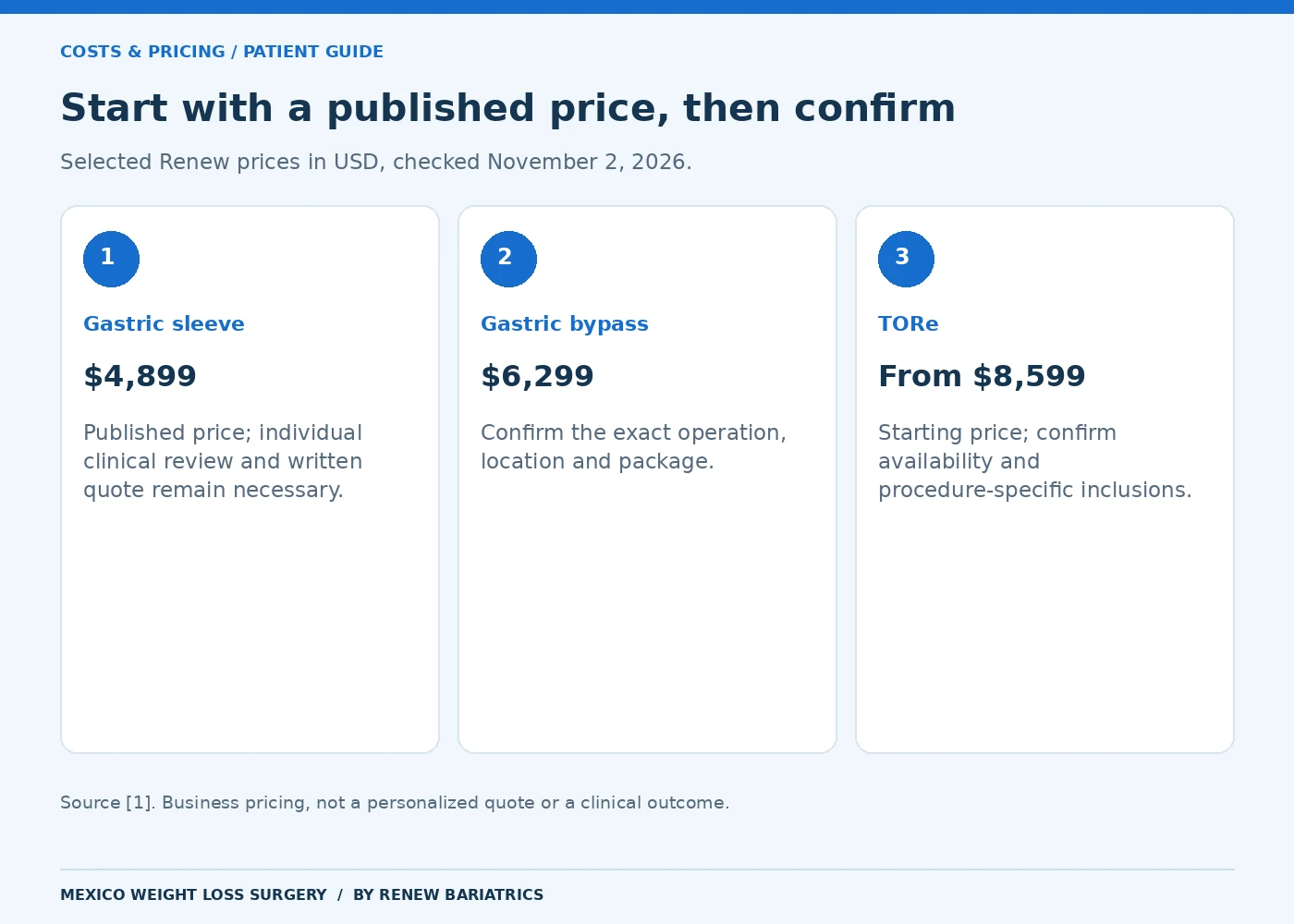
At the time of this review, Renew’s patient FAQ lists gastric sleeve at $4,899, gastric bypass at $6,299, SADI-S at $6,899, gastric balloon from $3,999, and TORe from $8,599, in U.S. dollars. The same page says mini gastric bypass, ESG, and revision procedures are quoted individually. These are published business prices, not independently measured treatment outcomes or a guarantee of your final charge. [1]
| Procedure | Published USD price | What to confirm |
|---|---|---|
| Gastric sleeve | $4,899 | Individual eligibility, location and package |
| Gastric bypass | $6,299 | Exact operation, location and package |
| SADI-S | $6,899 | Procedure suitability and current availability |
| Gastric balloon | From $3,999 | Device, placement, removal and follow-up costs |
| TORe | From $8,599 | Availability and procedure-specific inclusions |
| Mini gastric bypass | Individual quote | Resolve differing price presentations with Renew |
| ESG | Individual quote | Current availability and full care package |
| Revision procedures | Individual quote | Prior anatomy, proposed procedure and evaluation |
Published prices checked November 2, 2026. The qualifications above are questions to resolve, not additional promised inclusions. [1]
Use the procedure’s full name when requesting a quote. “Bypass,” “revision,” and “duodenal switch” can refer to materially different operations. Ask which operation is proposed, who will perform it, and where it will take place. If a quote uses a different procedure name from the one you expected, ask for clarification before comparing numbers.
Online price pages can disagree or become outdated. Renew’s comparison page, for example, also displays a numerical mini-bypass price, whereas its FAQ directs patients to an individual quote. This guide therefore does not present a firm mini-bypass price. A dated, personalized confirmation should resolve that discrepancy. [1],[2]
What does an all-inclusive package actually include?
Renew’s published FAQ describes surgeon, anesthesia, and hospital fees; preoperative hospital testing; two hospital nights and one hotel night; private transportation; take-home medications; and one companion. It excludes flights, companion meals, and extra hotel nights. Treat that as a published overview requiring confirmation for your procedure and location, particularly for endoscopy or a complex revision. [1]
For a usable comparison, ask for a separate answer beside every item. “Included” should identify what is included, the limits, and the circumstances that create another charge. A hotel allowance is different from an open-ended promise to pay for lodging. A standard laboratory panel is different from every test that a specialist might request. A routine medication supply is different from all medications you might need later.
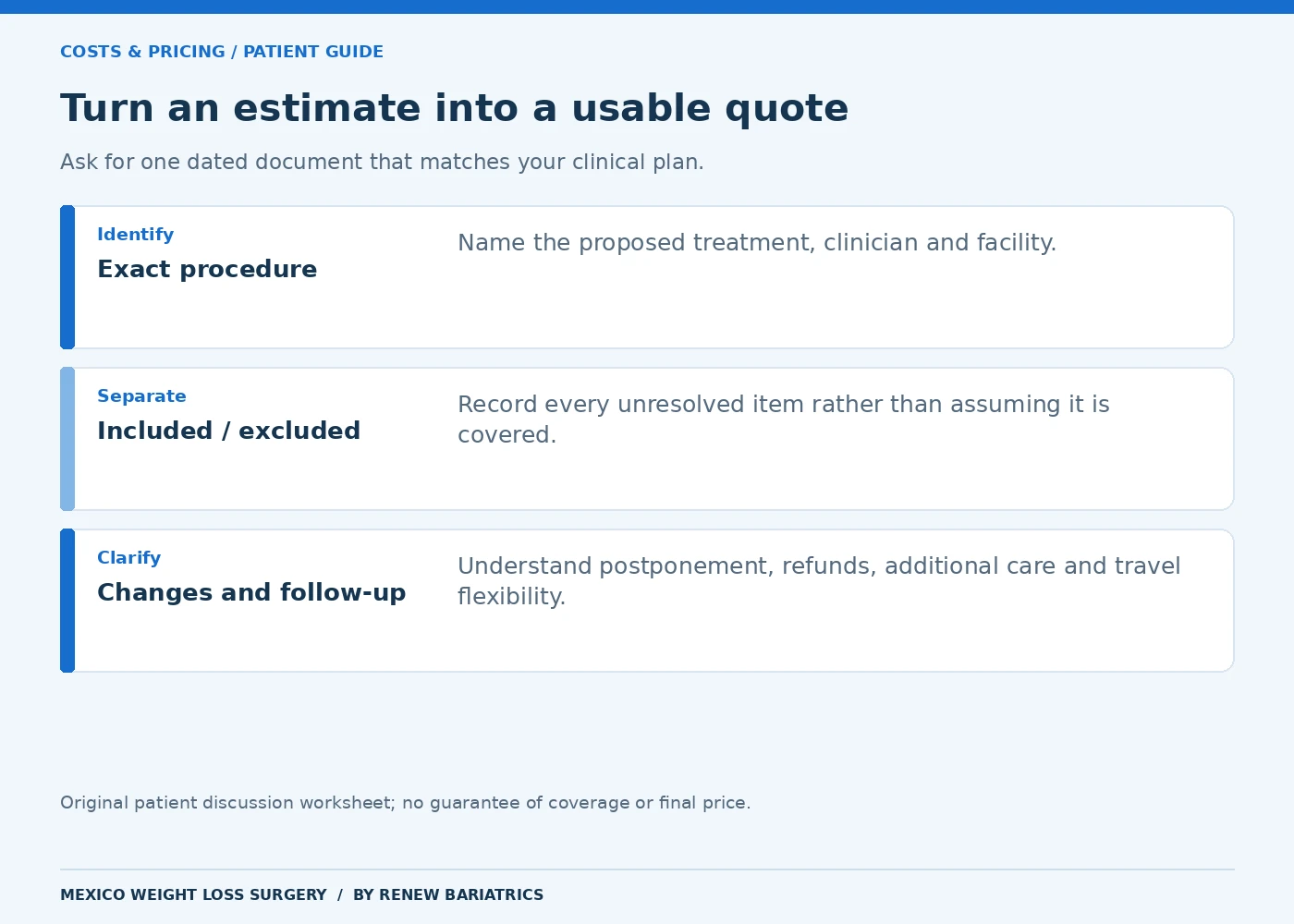
Create three columns in your notes: included, not included, and not yet confirmed. Do not silently move an unanswered item into the included column. That simple distinction makes a conversation much more productive: instead of asking “Is everything covered?” you can ask “Does this price include this specific test, at this specific facility, for my revision?”
Compare the care pathway before comparing the discount
There is no useful universal percentage by which surgery in Mexico is “cheaper.” The comparison depends on which U.S. or Canadian care option you could actually access, your insurance arrangements, the exact procedure, and the services bundled into each offer. A retail estimate for an uninsured patient is not equivalent to your insured out-of-pocket amount.
ASMBS explains that bariatric coverage varies by policy and employer, and directs patients to resources for understanding approvals and appeals. If you have coverage, obtain your own benefit information rather than assuming the operation is excluded because someone else’s claim was denied. [3]
For each option, write down the same facts: operation, surgeon, facility, preoperative evaluation, planned nights, routine postoperative visits, nutrition support, long-term laboratory monitoring, and how complications are handled. Only then compare the cost. A low figure with several unanswered categories is an incomplete offer, not necessarily a better offer.
Avoid comparing a primary sleeve operation with a complicated revision simply because both are described as weight loss surgery. The goal of a revision might be treating reflux, correcting an anatomical problem, or addressing weight recurrence. Your decision should begin with the clinical problem, followed by the options that reasonably address it.
Build a complete trip budget
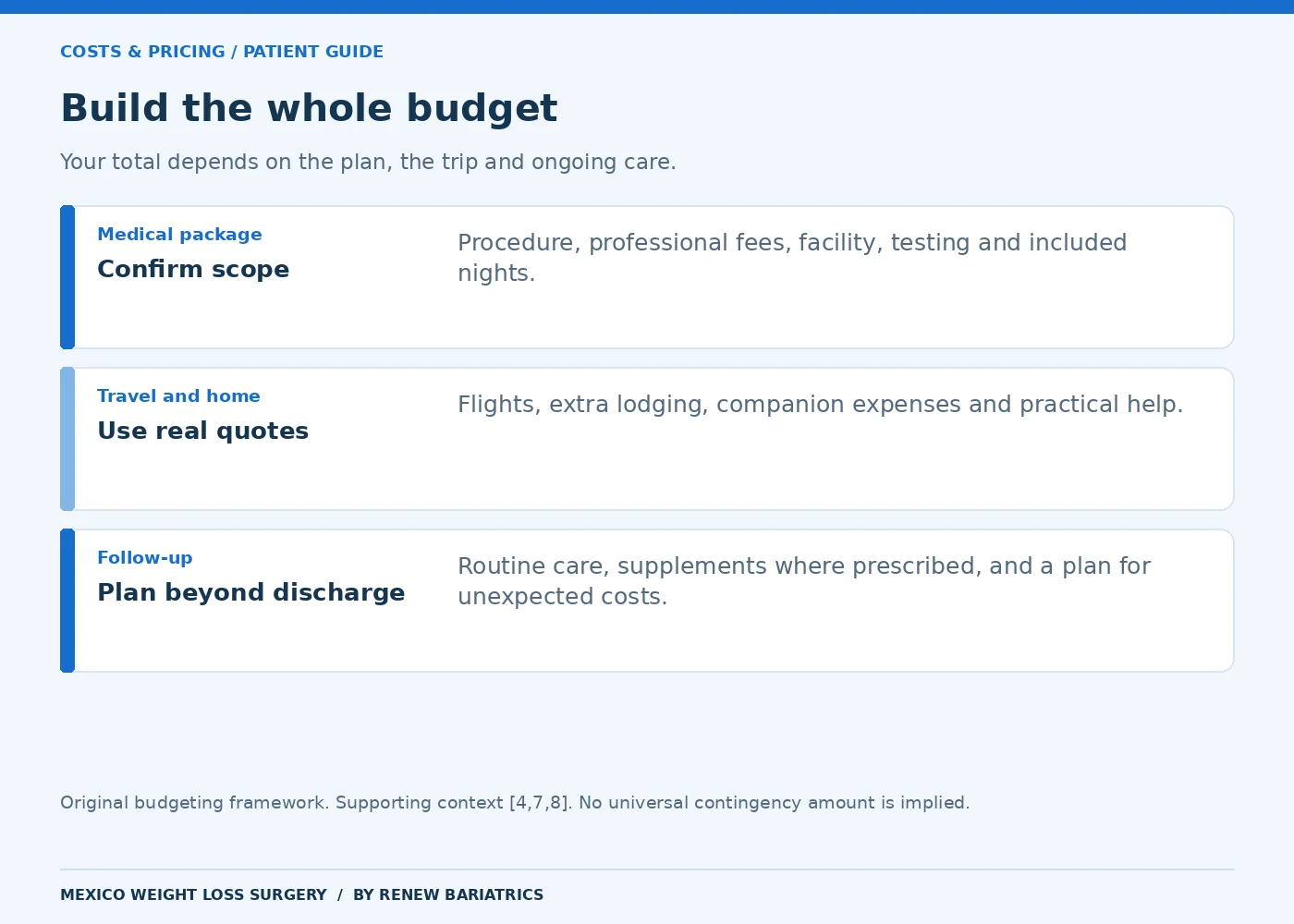
Your personal budget should include the quoted medical package plus costs outside that package. Start with travel to the departure airport, airfare, checked baggage, parking, and any overnight stay before your scheduled pickup. Then list companion expenses, meals that are not covered, additional accommodation, and the trip home.
The exact amounts depend on your departure city, season, flexibility, and whether you travel with someone. Obtain actual prices for your dates. Do not use a sample airline fare from a website article as your allowance. If your flight requires a connection, ask yourself whether the savings justify another transfer during the return journey.
Add time away from work, childcare, pet care, and help at home. These are not medical fees, but they can determine whether your plan is workable. A person who has paid leave and family support may face different practical costs from someone who is self-employed or has lifting responsibilities at work.
Finally, build a separate line for uncertainty. Label it as your own contingency, not an extra charge imposed by Renew. Its purpose is to identify how you would handle changed travel, extra accommodation, or a need for additional assessment. No website can calculate a universally adequate reserve for every patient.
Three hypothetical budgets, without invented market prices
Consider a person traveling alone for a primary operation. Their worksheet may be relatively simple: confirmed package, flights, airport expenses, and arrangements at home. The key unanswered question might be whether their return journey allows enough flexibility if clearance changes. Their advertised package remains only one part of the total.
Now consider a patient bringing a companion who needs a separate room. Even if the package permits one companion, that does not establish that a second room is covered. The worksheet should explicitly identify the room, number of nights, meals, transfers, and who pays if the stay extends. One clear question can prevent several assumptions.
A third person has had previous bariatric surgery and needs evaluation for revision. They should not budget from a primary-procedure advertisement. Their plan may need prior operative records and an individualized clinical proposal. The financial questions become: what is being evaluated, which findings might change the proposed operation, and when will the final quote be available?
These examples illustrate how to organize questions. They do not estimate anyone’s medical needs or predict extra charges. Your own coordinator should complete the worksheet using the actual plan approved for you.
Routine follow-up and unexpected care are different budget categories
Ask what the advertised aftercare means in practical terms: who provides it, how appointments take place, how long it continues, whether it includes individualized nutrition review, and what happens when you need an in-person examination near home. An online support group, a coordinator check-in, and an appointment with a clinician are different services.
For bariatric surgery, the budget should extend beyond the first postoperative month. ASMBS emphasizes continuing specialist follow-up and lifelong vitamin and mineral supplementation after surgical procedures. Costs and requirements differ by operation and clinical findings; endoscopic treatments need their own follow-up plan rather than automatically inheriting a surgical schedule. [4]
NIDDK identifies possible surgical complications including bleeding, infection, leaks, blood clots, and later nutritional or anatomical problems. This is why an “uncomplicated package” should not be interpreted as a promise that no further treatment will be needed. [5]
Ask two separate questions: “What routine follow-up have I purchased?” and “Who evaluates and pays for an unexpected problem?” Request examples that distinguish a routine contact from emergency imaging, readmission, another operation, or treatment after returning home. A specific explanation is more useful than a reassurance that the team will support you.
Insurance: confirm the policy, not the label
Renew’s application page describes the program as self-pay and says it does not accept insurance or Medicare. That statement concerns payment for the Renew program; it does not answer every question about your separate policy’s treatment of unrelated illness, emergency care, or postoperative follow-up. [6]
CDC distinguishes trip-disruption insurance, travel health coverage, and medical evacuation coverage. Their purposes differ. The existence of one policy does not prove that all three needs are covered. [7]
When contacting an insurer, explain that you are traveling for a planned bariatric or endoscopic procedure. Ask for a written answer describing whether that planned procedure and complications arising from it are included or excluded. Ask about limits, deductibles, waiting periods, authorization, payment before treatment, and the process for making a claim.
Keep the actual policy wording, not just a sales email. If a coordinator mentions “medical travel coverage,” request the insurer’s name, certificate, covered events, exclusions, time limits, geographic limits, and claims contact. This guide does not certify any policy or say that purchasing a particular product makes the trip financially risk-free.
Financing and payment terms deserve a separate review
Renew publishes a financing information page describing third-party financing options and recommends obtaining a complete package price. Financing availability is not the same as approval, and the lender’s agreement should be reviewed separately from the medical quote. [8]
Before submitting a financing application, identify the lender, amount financed, repayment schedule, total repayment, interest rate, fees, and any promotional conditions. Ask what happens to the loan if surgery is postponed or canceled. A payment that looks manageable each month can still represent a substantial total obligation.
If you plan to use a health savings account or flexible spending account, check eligibility and documentation with your own administrator before relying on reimbursement. Request an itemized medical invoice, but do not assume that every travel or companion expense qualifies because the main reason for the trip is medical care.
Similarly, obtain the current deposit, balance-due, refund, cancellation, and rescheduling rules directly. Ask which amounts are refundable if the clinical team decides you should not proceed, and whether airline and hotel charges are governed by different agreements. These are questions to resolve before payment, not after a difficult change in plans.
Keep payment instructions separate from marketing messages
Before sending money, verify the payment recipient and method through a contact route you already know belongs to the company. Ask which name will appear on the receipt and whether any processing or currency-conversion charges apply. Keep the invoice, receipt, and the version of the package terms that applied when you paid.
If instructions arrive that differ from the arrangements previously discussed, pause and confirm them with the team. This is an administrative accuracy check, not a claim that a particular payment method is unsafe. It helps you match each payment to your own account and avoid confusion between the deposit, medical balance, and separately booked travel expenses.
For payments made by someone helping you, agree in advance whose name appears on the invoice and who should receive refund or rescheduling correspondence. A clear paper trail makes a later question easier to resolve for everyone involved.
What should happen before you book nonrefundable travel?
Separate administrative readiness from medical readiness. You may have selected a date and discussed a price while parts of your evaluation remain outstanding. Ask whether your procedure, clinician, facility, and required records are confirmed and what must still be completed before the plan is final.
Your travel schedule also needs clinical review. The number of nights purchased is not, by itself, clearance to fly. The CDC’s medical-tourism guidance advises against flying for ten days after chest or abdominal surgery. If a proposed bariatric itinerary is shorter, ask the treating team to address that guidance explicitly and provide an individualized travel plan before buying tickets. Endoscopic procedures require their own assessment. [9]
Use a simple readiness list: written procedure quote, identified treating team, confirmed facility, outstanding-test list, written travel instructions, cancellation terms, and follow-up arrangements at home. An unanswered item is a reason for another question. It does not automatically mean care is inappropriate, but it should not disappear because a date is approaching.
Questions that reveal the real scope of a quote
Send the coordinator your questions together so the response can become one coherent document. Describe your prior procedure, preferred location, whether you will bring a companion, and any practical constraint that could change the trip. Use the appropriate clinical intake for sensitive medical information.
- What is the full name of the proposed procedure, and is this a primary operation or revision?
- Is this a fixed personal quote or an advertised starting figure, and when does it expire?
- Which clinician and facility does the quote assume?
- Which tests, professional fees, nights, transfers, medications, and routine follow-up services are included?
- What is excluded or subject to additional clinical review?
- What happens financially if the procedure changes, is postponed, or cannot proceed?
- Who handles urgent problems while I am in Mexico and after I return?
- Which return-travel instructions have been approved for my specific procedure?
Record the date and the person answering. If the proposal changes later, request an updated version rather than trying to reconcile several texts from memory. Both you and the team benefit from one current plan.
Frequently asked cost questions
Does a higher price prove that a center is safer?
No price alone establishes the quality of a clinician, facility, or follow-up system. Evaluate the actual care arrangements. ASMBS recommends checking surgeon credentials, facility accreditation, available outcomes, and plans for short- and long-term complications when patients consider bariatric medical tourism. Those checks are separate from a price comparison. [10]
Should I choose the operation with the lowest advertised cost?
The appropriate operation depends on your medical circumstances and goals, not only the immediate fee. Ask the clinical team to explain the reasonable alternatives and how their benefits, risks, and follow-up obligations differ. Then compare the complete costs of the suitable options. This page cannot determine which treatment is right for you.
Are flights included in Renew’s listed prices?
The current FAQ excludes flights. Confirm your own package and booking instructions before purchasing travel. Do not assume an older article or another company’s package describes Renew’s present offer. Use the dated written quote as your working document. [1]
Can I obtain a useful estimate before committing?
Renew’s application page describes its questionnaire as free and without an obligation to have surgery. It explains that the health history helps the clinical team review the case and develop a quote. You can also start by asking a coordinator which information is needed for your procedure. [6]
Why is an exact quote for revision sometimes unavailable immediately?
The word “revision” does not identify one standardized operation. Request an explanation of the evaluation needed and when a procedure-specific proposal can be provided. A responsible estimate should say what it assumes rather than conceal uncertainty behind a number that may not fit your anatomy or goal.
What if I need care after returning home?
Have that conversation before traveling. Identify who will provide routine local follow-up, where you would seek urgent care, and which bills might be your responsibility. The American College of Surgeons recommends organizing follow-up at home where possible and obtaining the complete medical record before leaving the overseas facility. [11]
Your next step: request a quote you can actually use
Begin with the guide for the procedure you are considering, then bring your unanswered questions to Renew. Ask for a dated proposal that matches your clinical review, location, companion plans, and follow-up needs. Keep the financial discussion connected to the care plan rather than treating them as separate purchases.
You do not need to decide today. A good next step is a complete explanation: what is proposed, why it may fit, what it costs, what remains uncertain, and what support will be available afterward. That is the information that makes a price comparison meaningful.
Compare a written care plan, not just a starting price
This page is the pricing and package hub. Use the procedure guides to understand treatment choices, then request a dated quote naming your operation, clinician, facility and currency. A starting price is not confirmation of your eligibility or total cost.
- Itemize consultations, testing, anesthesia, hospital stay and medicines.
- Confirm whether transport, hotel nights and companion arrangements are included.
- For a balloon, ask separately about placement, removal and follow-up.
- Ask about extra testing, an extended stay, complications and care after returning home.
- Read deposit, cancellation and rescheduling terms before payment.
Compare procedure options, plan travel and recovery, and read ongoing aftercare questions before accepting a quote. Renew’s published FAQs provide program context; your written quote should confirm the arrangements that apply to you.
Compare related options: Gastric sleeve vs. Gastric bypass
These options change different structures. Your anatomy, symptoms, health history and follow-up needs guide the choice; neither is automatically better for everyone.
| What to compare | Gastric sleeve → | Gastric bypass → |
|---|---|---|
| Anatomy | A stomach-reducing operation. | A small pouch plus intestinal rerouting. |
| Reflux | Reflux can develop or worsen. | May be considered when reflux is an important concern. |
| Follow-up | Lifelong nutritional monitoring remains important. | Requires ongoing supplementation and nutritional monitoring. |
| Decision point | Discuss permanence and reflux risk. | Discuss bowel-related risks, ulcers and nutritional effects. |
Comparison references: Mayo Clinic: Sleeve gastrectomy ↗ · ASMBS: Roux-en-Y Gastric Bypass ↗
These options are not interchangeable for every person. The treating clinician must assess your anatomy, medical history and goals.
Further reading
Check Renew’s current package and pricing FAQs ↗. Confirm the current care arrangements and your individual quote with the team.
Discuss your options with Renew.
Talk with a coordinator about costs & pricing, your goals and the information needed for clinical review. The treating team determines suitability and the care plan.
Call 844-736-3963 Complete health questionnaire ↗The questionnaire opens Renew’s existing intake. This review site does not collect health information.
References & evidence notes
Sources checked November 2026. Research findings are not a forecast for an individual or outcomes for Renew’s own program. Review study populations, methods and limitations alongside the reported results.
- Renew Bariatrics. Bariatric Surgery in Mexico FAQs ↗Published business prices and package overview checked November 2, 2026; confirm individualized terms.
- Renew Bariatrics. Gastric Sleeve vs Gastric Bypass ↗Displays a mini-bypass price differing in presentation from the FAQ; individual confirmation is required.
- ASMBS. Making Choices About Surgery ↗Patient resources for understanding insurance benefits and appeals.
- ASMBS. Life After Bariatric Surgery ↗Long-term surgical follow-up, supplementation and medication review; not an endoscopic recovery protocol.
- NIDDK. Weight-loss Surgery Side Effects ↗Patient education describing early and late surgical risks; not Renew-specific outcomes.
- Renew Bariatrics. Apply for Bariatric Surgery in Mexico ↗Describes free application, clinical review and self-pay arrangements; business source.
- CDC Yellow Book, 2026 edition. Travel Insurance, Travel Health Insurance, and Medical Evacuation Insurance ↗Distinguishes policy categories and stresses checking actual benefits and exclusions.
- Renew Bariatrics. Bariatric Surgery Financing ↗Published financing information; lender approval and actual contract terms govern.
- CDC Yellow Book, 2026 edition. Medical Tourism ↗Official travel-health guidance; includes the ten-day post-abdominal-surgery air-travel advice. Individual plans require clinical review.
- ASMBS. Medical Tourism ↗Professional guidance for patients considering bariatric treatment away from home; no individual-center endorsement.
- American College of Surgeons. Statement on Medical and Surgical Tourism ↗Professional position statement, 2009; principles of credentials, records and continuity, not a facility endorsement.