

Jump to a section
Anatomy illustrationCompare proceduresRelated ProceduresWhat a gastric balloon can—and cannot—doThe exact balloon mattersWho may be a candidate?Weight-loss evidence: use the right device and time pointCan the weight stay off after removal?Common symptoms versus serious complicationsWhat if you cannot tolerate the balloon?Preparing for placementEating and drinking with a balloonRemoval must be planned from the beginningMexico travel: think in more than one visitCompare the full cost, including removalBalloon, ESG, medication or surgery?Questions to bring to RenewFrequently asked questionsYour next stepReferencesA gastric balloon is a temporary medical device placed inside the stomach to support weight loss. It occupies space and can help you feel satisfied with smaller amounts of food. It does not remove part of the stomach or reroute the intestine. For commonly used endoscopically placed balloons, the clinician introduces the device through the mouth and fills it once it is positioned in the stomach. [1]
The temporary nature is both an attraction and a responsibility. You need a plan for placement, a device-specific plan for removal or passage, and a long-term strategy after the device is gone. When comparing gastric balloon treatment in Mexico, evaluate that entire course of care rather than the placement price alone. This guide does not confirm which balloon Renew currently offers; the exact model, local authorization, treating clinician and package must be verified before booking.
Understand the anatomy
A simplified, labeled view of the structures and treatment area. Select the image to view it at full size.
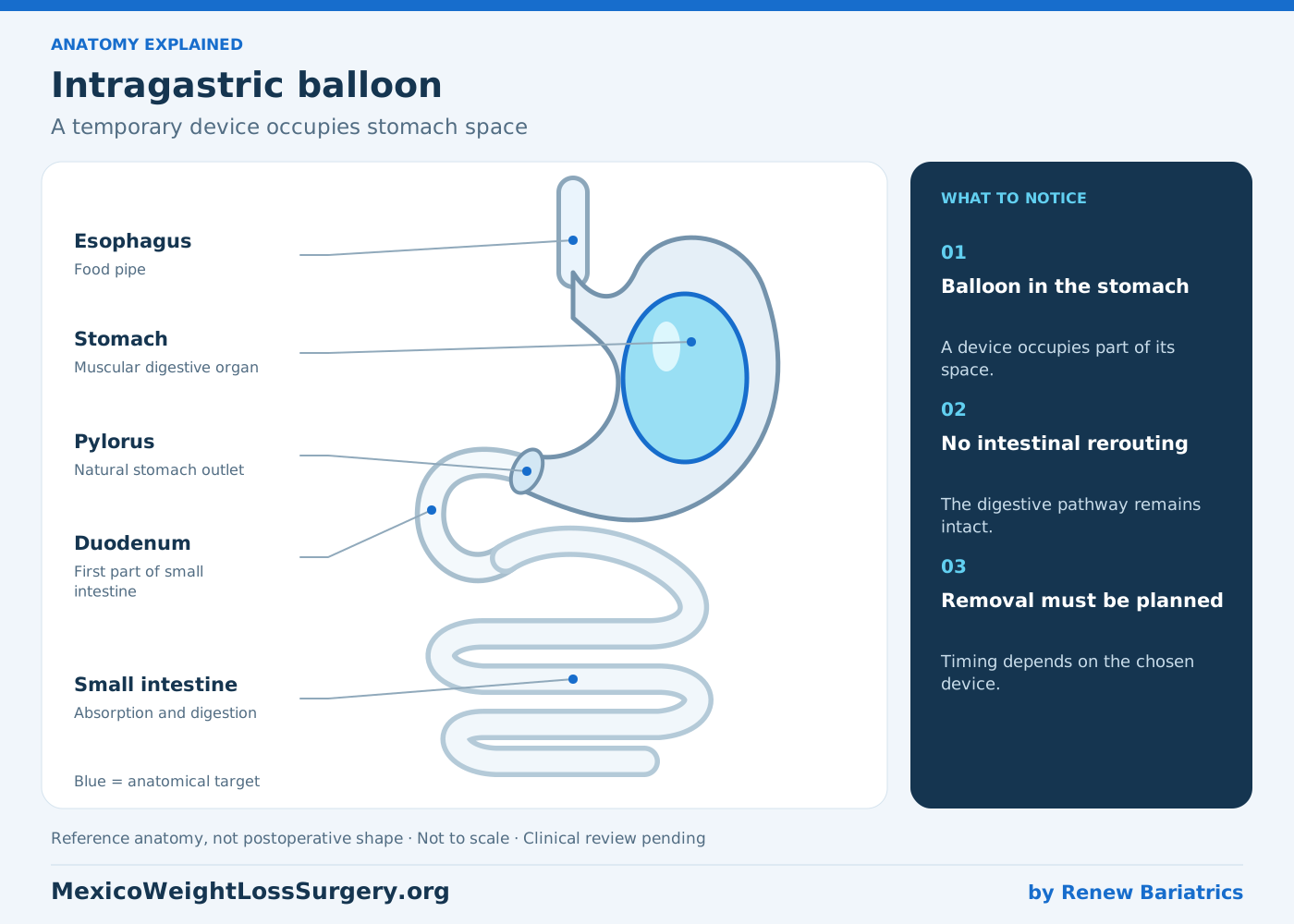
Anatomy references: Mayo Clinic: Intragastric balloon ↗ · Johns Hopkins Medicine: Endoscopic Sleeve Gastroplasty ↗
What a gastric balloon can—and cannot—do
The balloon is intended to help change the amount you eat and how quickly you feel full. It is used with a structured nutrition and behavior program. It does not create the anatomical changes of a sleeve gastrectomy or gastric bypass, and its physical effect ends when it is removed or passes according to the device design. [1]
The ASGE–ESGE guideline suggests intragastric balloons with lifestyle modification as an option for appropriately selected adults with obesity or certain adults with overweight and an obesity-related condition. That is a treatment recommendation at a population level, not permission to bypass device labeling or individual assessment. [2]
Think about why temporary treatment appeals to you. You might want to avoid permanent anatomical change, explore an option between medication and surgery, or discuss a specific short-term health objective with your clinician. Then ask what the plan becomes when the balloon is no longer present. A good answer should describe continued care, not simply tell you to maintain the result on your own.
The exact balloon matters
“Gastric balloon” is a category, not a single standardized treatment. Devices differ in how they are inserted, what fills them, whether volume can be adjusted, how long they may remain in place, and how they are removed. A result reported for one device does not automatically apply to another.
For example, U.S. FDA labeling for the Orbera balloon specifies a maximum placement period of six months. The FDA approval for Spatz3 specifies a maximum of eight months and a different eligibility description. These U.S. limits illustrate why the model and labeling matter; they do not establish the permitted duration for every device used in Mexico. [3],[4]
Ask the provider to name the manufacturer and exact model in writing and show you the instructions applicable where treatment will occur. If someone proposes a longer duration than a label you have read, ask them to explain which local authorization and model they are using. Do not infer that a similarly named product is identical.
The term “swallowable” also needs clarification. Ask whether swallowing replaces the placement endoscopy, whether removal still requires endoscopy, and what intervention is available if the device does not behave as intended. A marketing phrase should not be the only explanation of how a device enters or leaves your body.
Who may be a candidate?
Selection depends on the device, health history and ability to participate in follow-up. For reference, the FDA’s Orbera indication covers adults with BMI 30–40 who have not achieved durable results through more conservative approaches. Spatz3’s U.S. indication covers BMI 35–40, or BMI 30–34.9 with at least one major obesity-related condition, together with a supervised program. [3],[4]
Your clinician should review previous gastrointestinal surgery, reflux symptoms, ulcer disease, bleeding risk, liver conditions, medications and other relevant factors. Cleveland Clinic lists several of these as reasons balloon treatment may not be advised. Previous surgery is especially important to disclose; do not assume that a less invasive procedure is automatically compatible with altered anatomy. [5]
Bring a timeline of weight changes and previous treatment. Include what helped, what was difficult to sustain and why a treatment ended. This gives the team more useful information than a list of unsuccessful diets. It also helps distinguish a practical access problem—for example, losing medication coverage—from a treatment that was medically unsuitable.
If you are pregnant, planning pregnancy or breastfeeding, disclose that before treatment planning and request device-specific advice. Eligibility should not be decided by a coordinator calculating BMI alone. The final recommendation belongs to the treating clinical team after it has reviewed the full picture.
Weight-loss evidence: use the right device and time point
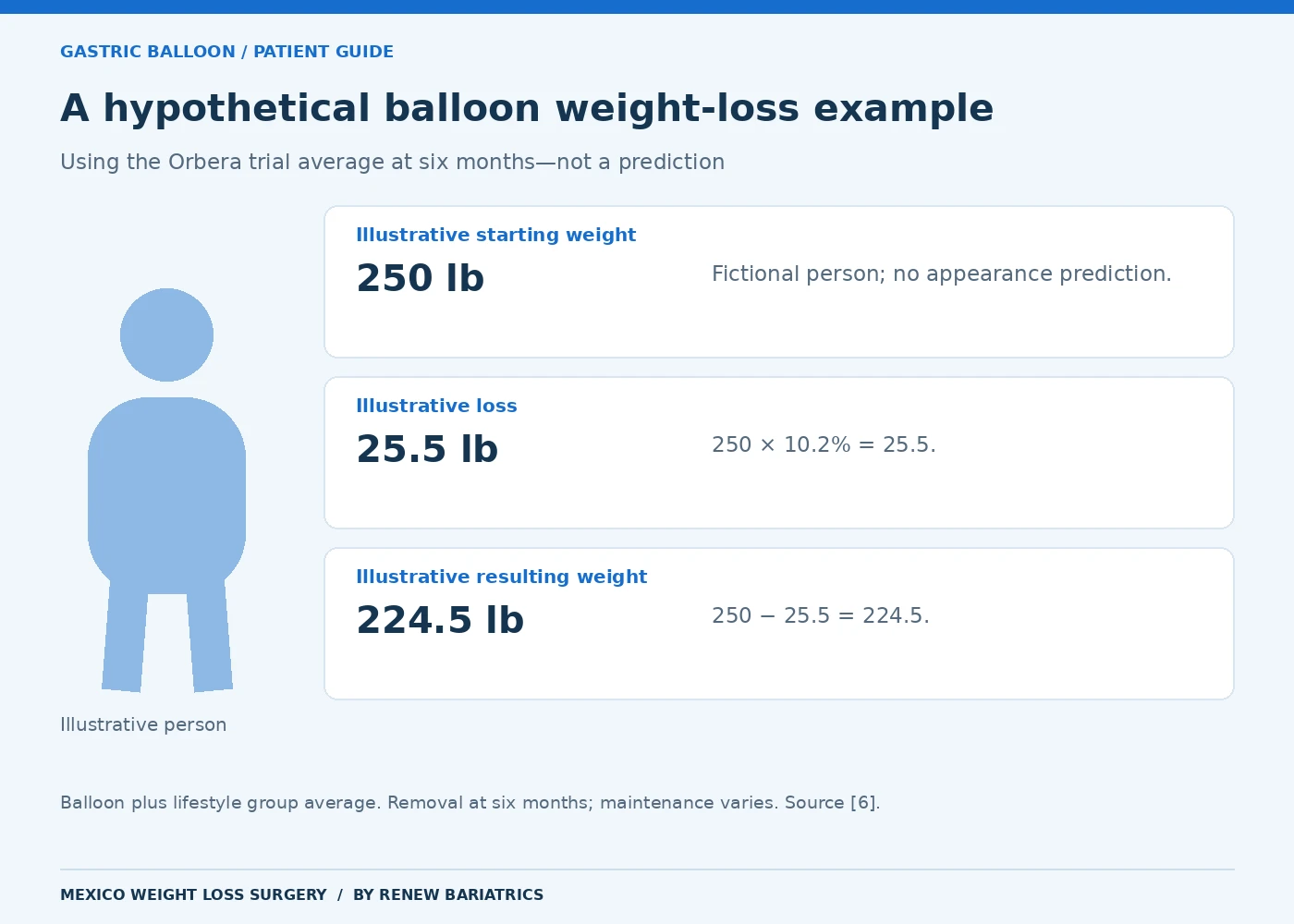
In a randomized trial of 255 adults, Orbera plus lifestyle intervention produced average total body weight loss of 10.2% at six months, compared with 3.3% with lifestyle intervention alone. Balloons were removed at six months. At twelve months, the corresponding averages were 7.6% and 3.1%. These numbers show both a treatment effect and the importance of evaluating what happens after removal. [6]
Using the six-month 10.2% average for illustration, a hypothetical 250-pound person would lose 25.5 pounds and weigh 224.5 pounds. That is arithmetic, not a patient outcome or a forecast. It does not predict how a body will look or what Renew’s patients will experience.
An adjustable-balloon randomized trial assigned 288 adults to Spatz3 plus lifestyle treatment or lifestyle treatment alone. At 32 weeks, mean total body weight loss was 15.0% versus 3.3%. Seventeen percent of the balloon group required early removal for intolerance, and device-related serious adverse events occurred in 4%. The different device, adjustment strategy and study design mean these results should not be used as proof that one balloon will outperform another for you. [7]
Ask whether a quoted percentage means total body weight loss or excess weight loss. Total body weight loss uses the initial weight as its denominator; excess weight loss uses a calculated amount above a reference weight. A clinic should identify the metric and time point every time it presents a percentage. Numbers measured at removal should not be described as permanent results.
Can the weight stay off after removal?
Weight regain is possible. An older five-year balloon cohort demonstrates why long-term claims need scrutiny: treatment interruptions and low initial responders were excluded from parts of the analysis, and only 195 of 474 patients who completed treatment had five-year follow-up. The long-term observations therefore cannot simply be presented as the expected result for all patients starting treatment. [8]
Rather than asking whether the balloon “works forever,” ask what continued treatment is available if your appetite or weight increases. The options may include more intensive nutrition support, a medication assessment or a discussion of another procedure, depending on your circumstances. The decision should be revisited clinically rather than framed as personal failure.
Set a removal-to-maintenance appointment before treatment begins. Ask who will review progress in the months after removal, what those visits cost and how to reconnect if a trend concerns you. A plan that ends the day the balloon leaves the stomach is incomplete for someone seeking durable weight management.
Common symptoms versus serious complications
Nausea, vomiting and cramping can occur as the stomach adjusts, and reflux can worsen. Johns Hopkins describes medications and close follow-up as part of managing early symptoms. Do not assume every symptom is harmless because nausea was mentioned in the consent form; severity, persistence and associated symptoms matter. [1]
Serious complications can include balloon deflation and migration, intestinal obstruction, ulceration, perforation, spontaneous overinflation and pancreatitis. The FDA has also received reports involving death with liquid-filled balloon systems. These reports establish that serious harm is possible; they do not provide a reliable individual probability or prove that every report was caused by the device. [9]
The FDA specifically warned clinicians that unexplained balloon overinflation and pancreatitis may require early removal. Symptoms can develop while a balloon is in place, not only immediately after insertion. [10]
Ask the clinician for a written escalation plan. It should distinguish a symptom that warrants a routine call from one that requires urgent assessment. Severe or worsening abdominal pain, persistent vomiting, inability to keep fluids down, bleeding, breathing difficulty or a markedly swollen abdomen should not be managed by waiting for the next scheduled visit. Mayo Clinic advises immediate contact for nausea, vomiting and abdominal pain occurring after balloon placement. [11]
If symptoms are severe or rapidly worsening, seek emergency care locally. Tell the treating clinician you have a gastric balloon and give them the device information. Do not delay urgent care while arranging travel back to Mexico or waiting for a coordinator to respond.
What if you cannot tolerate the balloon?
Early removal is a possible treatment outcome, not an imaginary worst case. The Spatz3 trial’s intolerance-related removals show why patients should understand that possibility before paying for placement. An adjustable device may allow a clinician to change volume in some circumstances, but an adjustment is a medical decision and may itself require another procedure. [7]
Ask who evaluates persistent symptoms and how quickly removal could be arranged. Clarify whether the package includes an early-removal procedure, anesthesia, hospitalization, travel changes or treatment at another facility. Request the policy before symptoms occur, when you have time to compare options calmly.
Also ask how the team distinguishes expected adjustment symptoms from a complication. You should not be left to decide that distinction from a social-media support group. A patient account can be reassuring, but another person’s experience cannot determine whether your symptoms are safe.
Preparing for placement
Before endoscopy, provide a complete medication and allergy list and follow the treating team’s written fasting instructions. ASGE emphasizes that medications, medical conditions and sedation arrangements need review beforehand. Its guidance is for endoscopy generally; your balloon team must provide the specific instructions for your device and procedure. [12]
Ask which clinician will coordinate any changes to diabetes treatment, blood thinners or medicines that affect stomach emptying. Do not combine instructions from unrelated clinics into your own schedule. If you use a GLP-1 medication, tell the procedural and anesthesia teams and ask for one agreed plan rather than assuming it must always be stopped for a fixed interval. [13]
Plan transport, a responsible companion when required, time away from work and access to the prescribed recovery foods and medicines. Confirm what must be completed before arrival and what will be assessed locally. Keep a copy of the consent information so you can review the risks and alternatives before the day of treatment.
Eating and drinking with a balloon
Food progression should follow the device-specific plan from your clinical team. Early recovery often starts with liquids and moves toward other textures as tolerated; this should not be replaced with a friend’s gastric sleeve diet or an online challenge. [5]
Ask for practical instructions in quantities and examples you can use: the fluid goal, how meals are structured, which symptoms mean you should pause and call, and how to handle medicines that are difficult to swallow. Find out whether a dietitian can adapt the plan to allergies, cultural preferences, work shifts and ordinary household meals.
The goal is a repeatable routine, not the most restrictive plan you can endure for a few days. NIDDK recommends choosing weight-management programs with realistic goals, an individualized eating plan, activity guidance and ongoing support. [14] Bring your actual circumstances into the discussion; a plan that ignores them is hard to evaluate and harder to follow.
Avoid using the balloon as a reason to ignore nutritional quality. Reduced meal size and adequate nutrition are separate questions. Your clinician can decide whether you need laboratory monitoring or supplementation based on your intake and medical history.
Removal must be planned from the beginning
For an endoscopically removed balloon, the clinician deflates the device and retrieves it through the mouth. Removal has its own preparation, sedation or anesthesia arrangements, recovery instructions and risks. It is not an administrative appointment that can be postponed indefinitely. [5]
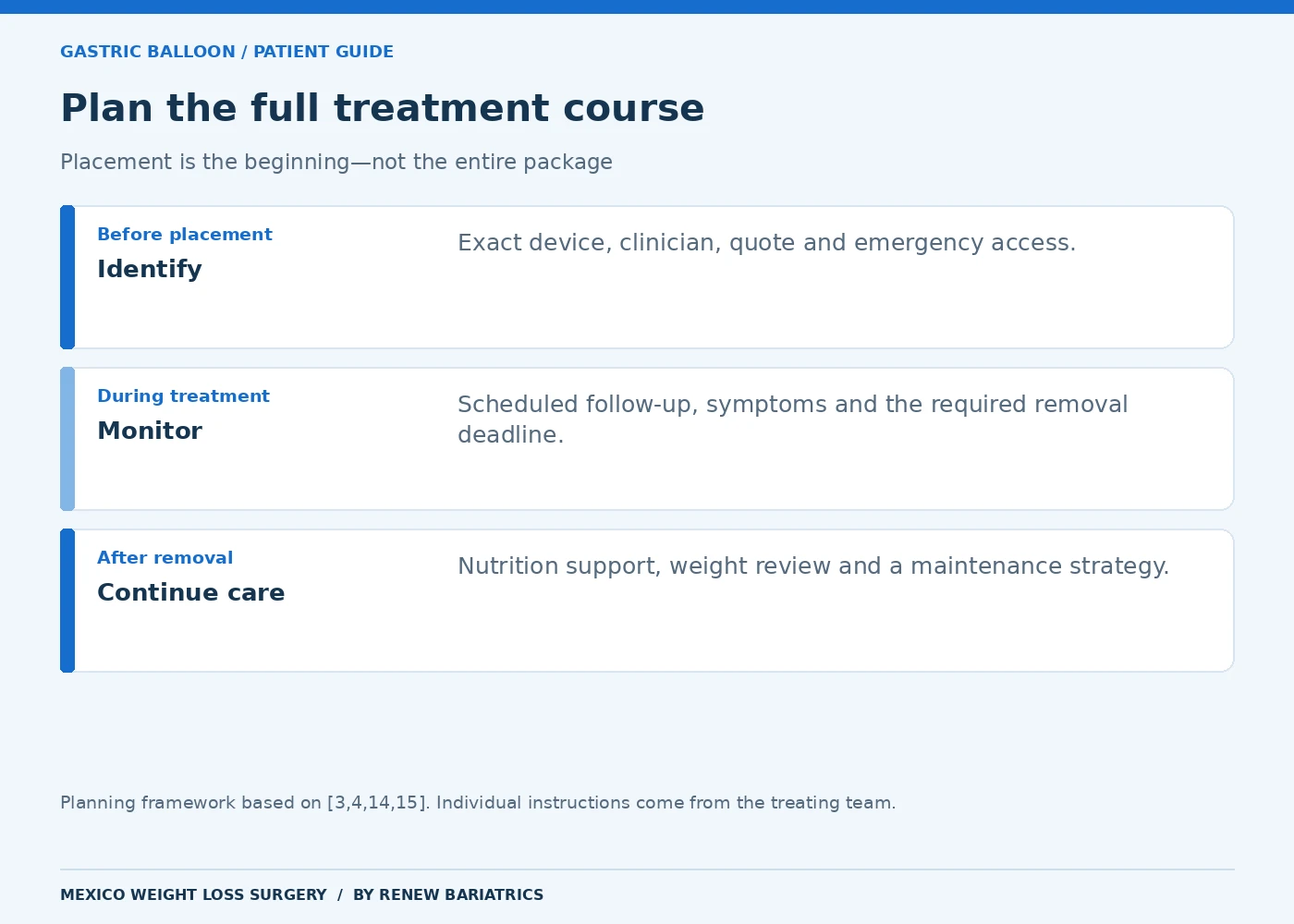
The manufacturer’s Orbera patient information describes a twelve-month treatment program: six months with the balloon followed by six months of continued diet and exercise support after removal. That is a useful example of a program extending beyond the implant period, not a statement that every brand follows the same timetable. [15]
Before placement, obtain the latest permitted removal date in writing and book the required appointment. Confirm who will remove it if the original clinician becomes unavailable, if you cannot travel, or if urgent removal is needed near home. Your discharge records should identify the model and placement date so another clinician does not have to reconstruct the history from memory.
Mexico travel: think in more than one visit
A balloon package may require a return trip for removal, and an adjustable device may involve additional visits. Ask for the full anticipated visit schedule before comparing prices. If the removal is to occur in your home country, arrange an accepting clinician beforehand rather than assuming any endoscopy unit can provide it.
The CDC recommends verifying the clinician and facility, arranging follow-up before travel, reviewing insurance coverage and keeping medical records. It also notes that complications after treatment abroad can create substantial costs and continuity-of-care problems. [16]
Ask where you will recover, who provides clinical assessment if you become unwell at the hotel, and how you reach the treating team outside office hours. Confirm when travel is considered appropriate for your situation. Being discharged from an outpatient unit is not the same decision as being ready for a long journey.
Choose travel arrangements that can accommodate a clinical change. A procedure marketed as quick may still require more time locally if symptoms need evaluation. The travel plan should leave room for the treating clinician to make that decision without financial pressure from a departure deadline.
Compare the full cost, including removal
Request a written quote naming the exact balloon and separating placement, removal, possible adjustments and follow-up. Ask about anesthesia, pre-procedure testing, medicines, transport, accommodation and a companion’s expenses. Do not assume the removal fee or second trip is included because the initial price is described as a package.
Clarify the financial consequences of early removal, an unsuccessful placement, a clinical cancellation, a delayed trip or a complication. Ask which costs are charged by the facilitator and which by the treating facility. You should know who is responsible for answering a billing question before you need to resolve one while recovering.
Compare treatment access as well as money. A slightly lower placement quote may be less useful if follow-up is difficult to reach or a necessary removal trip is unaffordable. The relevant budget is the complete treatment course and maintenance plan, with a realistic reserve for unexpected changes.
Balloon, ESG, medication or surgery?
A balloon is temporary and device-based. ESG uses internal sutures to reshape the stomach, while surgical procedures change anatomy in other ways. The FDA lists balloons and endoscopic suturing systems as distinct device categories. [9]
Medication may be another appropriate option. NIDDK explains that prescription treatment should be chosen with attention to health conditions, other medicines, side effects, cost and the possibility of long-term use. [17] Discuss whether a temporary implant, ongoing medication or a more durable anatomical intervention fits the problem you are trying to solve.
Do not select the option solely by the largest weight-loss percentage you find online. Compare evidence at similar follow-up times and ask whether the population resembles you. A treatment you cannot safely access or maintain is not a strong choice simply because its trial average is appealing.
Questions to bring to Renew
- Which exact balloon is currently offered, and what local labeling governs its use?
- Who assesses eligibility, performs placement and handles removal?
- What is the latest removal date, and is that visit included in the quote?
- What happens if symptoms require early removal or treatment near home?
- Which follow-up appointments occur while the balloon is in place and afterward?
- Why would this option fit my goals better than ESG, medication or surgery?
You can begin with a coordinator conversation to clarify availability and logistics. Clinical intake then supplies the information needed for a medical recommendation. Do not book treatment around an advertised starting price before the exact device and full care plan have been established.
Frequently asked questions
Is a balloon a permanent solution?
The device is temporary. Continued weight-management care matters after it is gone, and a result measured at removal should not be described as permanent maintenance. [6]
Can I leave it longer if I am still losing weight?
Do not extend a device’s placement period on your own. Follow the applicable labeling and your clinician’s removal plan; ask about the next treatment step before the deadline arrives. [3],[4]
Does no surgery mean no serious risk?
No. A gastric balloon can cause serious complications, and placement or removal may involve endoscopy and anesthesia or sedation. Understand the warning symptoms and emergency plan before proceeding. [9],[12]
Is every balloon available through Renew?
No availability claim should be inferred from this guide. Confirm the model, location, clinician, package and removal arrangements directly with Renew before committing to treatment.
Gastric balloon in Mexico: from $3,999 USD
Renew Bariatrics’ starting price is $3,999 USD. Ask for a written quote confirming the balloon type, placement, removal, follow-up, medicines and any travel arrangements. The starting price does not establish eligibility or guarantee a total cost.
Program information related to this guide
For information about care through our parent organization, explore gastric balloon options at Renew Bariatrics. Ask the team to confirm availability, your eligibility and the written scope of care.
Gastric balloon vs. ESG
These options change different structures. Your anatomy, symptoms, health history and follow-up needs guide the choice; neither is automatically better for everyone.
| What to compare | Gastric balloon → | ESG → |
|---|---|---|
| Mechanism | Temporary device inside the stomach. | Internal sutures reshape the stomach. |
| Next procedure | Device removal is part of the plan. | No routine balloon-removal appointment. |
| Tradeoff | Tolerance and device-related risks need review. | Suturing-related risks need review. |
| Budget | Confirm placement, removal and follow-up costs. | Confirm the procedure and long-term support costs. |
Comparison references: Mayo Clinic: Intragastric balloon ↗ · Johns Hopkins Medicine: Endoscopic Sleeve Gastroplasty ↗
These options are not interchangeable for every person. The treating clinician must assess your anatomy, medical history and goals.
Explore Renew’s gastric balloon options ↗. Confirm the current care arrangements and your individual quote with the team.
Discuss your options with Renew.
Talk with a coordinator about gastric balloon, your goals and the information needed for clinical review. The treating team determines suitability and the care plan.
Call 844-736-3963 Complete health questionnaire ↗The questionnaire opens Renew’s existing intake. This review site does not collect health information.
References & evidence notes
Sources checked November 2026. Research findings are not a forecast for an individual or outcomes for Renew’s own program. Review study populations, methods and limitations alongside the reported results.
- Johns Hopkins Medicine. Gastric Balloon for Weight Loss ↗Institutional description of a saline-filled endoscopically placed balloon.
- ASGE–ESGE, 2024. Guideline on primary endoscopic bariatric and metabolic therapies ↗Guideline recommendations do not replace device-specific labeling.
- U.S. FDA. Orbera Intragastric Balloon PMA P140008 ↗U.S. indication and six-month maximum; not a Mexican approval record.
- U.S. FDA. Spatz3 Adjustable Balloon PMA P190012 ↗U.S. indication and eight-month maximum; not a Mexican approval record.
- Cleveland Clinic. Intragastric Balloon: Procedure Details, Benefits & Risks ↗Selection, progression and removal information; device-specific instructions required.
- Courcoulas et al., 2017. Intragastric balloon as an adjunct to lifestyle intervention: a randomized controlled trial ↗255 adults; Orbera removed at six months, follow-up through twelve months.
- Abu Dayyeh et al., 2021. Adjustable intragastric balloon for treatment of obesity: a multicentre, open-label, randomised clinical trial ↗288 randomized participants; 32-week outcomes, intolerance and serious adverse events.
- Kotzampassi et al., 2012. 500 intragastric balloons: what happens 5 years thereafter? ↗Older cohort with exclusions and incomplete long-term follow-up; not an all-patient success estimate.
- U.S. FDA. Weight-Loss and Weight-Management Devices ↗Device categories and safety monitoring; reports include serious complications and deaths.
- U.S. FDA. Potential risks with liquid-filled intragastric balloons ↗Safety communication on spontaneous hyperinflation and pancreatitis.
- Mayo Clinic. Intragastric balloon ↗Warning symptoms and need for prompt medical assessment. Numerical weight-loss summary on this page was not used.
- ASGE. Understanding Upper Endoscopy ↗General preparation and sedation guidance; not balloon-specific instructions.
- American Society of Anesthesiologists. Drugs for Diabetes or Weight Loss: What To Know Before Surgery ↗Individualized planning for medicines affecting gastric emptying.
- NIDDK. Choosing a Safe & Successful Weight-loss Program ↗Program components and realistic expectations.
- Boston Scientific. Orbera Important Safety Information ↗Manufacturer patient information; six-month implant within a twelve-month support program.
- CDC. Medical Tourism: Travel to Another Country for Medical Care ↗Follow-up, credentials, records and financial planning.
- NIDDK. Prescription Medications to Treat Overweight & Obesity ↗Medication selection and continuing treatment.