

Jump to a section
Anatomy illustrationCompare proceduresRelated ProceduresFirst identify your main treatment goalHow the anatomy changesWhy reflux after sleeve needs a careful workupWhen is conversion considered for reflux?What research says about reflux improvementWhat about additional weight loss?How to interpret a before-and-after photographConversion carries additional surgical riskLonger-term tradeoffs deserve equal attentionAlternatives depend on the problem being treatedPreparing for assessment and surgeryRecovery after conversionLifelong care after sleeve-to-bypass conversionMexico travel and cost questionsFrequently asked questionsYour next stepReferencesConverting a gastric sleeve to Roux-en-Y gastric bypass can be considered for persistent reflux, weight recurrence or another problem after sleeve surgery. It is a new operation with a different digestive pathway and additional long-term responsibilities. A good assessment explains what problem the conversion is intended to solve, why bypass is being recommended, and which alternatives are reasonable.
This guide focuses on conversion to Roux-en-Y bypass, not mini gastric bypass or a repeat sleeve. It is designed to help you prepare for an informed discussion about care in Mexico. It does not establish your candidacy or confirm that a specific surgeon, facility or package is available through Renew. Those details require clinical and operational confirmation.
Understand the anatomy
A simplified, labeled view of the structures and treatment area. Select the image to view it at full size.
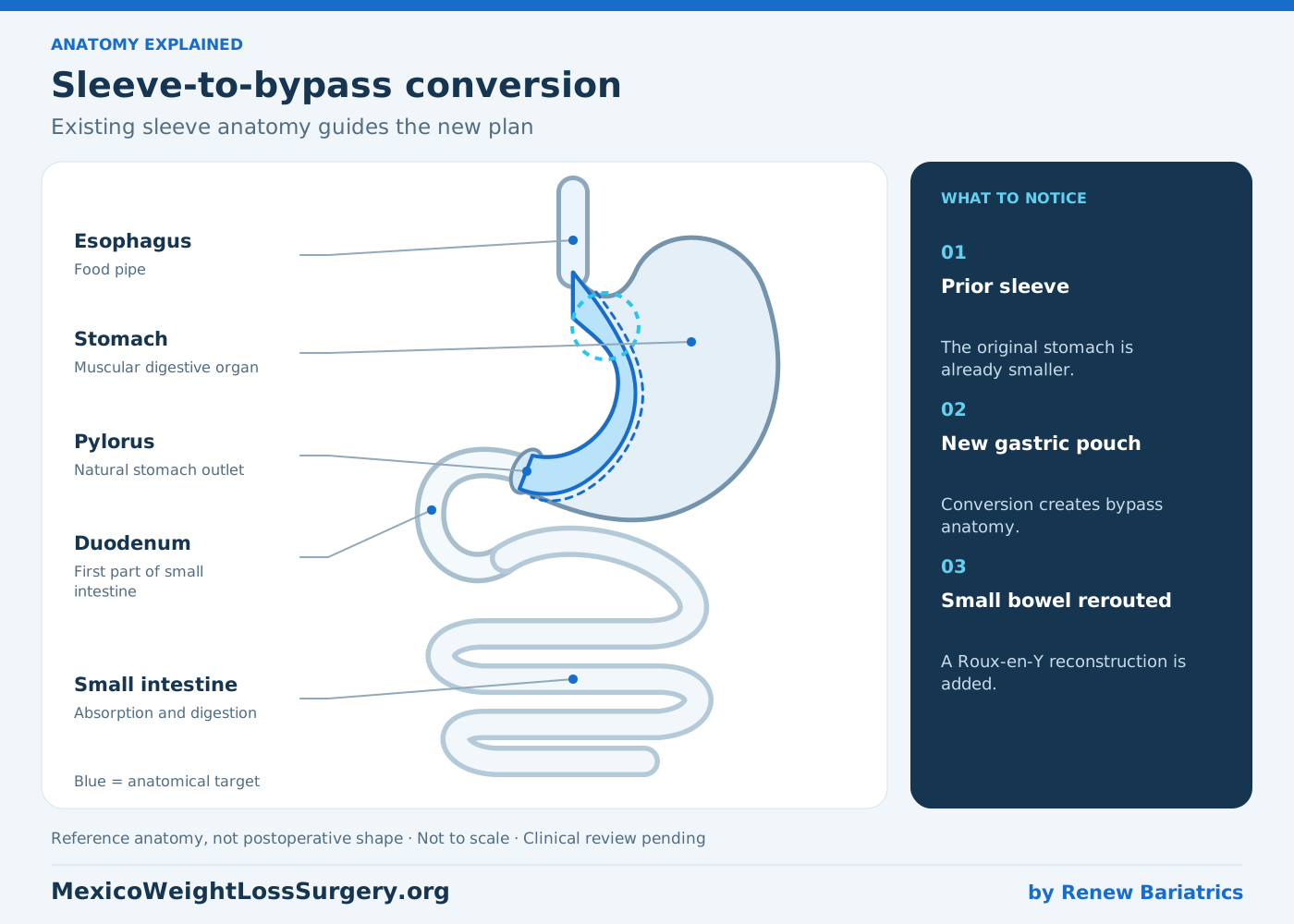
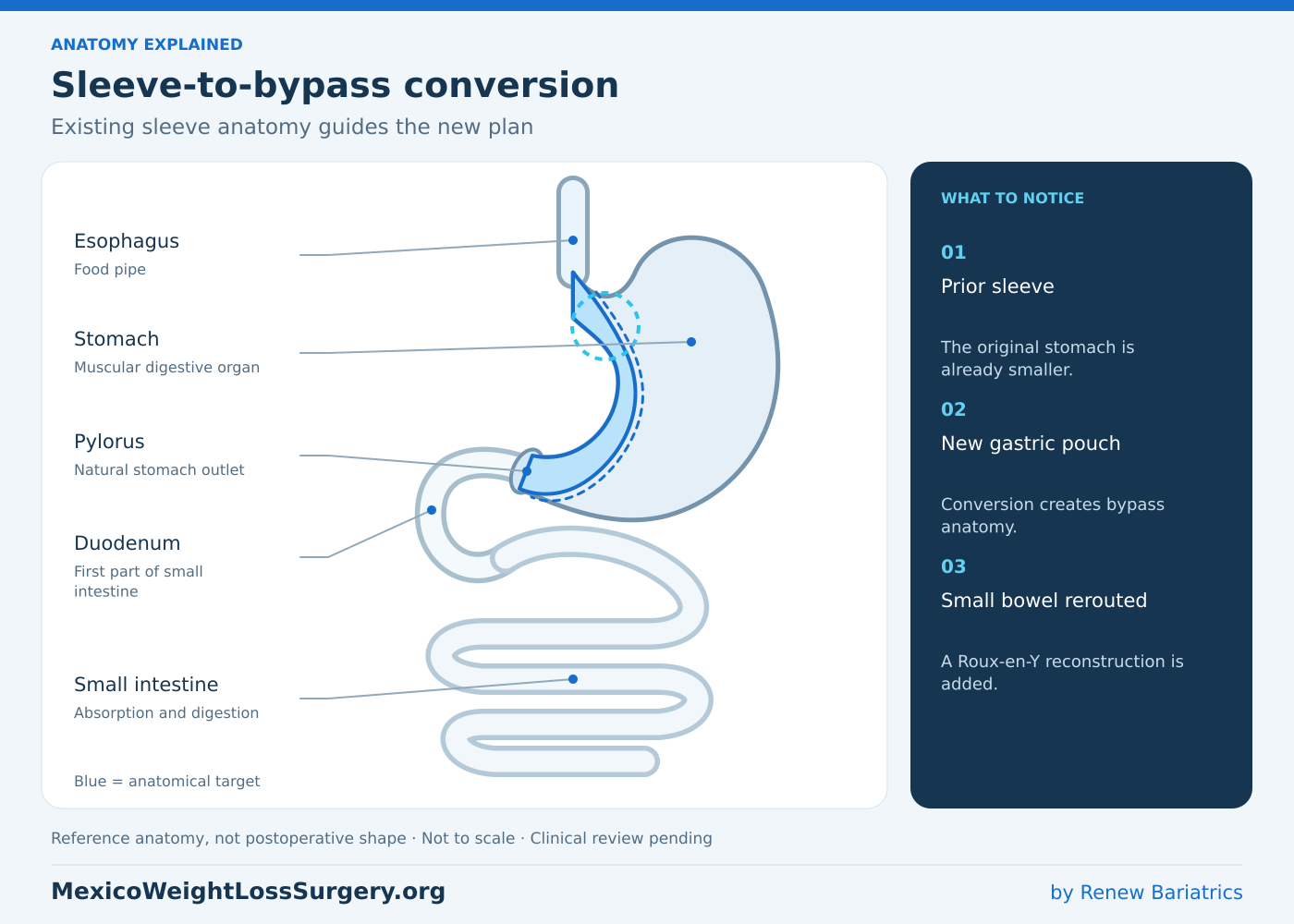
Anatomy references: UCLA Health: Reflux After Sleeve Gastrectomy ↗ · ASMBS: Roux-en-Y Gastric Bypass ↗
First identify your main treatment goal
Reflux and weight recurrence often appear together, but they should be assessed separately. If the main goal is relief from regurgitation or heartburn, ask how the team will determine whether reflux is actually responsible for the symptoms. If the main goal is additional weight loss, ask what nonoperative treatments and other conversions could reasonably be considered.
A conversion should not be described simply as making your stomach smaller again. It changes where food travels and creates intestinal connections that the original sleeve did not have. The potential benefits and burdens therefore differ from those of a primary sleeve. Your decision should reflect the condition being treated, rather than a belief that every sleeve eventually needs conversion.
Before the consultation, write down the problem that disrupts your daily life most: waking with regurgitation, avoiding meals because swallowing is difficult, recurrent diabetes, weight recurrence, or another concern. Describe frequency and severity. A concrete description helps the clinician discuss meaningful outcomes instead of treating a scale number as the only measure of success.
How the anatomy changes
Sleeve gastrectomy removes a substantial portion of the stomach and leaves a narrow stomach connected to the normal intestinal route. Roux-en-Y bypass creates a small stomach pouch and directs food into a section of small intestine, with a second connection allowing digestive secretions to rejoin the food stream. Conversion adapts the previous sleeve to this bypass arrangement; it does not regrow removed stomach tissue. [1]
Ask the surgeon to show you the proposed anatomy on a diagram. Find out whether a hiatal hernia or another identified abnormality will also be addressed. The operation's name alone does not tell you every technical detail or whether the plan may need to change after the surgeon sees the tissue.
Roux-en-Y and one-anastomosis, or mini, gastric bypass are different operations. Do not assume a quotation that says only “bypass revision” specifies the same procedure discussed in this article. Confirm the full name in the clinical plan and consent documents.
Why reflux after sleeve needs a careful workup
Heartburn is a symptom, not a complete diagnosis. Regurgitation, swallowing difficulty, chest discomfort and vomiting may need different investigations. A clinician may recommend endoscopy, reflux monitoring or tests of swallowing and anatomy depending on the history. ACG guidance recommends endoscopy when alarm symptoms such as swallowing difficulty or gastrointestinal bleeding are present; reflux monitoring can help when the diagnosis remains unclear. [2]
The purpose of testing is to connect the proposed treatment to a demonstrable problem. Ask what each test can establish, what it cannot establish, and how the result could change the recommendation. A scan showing anatomy and a test measuring acid exposure answer different questions.
If you have severe chest pain, breathing difficulty, significant bleeding or severe abdominal pain, seek urgent medical care rather than assuming it is ordinary reflux. Persistent vomiting or inability to maintain intake also needs prompt assessment. A planned consultation abroad should not delay care for a potentially serious problem. [3]
When is conversion considered for reflux?
SAGES guidance suggests a trial of medical treatment first for reflux after sleeve. For medically refractory reflux and BMI above 35, it suggests conversion to Roux-en-Y bypass. At lower BMI, the choice can involve different antireflux approaches and individual factors; a hiatal hernia may also influence treatment. The guideline explicitly acknowledges the limited quality of evidence supporting these recommendations. [4]
Ask what “medical treatment has not worked” means in your case. Has the diagnosis been established? Were medicines used as intended? Has the clinician reviewed other factors that might explain the symptoms? These questions do not mean you must tolerate uncontrolled symptoms indefinitely; they help define why surgery may be the appropriate next step.
For a patient whose weight is already lower, discuss the implications of further weight loss and nutritional change. An operation chosen mainly for reflux still creates bariatric anatomy. The plan should address symptom control and preserving nutritional health at the same time.
What research says about reflux improvement
A Michigan study examined 2,133 sleeve-to-bypass conversions across 41 hospitals. Among the 279 patients with both baseline and one-year reflux questionnaires and medication information, average symptom scores improved and reflux-medication use fell from 74% to 27%. Only 13% of the overall cohort had those paired reflux data. That missing follow-up matters when interpreting the results. [5]
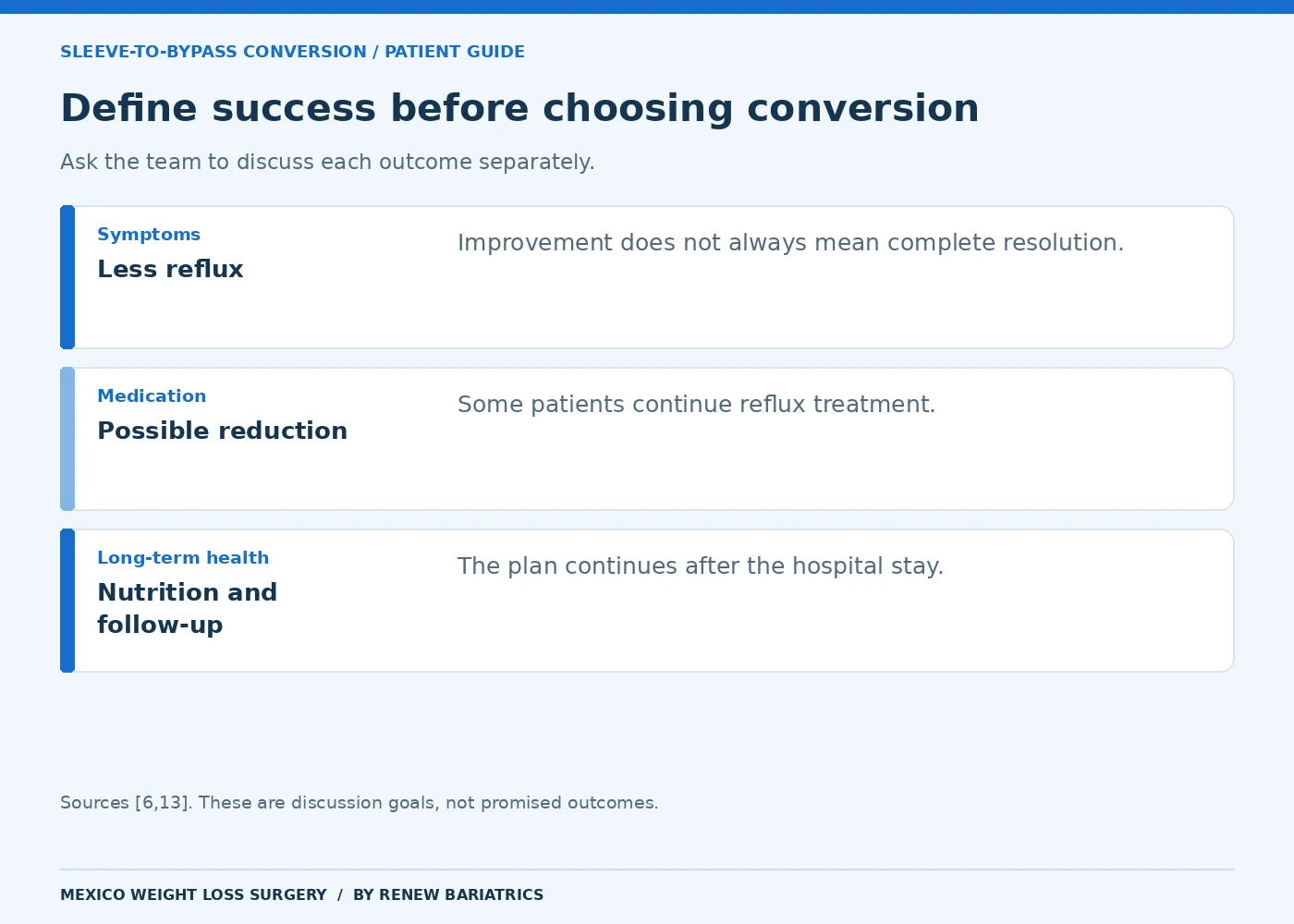
A separate retrospective study focused on people converted for reflux that medical treatment had not controlled. It reported complete symptom resolution in 70% and complete discontinuation of proton-pump inhibitors in 60%. The study supports a potential benefit but also shows that symptom relief and stopping medication are different endpoints and neither happened for everyone. [6]
These studies do not promise a particular result for you. Ask the surgeon whether your findings resemble the patients studied, what reasons might make reflux persist, and what further evaluation would follow persistent symptoms. A positive result can mean fewer symptoms or less medication without complete freedom from either.
What about additional weight loss?
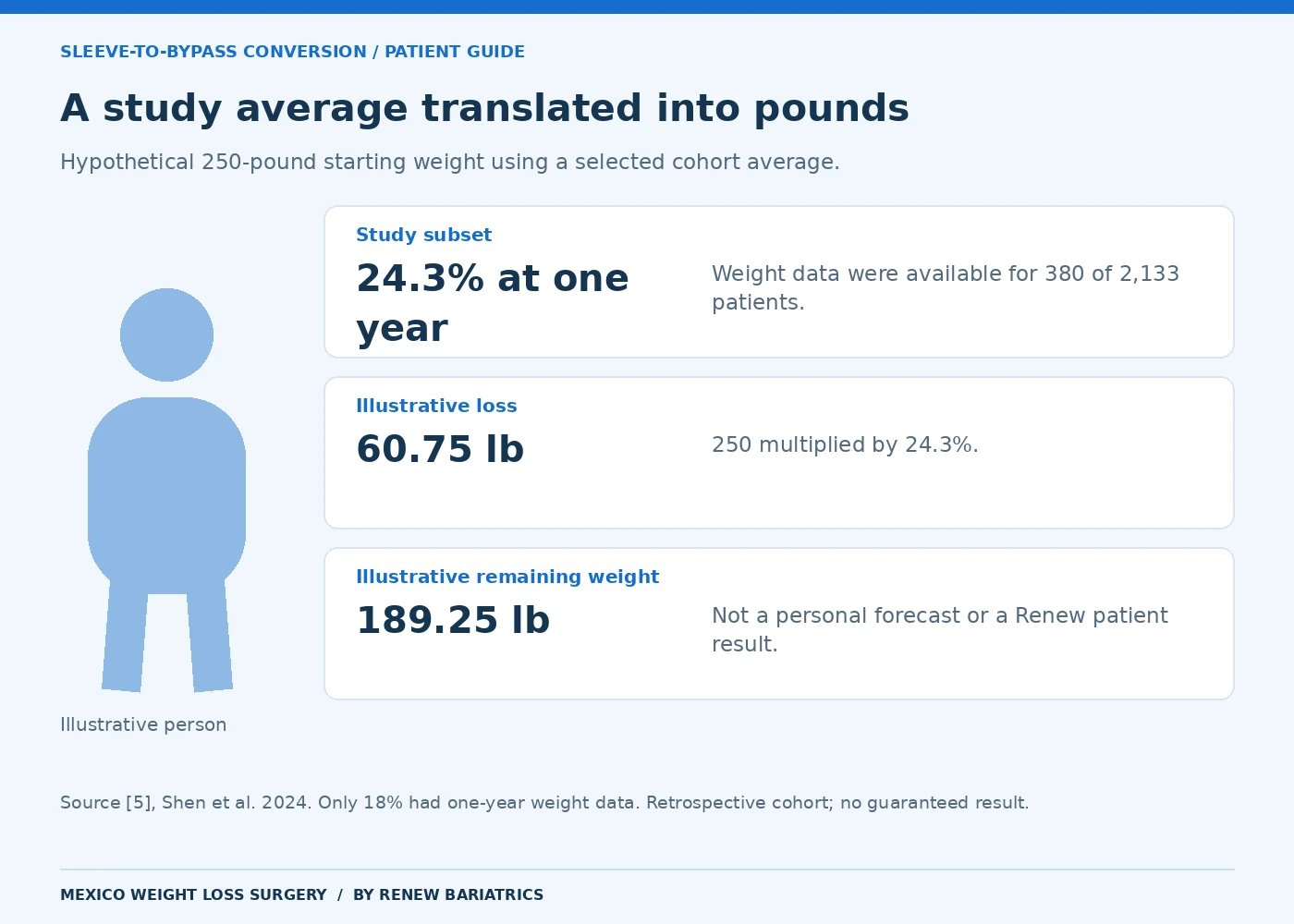
The same Michigan cohort had one-year weight information for 380 patients, or 18% of the total. In that subset, the average total body weight decline was 24.3% from the conversion baseline. Because most patients did not have the required weight data, this number should not be used as a universal prediction. It also does not establish what Renew patients achieve. [5]
To understand the metric, consider a hypothetical starting weight of 250 pounds. A 24.3% reduction equals 60.75 pounds, leaving 189.25 pounds. This is arithmetic using a study average, not a personal estimate, a promised result or a simulated patient's transformation. Your clinician may consider a different range appropriate for your circumstances.
Ask for results that match your reason for conversion. A group treated primarily for weight recurrence may start at a different weight and have different goals from a group treated primarily for reflux. Discuss the time horizon, how many people were followed, and whether medication was used after conversion before comparing percentages.
How to interpret a before-and-after photograph
A photograph can document one person's experience when its origin and consent are verified. It cannot show the average effect of a conversion, prove the treatment caused every change, or reveal complications and treatments outside the frame. Dates, original operation, conversion type, starting weight and follow-up duration matter.
If patient stories help you understand the experience, look for the practical details: what recovery felt like, how follow-up worked, what ongoing supplements cost, and what the patient would ask before doing it again. Those details may be more useful to your decision than an unusually large weight-loss result.
The custom graphic on this page deliberately uses transparent arithmetic rather than changing a person's body shape. Appearance cannot be reliably predicted from a percentage, and two people with the same weight change may look and feel different.
Conversion carries additional surgical risk
A national registry study compared 13,432 sleeve-to-bypass conversions with 84,543 primary bypass operations. Serious complications within 30 days occurred in 7.2% of conversions versus 5.0% of primary bypasses. Reoperation rates were 3.0% and 1.9%, respectively; mortality was 0.1% in both groups. This observational comparison cannot establish an individual risk, but it shows why revision should not be presented as identical to a first-time operation. [7]
The Michigan cohort used different data and reported different complication rates. These figures should not be mixed into one “success rate.” Definitions, patients and follow-up windows matter. When discussing safety, ask which complications are counted, whether emergency visits and readmissions are included, and whether results apply specifically to conversion patients.
Ask about the surgeon's experience with sleeve-to-bypass conversion, the hospital's ability to manage a leak or obstruction, and the process for urgent reassessment. Clinical teams should explain what they do when recovery does not follow the expected path, not only what happens in an uncomplicated stay.
Longer-term tradeoffs deserve equal attention
Bypass can be associated with ulcers at the stomach-intestine connection, bowel obstruction, dumping symptoms and nutritional deficiencies. Tobacco and NSAID use are important considerations in ulcer risk. The ASMBS procedure overview describes these tradeoffs alongside the potential benefits of bypass. [8]
A separate ASMBS review identifies several patient and technical risk factors for marginal ulcers and supports individualized prevention. Tell the team about pain medicines, nicotine, immune-suppressing medication and previous ulcers. Ask for a specific medication plan rather than stopping prescribed treatment on your own. [9]
Discuss how future abdominal symptoms will be evaluated and which records a local emergency clinician may need. A diagram and operative report can be useful when someone unfamiliar with your surgery is assessing you years later. Long-term planning is part of the operation's cost and burden even when the immediate recovery is smooth.
Alternatives depend on the problem being treated
For reflux, alternatives may include optimized medical care or selected antireflux or hernia treatment, depending on the findings. For weight recurrence, a review of eating patterns, medications, activity, behavioral health and anatomical factors can help identify an appropriate treatment plan. The existence of several options does not mean that all are suitable for every patient. [4],[10]
TORe is not a direct substitute for sleeve-to-bypass conversion: it targets an outlet created by a prior gastric bypass. A person who has only had a sleeve does not have that bypass outlet. Endoscopic treatment of a sleeve, when considered, is a different procedure with a different purpose. [11]
Ask the clinician to compare the recommended option with the strongest reasonable alternative for you. “Why this treatment instead of the other one?” is more useful than asking which operation is best in general. Include the option of treating reversible problems first and reassessing before committing to elective surgery.
Preparing for assessment and surgery
Gather the original sleeve operative report, recent endoscopy and imaging reports, pathology results if relevant, a medication list and recent laboratory information. Include the dates and doses of reflux treatments you have tried and describe whether symptoms improved. If a report is missing, tell the team rather than reconstructing details from memory.
Create a simple weight timeline and note changes in diabetes, sleep apnea or other conditions. Separate the weight goal from symptom goals. Ask which tests must be completed before travel and which, if any, are planned after arrival. The final operative plan should not depend on assumptions you did not know were being made.
Request written preparation instructions from the treating team. Medication holds, fasting, diet, nicotine requirements and clot-prevention planning are individualized. Generic instructions from a previous operation may no longer fit your health or the proposed conversion. Ask who can answer preparation questions and when a new illness should be reported.
Recovery after conversion
Recovery plans differ between patients and centers. A staged return to food, attention to hydration, gradual activity and scheduled review are common elements of bariatric recovery, but the actual timetable should come from the treating team. Do not copy another patient's diet calendar or infer readiness to travel from the date of hospital discharge. [12]
Before leaving the facility, ask how to manage expected discomfort, whom to contact about persistent nausea, and which symptoms require emergency care. Ask for medication names, doses and the reason each is prescribed. Confirm what to do if a medicine is unavailable at home or difficult to swallow.
Plan practical support: someone to handle luggage and heavy chores, suitable food and drink at your accommodation, and time away from work that reflects your duties. Driving, desk work, physical work and exercise are separate questions. A single answer such as “back to normal in a week” does not cover them.
Lifelong care after sleeve-to-bypass conversion
Nutritional follow-up remains necessary after conversion. Your team should specify supplements, laboratory monitoring and who adjusts the plan when results change. Deficiencies can affect blood counts, bones, muscles and nerves, so feeling well is not a substitute for follow-up. ASMBS patient guidance emphasizes ongoing monitoring and supplementation. [13]
Ask how the plan changes from your previous sleeve routine. Which existing supplements remain appropriate? Which additional tests are needed? Who monitors medicines for diabetes, blood pressure or other conditions while weight and intake change? A written handover prevents the assumption that the surgeon, coordinator and local clinician are each handling the same task.
Discuss barriers before booking: cost, prescription access, food tolerance, shift work or difficulty attending appointments. The purpose is to build a realistic plan that can continue after the initial motivation and travel arrangements are over.
Mexico travel and cost questions
Request a quote for sleeve-to-Roux-en-Y conversion specifically. Ask whether evaluation, anesthesia, planned hernia repair, hospital stay, routine medicines and follow-up are included. Identify what is excluded, including flights, extra nights, unplanned procedures and treatment after returning home. An advertised primary-bypass price should not be assumed to cover conversion.
Confirm the treating facility and surgeon and ask how complications would be handled during the stay and afterward. CDC medical-tourism guidance highlights the need for continuity of care, complete records and attention to the added risks of postoperative travel. Discuss the return date with the clinical team; a coordinator's itinerary is not medical clearance to fly. [14]
If further testing changes the recommendation, understand the financial consequences before traveling. Ask whether a postponed or modified operation changes the fee and which costs remain nonrefundable. Travel flexibility is especially useful when the final decision depends on findings that still need evaluation.
Frequently asked questions
Is this the same as having gastric bypass for the first time?
The final pathway may be similar, but the surgeon is operating on previously altered tissue. Published registry data show differences in short-term complication rates, so ask for counseling that addresses conversion rather than only primary bypass. [7]
Will I definitely stop reflux medicine?
No. Studies report improvement for many patients, but some continue medication or have ongoing symptoms. Clarify whether the expected benefit is symptom reduction, reduced medicine use, healing of inflammation, or a combination. [6]
Can I have the operation just because I regained weight?
Weight recurrence is a reason to seek assessment, not automatic proof that conversion is the best treatment. The team should evaluate the pattern, anatomy, prior treatments and health goals before recommending a plan. [10]
Is conversion reversible?
Do not choose it on the assumption that it can easily be undone. Bypass reversal is complex, and the stomach tissue removed during the original sleeve cannot be restored. Ask the surgeon to explain the permanent changes and future options. [1]
What should I ask Renew first?
Ask how to submit the original operative report and current reflux or weight history for clinical review. A coordinator can explain the process and organize next steps. Request confirmation of the proposed surgeon, procedure, facility and written quote before booking nonrefundable travel. This guide is a researched review draft, not a substitute for that assessment.
Program information related to this guide
For information about care through our parent organization, explore gastric sleeve revision options at Renew Bariatrics. Ask the team to confirm availability, your eligibility and the written scope of care.
For patient examples, view gastric sleeve before-and-after photos from Renew Bariatrics. These are sleeve patient examples; they do not predict an individual result or represent results of other procedures.
Sleeve-to-bypass conversion vs. SADI-S
These options change different structures. Your anatomy, symptoms, health history and follow-up needs guide the choice; neither is automatically better for everyone.
| What to compare | Sleeve-to-bypass conversion → | SADI-S → |
|---|---|---|
| Configuration | Converts a sleeve to a gastric pouch and Roux-en-Y bypass. | Retains a sleeve and adds a duodeno-ileal bypass. |
| Reflux | May be considered for persistent reflux after a sleeve. | Potential for reflux must be considered. |
| Nutritional follow-up | Ongoing supplements and laboratory monitoring. | Ongoing supplements and laboratory monitoring. |
| Decision | Clarify whether reflux, weight recurrence or another problem drives treatment. | Clarify the treatment goal and the malabsorption tradeoff. |
Comparison references: UCLA Health: Reflux After Sleeve Gastrectomy ↗ · ASMBS: Roux-en-Y Gastric Bypass ↗
These options are not interchangeable for every person. The treating clinician must assess your anatomy, medical history and goals.
Further reading
Discuss your options with Renew.
Talk with a coordinator about sleeve-to-bypass conversion, your goals and the information needed for clinical review. The treating team determines suitability and the care plan.
Call 844-736-3963 Complete health questionnaire ↗The questionnaire opens Renew’s existing intake. This review site does not collect health information.
References & evidence notes
Sources checked November 2026. Research findings are not a forecast for an individual or outcomes for Renew’s own program. Review study populations, methods and limitations alongside the reported results.
- NIDDK. Types of Weight-loss Surgery ↗Government patient education; anatomy and tradeoffs of procedures.
- Katz et al., 2022. ACG Clinical Guideline: Guidelines for the Diagnosis and Management of Gastroesophageal Reflux Disease ↗Clinical guideline; diagnostic testing and alarm symptoms.
- NHS. Complications of weight loss surgery ↗Patient education on complications and symptoms requiring urgent assessment; use local emergency services.
- SAGES, 2024. Guidelines for the management of comorbidities relevant to metabolic and bariatric surgery ↗Post-sleeve reflux recommendations; limited-quality evidence and expert opinion are identified.
- Shen et al., 2024. Conversion of sleeve gastrectomy to Roux-en-Y gastric bypass: impact on reflux and weight loss ↗Retrospective Michigan cohort, 2,133 patients; paired one-year reflux data in 13%, weight data in 18%.
- 2024 retrospective reflux series. Results of sleeve gastrectomy conversion to Roux-en-Y gastric bypass on gastroesophageal reflux disease symptoms and proton pump inhibitors use evolution over time ↗Selected patients converted for medically uncontrolled reflux; not a randomized comparison.
- Dang et al., 2023. Conversion of Sleeve Gastrectomy to Roux-en-Y Gastric Bypass: Indications, Prevalence, and Safety ↗Retrospective MBSAQIP analysis: 13,432 conversions and 84,543 primary bypasses; 30-day outcomes.
- ASMBS. Bariatric Surgery Procedures ↗Procedure anatomy, benefits and long-term tradeoffs.
- ASMBS Clinical Issues Committee, 2024. Literature review on risk factors, screening recommendations, and prophylaxis for marginal ulcers after metabolic and bariatric surgery ↗Individual risk factors and prevention; medication plans require treating-clinician guidance.
- Mayo Clinic, 2018. Weight regain after bariatric surgery ↗Clinical overview; behavioral, medical and anatomical contributors.
- Johns Hopkins Medicine. Transoral Outlet Reduction ↗Institutional explanation of bypass outlet reduction; not sleeve conversion.
- NHS. Recovering from weight loss surgery ↗General recovery framework; local protocols and individual timelines vary.
- ASMBS. FAQs of Bariatric Surgery ↗Nutritional consequences and ongoing laboratory follow-up.
- CDC Yellow Book. Medical Tourism ↗Travel, complication planning and continuity-of-care guidance; not a Renew itinerary.