

Jump to a section
Anatomy illustrationSynthetic illustrationCompare proceduresRelated ProceduresWhat does “360” actually mean?Why the pattern of loose skin mattersCompare the alternatives before choosing a larger operationWho may be considered for a lower body lift?Weight stability and nutritional readinessScars are a central part of the decisionWhat to clarify about the operationUnderstand risk evidence without turning it into a promiseSmoking, clot prevention, and medication reviewRecovery: plan for needs, not a single deadlineTravel to Mexico and the return journeyCircular Tummy Tuck Cost in MexicoEvaluate a proposal before making a commitmentFrequently asked questionsYour next stepReferencesA circular tummy tuck in Mexico is a body-contouring option to discuss when loose skin extends beyond the front of the abdomen and around the waist. The term often overlaps with circumferential abdominoplasty, belt lipectomy, and lower body lift, but those names do not always describe identical operations. The planned tissue removal, scar position, and areas lifted matter more than the label.[1],[2]
If you are researching circular tummy tuck cost in Mexico, begin by defining that scope. An individualized quote should identify exactly what is proposed, who performs it, and how recovery and follow-up are arranged. This guide does not verify a Renew Bariatrics price, operating surgeon, protocol, or currently available combination. Ask Renew for a current clinical assessment and written proposal.
This is not weight-loss surgery. It is a separate decision about excess skin and body shape after weight loss, with substantial scars, recovery demands, and medical risks.[3]
Understand the anatomy
A simplified, labeled view of the structures and treatment area. Select the image to view it at full size.
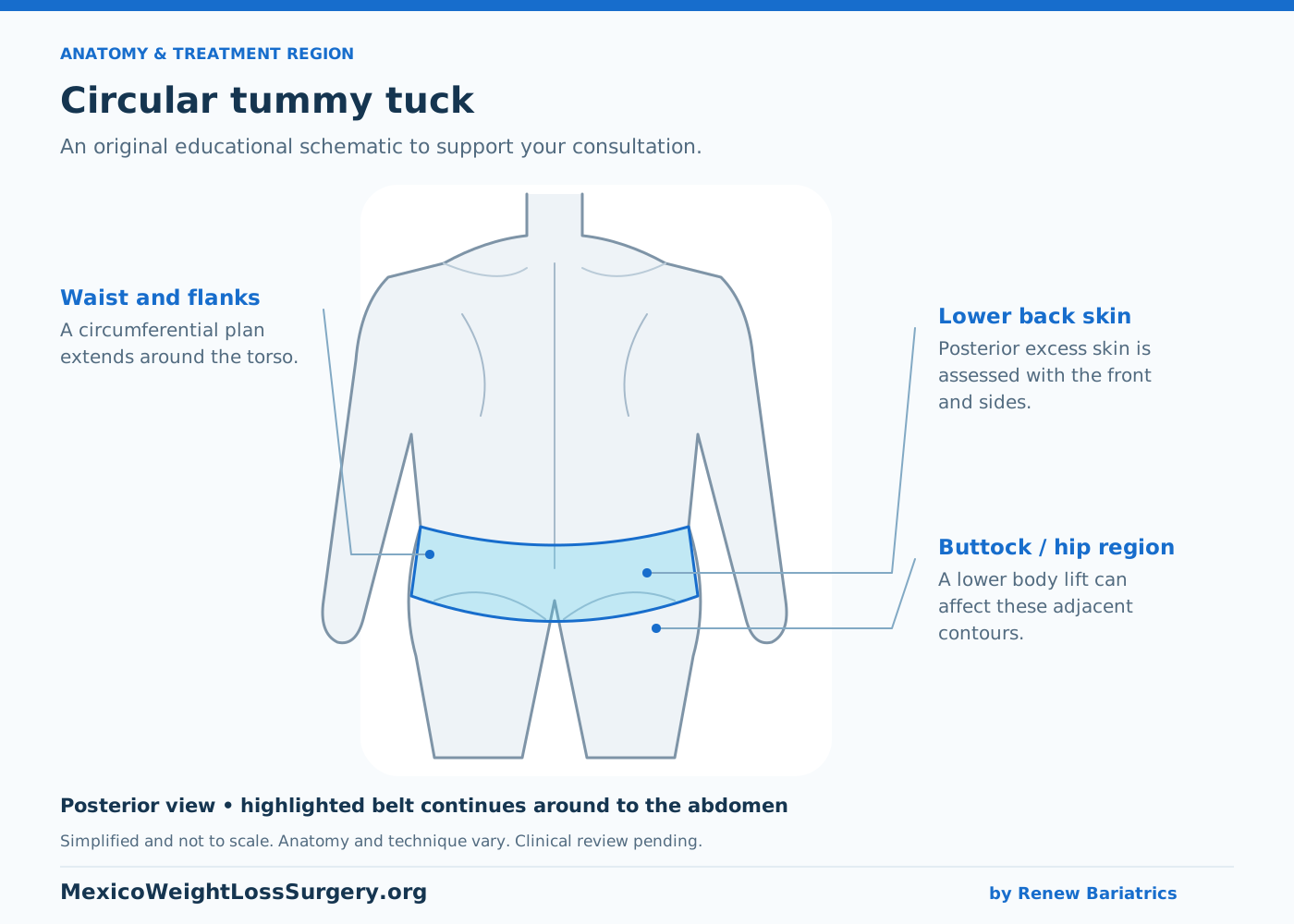
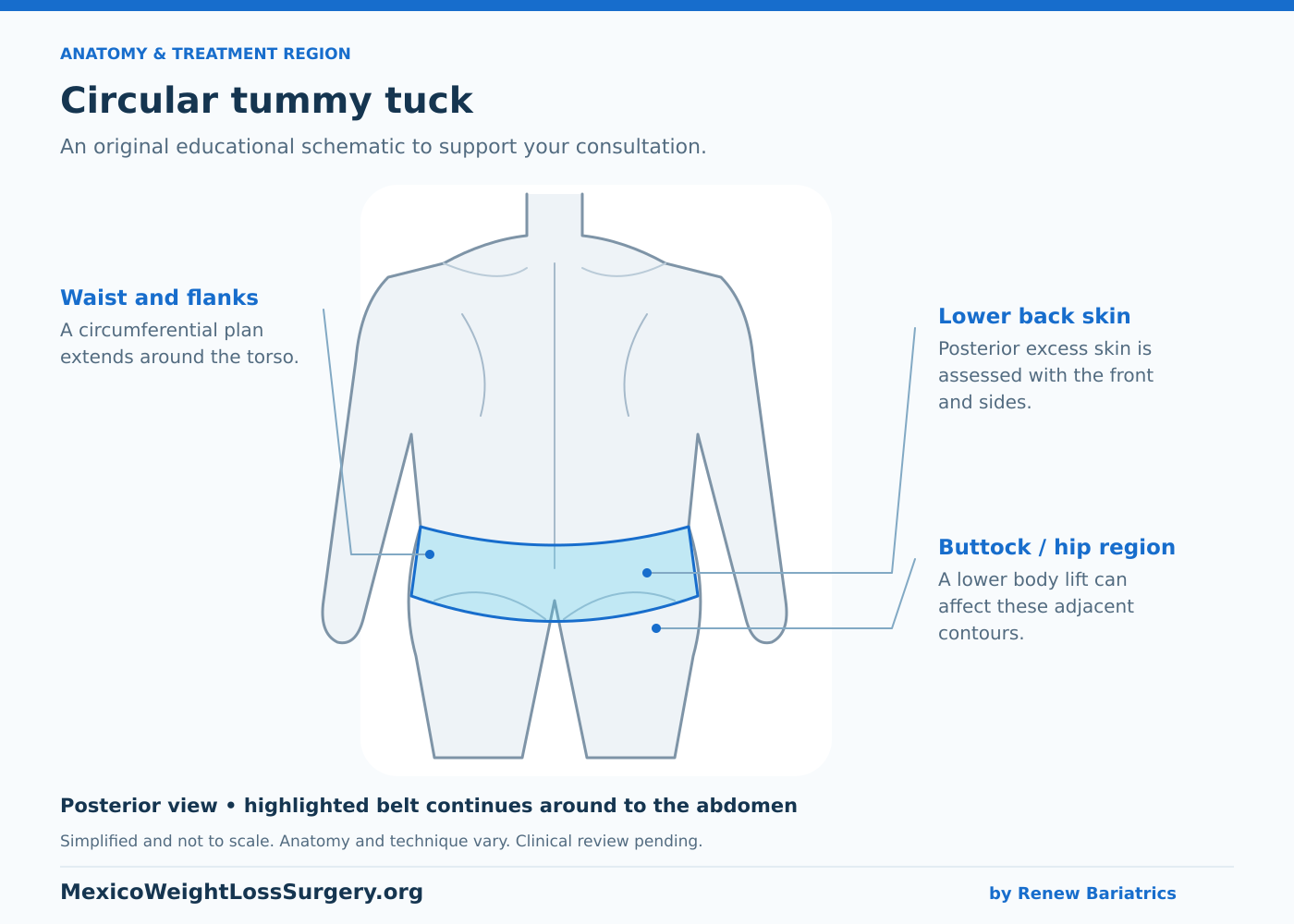
Anatomy references: ASPS — Circular tummy tuck ↗ · ASPS — Tummy tuck ↗
What does “360” actually mean?
“360” generally signals treatment around the trunk rather than the front alone. It should not be read as a promise to address every concern from the breasts to the knees. ASPS describes one common lower body lift pattern that encircles the body and removes excess skin and fat while repositioning tissues in the lower trunk.[1]
Terminology also reflects surgical goals. In the circumferential-contouring literature, belt lipectomy and lower body lift may differ in excision level and emphasis: a higher waist-level approach can address lower-back rolls, while a lower pattern may emphasize buttock and lateral-thigh lifting. Technique varies, so the name alone cannot establish your scar or result.[2]
Ask the surgeon to mark the proposed front, side, and back boundaries on a diagram. Then ask which areas are directly treated, which may change indirectly, and which are outside the plan. Request the same explanation if the quote uses “circular abdominoplasty,” “360 tummy tuck,” “body lift,” or a proprietary package name.
Why the pattern of loose skin matters
A front-only operation and a circumferential operation solve different anatomical problems. Someone whose excess is mainly a lower abdominal apron may have a different set of options from someone with folds extending around both flanks and across the lower back. Examination should determine the distribution and quality of the tissues rather than infer it from weight-loss history alone.[1],[3]
Prepare for consultation by describing what you notice from several viewpoints. You might write: “The front fold affects clothing,” “The side folds remain when I change garments,” or “The back roll is my main concern.” These descriptions help organize the discussion without trying to diagnose yourself from photographs.
Ask how a proposed lift would affect the relationship between the waist, buttocks, and thighs, and where residual laxity is expected. A diagram should explain the limitations as clearly as the proposed improvement. If your priorities are primarily in the upper abdomen or inner thighs, ask whether the suggested operation meaningfully addresses them or whether another plan is needed.
Compare the alternatives before choosing a larger operation
A standard or extended tummy tuck focuses primarily on the abdomen, with lateral extension depending on the technique. A fleur-de-lis approach adds a vertical abdominal component. A circumferential operation extends around the trunk. These categories can overlap in an individual surgical design; they are not interchangeable package tiers.[1],[2],[4]
Panniculectomy is another distinct option: it removes a hanging lower abdominal apron. It should not automatically be described as the same operation as a tummy tuck or lower body lift.[3]
Ask what the most limited reasonable operation would accomplish and what it would leave untreated. Then compare it with the broader proposal. If more than one operation is suggested, request a discussion of staging. The choice should account for your priorities, health, practical support, and willingness to accept scars and recovery demands, not merely the possibility of treating more areas during one trip.
Who may be considered for a lower body lift?
ASPS identifies substantial soft-tissue looseness, good general health, realistic expectations, nonsmoking, and commitment to appropriate nutrition and fitness as relevant candidate characteristics.[5]
Create a concise medical summary for assessment. Include prior bariatric or abdominal procedures, scars, episodes of poor healing, diabetes, sleep apnea, clot history, allergies, and current medicines. Explain your current weight trend and whether further significant weight change is anticipated. If a prior operation report is available, ask whether the surgeon needs a copy.
The consultation should connect those details to the proposed operation. Ask whether any finding changes the recommended technique, setting, timing, or need for another specialist. If a surgeon uses a weight or BMI threshold, ask what that threshold means in the practice and what other factors affect eligibility. Online photographs and a coordinator's initial opinion do not replace a clinician's assessment and examination.
Weight stability and nutritional readiness
After bariatric treatment, body-contouring preparation should include more than confirming that weight has decreased. A study of a structured post-bariatric nutritional pathway underscores the importance of nutritional assessment while also showing that preparation does not eliminate wound complications.[6]
Ask who reviews your weight trajectory, dietary intake, supplements, and laboratory results. Request a clear explanation of any finding that needs attention and who will reassess it. The aim is to understand your readiness, not to obtain a generic checklist of supplements to buy.
Prepare questions about the postoperative period as well. Who can advise you if your usual bariatric meal pattern becomes difficult during recovery? How will the surgical team communicate with your existing bariatric clinician? What information should your companion receive about the plan? These questions are especially useful when care is divided between two countries and several clinicians.
Do not schedule around an arbitrary anniversary of weight-loss surgery. Ask the assessing surgeon which health and stability conditions must be met in your case and whether further weight change would alter the proposed contour.
Scars are a central part of the decision
A circumferential operation involves an extensive incision. The exact length and position depend on the tissue pattern and surgical plan.[1]
Ask to see the proposed scar from the front, both sides, and back. Discuss clothing you routinely wear rather than assuming every scar will be hidden by a swimsuit or underwear. Ask what happens at the ends of any additional incisions and whether a vertical abdominal scar is part of the plan. A phrase such as “full body lift” is not sufficiently precise for that decision.
If you already have abdominal scars, point them out and ask how they influence the design. Request realistic examples of the surgeon's own work in people with reasonably comparable starting anatomy, with consent for the photographs to be shown. Ask how long after surgery each photograph was taken. Marketing imagery and custom illustrations are not clinical evidence of your likely result.
What to clarify about the operation
Before consent, ask for a plain-language account of the proposed sequence, anesthesia, repositioning if relevant, tissue removal, closure, and postoperative observation. Confirm whether liposuction, abdominal-wall repair, or any separate procedure is included. Each should appear consistently in the assessment, consent, and quote.[1]
Ask what could cause the operation to be modified or postponed and how you would be informed. If the plan includes more than one surgeon or facility, clarify responsibility for each stage. If overnight care is recommended, ask where it occurs, who provides clinical monitoring, and how escalation to a higher level of care works.
These are operational questions for the specific team. This educational page cannot supply a standard operating time, universal hospital stay, or a protocol applicable to every lower body lift. A confident estimate should still leave room for clinical judgment and changes in your condition.
Understand risk evidence without turning it into a promise
ASPS lists risks including bleeding, infection, fluid accumulation, poor healing, tissue loss, unfavorable scars, altered sensation, asymmetry, persistent swelling or pain, and possible revision. Deep-vein thrombosis and cardiopulmonary complications are also recognized risks.[7]
Circumferential-contouring studies use different techniques and definitions, which makes a single headline complication percentage difficult to apply. A meta-analysis examined predictors across lower-trunk contouring studies, while individual surgical series describe selected patients and particular techniques. Neither establishes the outcome of a different surgeon, facility, or patient.[2],[8]
Ask whether a quoted complication rate includes small wound openings, clinic drainage procedures, hospital admission, and reoperation. Ask how results are collected after international patients return home. If only major events are reported, that does not mean minor wound problems never occur.
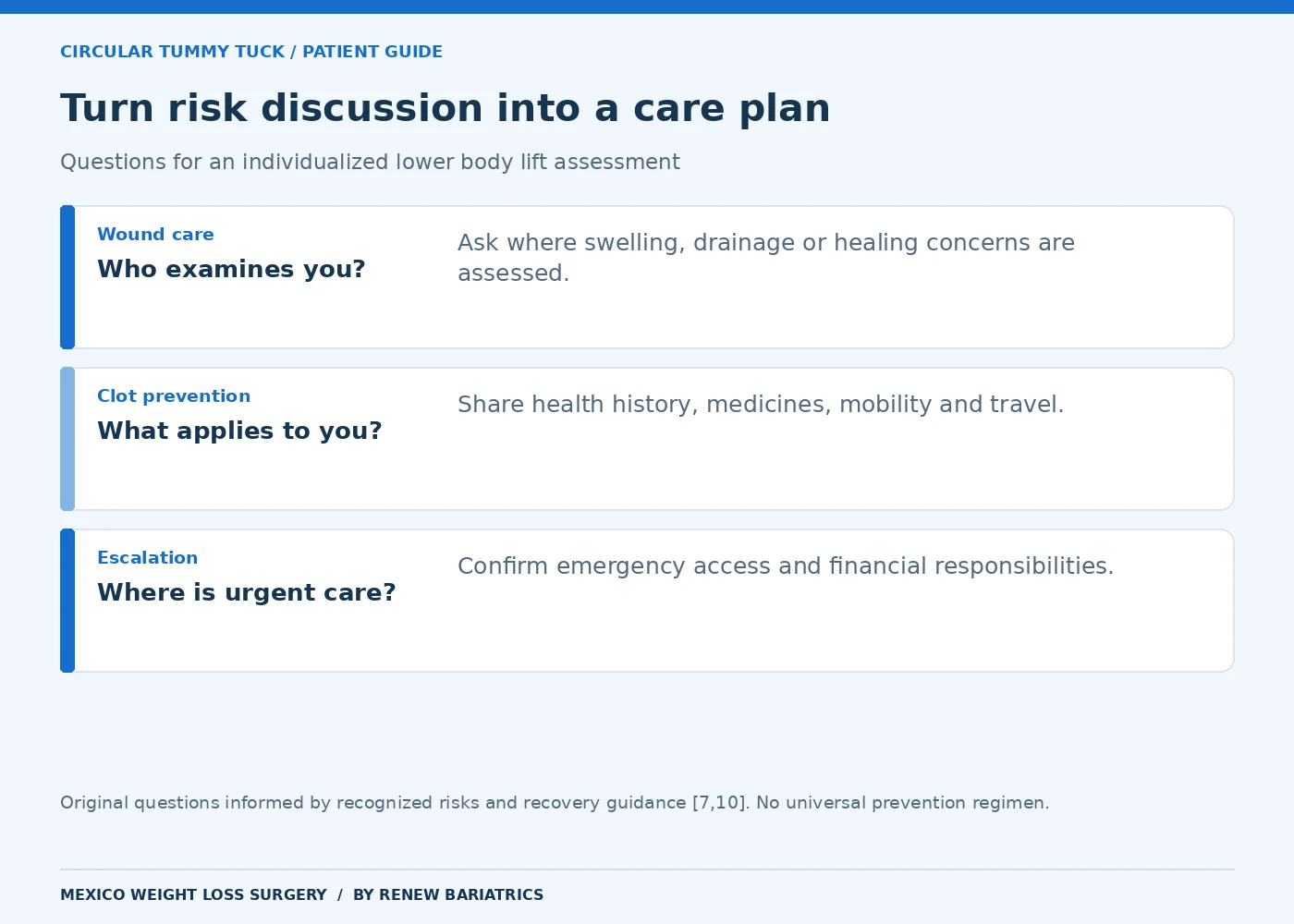
A meaningful consent discussion should translate recognized risks into a response plan. Who reviews a concern? Which facility handles an emergency? Who pays for additional treatment? What follow-up remains available after departure? These details deserve the same attention as the anticipated contour improvement.
Smoking, clot prevention, and medication review
Smoking cessation is part of preparation because smoking increases surgical and wound-healing problems. ACS patient guidance recommends stopping in advance of surgery and remaining smoke-free afterward; your surgeon should set the applicable requirements and discuss all nicotine exposure.[9]
Ask for individualized clot and bleeding risk assessment. Share previous clots, family history, mobility limitations, hormonal medicines, and the full travel itinerary. Request an explanation of any planned prevention measures, including their purpose, duration, and who answers questions after discharge. Do not copy a medication regimen from another patient's experience.[7]
Bring an accurate list of all medicines and supplements, including weight-management injections. Ask the prescribing clinician and anesthesia team to resolve any changes. If you receive conflicting instructions, obtain one reconciled written plan. A broad instruction such as “stop all medication” is not a substitute for a medicine-by-medicine review.
Recovery: plan for needs, not a single deadline
ASPS notes that lower body lift recovery may involve dressings, drains, compression, medication, and instructions for wound care and activity. The treating team decides what applies to the operation performed.[10]
Ask how you will get out of bed, use the bathroom, change position, and attend appointments. Explain your accommodation's layout and any stairs. Confirm what help a companion should provide and what tasks require a clinician. If professional assistance is part of a proposal, obtain the hours, qualifications, and responsibilities in writing.
For work and home life, ask separately about driving, lifting, prolonged sitting, standing, exercise, and caring for children or dependent adults. A date for desk work does not answer whether you can carry luggage or return to strenuous duties. Request a staged activity plan with reassessment points, not a guarantee that everyone is fully recovered after the same number of days.
Travel to Mexico and the return journey
CDC advises avoiding air travel for ten days after abdominal surgery and emphasizes that postoperative travel adds risks. This is a minimum travel warning, not a promise that you will be fit to fly on a particular day. Your surgeon may require a longer local recovery period.[11]
Discuss the complete journey, including driving, border waits, airport transfers, and connections. Ask who performs the final pre-travel assessment and what findings would delay departure. Reserve enough flexibility to change accommodation and travel if needed. A nonrefundable ticket should not determine medical clearance.
Before travel, arrange a plan for care after returning home. Identify who can assess routine concerns and where urgent care is available. Request records in English if that is the language your home clinicians use, including the operation performed and medicines prescribed. CDC highlights the importance of records and continuity after treatment abroad.[11],[12]
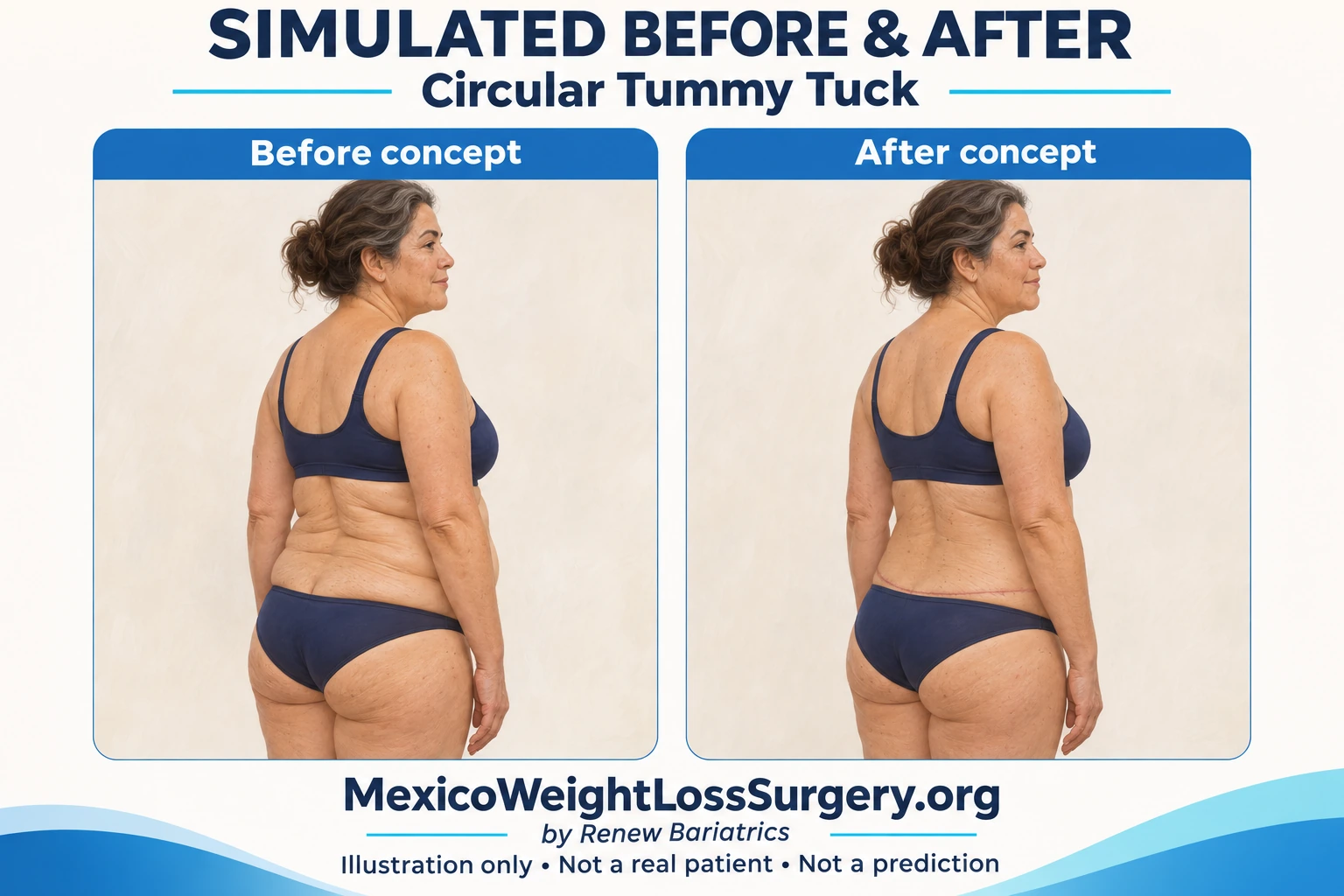
A synthetic illustration of possible changes
This fictional example illustrates a treatment concept. It cannot show the result you would achieve, predict scar healing, or establish a typical outcome.
Circular Tummy Tuck Cost in Mexico
The cost of a circular tummy tuck in Mexico depends on the actual operation proposed and the services included. A quote for front-only abdominoplasty is not equivalent to a circumferential lower body lift simply because both use “tummy tuck” in the description.
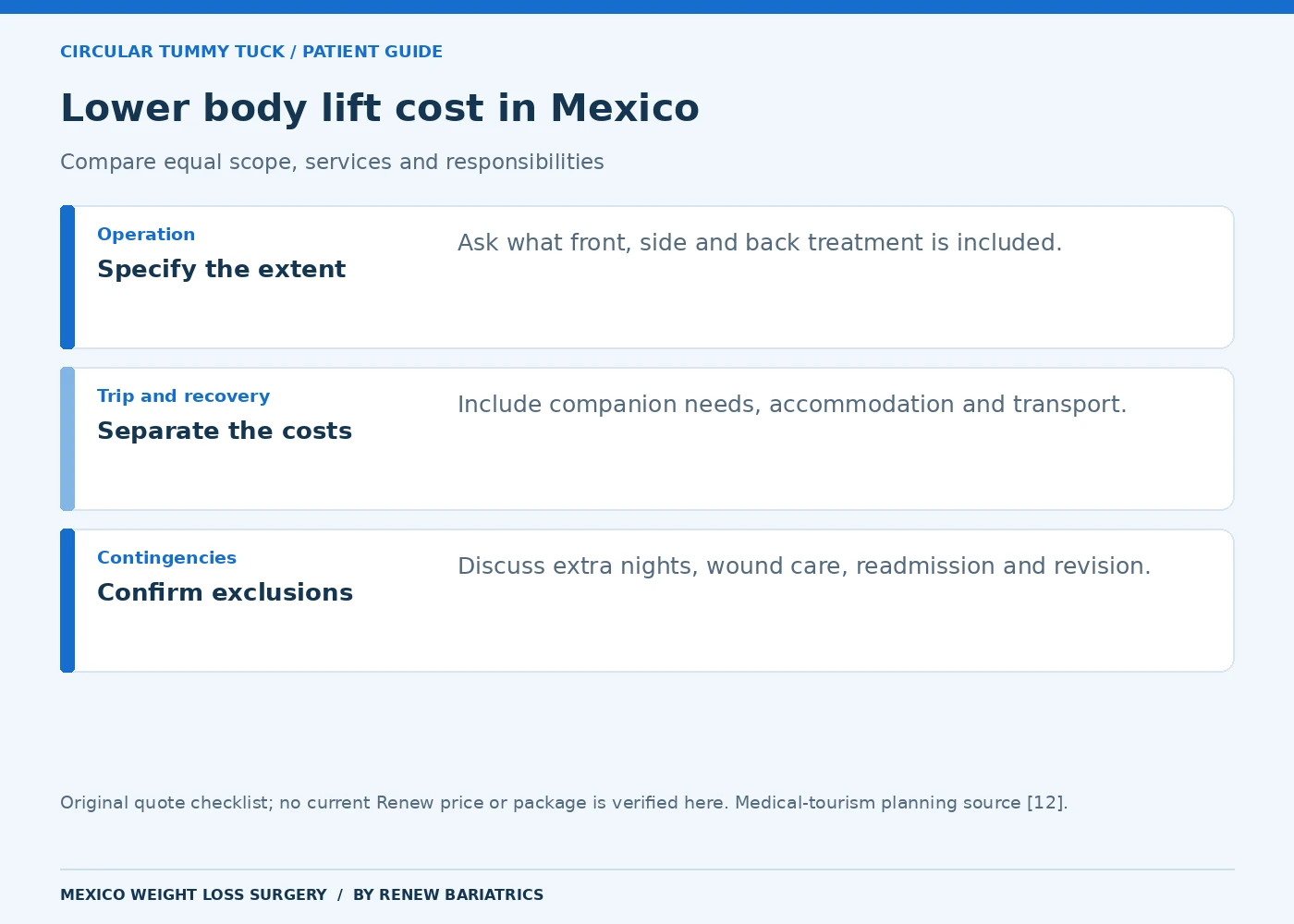
Request an itemized estimate covering the surgeon, anesthesia, facility, expected observation, tests, medicines, garments, follow-up appointments, and any additional procedure. Separately identify accommodation, transfers, meals, companion costs, and travel changes. Ask which services are included for a fixed period and what happens if recovery requires more visits or a longer stay.
Ask about exclusions explicitly: emergency evaluation, additional imaging, wound treatment, readmission, revision, and care after you return home. Do not assume that a complication policy or insurance benefit exists unless its terms are supplied in writing. CDC cautions that follow-up and complication costs may be substantial and may not be covered by ordinary insurance.[12]
This guide does not publish a verified Renew Bariatrics price. Request a current personalized quote following assessment, with currency, validity period, deposit terms, and cancellation rules. Compare proposals only after you can identify the same scope of surgery and the same practical responsibilities.
Evaluate a proposal before making a commitment
Use a one-page comparison for each proposal you receive. Record the named procedure, anatomical areas, scar pattern, operating surgeon, facility, recommended local stay, companion requirements, follow-up arrangements, and itemized cost. Leave a blank field when an answer is missing instead of filling it with an assumption.
Then ask the team to explain any inconsistency. For example, if a sales description promises a “360 transformation” but the consent describes only anterior abdominal surgery, request clarification. If transport is included but medical follow-up is not described, ask who is responsible for appointments. This is a way to make an informed decision, not a request for a standardized package.
Long-term research using the BODY-Q has associated body contouring after bariatric surgery with improved appearance satisfaction and health-related quality of life. That observational evidence can inform a discussion of possible benefits, but it cannot promise confidence, a relationship change, or a particular psychological outcome.[13]
Frequently asked questions
Is a circular tummy tuck the same as a lower body lift?
They overlap in common usage, but the terms can reflect different excision levels and priorities. Ask for the operative description and scar map. Do not rely on “360” to define what is included.[1],[2]
Does it remove loose skin everywhere?
No single name establishes that. Ask the surgeon to identify the areas treated directly, the areas that may change indirectly, and those outside the operation. Inner thighs, upper trunk, and other concerns may require a separate discussion.[1],[3]
Will this help me lose additional weight?
It is a contouring procedure after weight change, not a treatment for obesity. Continue long-term weight-management care independently of the decision about skin removal.[3]
Can a vertical tummy tuck be added?
Some individualized designs include more than one component, but suitability and current availability require confirmation. Ask what benefit the additional incision offers, how it changes recovery and risk, and whether staging is preferable.[2],[4]
How much does a lower body lift in Mexico cost?
Obtain a current itemized quote after a surgeon defines your operation. Ask whether the quoted “lower body lift” and “circular tummy tuck” describe the same scope. This page does not supply an unverified price or imply that every related service is included.
When can I exercise or fly home?
Those are separate clearance decisions. Ask for activity milestones and a travel assessment rather than using one recovery date for both. The CDC travel warning does not replace your surgeon's examination.[10],[11]
When should I seek urgent help?
New chest pain or shortness of breath needs immediate emergency evaluation. Obtain written instructions for escalating wound changes, fever, increasing pain, unexpected swelling, or other concerns. Do not wait for a routine appointment when symptoms are urgent.[7],[10]
How do I start an assessment?
Send Renew an accurate weight and medical history and describe your main concerns. Ask for confirmation of current availability, the assessing surgeon, alternatives, scar design, recovery responsibilities, and a complete quote. A thoughtful plan should make it equally possible to proceed, postpone, or decide against surgery.
Program information related to this guide
Explore Renew Bariatrics’ procedure options when discussing a plastic surgery plan. Availability, combinations and suitability require individual confirmation.
Circular tummy tuck vs. tummy tuck
These procedures address different concerns and may be combined or staged. A clinical assessment determines which, if either, fits your anatomy and goals.
| What to compare | Circular Tummy Tuck → | Tummy Tuck → |
|---|---|---|
| Main goal | Addresses circumferential lower-torso excess. | Addresses excess abdominal skin. |
| What changes | Abdomen, flanks and lower back. | Front abdominal skin; possible wall repair. |
| Key distinction | Broader extent means a circumferential scar. | Does not remove internal abdominal fat. |
| Recovery consideration | More body regions need protection during healing. | Abdominal wound healing affects activity. |
| Cost comparison | Request an itemized quote for this exact procedure and care plan. | Compare the same inclusions, exclusions and recovery expenses. |
Comparison references: ASPS — Circular tummy tuck ↗ · ASPS — Tummy tuck ↗
These options are not interchangeable for every person. The treating clinician must assess your anatomy, medical history and goals.
Further reading
Discuss your options with Renew.
Talk with a coordinator about circular tummy tuck, your goals and the information needed for clinical review. The treating team determines suitability and the care plan.
Call 844-736-3963 Ask about plastic surgery ↗The link opens Renew’s plastic surgery health questionnaire. This review site does not collect health information.
References & evidence notes
Sources checked November 2026. Research findings are not a forecast for an individual or outcomes for Renew’s own program. Review study populations, methods and limitations alongside the reported results.
- American Society of Plastic Surgeons. Body Lift Procedure Steps ↗Circumferential incision concept; actual surgical design varies.
- Aesthetic Surgery Journal, 2016. Are There Factors Predictive of Postoperative Complications in Circumferential Contouring of the Lower Trunk? A Meta-Analysis ↗Terminology and heterogeneous circumferential-contouring evidence.
- Johns Hopkins Medicine. Body Contouring ↗Institutional explanation of post-weight-loss contouring and panniculectomy.
- Cleveland Clinic. Tummy Tuck ↗Institutional terminology illustrates why an individualized incision plan matters.
- American Society of Plastic Surgeons. Body Lift Candidates ↗General health, tissue laxity, nutrition and nonsmoking criteria.
- Makarawung et al., 2022. Complications in post-bariatric body contouring surgery using a practical treatment regime to optimise the nutritional state ↗Prospective nutritional pathway study; optimization does not eliminate complications.
- American Society of Plastic Surgeons. Body Lift Risks and Safety ↗Recognized local and systemic surgical risks.
- Plastic and Reconstructive Surgery investigators, 2021. The Three-Hour Lower Body Lift: Evolution of a Technique and Personal Experience after 155 Consecutive Cases ↗Single-team surgical series; the title is not an operative-time promise.
- American College of Surgeons. Quit Smoking before Your Operation ↗Smoking and surgical wound risk; discuss an individualized cessation plan.
- American Society of Plastic Surgeons. Body Lift Recovery ↗Individualized postoperative care and warning symptoms.
- Centers for Disease Control and Prevention. Medical Tourism — Yellow Book ↗Postoperative travel, clot risk, records and medical clearance considerations.
- Centers for Disease Control and Prevention. Medical Tourism: Travel to Another Country for Medical Care ↗Credential checks, continuity, insurance and potential additional costs.
- International BODY-Q investigators, 2024. Body Contouring Surgery After Bariatric Surgery Improves Long-Term Health-Related Quality of Life and Satisfaction With Appearance ↗International longitudinal observational cohort; association is not an individual guarantee.