

Jump to a section
Anatomy illustrationCompare proceduresRelated ProceduresWhat ESG changes—and what it does notWho might consider ESG?How much weight loss has research shown?How should you judge before-and-after claims?ESG versus surgical sleeve, bypass and medicationIs ESG reversible?Risks deserve a specific conversationPreparation: get one written medication and fasting planRecovery is a progression, not a deadlineFollow-up should continue after the tripPlanning ESG in MexicoWhat should an ESG quote include?Questions to bring to RenewFrequently asked questionsYour next stepReferencesEndoscopic sleeve gastroplasty, usually shortened to ESG, is a procedure that changes the shape and usable volume of the stomach with internal sutures. The endoscopist works through the mouth, so there are no abdominal incisions and no portion of the stomach is removed. That makes ESG different from surgical sleeve gastrectomy, even though both names contain the word “sleeve.” It is a medical intervention with anesthesia, recovery requirements and possible complications—not a non-invasive cosmetic treatment. [1]
For someone researching ESG in Mexico, the useful question is not simply whether the procedure is available or cheaper. It is whether the expected benefit fits your health goals, whether the treating team has relevant experience, and whether you can access continued care after returning home. This guide explains the evidence and gives you a practical framework for that discussion. Renew’s current ESG operator, facility, package and availability require confirmation through the clinical assessment process.
Understand the anatomy
A simplified, labeled view of the structures and treatment area. Select the image to view it at full size.
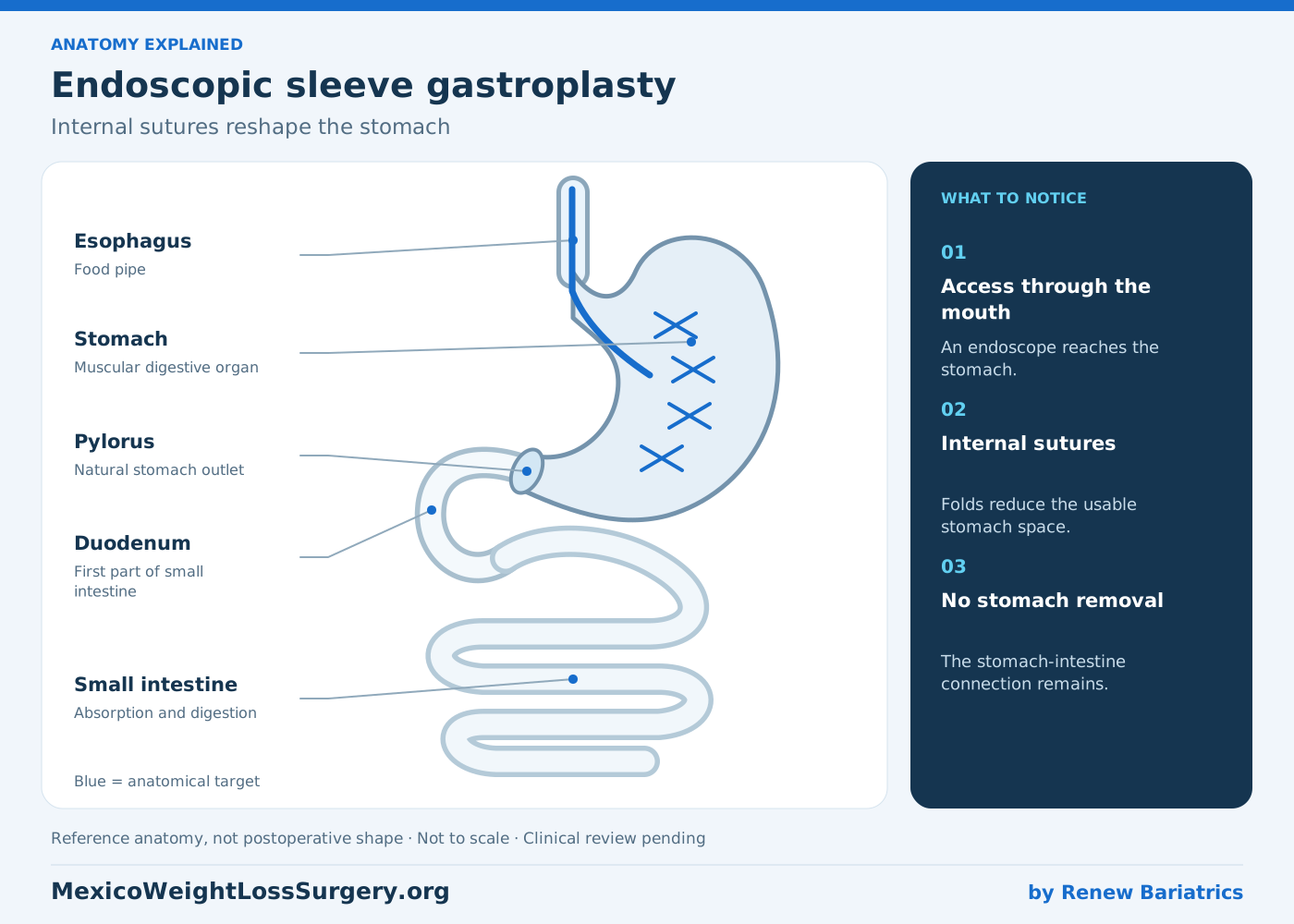
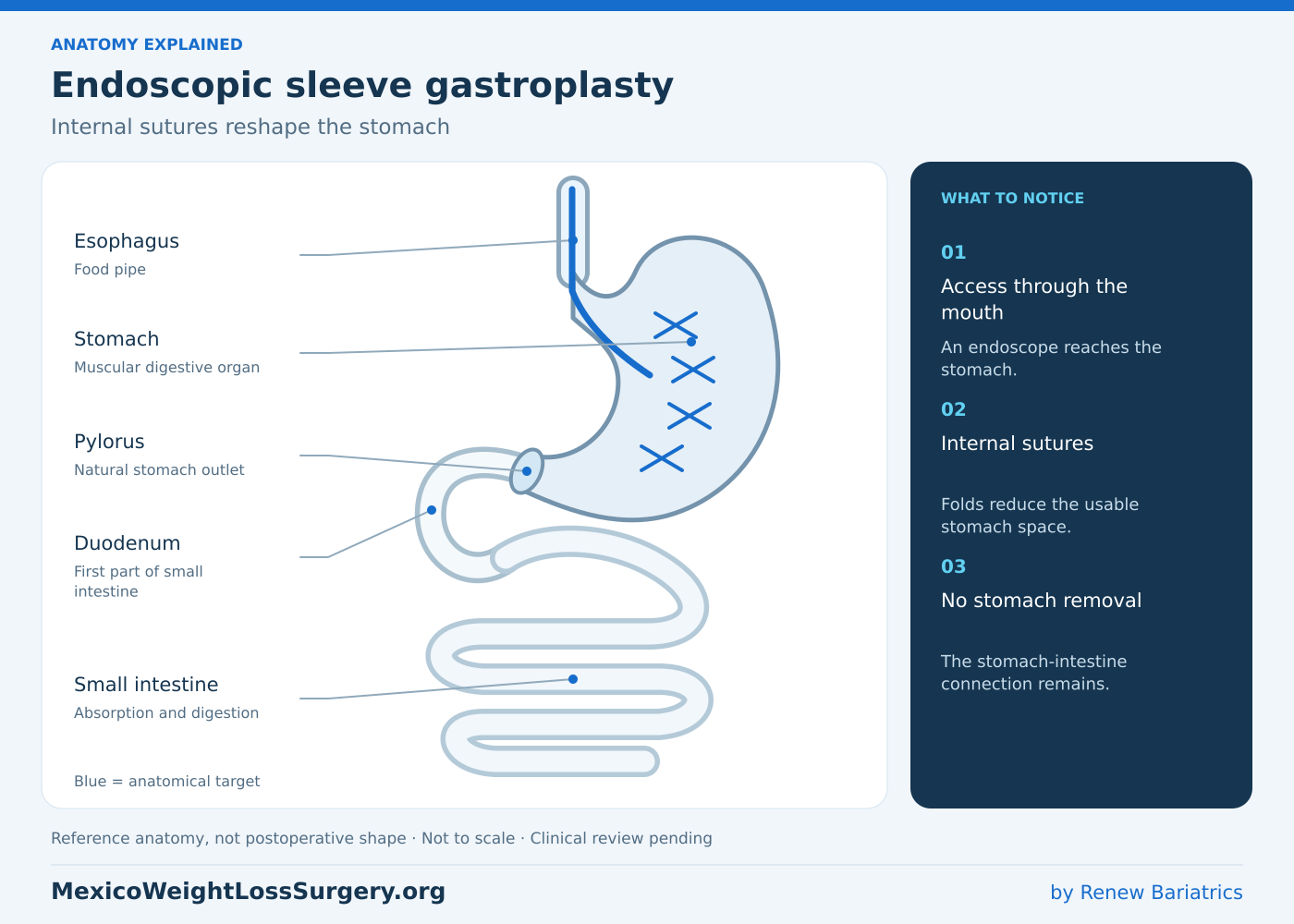
Anatomy references: Johns Hopkins Medicine: Endoscopic Sleeve Gastroplasty ↗ · Mayo Clinic: Sleeve gastrectomy ↗
What ESG changes—and what it does not
During ESG, a flexible endoscope carries a camera and suturing equipment into the stomach. The clinician places a pattern of stitches that brings sections of the stomach wall together. The reshaped stomach holds less food and can empty more slowly, which may help you feel satisfied with smaller meals. Food still follows the usual route through the stomach and intestine; ESG does not create an intestinal bypass. [1]
The procedure does not remove the biological, environmental or emotional contributors to obesity. It also does not make every food choice effortless. Think of the anatomical change as one part of a treatment program whose other parts include nutrition, activity, behavioral support and medical monitoring. The ASGE–ESGE guideline evaluates endoscopic treatments together with lifestyle intervention, rather than presenting them as standalone fixes. [2]
Your procedure report should identify the technique and device used. “Endoscopic weight loss” is a broad category: a balloon occupies space temporarily, ESG reshapes the stomach with sutures, and TORe treats an enlarged outlet in selected patients after gastric bypass. These are not interchangeable treatments. A quotation that says only “endoscopic sleeve” is not sufficiently specific for informed consent.
Who might consider ESG?
ESG may be considered when someone has obesity, has not achieved adequate durable benefit from less invasive treatment, and wants to discuss a procedural option. The ASMBS describes its primary role in carefully selected patients with a BMI of approximately 30–40, while acknowledging that individual situations outside that range may warrant consideration. It does not regard ESG as equivalent to sleeve gastrectomy or gastric bypass in expected weight loss or metabolic effect. [3]
Device labeling and professional guidance answer different questions. The FDA’s authorization for the Apollo ESG systems covers adults with BMI 30–50 who have not achieved or maintained weight loss through more conservative measures. That U.S. authorization is not proof of Mexican regulatory status, a particular clinician’s qualifications, or your eligibility. Your treating team needs to confirm the exact device, local authorization and individualized recommendation. [4]
Screening should address your health history, prior abdominal or stomach procedures, medications, eating patterns, weight trajectory and expectations. Mayo Clinic identifies a large hiatal hernia and gastrointestinal conditions associated with bleeding among reasons ESG may be unsuitable. A clinician may request additional testing before making a recommendation. [5]
Prepare a short description of what you want treatment to accomplish. Examples might include improving mobility, reducing the burden of weight-related disease, or achieving a weight change that previous treatment has not maintained. Bring your actual priorities rather than selecting a procedure from a photograph. It is reasonable to ask the team to explain why ESG fits those priorities better than another option—and what would make them recommend against it.
How much weight loss has research shown?
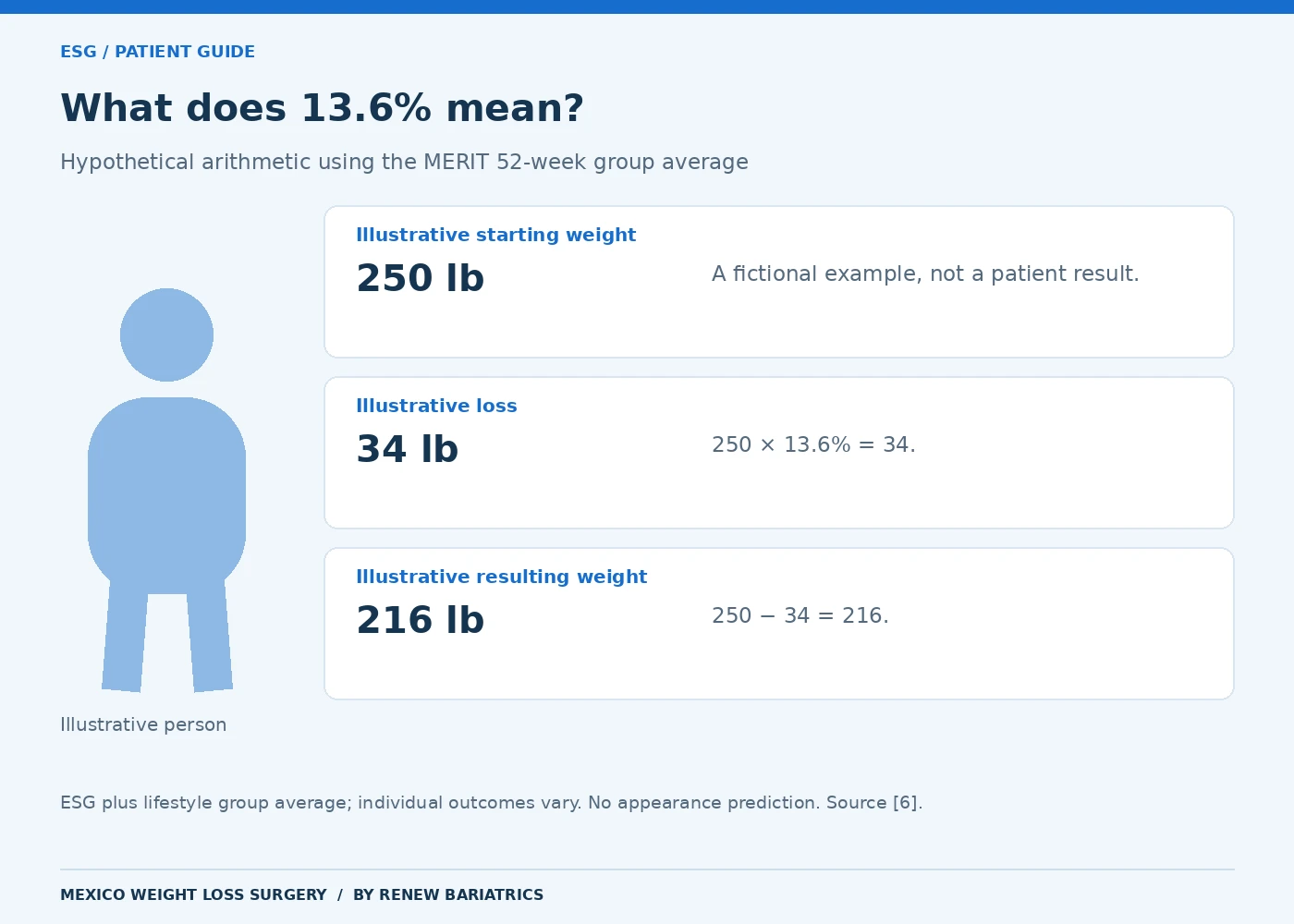
The MERIT randomized trial enrolled 209 adults with class I or II obesity across nine U.S. centers. At 52 weeks, the ESG-plus-lifestyle group averaged 13.6% total body weight loss, compared with 0.8% in the lifestyle-only group. This is a group average, not an individual prediction. The trial’s patients, treatment program and follow-up may differ from the program you are considering. [6]
For arithmetic only, 13.6% of a hypothetical starting weight of 250 pounds equals 34 pounds, leaving 216 pounds. This example does not describe a real patient, forecast a change in appearance, or estimate Renew’s results. Someone may lose more, less or no weight. It is more useful to ask how a program measures its own outcomes than to assume a published average transfers directly to every patient.
Be careful with the denominator. Total body weight loss compares pounds lost with your starting weight. Excess weight loss compares pounds lost with a calculated amount above a reference weight. They are different measures, and an impressive percentage using one cannot be read as the same percentage using the other. Ask any provider quoting a number to specify the metric, follow-up time and number of patients assessed.
One prospective single-center cohort included 216 ESG patients. At five years, mean total body weight loss was 15.9% among the long-term follow-up analysis; 68 patients were eligible for that time point and follow-up was 82%. All procedures were performed by one endoscopist. The results provide encouraging durability evidence, but incomplete follow-up, a single setting and lack of a randomized comparison limit how broadly they can be applied. [7]
How should you judge before-and-after claims?
A compelling photograph can tell you that one person’s experience mattered to them. It cannot tell you the average result, the probability of a complication, or whether your health profile resembles theirs. NIDDK cautions against weight-loss marketing that relies on unrealistic promises or unusually impressive endorsements. [8]
When reviewing a result, ask for the procedure date, starting weight, follow-up date and whether medication, repeat treatment or another intervention contributed. A result at three months is not evidence of five-year maintenance. A patient selected because they achieved an exceptional result is not representative of every patient treated.
For a clinic’s outcomes, useful questions include: How many consecutive patients were treated? How many returned for measurement? Were results self-reported? Were complications counted after patients returned to another country? Does the average include people who needed additional treatment? These questions do not demand that every clinic conduct a research trial; they help distinguish a transparent clinical summary from a promotional number.
ESG versus surgical sleeve, bypass and medication
Surgical sleeve gastrectomy removes stomach tissue; ESG folds and sutures tissue internally. Gastric bypass creates a pouch and reroutes part of the intestine. The tradeoffs are therefore more substantial than whether the procedure leaves visible incisions. The ASMBS emphasizes that metabolic surgery generally has greater weight-loss and metabolic effects and more extensive long-term evidence than ESG. [3]
Medication is another legitimate treatment path. NIDDK explains that prescription obesity treatment is selected according to health conditions, possible adverse effects, other medicines and cost, and may need to continue long term. The relevant comparison is the treatment you could realistically sustain, with the necessary monitoring—not simply a monthly prescription price versus a procedure fee. [9]
Ask your clinician to compare options against the same goals: the amount of weight change that would be meaningful, management of weight-related conditions, procedural risk, likely nutritional demands, reversibility limitations, ongoing expense and access to follow-up. Do not assume that results from separate ESG and medication trials establish which is better for you; study populations and treatment conditions can differ.
If you already have a sleeve or bypass, make that clear before discussing primary ESG. A prior operation changes the anatomical question. The assessment may concern revision of an existing procedure rather than creation of a primary endoscopic sleeve, and the evidence supporting each treatment is different.
Is ESG reversible?
ESG preserves stomach tissue, but “nothing is removed” should not be translated into “easy to undo.” Mayo Clinic describes ESG as a treatment that is not intended to be temporary, although conversion to another bariatric operation can be possible. [5]
Ask what the clinician means by reversal: cutting sutures, attempting to restore anatomy, repeating suturing, or converting to surgery are different interventions. Also ask what symptoms or outcomes would justify reassessment and which specialist would perform it. A future procedure should not be treated as a guaranteed fallback without its own assessment, cost and risk discussion.
You do not need to predict every future circumstance before choosing treatment. You do need an honest explanation of the intended durability and the options if the treatment no longer fits your needs.
Risks deserve a specific conversation
Temporary pain, nausea and vomiting can occur after ESG. More serious complications described by Johns Hopkins include bleeding, infection, tears or leakage, and cardiopulmonary complications. The absence of skin incisions does not eliminate internal injury or anesthesia-related risks. [1]
In MERIT, ESG-related serious adverse events occurred in three of 131 treated participants in the safety population, approximately 2%; no deaths or need for intensive care or surgery were reported in that trial. This does not establish a zero risk of those outcomes outside the trial. [6]
A useful consent discussion separates common short-term symptoms from events requiring urgent evaluation, admission, repeat endoscopy or surgery. Ask how the facility manages an unexpected complication, whether a surgical team is available when needed, and who pays for unplanned care. Request the explanation in language you understand and allow time to ask questions before the procedure day.
After ESG, severe abdominal pain, fever, blood in vomit or stool, chest pain, breathing difficulty, or difficulty swallowing warrant prompt medical assessment. Cleveland Clinic also advises contacting the treating team for nausea or vomiting after the procedure. For severe or rapidly worsening symptoms, seek local emergency care rather than waiting for a travel coordinator’s response. [10]
Preparation: get one written medication and fasting plan
General upper-endoscopy guidance stresses an accurate medication list and individualized fasting instructions. Give the team the names and doses of prescriptions, over-the-counter medicines and supplements, along with allergies and relevant heart or lung conditions. Some medicines require a coordinated plan; do not stop a prescribed treatment solely because of a generic website checklist. [11]
GLP-1 and related medications deserve particular attention because they can delay stomach emptying. Current multi-society guidance summarized by the American Society of Anesthesiologists says most patients can continue them, while individual risk factors may require a different plan. The prescriber, procedural clinician and anesthesia team should agree on instructions. A universal stop interval on a sales page is not a substitute for that decision. [12]
Before travel, request a consolidated document covering testing, food and fluid restrictions, medication changes, arrival requirements and reasons the procedure might be postponed. If instructions from different staff members conflict, resolve that conflict before boarding a plane. Keep the final version available offline, alongside the contact details for the clinical team.
Recovery is a progression, not a deadline
Cleveland Clinic describes recovery as a staged return from liquids to softer food and then solid food, with stomach healing taking longer than the earliest return to ordinary activities. The exact progression and restrictions should come from your treating team. Feeling well enough to answer email does not mean you are ready for unrestricted eating, lifting or travel. [10]
Ask for instructions that answer everyday questions: which fluids and foods are permitted, how much to drink, how to take medicines, when to advance textures, and what to do if you cannot tolerate the current stage. Avoid borrowing the postoperative diet of someone who had a different procedure. Even programs using the same procedure name can give different instructions based on clinical circumstances.
Arrange practical help rather than relying on willpower during the first days. Think about childcare, groceries, transport and work expectations. After sedating medication, judgment and reflexes can remain impaired even if you feel awake; ASGE advises that someone drive you and stay with you after an endoscopy. Your ESG team may impose additional restrictions. [11]
Follow-up should continue after the trip
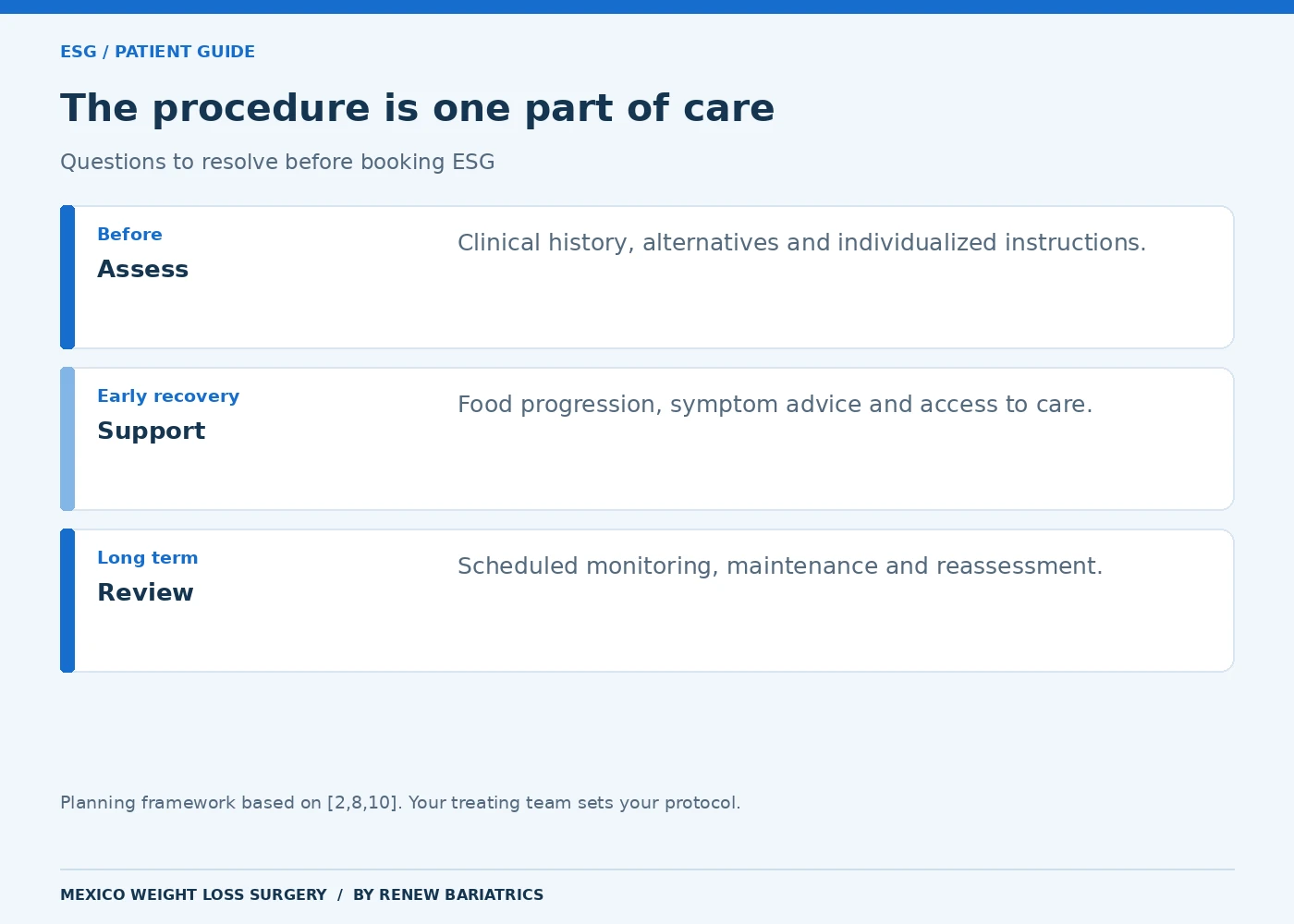
A follow-up program should make it easy to raise a concern before it becomes a crisis. Ask who reviews food tolerance, hydration, weight trajectory and relevant laboratory results, and who adjusts treatment for existing conditions. Find out which appointments are included and what happens when the included period ends.
NIDDK’s framework for choosing a weight-management program includes an appropriate eating plan, activity guidance, behavioral support and a maintenance strategy. [8] Translate those broad components into concrete services: named professionals, scheduled appointments, clear communication methods and a route back into care if weight begins to rise.
Keep a small set of measures that matters to you and your clinician. Weight is one; day-to-day function and management of associated conditions may be others. Avoid treating a single week’s scale reading as a verdict on the procedure. Instead, agree in advance on when a trend should prompt a review and what information the team wants you to bring.
Planning ESG in Mexico
Medical travel adds a coordination problem to the procedure itself. The CDC recommends arranging follow-up before travel, reviewing insurance coverage and obtaining medical records for clinicians at home. It also emphasizes that accreditation does not guarantee a good outcome. [13]
Ask for the treating clinician’s name and relevant ESG experience, the actual facility address, anesthesia arrangements and the emergency transfer plan. Verify credentials with the relevant issuing bodies rather than interpreting a logo as proof. A facilitator’s reputation and a clinician’s qualifications are separate parts of the decision.
Confirm how long you should stay locally and who decides you are ready to travel. A general bariatric surgery itinerary is not automatically an ESG itinerary. Choose flights and accommodation with enough flexibility to follow clinical advice if recovery does not proceed as expected. Recovery time should drive the travel plan, rather than a nonrefundable ticket determining discharge.
What should an ESG quote include?
No universal ESG price tells you the full cost of your treatment. Request an individualized written quote identifying the procedure, device, clinician, facility and currency. Ask whether anesthesia, testing, medicines, observation, transport, accommodation and follow-up are included. Do not assume airfare, a companion’s expenses or additional treatment is covered by “all-inclusive.”
Compare like with like. One quote may include a longer nutrition program; another may cover only the procedure encounter. Ask how early cancellation, clinical ineligibility, postponement and unplanned hospitalization affect payment. A lower entry price can be difficult to evaluate until those terms are visible.
Use three budget categories: confirmed package charges, predictable personal travel expenses, and money available for unexpected changes. This is a planning framework, not a claim that every patient will need extra care. Ask your insurer directly about treatment abroad and complications after returning home; the answer should come from your policy, not an assumption based on the procedure being outpatient. [13]
Questions to bring to Renew
- Is primary ESG appropriate to discuss given my history, or do I need a different assessment?
- Who would perform it, with which device, and at which facility?
- What outcomes and complications does that team track for its own patients?
- What would make the clinician recommend surgery or medication instead?
- What is the written recovery and follow-up plan, including after I return home?
- Which costs are fixed, which depend on assessment, and which are excluded?
Start with a coordinator conversation if you are still comparing options. If you are ready for assessment, provide your complete history through the clinical intake process. The first conversation helps organize the next step; it does not replace a clinician’s decision about suitability.
Frequently asked questions
Will ESG cure obesity?
It is one treatment within ongoing obesity care. Neither the presence of sutures nor an early weight change removes the need to review progress and adjust the plan. Professional guidance places ESG within comprehensive treatment rather than presenting it as a permanent cure. [2],[3]
Can I choose ESG solely to avoid scars?
Scar preference can be part of your decision, but it should not outweigh health goals, expected benefit and risk. Ask the clinician to explain whether avoiding abdominal incisions changes the overall recommendation in your case.
Do I need a particular amount of weight loss to call it successful?
Agree on realistic goals before treatment. A research average is useful context, but your clinician should help define meaningful changes in weight, function and health, along with when the treatment plan should be reassessed.
Is ESG currently available through Renew in my preferred city?
Confirm current operator, location and scheduling directly with Renew before making travel arrangements. This educational guide does not establish availability at every facility or endorse a particular device or clinician.
Program information related to this guide
For information about care through our parent organization, explore endoscopic sleeve gastroplasty at Renew Bariatrics. Ask the team to confirm availability, your eligibility and the written scope of care.
For patient examples, view gastric sleeve before-and-after photos from Renew Bariatrics. These are sleeve patient examples; they do not predict an individual result or represent results of other procedures.
ESG vs. surgical gastric sleeve
These options change different structures. Your anatomy, symptoms, health history and follow-up needs guide the choice; neither is automatically better for everyone.
| What to compare | ESG → | Gastric sleeve → |
|---|---|---|
| Technique | Endoscopic suturing through the mouth. | Surgical removal of stomach tissue. |
| Skin incisions | No abdominal skin incisions for ESG. | Usually performed through abdominal incisions. |
| Permanence | Sutures reshape retained tissue. | Removed stomach tissue cannot be restored. |
| Care plan | Diet progression and ongoing obesity care. | Surgical recovery, diet progression and nutritional follow-up. |
Comparison references: Johns Hopkins Medicine: Endoscopic Sleeve Gastroplasty ↗ · Mayo Clinic: Sleeve gastrectomy ↗
These options are not interchangeable for every person. The treating clinician must assess your anatomy, medical history and goals.
Explore ESG with Renew ↗. Confirm the current care arrangements and your individual quote with the team.
Discuss your options with Renew.
Talk with a coordinator about esg, your goals and the information needed for clinical review. The treating team determines suitability and the care plan.
Call 844-736-3963 Complete health questionnaire ↗The questionnaire opens Renew’s existing intake. This review site does not collect health information.
References & evidence notes
Sources checked November 2026. Research findings are not a forecast for an individual or outcomes for Renew’s own program. Review study populations, methods and limitations alongside the reported results.
- Johns Hopkins Medicine. Endoscopic Sleeve Gastroplasty ↗Institutional patient education; technique and risks.
- ASGE–ESGE, 2024. Guideline on primary endoscopic bariatric and metabolic therapies ↗Evidence-based guideline; procedures combined with lifestyle treatment.
- ASMBS. Endoscopic Sleeve Gastroplasty Frequently Asked Questions ↗Professional society position; selection and distinction from surgery.
- U.S. Food and Drug Administration. Apollo ESG De Novo decision summary DEN210045 ↗U.S. device authorization; does not establish Mexican approval or individual eligibility.
- Mayo Clinic. Endoscopic sleeve gastroplasty ↗Patient selection and intended durability.
- Abu Dayyeh et al., 2022. Endoscopic sleeve gastroplasty for treatment of class 1 and 2 obesity (MERIT) ↗Lancet randomized trial; 209 randomized participants; one-year weight outcomes and safety population differ.
- Sharaiha et al., 2021. Five-Year Outcomes of Endoscopic Sleeve Gastroplasty for the Treatment of Obesity ↗Single-center prospective cohort; 68 eligible at five years, 82% follow-up.
- NIDDK. Choosing a Safe & Successful Weight-loss Program ↗Program quality and realistic marketing claims.
- NIDDK. Prescription Medications to Treat Overweight & Obesity ↗Medication selection and long-term treatment considerations.
- Cleveland Clinic. Endoscopic Sleeve Gastroplasty ↗Recovery progression and warning symptoms; individual protocol required.
- ASGE. Understanding Upper Endoscopy ↗General endoscopy preparation and sedation guidance, not an ESG-specific protocol.
- American Society of Anesthesiologists. Drugs for Diabetes or Weight Loss: What To Know Before Surgery ↗Patient explanation of individualized peri-anesthesia medication planning.
- CDC. Medical Tourism: Travel to Another Country for Medical Care ↗Continuity of care, records, credentials and insurance considerations.