

Jump to a section
Anatomy illustrationSynthetic illustrationCompare proceduresRelated ProceduresWhat is a mommy makeover?Define the change that matters to youBreast options: volume, position and reductionIf the plan includes breast implantsAbdominal options and their limitsWho may be a candidate?Consultation and medical preparationCombined surgery or separate stages?Risks and the meaning of informed consentRecovery involves your householdNutrition and previous weight-loss surgeryResults, scars and future changesMommy Makeover Cost in MexicoTravel and continuity of careFrequently asked questionsYour next stepReferencesA mommy makeover in Mexico should begin with your priorities, not with a preselected package. The term describes a personalized combination of procedures that may address changes in the breasts, abdomen or other areas after pregnancy. It is not one standardized operation, and the name does not tell you how much surgery is appropriate for you.[1]
People researching mommy makeover cost in Mexico often want one clear number. A useful quote comes later, after the team defines the procedures, considers whether to stage them and reviews the support required during recovery. The lowest advertised package price cannot answer those clinical questions.
This guide explains common choices, the importance of timing and candidacy, how to compare combined and staged treatment, and what belongs in a written cost estimate. MexicoWeightLossSurgery.org is owned by Renew Bariatrics. Ask the team to confirm current availability, the treating surgeon and the specific assessment process before arranging surgery or travel.
Understand the anatomy
A simplified, labeled view of the structures and treatment area. Select the image to view it at full size.
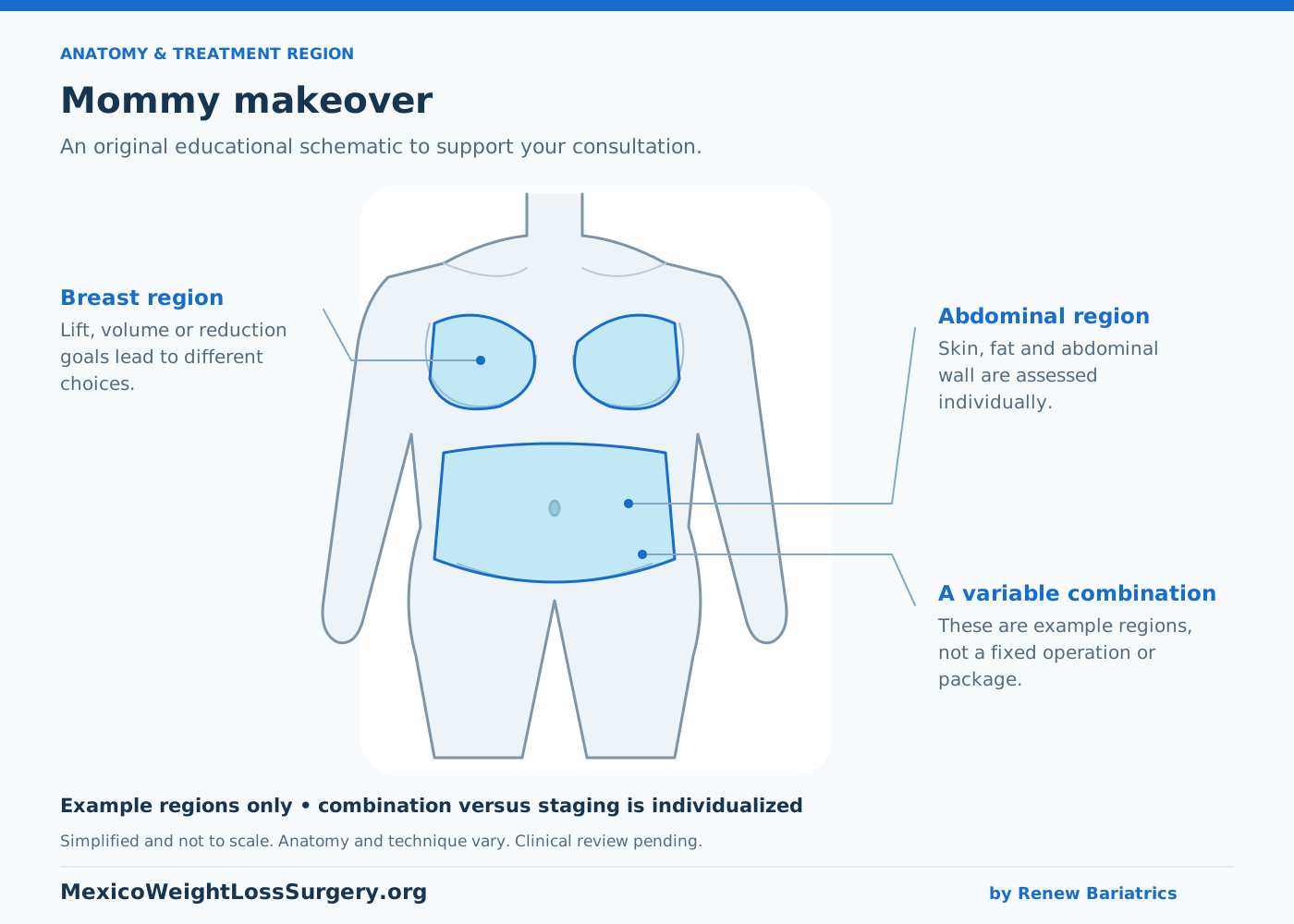
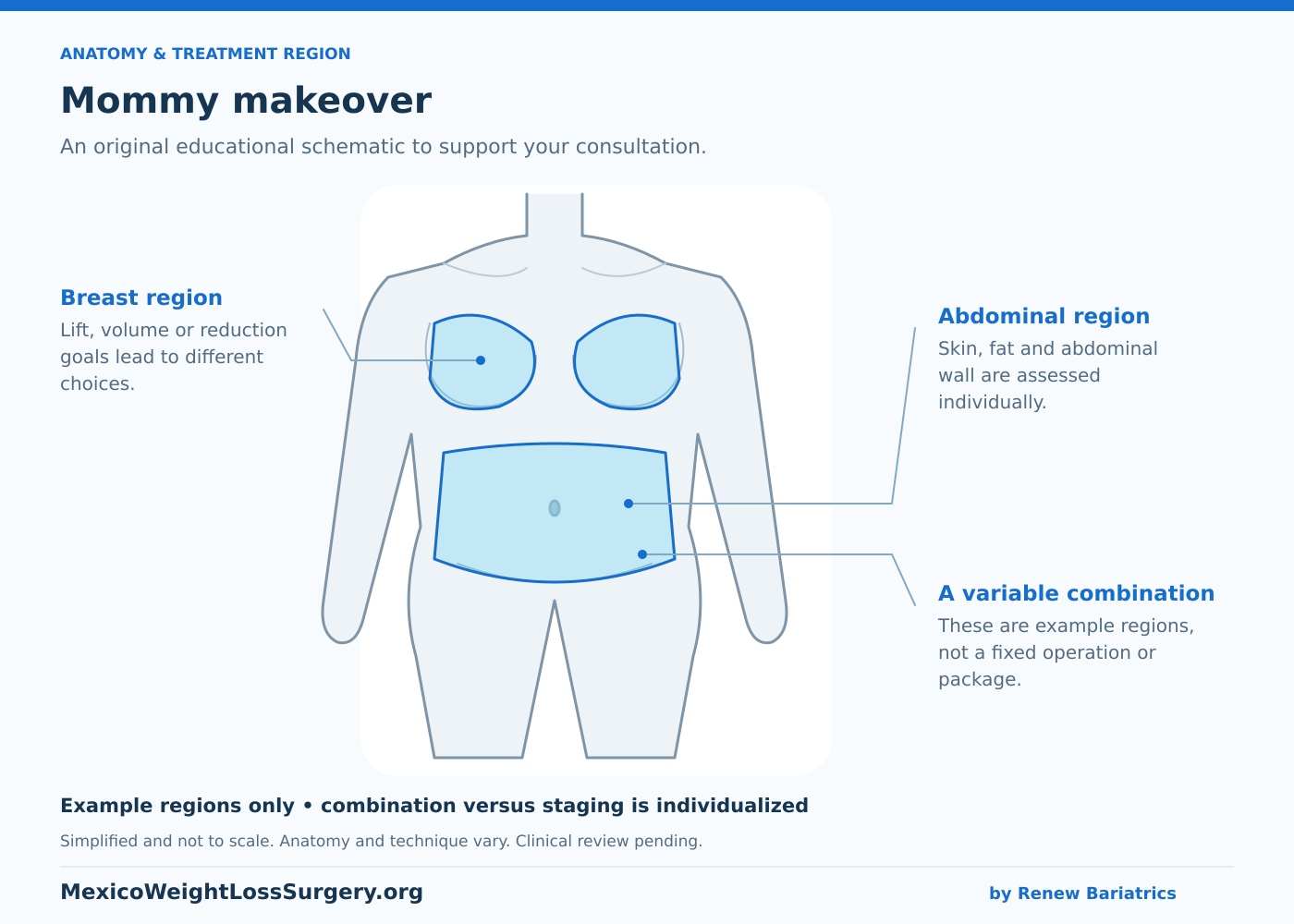
Anatomy references: ASPS — Mommy makeover ↗ · ASPS — Skin removal after weight loss ↗
What is a mommy makeover?
ASPS describes a mommy makeover as an individualized approach to post-pregnancy body changes. Possible components include breast augmentation or lift, tummy tuck, liposuction and other procedures. The particular combination should reflect the person's anatomy and goals.[1]
The term is useful for searching, but less useful for informed consent. Your treatment proposal should list every planned operation by name and location. “Full makeover” is not a sufficiently clear description. Ask what tissue will be removed or repositioned, whether an implant is involved and where incisions are expected.
You do not need to choose surgery because your body changed during pregnancy. Nor do you need to treat every area you dislike. Some people decide on one operation, others consider several stages, and others choose no surgery after learning about the tradeoffs. A consultation should make those choices clearer without implying that motherhood creates a problem that must be corrected.
Define the change that matters to you
Before reviewing packages, make a brief priority list. Consider what would make the largest difference to your everyday comfort or satisfaction. You might place breast position ahead of breast size, abdominal skin ahead of a smaller waist, or a manageable recovery ahead of treating several areas together.
Separate essential goals from optional ones. If your budget or medical assessment limits the plan, this distinction helps you and the surgeon decide what to keep and what to leave out. It also helps reveal whether a proposed package includes operations that were never priorities for you.
Bring examples to explain preferences, but avoid treating another person's body as a promised endpoint. Ask what is realistic for your starting anatomy and what is likely to remain unchanged. The useful outcome of the first consultation is a shared understanding of the goal, including what the surgeon does not recommend.
Breast options: volume, position and reduction
A breast lift addresses drooping by reshaping and raising breast tissue. It does not automatically create the upper-breast fullness associated with augmentation. ASPS notes that a lift and augmentation may be considered together when both position and volume are concerns.[5]
Ask the surgeon to separate these decisions. Do you want more volume, a different position, less weight, or some combination? A breast reduction may be relevant when the goal is smaller breasts, while an implant adds a separate set of long-term considerations. The package name should not determine which option you select.
If you are unsure about implants, ask to compare a plan with and without them. Discuss incision patterns, nipple position, existing asymmetry and what can reasonably be improved. Request an explanation of possible effects on sensation and breastfeeding as part of the consent process.[7]
A preference for a particular cup size is not a complete surgical plan. Describe how you want clothing to fit and the balance you hope to achieve, then ask what the clinician considers feasible. Keep enough time between the consultation and the decision to consider the tradeoffs without pressure.
If the plan includes breast implants
FDA guidance emphasizes that implants can lead to additional operations and complications such as rupture or deflation, capsular contracture, pain and changes in sensation. Implant-associated cancers and reported systemic symptoms also belong in an informed discussion. Implants are not a lifetime maintenance-free purchase.[6]
Ask for the proposed manufacturer, model, filling and surface type. Read the actual patient information for that device rather than relying on a general reassurance that an implant is “approved.” U.S. FDA guidance does not by itself establish authorization for a product used in Mexico.
FDA patient information describes decision checklists and device records as part of informed choice. Ask how you will receive your implant details and what monitoring is recommended for that product. Keep that record with your other medical documents so a future clinician can identify the device.[11]
Discuss long-term costs as well as the first operation. Who would evaluate a concern years later? What might replacement or removal involve? If you prefer not to take on those obligations, ask whether a different breast procedure would better match your priorities.
Abdominal options and their limits
A tummy tuck removes excess abdominal skin and fat and may restore weakened or separated abdominal muscles. ASPS emphasizes that it is not a substitute for weight loss or exercise. It also cannot eliminate every stretch mark; which marks are removed depends on the skin included in the operation.[4]
Ask the surgeon to show you the anticipated scar pattern and explain the difference between the proposed operation and less extensive alternatives. A standard tummy tuck, extended approach and circumferential procedure are different plans. Their names should not be used interchangeably in a quote.
If you have a bulge, pain or a previous abdominal operation, include that history. Ask whether an additional assessment is needed to clarify the cause. Do not assume that every abdominal concern is simply loose skin or that a cosmetic package includes treatment of an unrelated medical condition.
When liposuction is proposed, ask which areas it addresses and how it complements the skin-removal plan. Request a separate explanation for each additional area. “More contouring” should be translated into a specific operation, anticipated benefit and added recovery demand before you consent.
Who may be a candidate?
ASPS identifies good medical health, an appropriate stable body weight, realistic expectations and completion of childbearing as general considerations. These are broad guidelines rather than a guarantee that a particular combination is suitable.[2]
The decision may be different if you plan another pregnancy, are still breastfeeding, are continuing substantial weight loss or have unresolved health issues. Ask the treating surgeon what milestones should be reached before assessment or surgery. There is no responsible single calendar rule that replaces review of your circumstances.
If your life currently offers no realistic opportunity for recovery assistance, include that fact in the decision. A medically suitable operation may still be poorly timed for your household. Changing the date, reducing the scope or choosing stages can be discussed without treating those options as a failure to follow through.
Ask how the surgeon evaluates weight history, prior scars, diabetes, sleep apnea, clot history and other individual factors. An online form can organize this information, but it is not the final clinical decision.
Consultation and medical preparation
A mommy makeover consultation usually includes a review of goals, medical history, medicines, supplements, prior surgery and substance use, along with examination of the areas being considered. ASPS emphasizes discussing options, likely outcomes and risks.[3]
Prepare a medication list that includes prescriptions, over-the-counter products and supplements. Tell the team about weight-management treatment and previous bariatric procedures. Ask who is responsible for coordinating any medication changes with your existing clinicians. Do not independently stop a prescribed medicine to fit a generic surgery checklist.
Body-contouring preparation can involve laboratory testing and clearance from primary care or bariatric clinicians. Smoking and medications that affect bleeding also need attention. The operating team should provide individualized instructions rather than leaving you to assemble a protocol from websites.[14]
Ask what happens if a test result requires treatment or postponement. Confirm the cancellation or rescheduling terms before payment. A clinically appropriate delay should be an anticipated possibility in the booking process, not a financial surprise introduced after travel.
Combined surgery or separate stages?
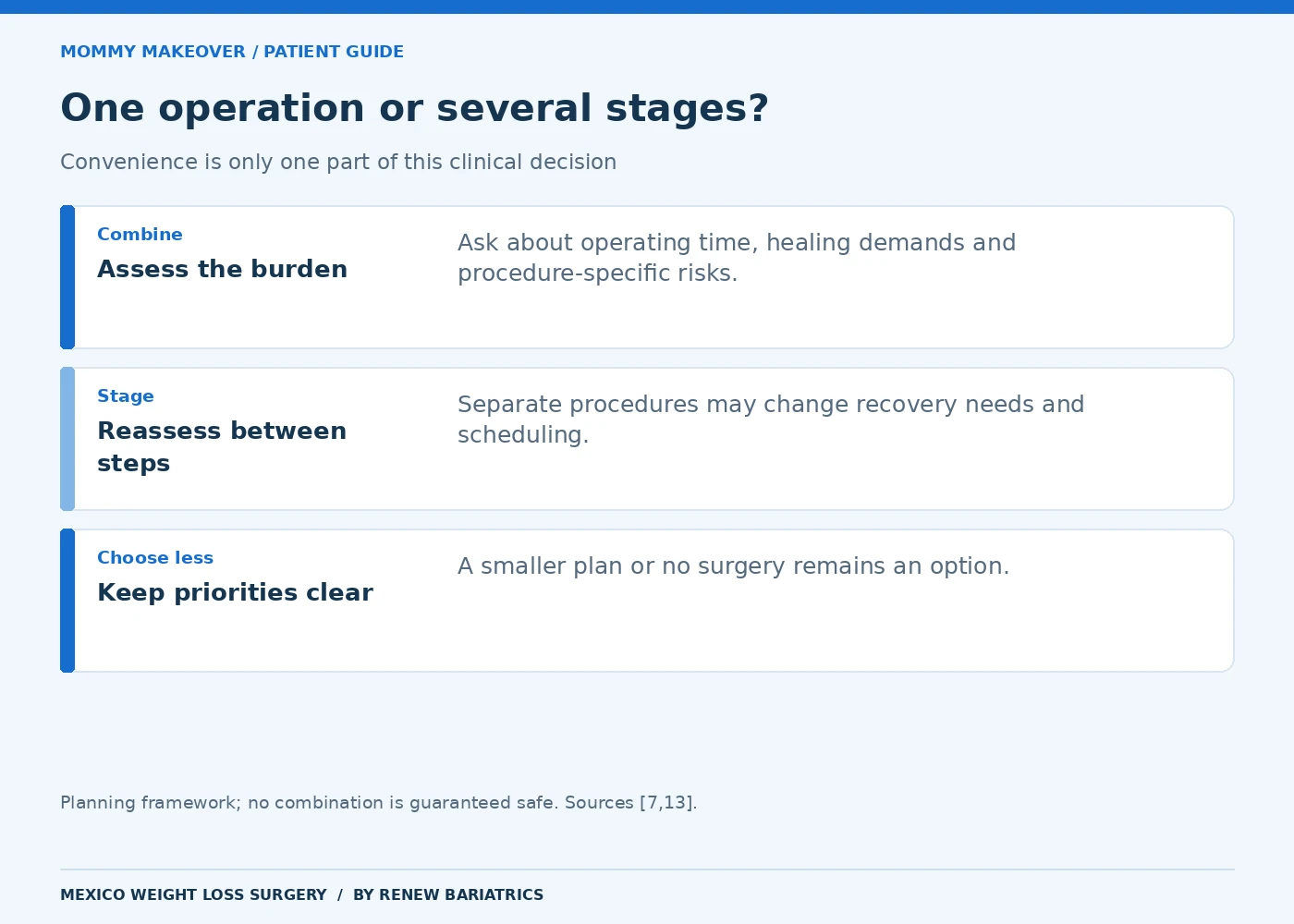
Combining procedures can appeal to people who want fewer trips or one initial recovery period. That convenience does not establish that a particular combination is advisable. Ask the surgeon to discuss the overall operation, the expected anesthesia and operating time, and the recovery requirements of each component.[7]
A retrospective multicenter study in carefully selected patients after major weight loss found more complications in groups undergoing larger numbers of combined procedures. Its population and selection criteria do not translate into a universal rule for mommy makeovers. The useful lesson is that adding procedures requires an explicit risk discussion, not an assumption that a bundle is safe for everyone.[13]
Request a comparison of three possibilities: your preferred combined plan, a smaller operation and a staged plan. Ask what would be gained or lost with each. If staging is recommended, clarify which procedure would come first and what information would guide the decision about a later stage.
Ask how recovery instructions interact. A plan involving the breasts, abdomen and another area may create competing practical demands. The surgeon should explain how you would rest, move, dress and receive help. A clear answer is more valuable than a general statement that many patients choose the same package.
Risks and the meaning of informed consent
The risk profile depends on the actual procedures. ASPS lists possible complications including bleeding, infection, fluid collections, poor healing, scarring, altered sensation, asymmetry, persistent pain, blood clots, anesthesia problems and procedure-specific issues such as implant complications or fat embolization.[7]
Ask which risks are most relevant to your plan and personal history. A consent form listing many possibilities is not a substitute for that conversation. You should know which symptoms need urgent evaluation, who makes the assessment and where treatment would occur.
Clarify responsibility for unplanned care. If a wound needs additional visits, if a fluid collection needs assessment, or if a hospital admission becomes necessary, what services and charges apply? Ask about local treatment while in Mexico and care after you return home. These questions should be answered before surgery rather than negotiated during a stressful recovery.
No page, review or photograph can eliminate risk. A good decision is one in which you understand the proposed benefit, accept the tradeoffs and have a realistic plan for support and follow-up.
Recovery involves your household
ASPS describes dressings, support garments and sometimes compression as parts of recovery, depending on the operations performed. Specific instructions should address wound care, prescribed medicines, activity and follow-up. Healing continues as swelling changes over subsequent weeks.[8]
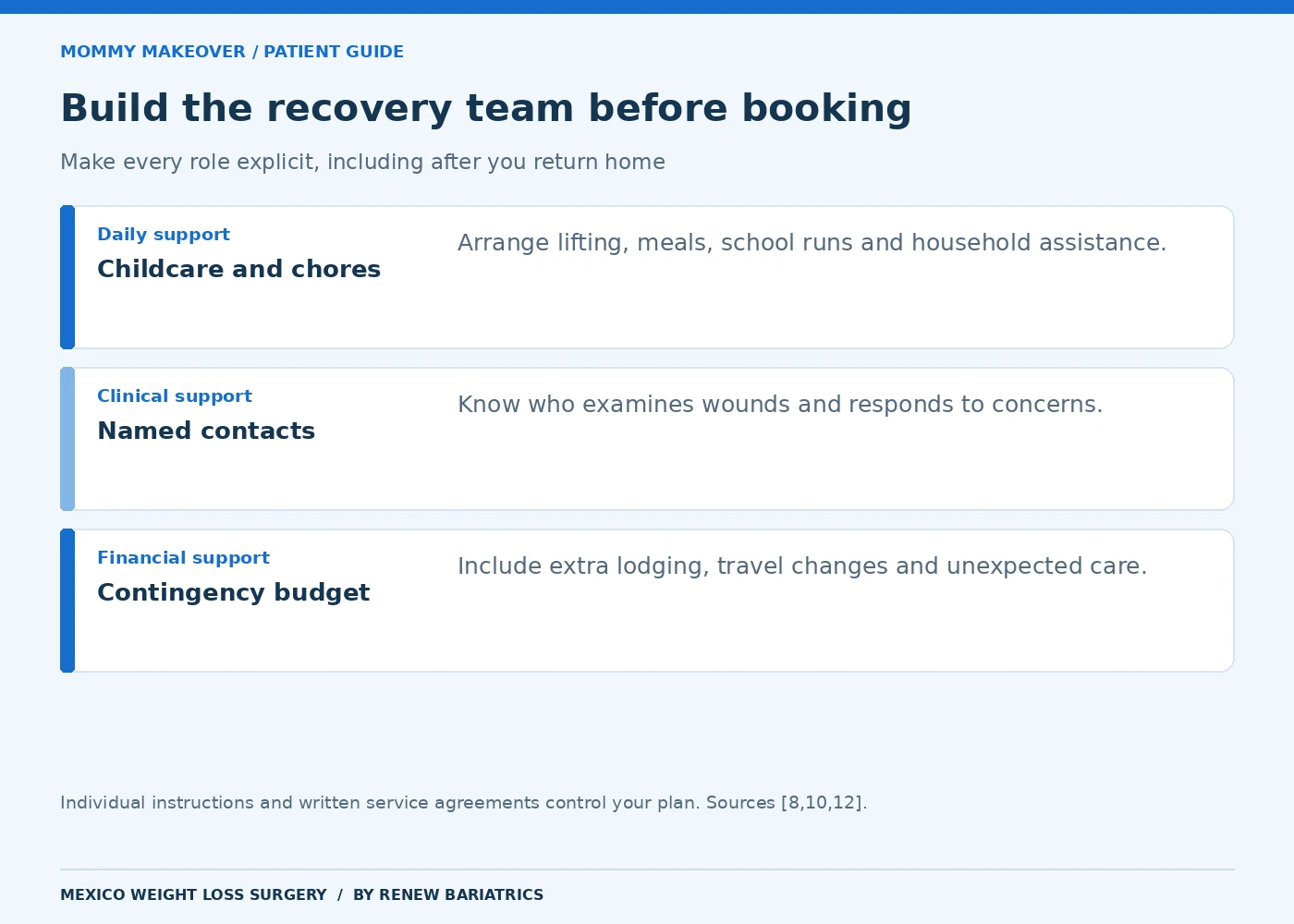
Plan support around your actual responsibilities. Who will lift a child, manage car seats, carry groceries, handle laundry and respond to an unexpected school closure? Who can help if your usual support person becomes unavailable? Write down those roles instead of relying on a broad promise that someone will “be around.”
If you care for another adult, discuss that work as carefully as childcare. The same applies to pets, stairs, a physically demanding job or a long commute. Ask the surgeon about each activity and obtain a practical restriction and return plan.
Arrange meals, accessible clothing and the supplies the team actually recommends. Do not purchase an extensive collection of recovery products before learning what is appropriate for your operation. A support person should also know how to contact the team and recognize the warning signs included in your discharge instructions.
Nutrition and previous weight-loss surgery
If you have had gastric sleeve, bypass or another bariatric procedure, bring your surgical history and current follow-up information. Ask whether the plastic surgeon wants updated assessment from your bariatric or primary care team before treatment. ASPS preparation guidance specifically recognizes the role of these clinicians.[14]
Discuss how you will manage eating, drinking and your existing supplements during recovery. Request a plan compatible with your established medical care rather than starting a restrictive diet to reach a last-minute target. If you have difficulty meeting your usual intake or ongoing gastrointestinal symptoms, raise that before a surgery date is finalized.
The practical questions matter: where will suitable meals come from, who will prepare them and how will you obtain any prescribed supplements while away? A recovery plan should work in the setting where you will actually stay, not only in an ideal home environment.
Results, scars and future changes
ASPS notes that final results may take months to become apparent and that scars do not disappear completely. Some people need additional surgery, and a particular outcome cannot be guaranteed.[9]
Ask to review the expected incision patterns before agreeing to the procedure. Consider how you feel about the location and extent of scars, including when wearing the clothes you normally choose. A willingness to accept a scar should be based on your own priorities, not on a promise that it will become invisible.
Future pregnancy, weight changes and aging are relevant to long-term planning. Discuss your plans openly rather than choosing a package based only on the appearance you hope to have immediately after recovery. Keep follow-up visits even if the early result looks encouraging; appearance is only one part of postoperative assessment.
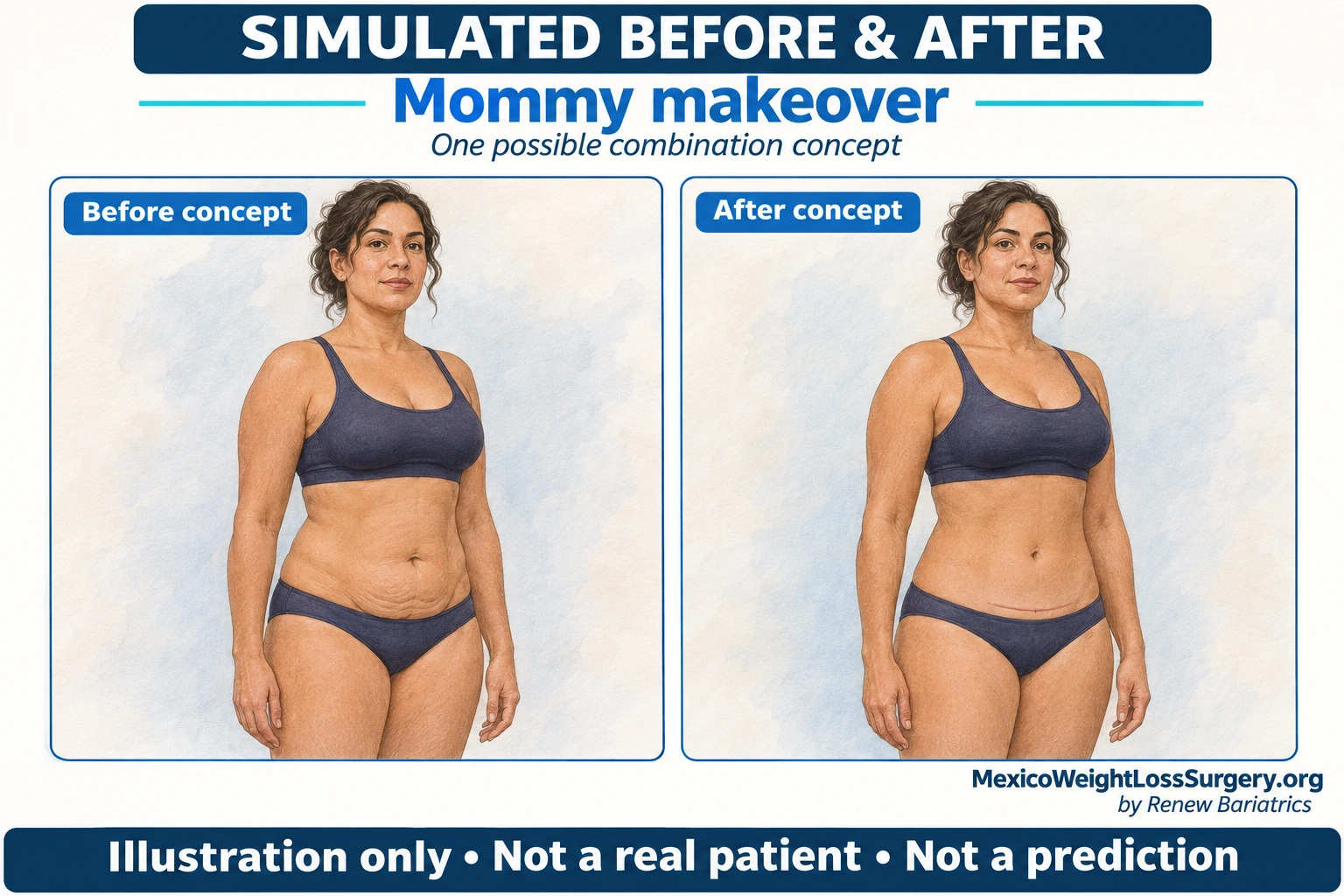
A synthetic illustration of possible changes
This fictional example illustrates a treatment concept. It cannot show the result you would achieve, predict scar healing, or establish a typical outcome.
Mommy Makeover Cost in Mexico
Mommy makeover cost in Mexico depends on the combination of procedures and the services included. ASPS identifies surgeon, anesthesia, facility, implants, testing, medicines and garments as possible cost components. A package label alone does not explain the complete expense.[10]
Ask for a written quote tied to a named surgeon and a specific procedure list. Each component should be identifiable. If the plan changes after examination, request a revised quote rather than accepting a verbal adjustment. If the surgeon recommends staging, obtain separate estimates for each stage and understand which costs would recur.
Useful questions for comparing proposals include:
- Are the proposed breast and abdominal operations described precisely?
- Are implants included, and is the exact device identified?
- What facility, anesthesia and postoperative observation charges are included?
- Which tests, medicines, garments and follow-up visits are included?
- Are transportation, lodging, a companion's stay and meals included or separate?
- What are the terms for postponement, additional nights and unplanned treatment?
- Does a revision policy cover only the surgeon's fee or other expenses as well?
Add a personal contingency budget for travel changes and recovery support at home. If financing is involved, compare the total repayment cost and the cancellation terms. Financial convenience should not determine how much surgery you undergo.
Do not assume insurance will cover an elective combination or complications from overseas care. Ask the insurer directly about your specific policy and keep the response. This page does not publish a provider price because a current clinical proposal is needed for a meaningful estimate.
Travel and continuity of care
CDC identifies additional risks associated with postoperative travel and emphasizes having medical records and a plan for follow-up. General travel guidance is not individual permission to fly.[12]
Ask how long the team expects you to remain locally and who will assess readiness to leave. Build flexibility into the booking. A return ticket should follow the care plan rather than forcing the care plan to fit a deadline.
Identify who will examine you after returning home if an in-person assessment is needed. Ask how records will be shared and how the operating surgeon will communicate with that clinician. Keep a written list of emergency and routine contacts. If you develop urgent symptoms, seek appropriate local care rather than waiting for a remote response.
Frequently asked questions
Is a mommy makeover always a tummy tuck and implants?
No. The term can cover different procedures, and implants are not mandatory. Define your goals first, then ask the surgeon which options address them.[1],[5]
Can all the procedures be done at once?
That requires an individualized decision. Ask for a comparison with staged treatment and an explanation of the added burden of each procedure. A commonly advertised combination is not automatically appropriate for you.[7],[13]
How much does a mommy makeover cost in Mexico?
The price depends on the actual procedures, devices, facility and follow-up arrangements. Request an itemized current quote after assessment, including exclusions and the terms for a changed or postponed plan.[10]
How soon can I resume caring for my children?
Ask about the specific tasks involved, especially lifting, driving and physical assistance. Arrange backup care until your team clears those activities. Recovery instructions vary with the operation.[8]
Do I have to decide at the first consultation?
No. Use the consultation to understand options, limitations and costs. Request the proposal in writing, review the individual procedure guides and return with any unanswered questions before making a commitment.
Program information related to this guide
Explore Renew Bariatrics’ procedure options when discussing a plastic surgery plan. Availability, combinations and suitability require individual confirmation.
Mommy makeover vs. skin removal after weight loss
These are overlapping treatment categories rather than single fixed operations. Compare the actual component procedures, timing and recovery plan.
| What to compare | Mommy makeover → | Skin removal after weight loss → |
|---|---|---|
| Main goal | Combines selected post-pregnancy procedures. | Addresses skin excess after major weight loss. |
| What changes | The component operations define the plan. | Region-specific lifts, often considered in stages. |
| Key distinction | There is no single standardized package. | Stable weight and nutrition affect readiness. |
| Recovery consideration | Combined or staged recovery must be individualized. | Recovery depends on the regions treated. |
| Cost comparison | Request an itemized quote for this exact procedure and care plan. | Compare the same inclusions, exclusions and recovery expenses. |
Comparison references: ASPS — Mommy makeover ↗ · ASPS — Skin removal after weight loss ↗
These options are not interchangeable for every person. The treating clinician must assess your anatomy, medical history and goals.
Discuss your options with Renew.
Talk with a coordinator about mommy makeover, your goals and the information needed for clinical review. The treating team determines suitability and the care plan.
Call 844-736-3963 Ask about plastic surgery ↗The link opens Renew’s plastic surgery health questionnaire. This review site does not collect health information.
References & evidence notes
Sources checked November 2026. Research findings are not a forecast for an individual or outcomes for Renew’s own program. Review study populations, methods and limitations alongside the reported results.
- American Society of Plastic Surgeons. Mommy Makeover ↗Professional society patient guidance; individualized assessment required.
- American Society of Plastic Surgeons. Mommy Makeover Candidates ↗Professional society patient guidance; individualized assessment required.
- American Society of Plastic Surgeons. Mommy Makeover Consultation ↗Professional society patient guidance; individualized assessment required.
- American Society of Plastic Surgeons. Tummy Tuck ↗Professional society patient guidance; individualized assessment required.
- American Society of Plastic Surgeons. Breast Lift ↗Professional society patient guidance; individualized assessment required.
- U.S. Food and Drug Administration. Risks and Complications of Breast Implants ↗Implant-specific risks; U.S. guidance does not establish Mexican product approval.
- American Society of Plastic Surgeons. Mommy Makeover Safety ↗Professional society patient guidance; individualized assessment required.
- American Society of Plastic Surgeons. Mommy Makeover Recovery ↗Professional society patient guidance; individualized assessment required.
- American Society of Plastic Surgeons. Mommy Makeover Results ↗Professional society patient guidance; individualized assessment required.
- American Society of Plastic Surgeons. Mommy Makeover Cost ↗Professional society patient guidance; individualized assessment required.
- U.S. Food and Drug Administration. What to Know About Breast Implants ↗Product labeling, informed decisions and device records.
- Centers for Disease Control and Prevention. Medical Tourism, CDC Yellow Book ↗Travel risks and continuity of care; not individualized fitness-to-fly clearance.
- Multicenter retrospective study. Safety and Efficacy of Combining Multiple Body-Contouring Procedures in Massive-Weight-Loss Patients: A Retrospective Multicenter Study ↗Selected post-weight-loss population; not proof that any mommy makeover combination is safe.
- American Society of Plastic Surgeons. Body Contouring Preparation ↗Professional society patient guidance; individualized assessment required.