

Jump to a section
Anatomy illustrationSynthetic illustrationCompare proceduresRelated ProceduresWhat makes the fleur-de-lis technique different?Who might consider the additional vertical scar?Fleur-de-lis versus standard, extended, and circular surgeryHow is panniculectomy different?Candidacy after major weight lossNutritional and medical preparationSmoking and medication instructions need to be explicitWhat does research say about complications?Risks to discuss before consentRecovery and help at homeTravel and follow-up across bordersScars and realistic expectationsFleur-de-Lis Tummy Tuck Cost in MexicoPrepare for a useful Renew Bariatrics assessmentFrequently asked questionsYour next stepReferencesA fleur-de-lis tummy tuck in Mexico is an abdominoplasty option for selected people with substantial abdominal skin excess after major weight loss. It combines a horizontal excision with a vertical component, creating an additional midline scar. The purpose is to address a pattern of looseness that a horizontal operation alone may not adequately treat—not to provide a universally better tummy tuck.[1],[2]
If you are comparing fleur-de-lis tummy tuck cost in Mexico, first ask a surgeon to define the proposed operation and its scar pattern. Price comparisons are only meaningful when the scope, facility, anesthesia, recovery arrangements, and follow-up are clear. This guide does not establish a current Renew Bariatrics price, surgeon, protocol, or specific combination's availability; request a current assessment and itemized quote.
Fleur-de-lis surgery is body contouring, not weight-loss surgery. Deciding whether the contour improvement is worth the additional visible scar is an individual choice that should follow an examination and a balanced discussion of alternatives.[1],[3]
Understand the anatomy
A simplified, labeled view of the structures and treatment area. Select the image to view it at full size.
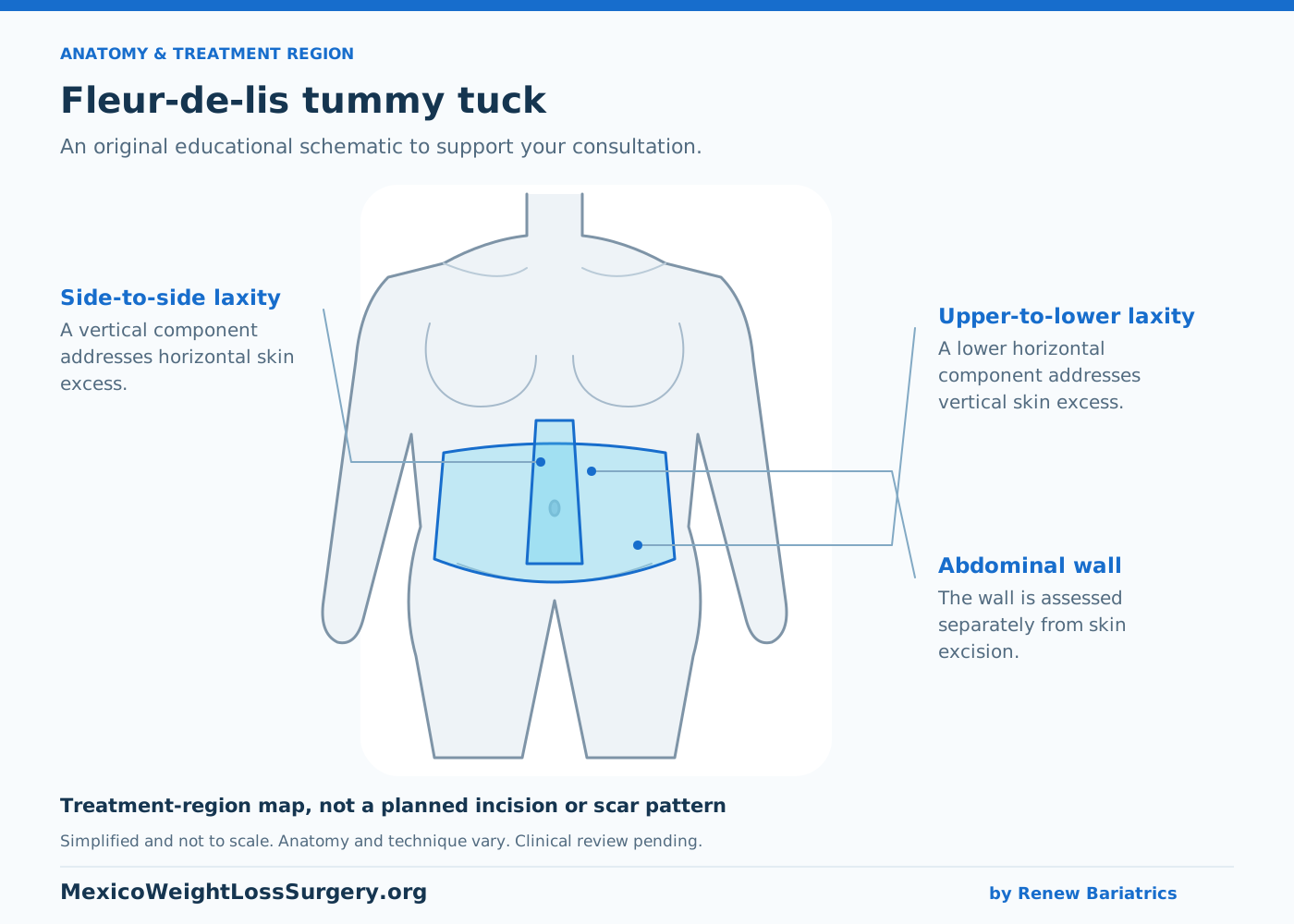
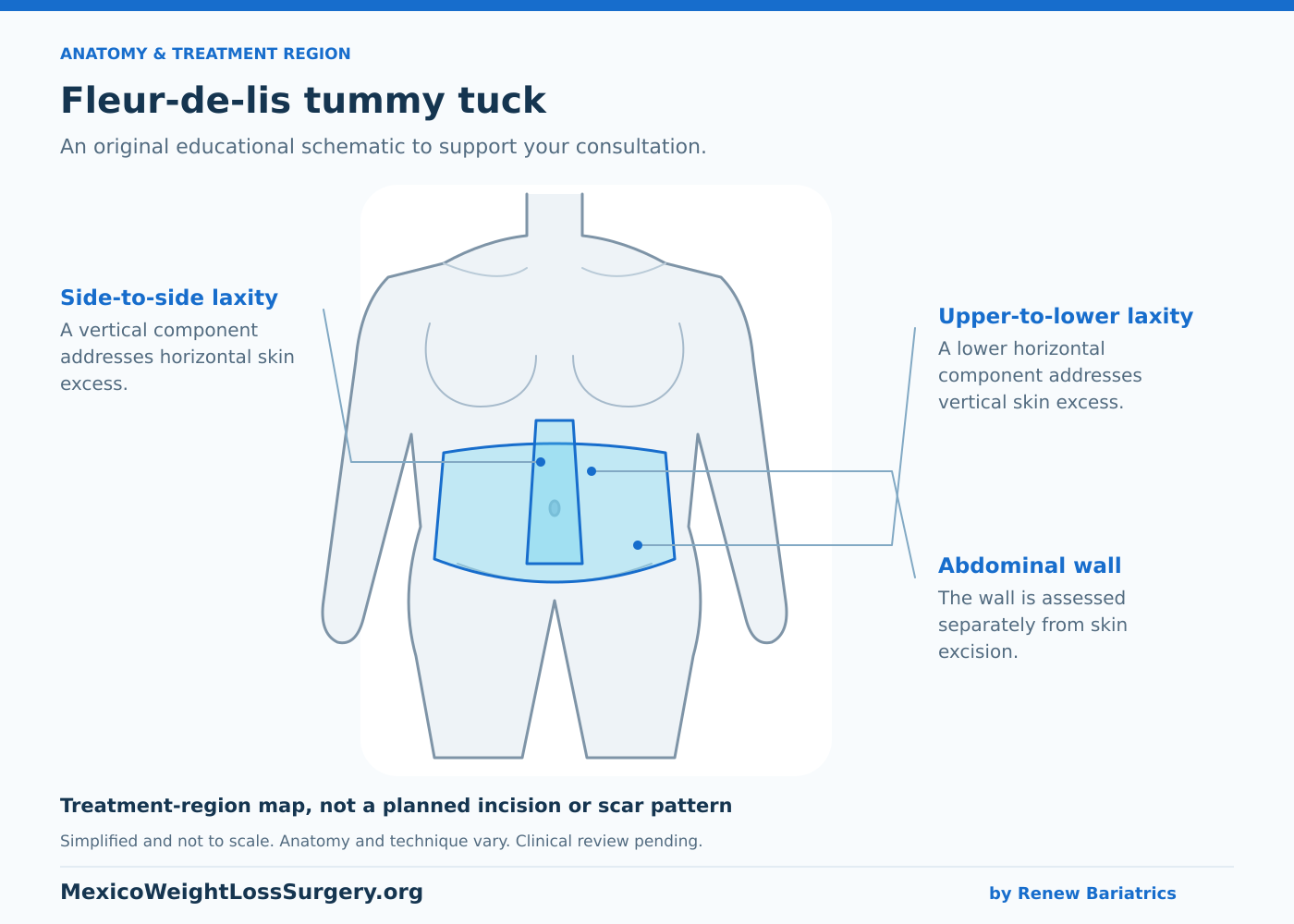
Anatomy references: Friedman et al. — Fleur-de-lis abdominoplasty ↗ · ASPS — Tummy tuck ↗
What makes the fleur-de-lis technique different?
A conventional horizontal abdominoplasty removes tissue through a lower abdominal pattern. Fleur-de-lis adds a vertical excision, allowing the surgeon to address excess in another direction. The resulting scar commonly includes a lower horizontal line and an abdominal midline line, with their intersection requiring particular discussion.[1],[2]
Ask the surgeon to show which direction of looseness each part of the operation addresses. You do not need to learn surgical terminology to ask a useful question: “What would remain if I had only the horizontal component?” The answer should explain the expected limitation in your own anatomy.
The name describes an approach, not a guaranteed contour. It does not establish whether liposuction, fascial tightening, hernia repair, or back treatment is included. Those are separate elements to clarify in the written plan. If a quote lists “fleur-de-lis” without describing those details, request the operative scope before comparing it with another offer.
Who might consider the additional vertical scar?
A frequently cited study evaluated fleur-de-lis and traditional abdominoplasty in people who had lost at least fifty pounds. Its rationale was to improve treatment of abdominal skin laxity that conventional approaches might leave behind. That study population does not create a weight-loss cutoff that automatically makes someone eligible.[1]
In practice, the consultation should identify where excess remains when the surgeon examines the abdomen and what tradeoff the vertical component offers. Ask whether the additional scar addresses your main concern or mainly changes an area that matters less to you. If you would strongly prefer residual laxity to a central scar, say so early.
Bring a short description of your priorities rather than a demand for a particular technique. You might prioritize how clothes fit, the location of folds, or a more balanced outline. The surgeon can then discuss whether a horizontal, extended, fleur-de-lis, circumferential, or more limited approach best matches those priorities and your health.
Fleur-de-lis versus standard, extended, and circular surgery
A standard tummy tuck generally focuses on the front of the abdomen. An extended horizontal approach commonly reaches farther toward the sides. A circular operation extends around the trunk. Fleur-de-lis adds a vertical abdominal component; it does not automatically mean that the back or buttocks are included.[2],[4]
Terminology is not perfectly consistent across providers. Even institutional patient materials use some labels differently. A marked incision diagram and written description are therefore more useful than assuming that “extended” or “360” means the same thing everywhere.[4]
Ask the team to compare realistic alternatives on your own anatomy. For each option, identify the tissue it treats, the scars it leaves, and the concerns likely to remain. If a combined design is proposed, ask why each component is necessary and whether separate stages are reasonable. A more extensive operation should have a clear purpose beyond making a package sound comprehensive.
How is panniculectomy different?
Panniculectomy removes an overhanging apron of lower abdominal tissue. Tummy tuck techniques generally pursue broader abdominal contouring, with possible fascial work and belly-button treatment. A fleur-de-lis incision pattern does not by itself answer whether a procedure is primarily functional, cosmetic, or both.[3]
If you have irritation, hygiene difficulties, or other symptoms beneath a fold, describe them and obtain appropriate evaluation. Ask which symptoms the proposed operation is intended to address and which need separate care. Do not assume that the presence of symptoms establishes insurance coverage or that a cosmetic quote includes all related treatment.
Keep the language consistent across the consultation, consent, and payment documents. If one document says panniculectomy and another says fleur-de-lis abdominoplasty, ask whether they describe the same planned components. Resolving that discrepancy before surgery is more useful than trying to infer the answer from a package title.
Candidacy after major weight loss
ASPS describes stable weight, good health, realistic expectations, and nonsmoking as general considerations for tummy tuck candidates. These are starting points for assessment, not a substitute for an examination.[5]
Prepare a timeline showing your weight changes and any bariatric procedure, medication treatment, prior abdominal operation, or pregnancy relevant to the discussion. Include current medicines, allergies, medical conditions, and any history of delayed healing or abnormal scarring. If you have a prior abdominal incision, ask how it changes the proposed design.
Request a specific explanation of any reason to delay surgery. Is the issue further expected weight change, a medical condition, nutrition, nicotine exposure, or the need for additional evaluation? Ask what the next step is and who should reassess you. A recommendation to optimize health or reconsider timing should be understood as a clinical decision, not merely an obstacle to booking.
Nutritional and medical preparation
Post-bariatric patients may need coordinated nutritional assessment before body contouring. Research on a structured nutritional pathway supports careful preparation while demonstrating that wound complications can still occur. Supplements or a “normal” result on one test do not create a guarantee of readiness.[6]
Ask which laboratory tests and clinical information your surgeon needs, who interprets them, and how any deficiencies will be addressed. Bring your supplement containers or an accurate list of their contents and doses. Ask your bariatric clinician and plastic surgeon to coordinate rather than independently changing treatment to meet a travel date.
Discuss the practical postoperative eating and hydration plan as well. If you have difficulty tolerating food, maintaining intake, or taking supplements now, disclose that during assessment. Request a contact for problems during recovery. This page does not provide a universal protein prescription or recommend adding high-dose supplements without clinical review.
Smoking and medication instructions need to be explicit
ACS explains that smoking increases postoperative problems and that stopping before surgery can reduce wound complications. Ask the surgeon's requirements for cigarettes and all nicotine products, including vaping, and request help with cessation if needed.[7]
The anesthesia team should receive the full medication list, including weight-management injections, hormones, anticoagulants, nonprescription drugs, and herbal products. Ask who is responsible for instructions and how changes are coordinated with the original prescriber. Do not independently stop essential medicines or follow another patient's schedule.
Before departure, collect one reconciled preparation plan. It should explain required tests, fasting, medicine instructions, arrival details, and circumstances that should trigger a call or postponement. If a coordinator's instructions differ from the clinician's written directions, ask for clarification. The goal is a plan that can be followed accurately, including by your companion if assistance is needed.
What does research say about complications?
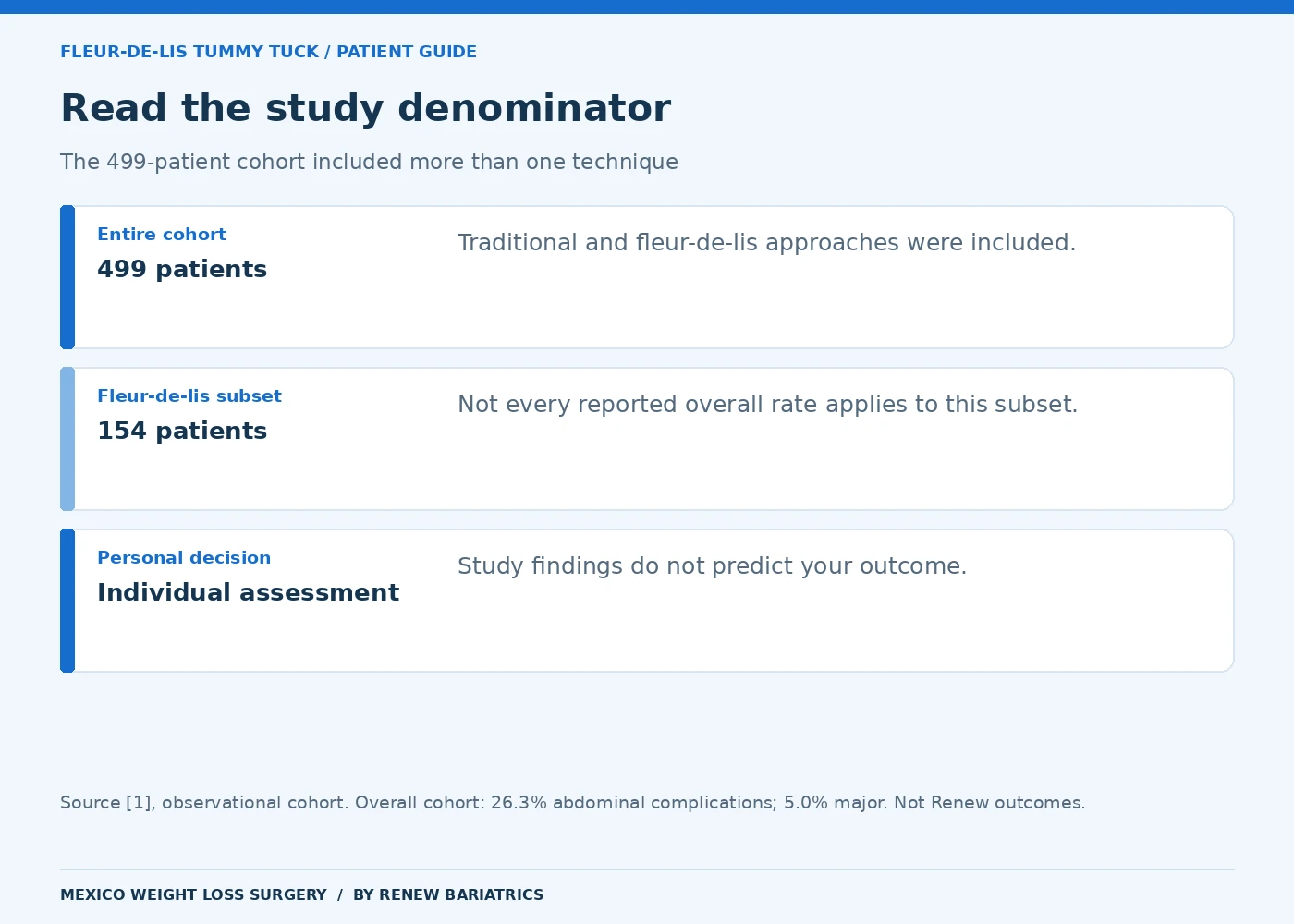
In a 499-patient post-weight-loss cohort, 154 patients received a fleur-de-lis component. Across the entire cohort, abdominal complications occurred in 26.3% and major complications in 5.0%. Overall complication rates were broadly comparable between techniques, but adjusted analysis found more wound infection with fleur-de-lis. The overall percentages must not be presented as fleur-de-lis-only rates or as your personal probability.[1]
A 779-patient institutional abdominoplasty series also identified fleur-de-lis technique among variables associated with complications. A large insurance-database analysis found the highest major-complication rate in its fleur-de-lis category. These observational findings involve different patients, definitions, and clinical settings; they do not establish a single universal risk percentage.[8],[9]
The practical implication is to have a detailed discussion about your health and the proposed extent of surgery. Ask what a complication means in the surgeon's own reporting, whether minor wound issues are counted, and how long follow-up continues. A surgeon's results should not be inferred from a paper written by another team.
Risks to discuss before consent
ASPS lists abdominoplasty risks including bleeding, infection, fluid accumulation, poor healing, tissue loss, altered sensation, persistent pain, asymmetry, unfavorable scars, and possible revision. Blood clots and serious cardiopulmonary complications also require discussion.[10]
For fleur-de-lis specifically, ask about the central scar and the point where incisions meet. What wound-care needs might arise there? How would the team assess an area that heals slowly? What would make an in-person examination necessary? These questions help translate an abstract risk list into a practical care plan.
Ask separately about clot prevention and bleeding risk. Share any personal or family clot history, mobility limitation, hormonal medication, and travel plans. Your team should explain the prevention measures selected for you. Do not use a research article or an online testimonial to choose anticoagulants or their duration.
Recovery and help at home
Recovery may involve dressings, drains, compression, medication, and restrictions tailored to the operation. ASPS recommends obtaining specific instructions for wound care, follow-up, and return to activity rather than assuming every patient follows the same schedule.[11]
Before booking, describe your actual home and work tasks. Can another adult help with children, pets, shopping, and household responsibilities? Does your job involve lifting, standing, driving, or emergency physical effort? Ask for separate milestones for each relevant activity. A general estimate for returning to desk work cannot answer every question about normal daily life.
If drains or wound care are planned, ask for a demonstration and written instructions. Confirm who reviews questions after hours and who can see you in person. A messaging contact may be useful, but ask what happens if a photo is insufficient to assess a concern. Identify the backup plan before you need it.
Travel and follow-up across borders
CDC notes that surgery and travel both contribute to clot risk and advises avoiding flight for ten days after abdominal surgery. This is not automatic medical clearance after that interval; your surgeon may recommend more time based on the operation and recovery.[12]
Ask about the entire route, including long car rides, border delays, airport transfers, and connections. Request a pre-departure assessment and a plan if travel must be postponed. Confirm whether accommodation and companion arrangements can be extended and what additional costs would apply.
Arrange continuity before leaving home. Identify a clinician or facility that can evaluate postoperative concerns when you return, and ask the surgical team which records will be provided. CDC recommends obtaining records and planning for follow-up costs after medical treatment abroad. Ordinary travel or health insurance should not be assumed to cover elective surgery or its complications.[12],[13]
Scars and realistic expectations
The vertical scar is an intentional part of the fleur-de-lis tradeoff. Ask how far it is expected to extend and whether there will also be a scar around the belly button. The surgeon should explain the expected location, uncertainty, and follow-up for scar concerns.[1],[2]
Discuss preferences in practical terms. Which clothes do you wear? How do you feel about a midline scar when changing, swimming, or being intimate? Would you accept more residual skin to avoid that scar? There is no single correct answer, and a successful consultation should give you room to express those priorities.
Ask when the team will assess contour and scars and what it considers an indication for revision. Clarify whether a revision policy refers to professional fees only or also includes anesthesia, facility, travel, and accommodation. An offer of future review is not the same as a promise of free corrective treatment.
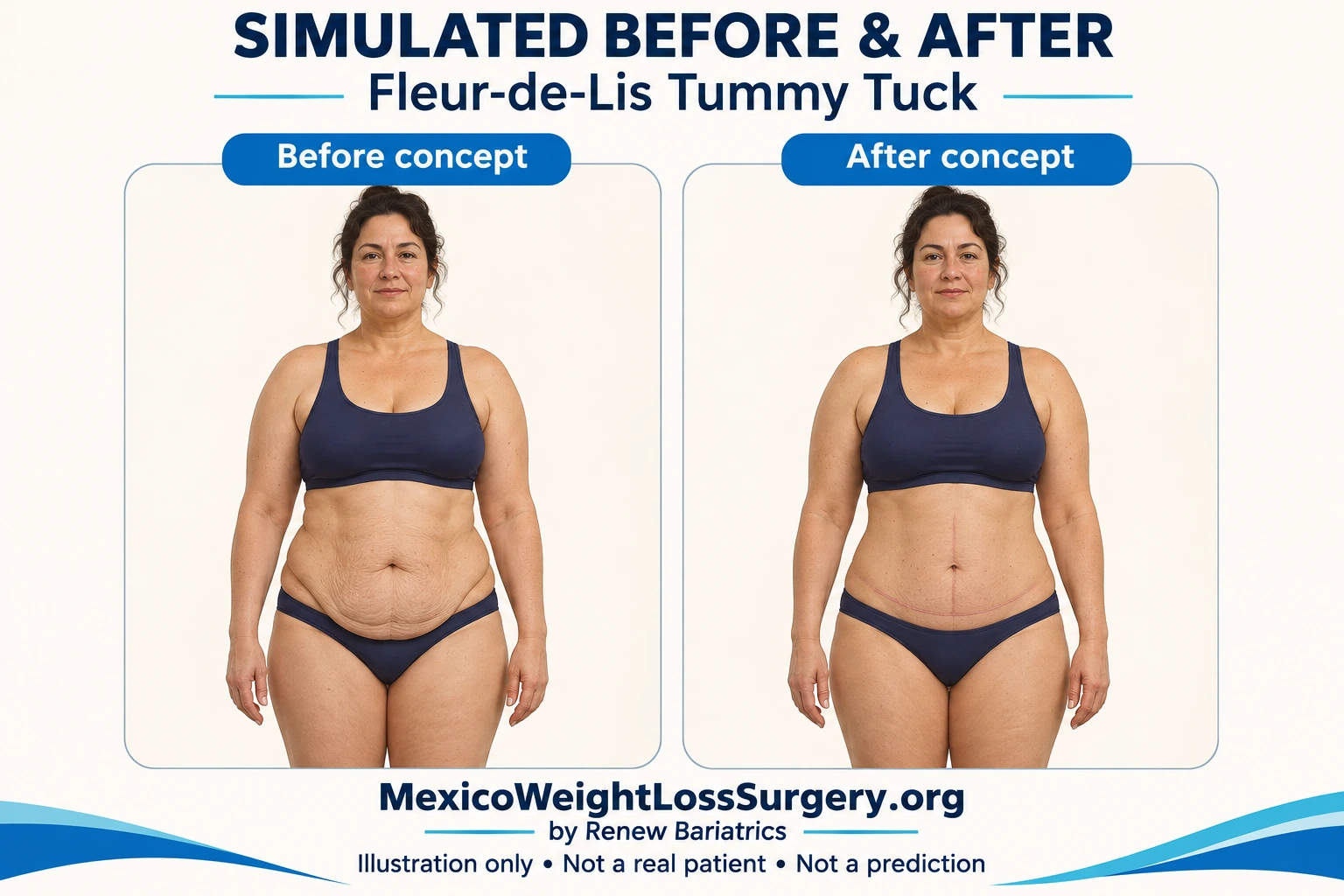
A synthetic illustration of possible changes
This fictional example illustrates a treatment concept. It cannot show the result you would achieve, predict scar healing, or establish a typical outcome.
Fleur-de-Lis Tummy Tuck Cost in Mexico
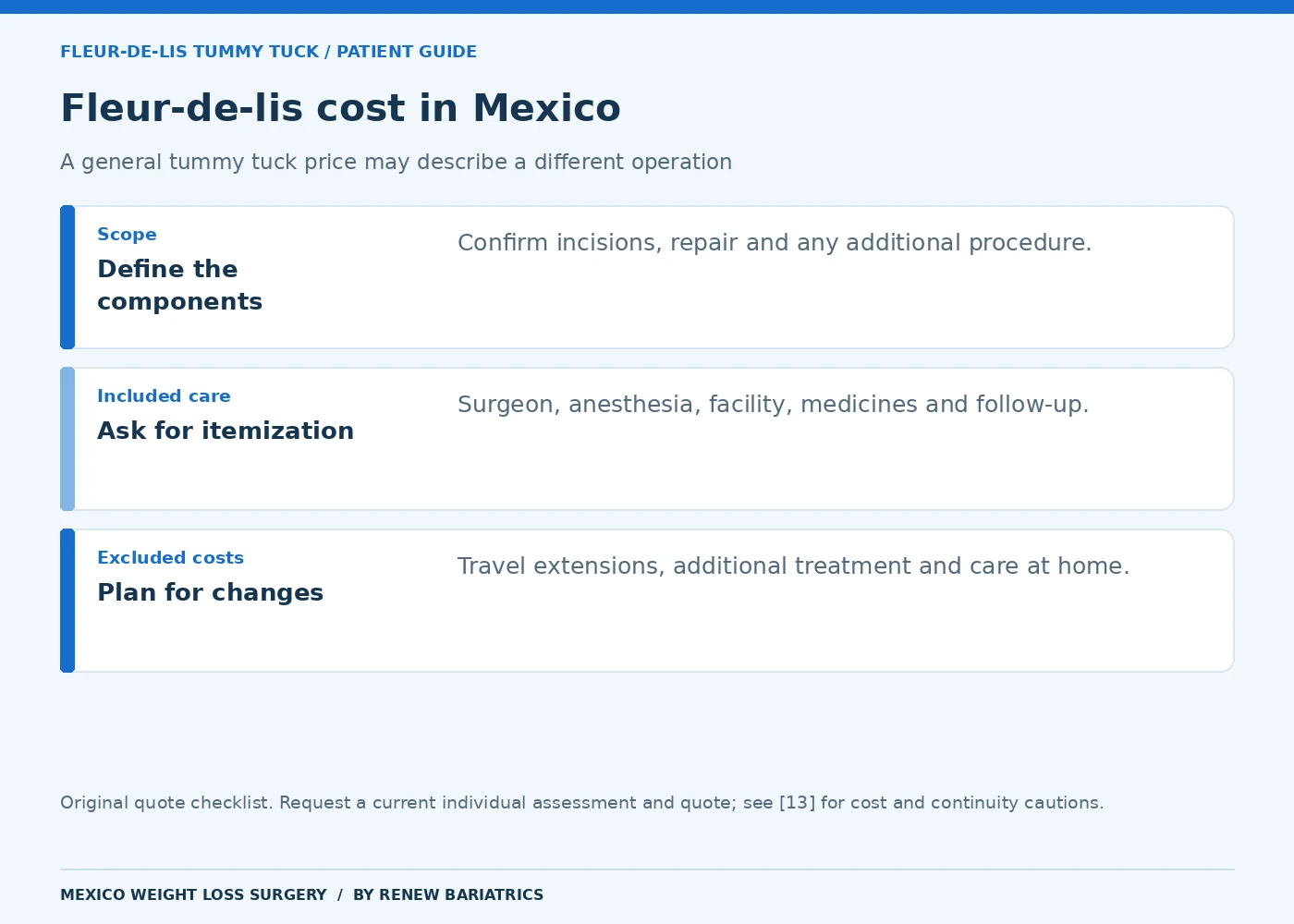
Fleur-de-lis tummy tuck cost in Mexico should be quoted for a defined operation after assessment. A general tummy tuck price may describe a different incision pattern, different extent of treatment, or different supporting services. Do not assume a published starting price applies to your proposed fleur-de-lis procedure.
Ask for an itemized quote naming the surgeon, anesthesia, facility, tests, expected observation, garments, medicines, and follow-up. Confirm whether abdominal-wall repair, liposuction, or another procedure is included or separately priced. Ask what happens if the final examination changes the plan or indicates that surgery should be postponed.
Separate surgical costs from travel and recovery expenses: flights, transport, accommodation, companion needs, meals, extra nights, and changes to the return journey. Request written exclusions for emergency care, additional testing, wound treatment, readmission, revision, and care at home. Confirm currency, deposit, cancellation terms, and how long the quote remains valid.
This page does not supply a verified current Renew fleur-de-lis price. Request an individualized quotation and compare it with other proposals only after matching the surgical scope and responsibilities. CDC warns that complication and follow-up care can be expensive and may not be covered by insurance.[13]
Prepare for a useful Renew Bariatrics assessment
Provide an accurate history and a concise statement of your goals. For example: “I want to understand whether the loose skin across my upper and lower abdomen requires a vertical scar.” That question invites an anatomical explanation instead of assuming a procedure before assessment.
Ask Renew to confirm current procedure availability, the proposed operating surgeon, and the facility. Request information that allows independent verification of relevant qualifications. Ask who makes the final candidacy decision, who provides postoperative clinical care, and who is responsible after you leave Mexico.
Before committing, review the scar plan, alternatives, preparation requirements, recovery arrangements, and itemized cost together. If any part is unclear, request a specific answer. An informed choice can be to proceed, delay, choose a more limited operation, or decide that the scar tradeoff is not acceptable to you.
Frequently asked questions
Is fleur-de-lis a weight-loss procedure?
No. It addresses excess tissue and contour after weight change. It does not replace obesity treatment or ongoing bariatric follow-up.[2],[3]
Will I definitely need a vertical scar after major weight loss?
No. Weight-loss history alone does not determine the incision pattern. Ask what your examination shows and what a horizontal-only approach would leave untreated.[1],[5]
Is it riskier than a standard tummy tuck?
Several observational studies raise specific concerns, including wound issues or higher complication rates in selected fleur-de-lis groups. Differences in patients and definitions prevent a universal numerical comparison. Request an individualized explanation of the tradeoff.[1],[8],[9]
Does it include a circular body lift?
Not automatically. Ask whether the incision continues around the back and what regions are included. “Fleur-de-lis” identifies the vertical abdominal component, not an entire-body package.[2],[4]
How much does fleur-de-lis surgery in Mexico cost?
Request a current quote after the surgeon defines your procedure. Compare inclusions, exclusions, recovery costs, and possible additional treatment expenses. A general abdominoplasty estimate should not be treated as a confirmed fleur-de-lis price.
When can I return to exercise and travel?
Ask for separate individualized clearance decisions. Your work, exercise, driving, and international journey impose different demands; one advertised recovery time cannot cover all of them.[11],[12]
What symptoms require urgent care?
New chest pain or shortness of breath requires emergency evaluation. Obtain written instructions for wound changes, fever, increasing pain, swelling, or other concerns, including when to contact the team and when to seek in-person care immediately.[10],[11]
What is the most important decision before booking?
Understand why the vertical component is proposed for you, what benefit it may add, and whether you accept the scar and recovery tradeoffs. Then confirm that the clinical plan, consent, quote, and travel arrangements describe the same procedure and responsibilities.
Program information related to this guide
Explore Renew Bariatrics’ procedure options when discussing a plastic surgery plan. Availability, combinations and suitability require individual confirmation.
Fleur-de-lis tummy tuck vs. tummy tuck
These procedures address different concerns and may be combined or staged. A clinical assessment determines which, if either, fits your anatomy and goals.
| What to compare | Fleur-de-Lis Tummy Tuck → | Tummy Tuck → |
|---|---|---|
| Main goal | Addresses abdominal excess in two directions. | Addresses excess abdominal skin. |
| What changes | Vertical and horizontal skin excision. | Front abdominal skin; possible wall repair. |
| Key distinction | Adds a visible vertical abdominal scar. | Does not remove internal abdominal fat. |
| Recovery consideration | The intersecting wounds need careful follow-up. | Abdominal wound healing affects activity. |
| Cost comparison | Request an itemized quote for this exact procedure and care plan. | Compare the same inclusions, exclusions and recovery expenses. |
Comparison references: Friedman et al. — Fleur-de-lis abdominoplasty ↗ · ASPS — Tummy tuck ↗
These options are not interchangeable for every person. The treating clinician must assess your anatomy, medical history and goals.
Further reading
Discuss your options with Renew.
Talk with a coordinator about fleur-de-lis tummy tuck, your goals and the information needed for clinical review. The treating team determines suitability and the care plan.
Call 844-736-3963 Ask about plastic surgery ↗The link opens Renew’s plastic surgery health questionnaire. This review site does not collect health information.
References & evidence notes
Sources checked November 2026. Research findings are not a forecast for an individual or outcomes for Renew’s own program. Review study populations, methods and limitations alongside the reported results.
- Friedman et al., 2010. Fleur-de-Lis abdominoplasty: a safe alternative to traditional abdominoplasty for the massive weight loss patient ↗499-patient observational cohort; overall cohort rates are not fleur-de-lis-only estimates.
- Johns Hopkins Medicine. Tummy Tuck ↗Institutional description of abdominoplasty and candidacy considerations.
- Johns Hopkins Medicine. Body Contouring ↗Institutional explanation of post-weight-loss contouring and panniculectomy.
- Cleveland Clinic. Tummy Tuck ↗Institutional terminology illustrates why an individualized incision plan matters.
- American Society of Plastic Surgeons. Tummy Tuck Candidates ↗General candidacy criteria; individualized examination required.
- Makarawung et al., 2022. Complications in post-bariatric body contouring surgery using a practical treatment regime to optimise the nutritional state ↗Prospective nutritional pathway study; optimization does not eliminate complications.
- American College of Surgeons. Quit Smoking before Your Operation ↗Smoking and surgical wound risk; discuss an individualized cessation plan.
- Massachusetts General Hospital investigators, 2017. Impact of Patient Subtype and Surgical Variables on Abdominoplasty Outcomes: A 12-Year Massachusetts General Hospital Experience ↗779-patient retrospective series; includes wound and scar complications.
- Aesthetic Surgery Journal investigators, 2024. Complications and Risks Associated With the Different Types of Abdominoplasties: An Analysis of 55,956 Patients ↗Large observational database; major-complication definitions differ from all-event surgical cohorts.
- American Society of Plastic Surgeons. Tummy Tuck Risks and Safety ↗Recognized complications for informed consent.
- American Society of Plastic Surgeons. Tummy Tuck Recovery ↗Postoperative care elements; no universal recovery timetable.
- Centers for Disease Control and Prevention. Medical Tourism — Yellow Book ↗Postoperative travel, clot risk, records and medical clearance considerations.
- Centers for Disease Control and Prevention. Medical Tourism: Travel to Another Country for Medical Care ↗Credential checks, continuity, insurance and potential additional costs.