

Jump to a section
Anatomy illustrationCompare proceduresRelated ProceduresWhat TORe changes—and what it does notWhy weight can return after bypassWho may be a candidate?What happens during TORe?How much weight loss is realistic?How durable are the results?Risks, side effects and the limits of “minimally invasive”TORe, medication or surgical revision?Preparation and recoveryNutrition and follow-up remain part of the treatmentTORe in Mexico: cost and choosing your care teamQuestions to bring to your consultationTake the next step with RenewReferences & evidence notesRegaining weight after gastric bypass can bring back questions you thought you had already answered. Is your bypass still working? Has something changed? Would another procedure help, or would a different treatment make more sense? You deserve an assessment that takes those questions seriously, without treating the number on the scale as a personal failure.
Transoral outlet reduction, usually called TORe, is an endoscopic treatment for selected people who have regained weight after Roux-en-Y gastric bypass. It targets an enlarged connection between the stomach pouch and small intestine. It is not a new gastric bypass, and it is not the same procedure as revising a gastric sleeve. [5]
This guide explains what TORe changes, how to interpret published results, what risks to discuss and how to evaluate care in Mexico. MexicoWeightLossSurgery.org is owned by Renew Bariatrics, a medical tourism scheduling facilitator. Research cited here describes the studied programs—not Renew-specific results. A coordinator can help organize an inquiry; the treating clinical team determines whether TORe is appropriate.
Understand the anatomy
A simplified, labeled view of the structures and treatment area. Select the image to view it at full size.
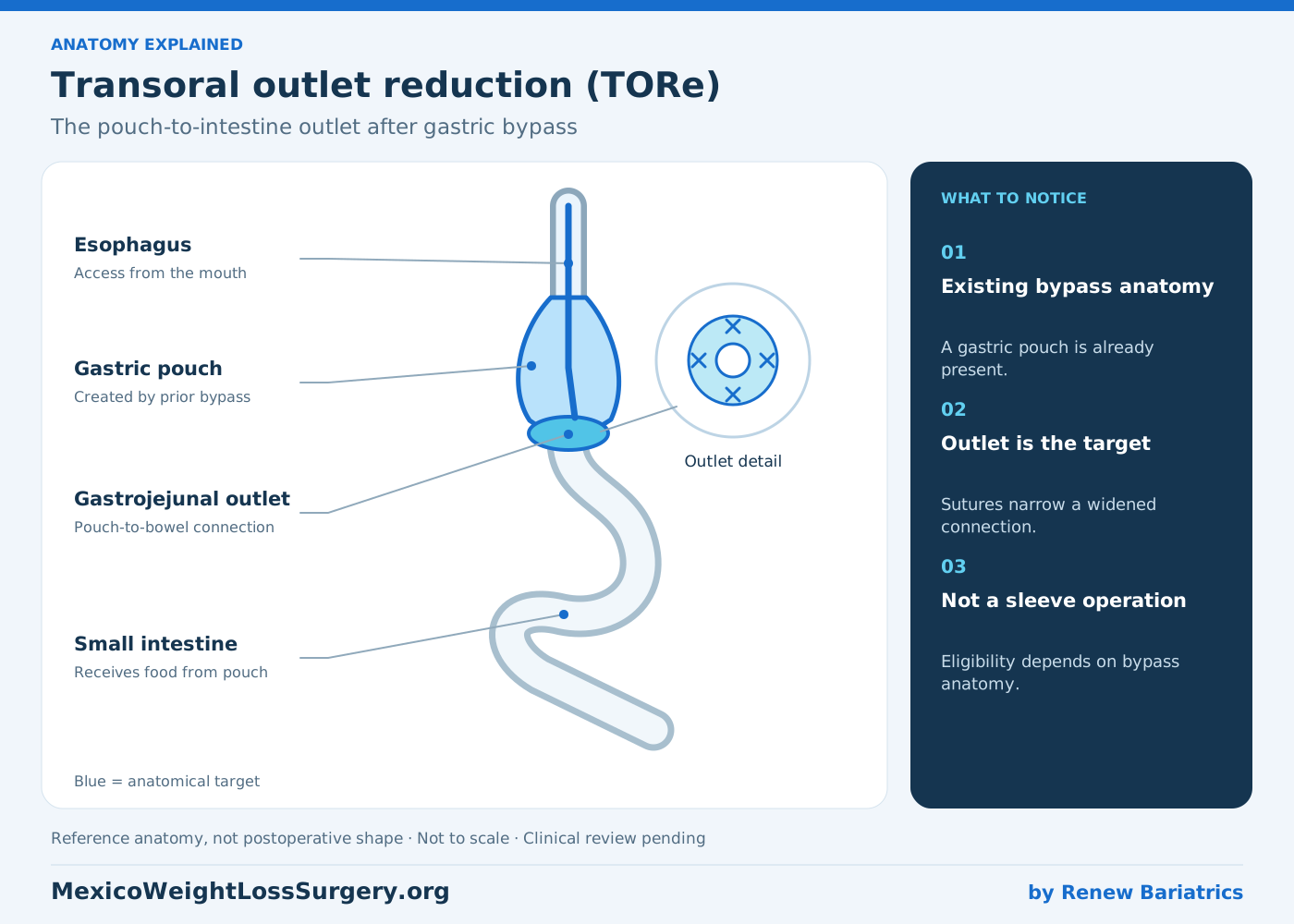
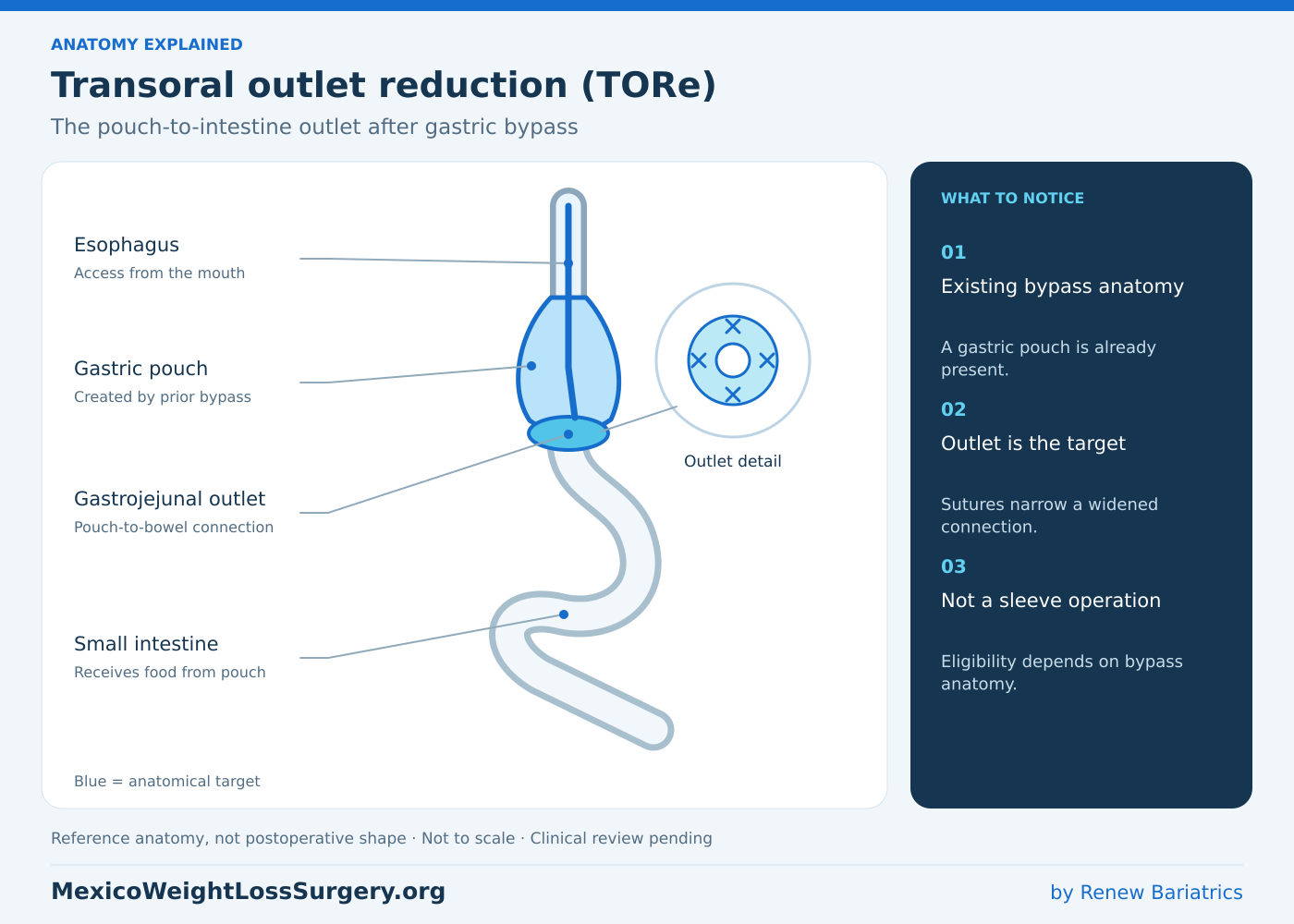
Anatomy references: Johns Hopkins Medicine: Transoral Outlet Reduction ↗ · ASMBS: Scientific evidence for updated indications for metabolic and bariatric surgery ↗
What TORe changes—and what it does not
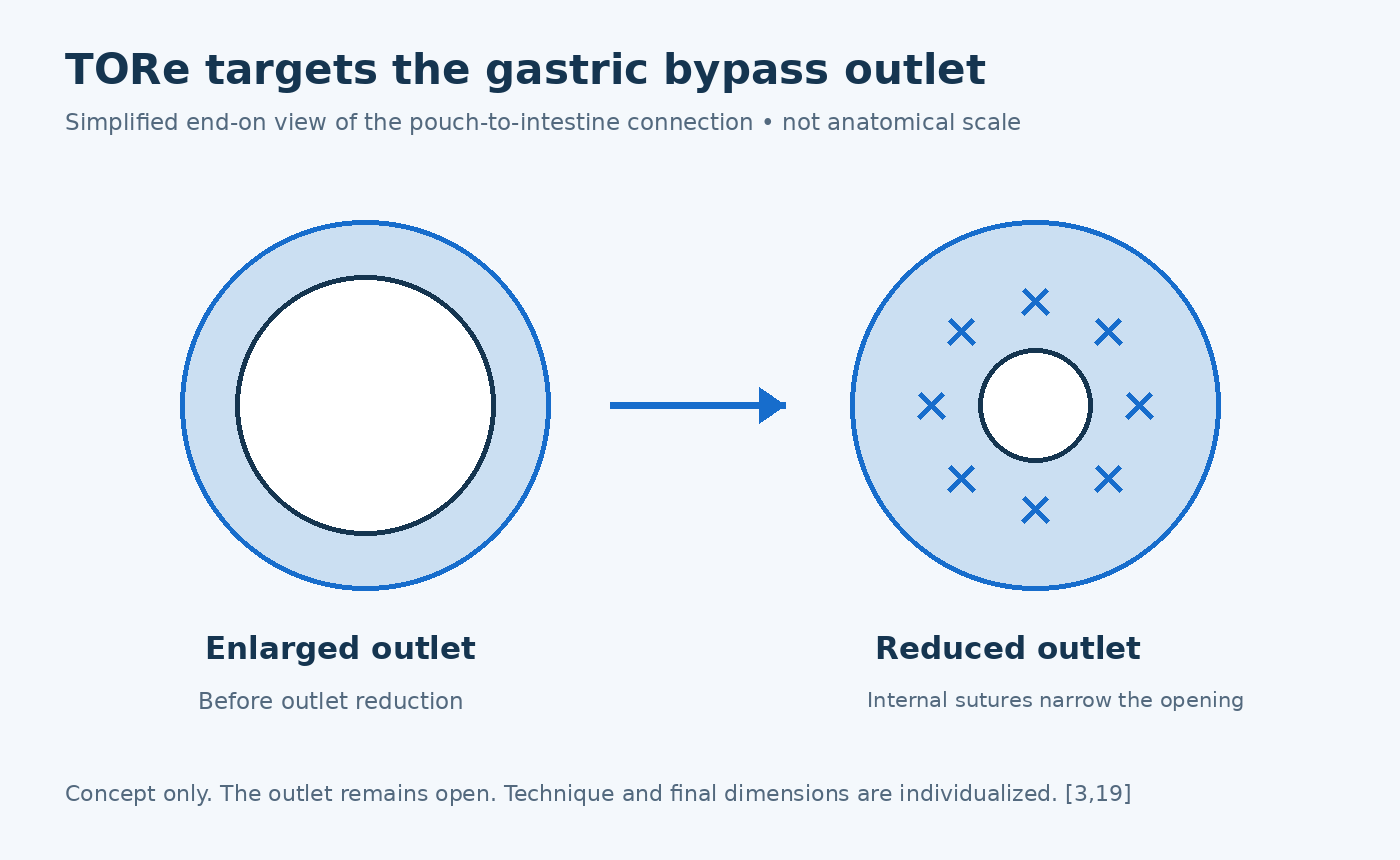
Roux-en-Y gastric bypass creates a small stomach pouch that empties into a segment of small intestine. The connection is called the gastrojejunal anastomosis, or gastric outlet. If that opening enlarges, food can leave the pouch more quickly. Some patients notice less lasting fullness. TORe uses an endoscope passed through the mouth to narrow the outlet with internal sutures; there are no incisions through the skin. [19]
The procedure works on existing bypass anatomy. It does not remove another large section of stomach or automatically change the length of intestine bypassed. Some techniques also place sutures in the pouch. The exact approach depends on the findings and the clinician's judgment. In published research, approaches differ enough that the name “TORe” alone does not tell you precisely what will be performed. [2],[3]
Ask the clinician to show you the area being treated on your own endoscopy images. A useful explanation should identify the problem, what the procedure is intended to change, and what symptoms or concerns it is unlikely to resolve. Understanding that distinction is more valuable than hearing that your bypass will simply be “reset.”
Why weight can return after bypass
Weight recurrence can have several contributors. Changes in eating patterns, appetite, medications, activity, psychological health and anatomy can all matter. A larger outlet may be part of the picture, but it should not become the automatic explanation for everyone who regains weight. Mayo Clinic describes management that can include behavioral support, medication and endoscopic treatment rather than assuming one solution fits every patient. [4]
That is why a useful consultation begins with your history. Bring your original procedure date, your lowest postoperative weight, your current weight and the timeline of the regain. Explain whether your appetite changed gradually or suddenly, whether meals feel different, and whether symptoms are affecting what you can eat. These details help the team decide what to investigate.
Your goals deserve equal attention. You may want improved mobility, a steadier weight, more comfortable eating or better management of a weight-related condition. Tell the team which changes would make a practical difference in your life. A number-based target can be part of the conversation, but it should not replace a discussion of health, function and the work required after treatment.
Who may be a candidate?
TORe is primarily considered for people with prior Roux-en-Y gastric bypass, recurrent weight gain and an outlet that is suitable for reduction. Johns Hopkins notes that patients whose BMI reaches 30 or above may be candidates, with clinical evaluation required. That is a screening consideration, not automatic approval or a universal rule for every program. [1]
The assessment should establish the original operation, current anatomy, relevant symptoms and whether the likely benefit justifies the risks. A 2026 expert consensus emphasizes diagnostic endoscopy and technical competence as part of a standardized approach. This consensus was developed by a small panel of experienced operators; it should not be confused with evidence that every clinic performs TORe equally well. [3]
If your previous operation was a gastric sleeve, do not assume this page describes your treatment. A sleeve does not create the same pouch-to-intestine outlet as Roux-en-Y bypass. Sleeve revision and endoscopic revision after sleeve require a different discussion. Confirm the name of your prior surgery rather than relying on a general description such as “stomach reduction.” [5]
Before paying a deposit, ask what would cause the team to recommend a different treatment or postpone the procedure. A good assessment should leave room for those answers. If the proposed plan depends on an endoscopy that has not happened yet, ask whether your quote and travel arrangements remain conditional on its findings.
What happens during TORe?
The procedure is performed under anesthesia using endoscopic equipment. A common approach combines treatment around the outlet with suturing to reduce its diameter. The 2026 expert consensus describes argon plasma coagulation around the connection and a purse-string suture pattern. A purse-string works like a drawstring, bringing the opening inward. The clinician controls the final size rather than closing the outlet completely. [3]
Technique matters. A comparative study evaluated purse-string and interrupted suturing, and newer evidence reviews distinguish between devices and suture patterns. Those differences help explain why results from one center cannot automatically be applied to another. Asking which technique is planned is reasonable; choosing the number of stitches yourself is not the goal. [6],[7]
Ask who will administer anesthesia, who will perform the procedure and where recovery monitoring will take place. Also ask what happens if the examination shows that TORe should not proceed. Having that conversation beforehand makes consent more meaningful and prevents the procedure day from becoming the first time you hear about alternatives.
How much weight loss is realistic?
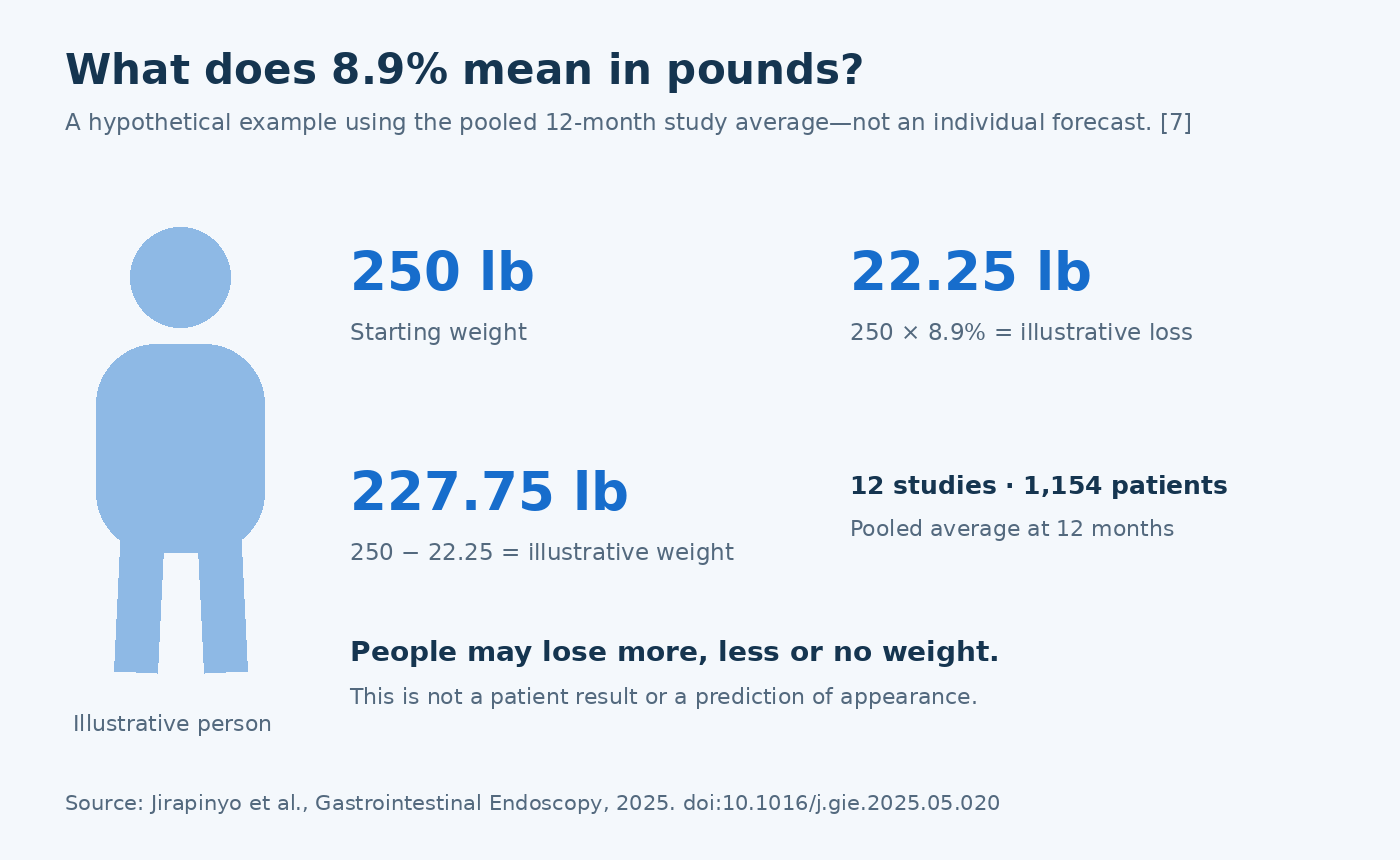
A useful starting point is the 2025 Association for Bariatric Endoscopy review, which pooled 12 studies involving 1,154 patients for the 12-month weight-loss analysis. The pooled result was 8.9% total weight loss. This is an average across studies, not a personal prediction. The review also found differences by technique. [7]
“Total weight loss” uses your weight immediately before the treatment as its denominator. “Excess weight loss” uses a different denominator based on weight above a reference weight. These percentages are not interchangeable. When comparing claims, check the measurement, the follow-up time and whether medication or additional procedures contributed.
For a hypothetical person weighing 250 pounds, 8.9% equals 22.25 pounds. Subtracting that amount produces an illustrative weight of 227.75 pounds. This calculation translates a research percentage into familiar units; it cannot tell you what you will weigh or how your body will look. The accompanying graphic intentionally avoids a simulated photographic transformation.
Results can be higher or lower. A 2023 community-practice cohort reported 17.3% total body weight loss at 12 months, alongside ongoing nutritional support. However, only 110 of its 284 patients had reached eligibility for 12-month follow-up when analyzed, and 77.3% of those eligible had follow-up data. The higher figure is useful context, not a stronger promise. [8]
A five-year cohort of 331 patients reported average total weight loss of 8.5% at one year, 6.9% at three years and 8.8% at five years. Not all patients were eligible for every follow-up interval; 123 had reached the five-year window. Additional weight-loss therapy was used by 39.3% of the cohort, and some underwent repeat TORe. These outcomes describe a treatment pathway, not necessarily one isolated procedure. [2]
Randomized evidence also deserves attention. An earlier sham-controlled trial supported a benefit from endoscopic outlet reduction using an older suturing approach. A 2024 trial found greater excess-weight loss with TORe plus nutritional management than with a sham procedure and nutritional management, but also reported serious complications. Both efficacy and safety belong in an honest discussion. [9],[10]
How durable are the results?
Long-term follow-up suggests that benefit can persist, but the effect is not guaranteed to remain unchanged. The five-year cohort above supports durability for some patients while also documenting additional treatments. “Five-year results” does not mean every person maintained the same loss for five years without further care. [2]
Other long-term research has reported a less favorable weight trajectory. A separate five-year series showed diminishing average weight loss over time. Differences in technique, patients and follow-up make direct comparisons difficult, but they reinforce a practical point: a single impressive number should not be the whole basis for consent. [11]
Ask how your team defines a meaningful response and when it reassesses someone whose progress is limited. Agree on follow-up checkpoints before traveling. A useful plan tells you who reviews progress, which concerns trigger a clinical appointment, and how decisions about further treatment will be made. It should not leave you guessing whether to wait, change your diet independently or seek another procedure.
Risks, side effects and the limits of “minimally invasive”
TORe avoids abdominal incisions, but it is still an invasive procedure performed inside the digestive tract. Bleeding, perforation, infection and excessive narrowing of the outlet are possible. Anesthesia introduces additional considerations. “No incisions” should never be interpreted as “no complications.” [1],[12]
The 2025 pooled review reported a 1.5% serious adverse-event rate across 15 studies involving 1,373 patients. That figure is an estimate from the included studies, not the risk for a particular person or clinic. Definitions, technique, patient selection and operator experience affect how safety findings should be interpreted. [7]
In the 2023 community cohort, outlet narrowing occurred in 3.9% of patients and was treated with endoscopic dilation. The study also reported one serious event involving nausea that required overnight observation. This illustrates why access to follow-up endoscopy matters even when treatment is intended to be outpatient. [8]
The 2024 randomized trial deserves explicit mention: it reported procedure-related adverse events in 20% of the TORe group, including three serious events. Two perforations contributed to early termination of the study. That result should not be presented as the universal complication rate, but omitting it would give an incomplete account of the evidence. [10]
For your consultation, ask for the treating clinician's own complication definitions and management process. What happens if you need observation, dilation, hospitalization or surgery? Who covers those costs? A clear response is more useful than a general assurance that complications are rare.
TORe, medication or surgical revision?
These options address different aspects of weight recurrence, and they may sometimes be combined. The right choice depends on the reason for regain, the anatomy, medical considerations and your preferences. A comparison should include the treatment burden and follow-up requirements, not just expected pounds lost.
A retrospective study of 145 patients receiving TORe with anti-obesity medication reported 15.2% total weight loss at 12 months. The drugs commonly used included topiramate, phentermine-based treatments and liraglutide. This was not a randomized trial of modern semaglutide or tirzepatide regimens, so it should not be used to promise the same result from any particular drug combination. [13]
A small matched comparison of 31 endoscopic and 31 surgical revision patients found fewer adverse events in the endoscopic group and no statistically significant difference in weight loss at one, three or five years. This retrospective comparison concerned revision of an enlarged outlet; it does not prove that TORe replaces every type of revisional bariatric surgery. [14]
Ask the team to explain why the recommended approach fits your findings better than the alternatives. If you are considering medication, discuss ongoing access, tolerability and the monitoring plan. If surgery is proposed, ask exactly what anatomy will change. For either approach, request the expected benefits and uncertainties in language you can explain back in your own words.
Preparation and recovery
Preparation should be individualized. Share a complete list of prescriptions, over-the-counter medicines and supplements, along with allergies and previous anesthesia problems. Obtain written fasting and medication instructions from the treating team. Do not stop a prescribed medicine or apply a generic internet schedule without that review. [12]
Arrange an adult companion or other support as instructed. After sedation, judgment and reflexes may remain impaired even when you feel awake. ASGE advises against driving or operating machinery on the day of an endoscopic examination and notes that someone should take you home and stay with you. A TORe team may impose additional restrictions. [12]
Eating usually progresses through a temporary modified diet. Johns Hopkins describes a transition from liquids to soft foods over four weeks, but this is not a universal Renew protocol. Follow the specific instructions issued for your procedure, including fluid intake, food texture and how to contact the team if intake is difficult. [1]
Plan practical support before treatment: appropriate food at your lodging, help with transportation, time away from physically demanding work, and a way to join follow-up appointments. Ask what “return to normal activity” means for your job rather than assuming it applies equally to desk work, lifting and long-distance travel.
Seek urgent medical assessment for concerning symptoms, including severe or persistent abdominal pain, chest pain, shortness of breath, fever, vomiting blood or black stools. Mayo Clinic lists these as possible warning signs after upper endoscopy. Follow your discharge instructions and use local emergency services for severe symptoms; do not wait for a routine coordinator reply. [15]
Nutrition and follow-up remain part of the treatment
Your original gastric bypass still requires long-term care. ASMBS emphasizes ongoing follow-up, appropriate eating, activity and lifelong vitamin/mineral supplementation after bariatric surgery. TORe does not erase those responsibilities. Ask your team how it will coordinate the temporary post-procedure diet with your established bypass nutrition plan. [16]
Laboratory monitoring also remains important. ASMBS explains that nutritional problems can arise from reduced intake and altered absorption, and that regular assessment and appropriate supplementation help prevent deficiencies. Your clinician should determine the tests and supplementation appropriate to your history rather than simply copying another patient's regimen. [17]
Make the follow-up arrangement concrete. Identify the person responsible for nutrition questions, the clinician who handles symptoms and the local provider who can help once you return home. Request a written handoff, including the procedure report and discharge instructions. Put scheduled appointments in your calendar before departure, and ask what happens if you miss one.
TORe in Mexico: cost and choosing your care team
Renew's public FAQ lists TORe from $8,599 USD, checked November 2, 2026. Treat this as a published starting price, not a personalized quote. Confirm current availability, treating clinician, facility and procedure-specific inclusions directly. Do not assume a general surgical package or hospital-night description automatically applies to TORe. [18]
A useful written quote should answer the following questions:
- Are diagnostic endoscopy, anesthesia and the planned suturing equipment included?
- What testing or medical clearance must be arranged separately?
- How many nights of observation or local accommodation are planned for my case?
- Are medications, ground transportation and companion arrangements included?
- What happens financially if the procedure cannot proceed after evaluation?
- What follow-up is included, and what would an additional endoscopy cost?
- Who pays for unplanned hospital care or a longer stay?
Compare the complete plan, not just the headline price. Request the clinician's name and relevant endoscopic experience, the exact facility and the emergency-care arrangements. Ask where any required follow-up procedure would be performed after you return home. These are reasonable questions for any destination, including care close to home.
Do not buy flights around a generic recovery estimate. Have the clinical team confirm your arrival requirements, local stay and return-travel clearance. Build your budget around the written itinerary, including airfare and expenses that are not covered. The destination should fit the care plan, rather than the care plan being compressed to fit a vacation schedule.
Questions to bring to your consultation
Consider saving these questions with your previous operative records. They are designed to make the discussion specific to you, rather than turning it into a request for the largest possible weight-loss estimate.
- What evidence suggests that my outlet contributes to the regain?
- Is my previous operation definitely Roux-en-Y gastric bypass?
- What further evaluation would change your recommendation?
- Which technique would you use, and why?
- What outcome would count as a worthwhile response for me?
- How do your published or audited results compare with the studies cited here?
- What complications have you managed, and where would I receive help?
- What are the medication, nutritional and surgical alternatives?
- Who provides care after I go home?
- What costs or decisions remain uncertain before I commit?
You do not need to arrive with every record already organized. Start by identifying what you have and asking which missing documents matter. The aim is a clear, individualized recommendation—not pressure to choose a procedure before the clinical questions are answered.
Take the next step with Renew
If you have regained weight after bypass, an inquiry can begin with your original surgery, current concerns and what you hope to change. A Renew coordinator can explain how to submit your health history and request a review. The clinical team—not a calculator, photograph or research average—determines eligibility.
Ask for a TORe-specific review and written quote. If another approach is more appropriate, ask the team to explain why. The most useful next step is a plan you understand, with realistic expectations and follow-up responsibilities established before you travel.
Program information related to this guide
For information about care through our parent organization, explore TORe treatment at Renew Bariatrics. Ask the team to confirm availability, your eligibility and the written scope of care.
TORe vs. surgical bypass revision
These options change different structures. Your anatomy, symptoms, health history and follow-up needs guide the choice; neither is automatically better for everyone.
| What to compare | TORe → | Revision surgery → |
|---|---|---|
| Access | Endoscopic access through the mouth. | Surgery; the approach depends on the required correction. |
| Target | An enlarged pouch-to-bowel outlet in selected bypass patients. | A broader range of structural problems may be addressed. |
| Scope | Does not replace every type of revisional operation. | Not one standard operation for all patients. |
| Assessment | Endoscopy and multidisciplinary weight-regain assessment. | Prior records, anatomy, symptoms and nutritional status. |
Comparison references: Johns Hopkins Medicine: Transoral Outlet Reduction ↗ · ASMBS: Scientific evidence for updated indications for metabolic and bariatric surgery ↗
These options are not interchangeable for every person. The treating clinician must assess your anatomy, medical history and goals.
Further reading
Ask about a TORe assessment.
Discuss your previous bypass, goals and next steps with Renew. Clinical review determines suitability.
Call 844-736-3963 Complete health questionnaire ↗The questionnaire opens Renew’s existing intake. This sample itself collects no health information.
References & evidence notes
Sources checked November 2, 2026. Linked studies and institutional sources support the numbered claims. Several studies disclose industry relationships; read their disclosures alongside the methods and limitations. No source establishes outcomes for Renew’s own TORe program.
- Johns Hopkins Medicine. Transoral Outlet Reduction ↗Patient education; candidacy, recovery and risks.
- Jirapinyo et al., 2020. Five-year outcomes of transoral outlet reduction for the treatment of weight regain after Roux-en-Y gastric bypass ↗Gastrointestinal Endoscopy 91:1067–1073. doi:10.1016/j.gie.2019.11.044. Retrospective cohort; additional therapies and follow-up limitations.
- McCarty et al., 2026. Establishing standards of practice for transoral outlet reduction: an expert consensus using a modified Delphi method ↗Gastrointestinal Endoscopy 103:780–785. doi:10.1016/j.gie.2025.11.007. Six-expert consensus; not a comparative outcomes trial.
- Mayo Clinic, 2018. Weight regain after bariatric surgery ↗Clinical overview of multifactorial regain and management.
- Cleveland Clinic. Bariatric Endoscopy Program ↗Distinguishes bypass outlet revision from endoscopic sleeve revision.
- Schulman et al., 2018. Transoral outlet reduction: a comparison of purse-string with interrupted stitch technique ↗Gastrointestinal Endoscopy. Comparative technique study; 241 patients.
- Jirapinyo et al., 2025. Association for Bariatric Endoscopy systematic review and meta-analysis assessing ASGE PIVI thresholds for TORe ↗Gastrointestinal Endoscopy 102:440–453.e6. doi:10.1016/j.gie.2025.05.020. Pooled efficacy and safety estimates; variation across studies.
- Maselli et al., 2023. Transoral outlet reduction: outcomes of endoscopic Roux-en-Y gastric bypass revision in 284 patients at a community practice ↗World Journal of Gastrointestinal Endoscopy 15:602–613. doi:10.4253/wjge.v15.i10.602. Single-center retrospective cohort; 12-month follow-up incomplete.
- Thompson et al., 2013. Endoscopic suturing for transoral outlet reduction increases weight loss after Roux-en-Y gastric bypass surgery ↗Gastroenterology 145:129–137.e3. Randomized, blinded, sham-controlled trial using an earlier device.
- Valats et al., 2024. Prospective evaluation of transoral outlet reduction after Roux-en-Y gastric bypass failure ↗Surgical Endoscopy 38:1454–1464. doi:10.1007/s00464-023-10650-5. Randomized trial; 73 randomized, 50 in final analysis; serious complications and early termination.
- Five-year series, 2019. Five-year results of endoscopic gastrojejunostomy revision for weight gain after gastric bypass ↗Surgical Endoscopy. Separate long-term series; outcomes should not be conflated with reference 2.
- American Society for Gastrointestinal Endoscopy. Understanding Upper Endoscopy ↗General endoscopy preparation, sedation and complication information; not a TORe-specific protocol.
- Jirapinyo and Thompson, 2023. Combining transoral outlet reduction with pharmacotherapy ↗Gastrointestinal Endoscopy 98:552–558. doi:10.1016/j.gie.2023.04.2092. Retrospective combination-treatment study; not a trial of every modern obesity drug.
- Dolan et al., 2021. Endoscopic versus surgical gastrojejunal revision: 5-year safety and efficacy comparison ↗Retrospective matched comparison, 31 patients per group; limited to studied revision approaches.
- Mayo Clinic. Upper endoscopy ↗Warning signs and when to seek urgent medical assessment.
- American Society for Metabolic and Bariatric Surgery. Life After Bariatric Surgery ↗Long-term nutrition, supplementation, activity and follow-up.
- American Society for Metabolic and Bariatric Surgery. FAQs of Bariatric Surgery ↗Nutritional monitoring and deficiency prevention.
- Renew Bariatrics. Bariatric Surgery in Mexico FAQs ↗TORe starting price; checked November 2, 2026. Business information, not independent efficacy evidence.
- Mayo Clinic. Minimally Invasive Approaches: Gastric Bypass Transoral Outlet Reduction ↗Clinician explanation of outlet anatomy, endoscopic suturing and evaluation.