
Jump to a section
Anatomy illustrationSynthetic illustrationCompare proceduresRelated ProceduresWhat an arm lift can changeWho may be a suitable candidate?Nutrition after bariatric surgeryWhat happens during the consultation?Incisions, anesthesia, and the surgical planArm lift risks and what the evidence meansRecovery: plan around tasks, not promisesWhen to seek medical helpArm Lift Cost in MexicoTraveling for an arm lift in MexicoFrequently asked questionsYour next stepYour next stepReferencesAn arm lift in Mexico may be worth considering when loose upper-arm skin remains after substantial weight loss and affects comfort, clothing, or how you feel about your shape. The operation, called brachioplasty, removes redundant tissue and reshapes the upper arm. It does not treat obesity, replace strength training, or promise a particular clothing size. Understanding the scar, healing demands, and total arm lift cost in Mexico is as important as understanding the possible contour change.[1]
Renew Bariatrics lists arm lift among its post-weight-loss plastic surgery services. That establishes the procedure as an option to discuss, not proof that every person qualifies or that a particular combination, surgeon, or price is available. Your consultation should produce an individualized surgical plan and written quote.[13]
This guide explains how to evaluate that plan. The illustrations are editorial examples featuring fictional people; they are not patient photographs or evidence of an expected surgical result.
Understand the anatomy
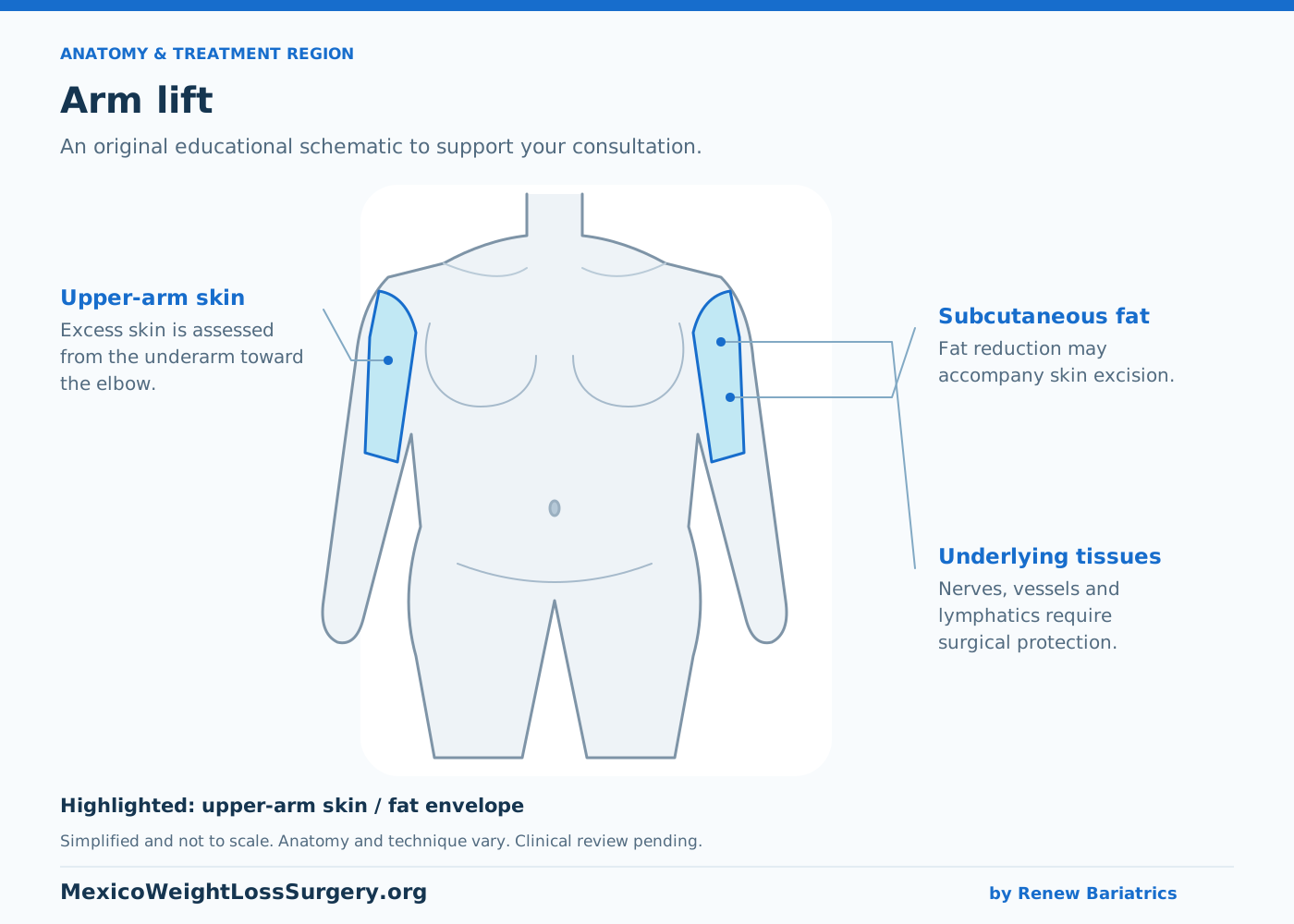
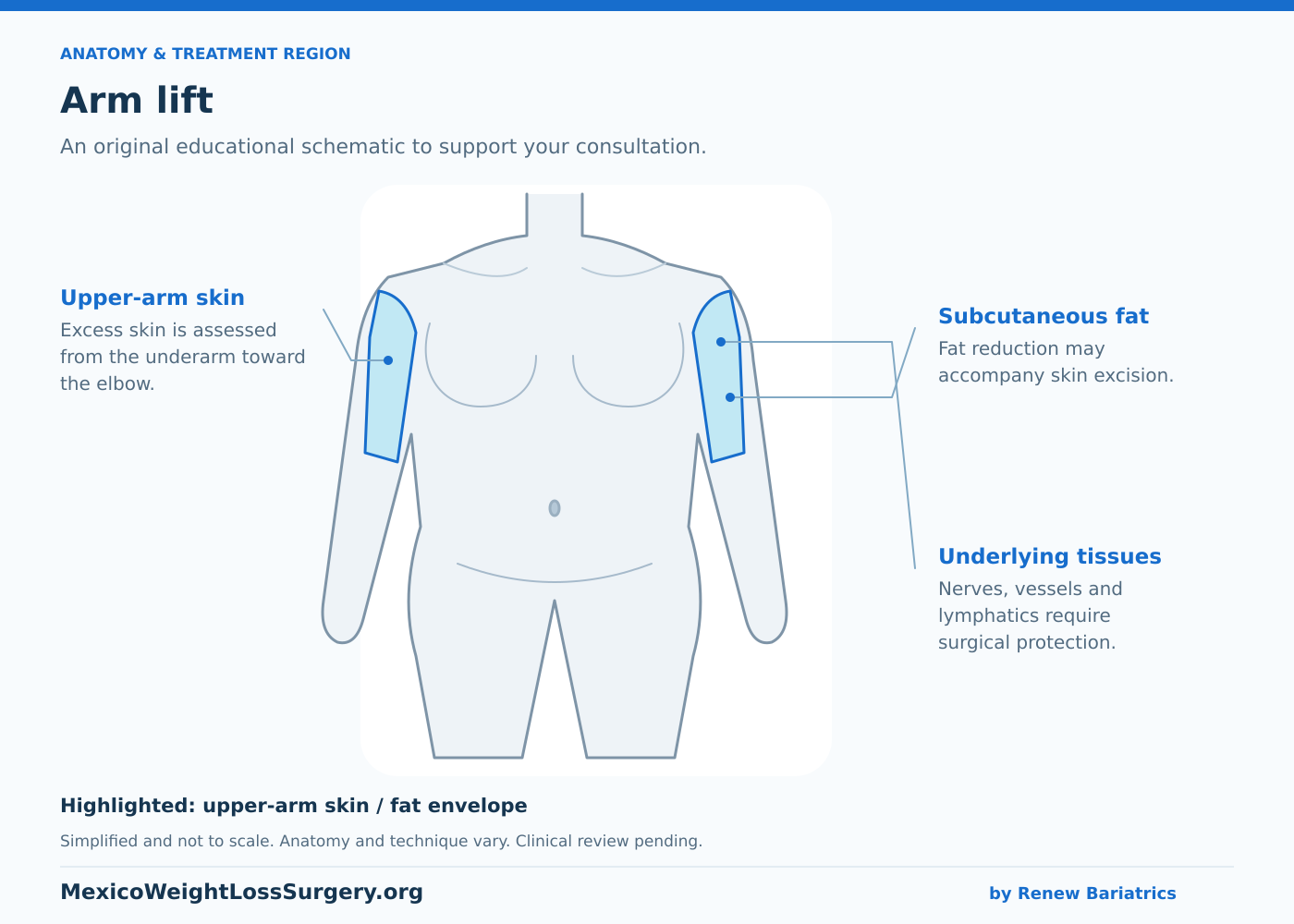
A simplified, labeled view of the structures and treatment area. Select the image to view it at full size.
Anatomy references: ASPS — Arm lift ↗ · ASPS — Liposuction ↗
What an arm lift can change
The main target is skin and supporting tissue hanging beneath the upper arm, often between the armpit and elbow. A surgeon may also address localized fat. After major weight loss, the amount of tissue remaining and its ability to retract vary considerably. Two people with the same weight can need different operations because their skin distribution and previous scars differ.[1]
Think about your goal in practical terms. Is the concern fabric catching under the arm, discomfort in a sleeve, rubbing during movement, or the appearance of a hanging fold? Write down the two changes that matter most. This gives the consultation a clearer starting point than asking for an arm that looks like someone else's.
The tradeoff is permanent surgical scarring. A more extensive fold can require a longer incision to remove enough skin. A smaller scar is not automatically a better operation if it leaves most of the problem untouched. Conversely, an extensive operation is not justified just because it removes more tissue. The plan should match the area you want treated and the scar you can accept.[4],[7]
Arm lift versus liposuction
Liposuction addresses fat, while brachioplasty addresses excess skin and tissue laxity. In selected patients the procedures can be combined. Ask the surgeon to identify which part of your concern comes from fat and which comes from skin, then explain what each proposed component contributes. An answer should describe your examination, not simply promote a packaged combination.[1],[4]
Exercise can improve strength and physical function, but it cannot reliably eliminate substantial excess skin. Continuing an appropriate fitness routine may still be valuable for health; choosing surgery does not imply that your previous effort failed. Equally, choosing to live with loose skin is a reasonable decision.[1]
Who may be a suitable candidate?
ASPS describes typical candidates as adults with meaningful upper-arm laxity, relatively stable weight, realistic expectations, and health that supports healing. Nonsmoking matters. Candidacy is a medical assessment rather than a photograph-based guarantee or a single universal weight threshold.[2]
Discuss your weight trajectory rather than only your current number. Tell the team whether you are still losing weight, recently changed medication, anticipate pregnancy, or struggle to maintain intake. Ask what period of stability your surgeon requires and why. A plan that assumes your body will remain unchanged while your weight is still falling may not match your situation.[2],[12]
Reasons to pause before booking
A consultation may lead to postponement while another problem is addressed. Examples to discuss include active skin infection, unresolved nutritional concerns, nicotine exposure, or a medical condition that makes anesthesia or wound healing more difficult. Delaying an elective procedure can be part of sound planning rather than a rejection of your goals.[2],[8]
Be particularly clear about previous breast surgery, lymph-node removal, radiation, unexplained arm swelling, and prior arm operations. These details may affect drainage pathways, scar placement, or the safety of the proposed approach. A history that seems unrelated to appearance can be central to an arm-lift assessment.[9]
You should also be able to explain the limits of the operation in your own words: it changes contour, leaves scars, requires recovery, and cannot guarantee symmetry or satisfaction. If the consultation has not made those points understandable, request a clearer explanation before paying a deposit.[7]
Nutrition after bariatric surgery
Body contouring takes place after weight loss, but nutritional follow-up does not end when the scale stabilizes. Bring your bariatric operation history, current supplements, recent laboratory results, and any difficulty eating to the consultation. The relevant question is whether you can support healing now, not whether your bariatric surgery happened years ago.[12]
A prospective study of 140 post-bariatric body-contouring patients used laboratory assessment, treatment of identified deficiencies, and a dietitian-prescribed protein-enriched diet. It found only a weak association between nutritional optimization and better wound outcomes; it did not prove that a supplement program prevents complications. Nutrition remains an assessment and treatment issue, not a guarantee.[12]
Ask who will review your intake and laboratory findings, what needs correction, and how the team decides you are ready. Avoid treating a normal-looking meal plan as proof that all nutritional needs are met. Conversely, do not start high-dose supplements on your own because another patient used them. The preparation plan should connect a finding to a specific recommendation and a follow-up check.[12]
Practical preparation includes identifying foods and fluids you tolerate, arranging help with shopping and cooking, and deciding who will contact the team if nausea or poor appetite interferes with the prescribed plan. This is especially useful if your companion normally depends on you to organize meals. Write these responsibilities down before travel.
What happens during the consultation?
Expect discussion of your medical conditions, medications, supplements, nicotine use, previous surgery, and goals. The surgeon may examine and measure the arms and obtain photographs for planning. Ask how images will be stored and shared; permission for clinical photography should be distinguishable from permission to use photographs in advertising.[3]
Bring a list of everyday tasks you need to resume: computer work, lifting children, carrying groceries, driving, transferring from a chair, and overhead work. These are more useful than asking only when you can return to normal. A desk-based employee and a person who regularly lifts equipment may need different plans even after a similar incision.
Request a drawing of the proposed scar on your body or a diagram. Ask where it will sit when your arms hang naturally and when they are raised. If tissue near the armpit or side of the chest is included, have that extension identified explicitly. The words standard, extended, and mini should be translated into actual regions and incision lines.[4]
A useful consultation ends with a clear description of what is included, what remains untreated, the main risks for you, and the alternatives. It is reasonable to take time afterward to compare the plan against your original priorities.
Incisions, anesthesia, and the surgical plan
Anesthesia may involve intravenous sedation or general anesthesia, depending on the procedure and clinical judgment. Incisions can lie along the inner arm or toward its back and may extend from the underarm toward the elbow. Selected patients may be considered for a more limited approach. Skin distribution determines what is feasible.[4]
Ask who provides anesthesia, where the operation takes place, and what arrangements exist if you need a higher level of care. Confirm the individual surgeon's relevant credentials and the facility's authorization directly through appropriate organizations rather than relying only on a sales description. These are questions to resolve before travel.[14]
Combining procedures
An arm lift may be discussed alongside other contouring procedures, but combining operations changes the practical recovery plan. For example, if both your arms and another body region are healing, the movements you normally use to get out of bed or dress may be more difficult. Ask the team to demonstrate how you would move safely with the proposed combination.
The reason for combining procedures should be clinical and practical, not simply that you are already traveling. Ask what would make staging preferable, how the estimated operation changes, and whether the recovery setting can support the combined plan. Obtain separate explanations for each procedure so that removing one component does not make the quote or consent unclear.
Arm lift risks and what the evidence means
Recognized risks include bleeding, infection, fluid collections, poor wound healing, fat necrosis, persistent pain, sensory change, damage to deeper structures, unfavorable scars, and possible revision. Some complications require additional treatment or surgery. Your risk depends on the operation and your health; a general list cannot calculate it for you.[5]
Lymphatic injury can cause swelling, and nerve injury can produce temporary or persistent numbness or other symptoms. Discuss any existing swelling or altered sensation before surgery so there is a clear baseline. A complication that changes arm function deserves attention even when it is less visible than a scar.[8]
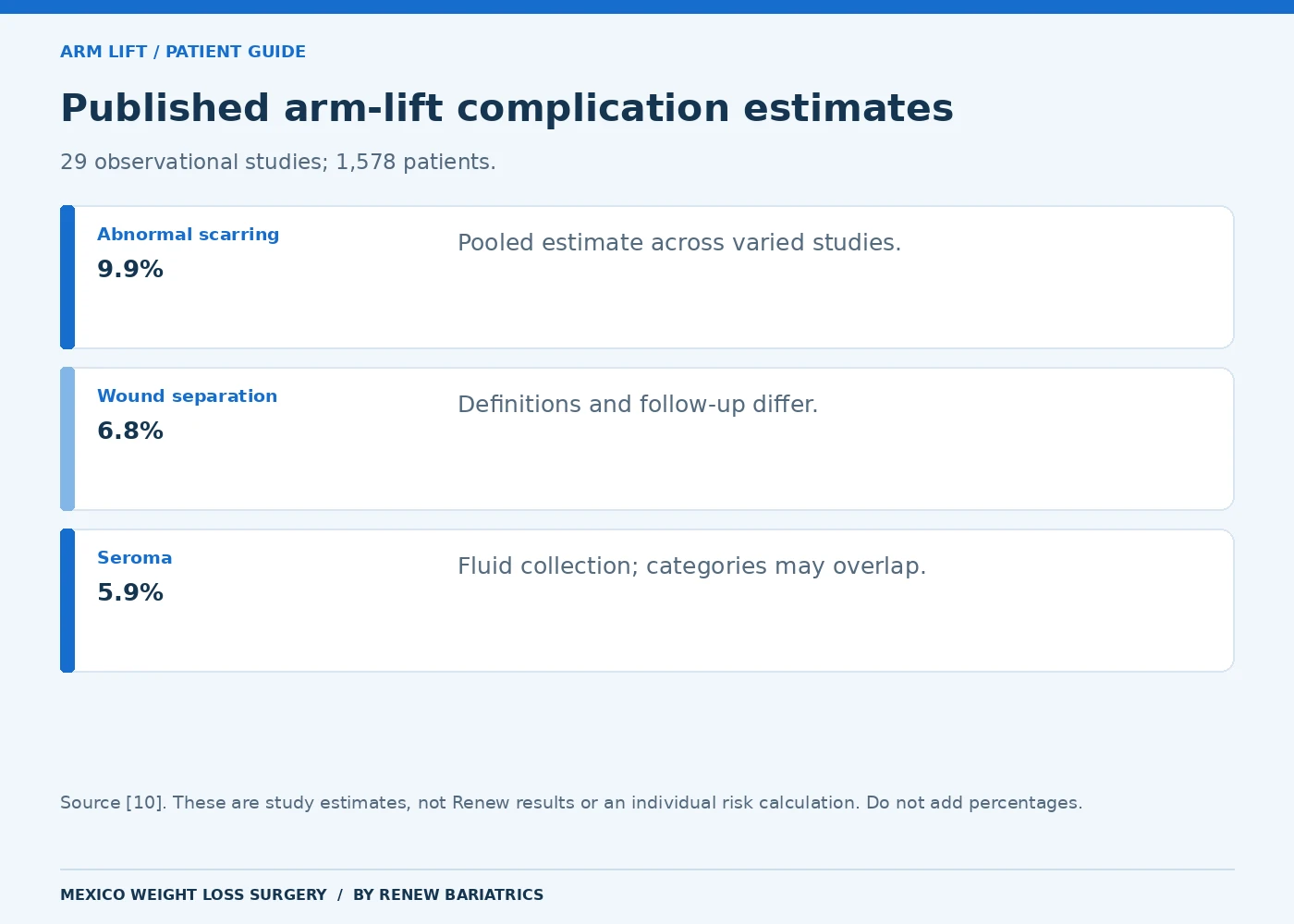
A 2022 meta-analysis combined 29 observational studies involving 1,578 patients. Pooled estimates included abnormal scarring of about 9.9%, wound separation of 6.8%, and seroma of 5.9%. These categories may overlap. The figures describe published populations with varied techniques and follow-up; they are neither Renew Bariatrics results nor a personalized forecast.[10]
Why complication percentages differ
A study counting every small area of delayed healing answers a different question from one counting hospital admission or another operation. Follow-up length also matters: early healing and later scar appearance are different outcomes. When a clinic quotes a rate, ask what was counted, how many patients were included, and whether follow-up was complete.
Ask for the surgeon's experience with patients who have a similar amount of skin excess and a similar medical history. A low number without a clear definition is not enough to compare two options. Similarly, a published average does not mean a complication is inevitable or impossible for you.[10]
Recovery: plan around tasks, not promises
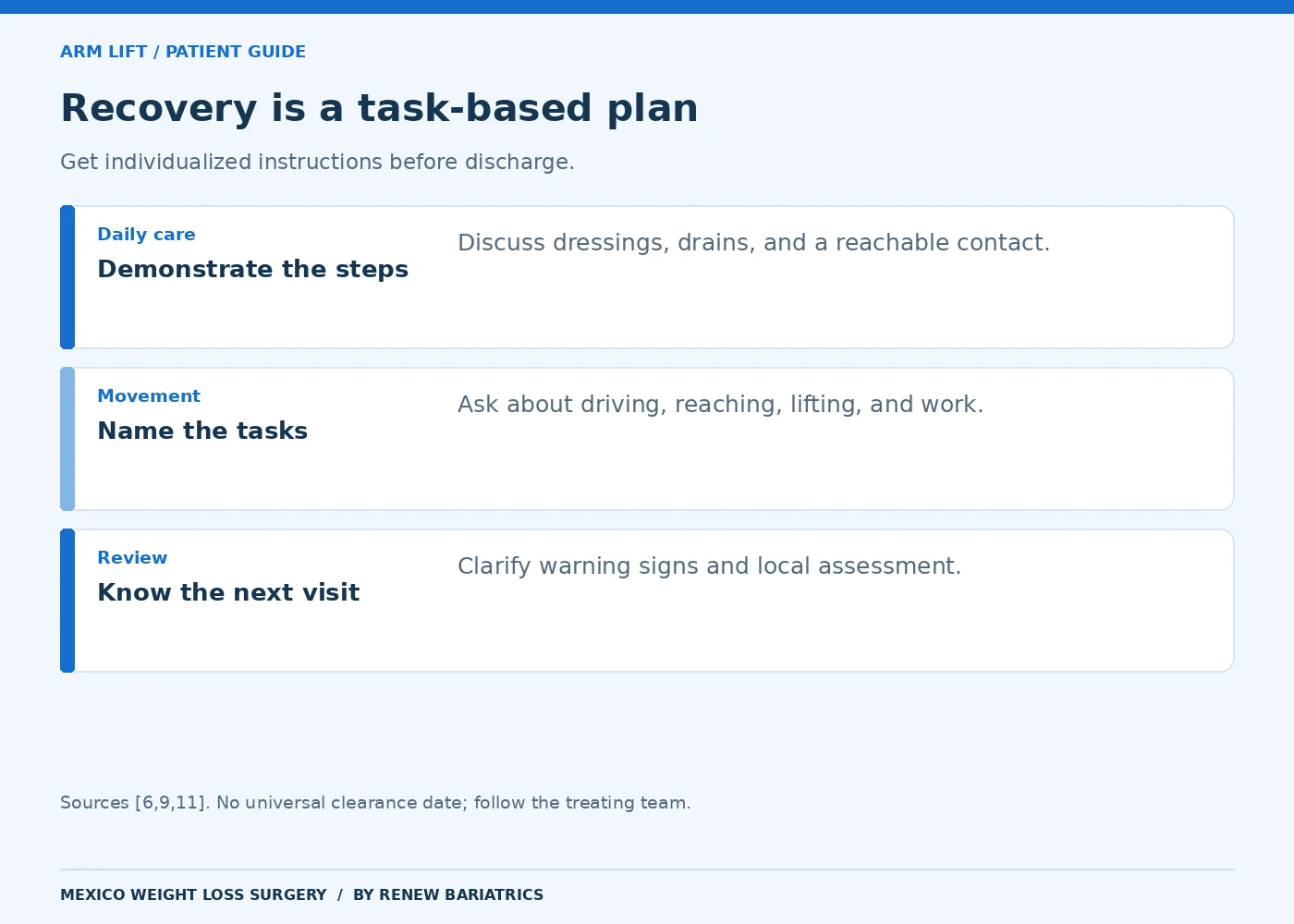
Dressings, compression, and temporary drains may be used, depending on the operation. You should receive specific instructions for wound care, medications, concerning symptoms, and follow-up. Do not assume that another person's garment or drain schedule applies to you.[6]
Before discharge, ask the team to demonstrate care rather than only handing you a leaflet. Your companion should know whom to call, how to record any requested drain measurements, and what supplies are needed. Check that you can understand the written instructions and access them without depending on a phone connection.
Movement, lifting, and work
Early restrictions may involve heavy lifting, forceful pushing or pulling, and overhead activity. Driving should wait until you are off impairing medication and can control the vehicle safely, with your surgeon's clearance. The ability to sit in a car is not the same as being able to steer, brake, and respond to an emergency.[9]
For work planning, list the movements your role actually requires. Request written restrictions that distinguish light tasks from physically demanding work. Build flexibility into the return date, especially if travel, commuting, or a second procedure adds demands. An institutional recovery guide can provide context, but it cannot set your personal schedule.[11]
Arrange easy-to-put-on clothing and place commonly used items where you can reach them without stretching. Decide who will carry luggage and manage pets, children, laundry, and household tasks. These practical details do not determine whether surgery is medically appropriate, but they can make a prescribed restriction possible to follow.
Compression, medication, and scar care
Ask whether compression is recommended, how it should fit, and what symptoms should prompt a call. More pressure is not automatically better. Confirm the exact medication list with the treating team, including how it fits with your bariatric history and existing prescriptions. Do not independently stop anticoagulants, restart supplements, or borrow someone else's pain medication.[6]
Scars are permanent even when they soften or become less noticeable. Ask when any recommended scar-care product may start and how the incision will be reviewed. A scar can widen, thicken, or remain conspicuous; additional treatment may not erase it. Judge the decision on whether the contour benefit is worth a visible scar, not on an assumption that the scar will disappear.[7],[8]
When to seek medical help
Seek emergency care for sudden shortness of breath, chest pain, fainting, or other severe symptoms rather than waiting for a routine message response. Promptly contact the surgical team about worsening redness, significant drainage, fever, or a concerning change in the wound or arm. Your discharge instructions should give specific thresholds and local contacts.[8]
If you seek care after returning home, explain where and when surgery occurred and provide the operative records and medication list. Avoid assuming that a photograph is enough to rule out a problem. A remote review may be useful, but a clinician may need an in-person assessment.[14]
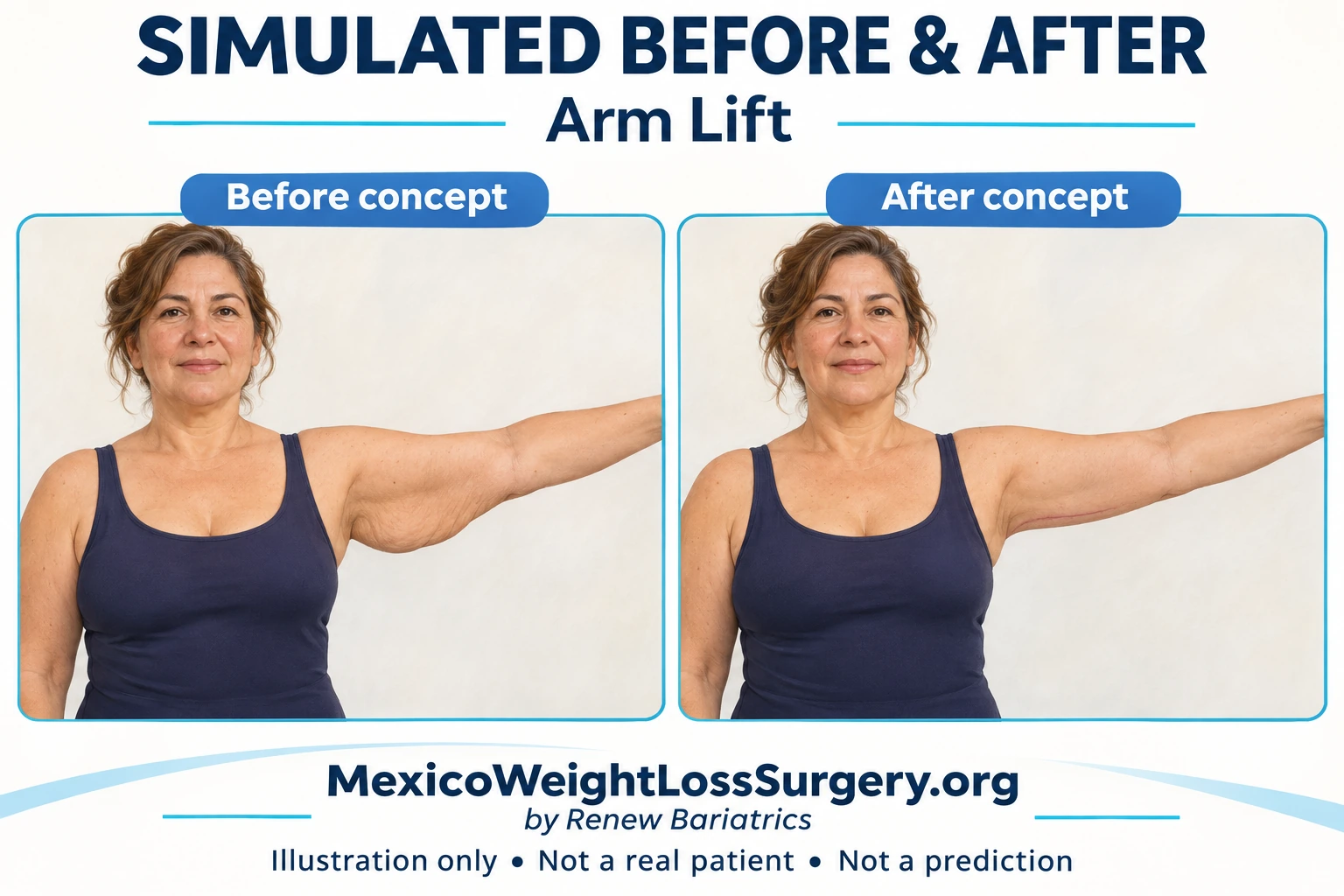
A synthetic illustration of possible changes
This fictional example illustrates a treatment concept. It cannot show the result you would achieve, predict scar healing, or establish a typical outcome.
Arm Lift Cost in Mexico
Arm lift cost in Mexico depends on the extent of skin removal, whether liposuction or another procedure is included, anesthesia, facility requirements, and the care plan. This page does not publish a price because a current individualized Renew quote has not been established here. A number without a defined operation and inclusions would be a poor basis for comparison.
Request an itemized quote identifying the surgeon's fee, anesthesia, operating facility, laboratory testing, garments, medications, scheduled follow-ups, and any required overnight care. Have the team label each item included, excluded, or conditional. Ask whether transport and lodging are medical services or separate travel arrangements.
A useful total budget also considers flights, companion expenses, meals, time away from work, additional nights, and care after returning home. Ask in writing how unplanned wound visits, drainage procedures, hospital treatment, and revision are billed. A revision policy should specify what costs it covers; the word revision alone does not mean every expense is free.
Compare quotes only after comparing the proposed incisions and regions treated. A limited arm procedure and an extended operation are not equivalent purchases. Confirm the currency, deposit terms, cancellation policy, quote validity, and circumstances that can change the final price before making nonrefundable travel arrangements.
Traveling for an arm lift in Mexico
Plan recovery as medical travel. Discuss postoperative travel timing with the surgeon; surgery and prolonged sitting both affect clot risk. Arrange follow-up before departure and obtain a complete record of care. Insurance coverage for overseas treatment and complications needs direct confirmation with the insurer.[14]
The itinerary should identify where you will stay, who will help, how you will reach follow-up, and what happens if clearance to travel is delayed. Ask for a realistic contingency plan instead of treating a return ticket as a medical deadline. At home, identify who can examine a wound if needed and how that clinician will receive records.
Frequently asked questions
Will brachioplasty make me lose weight?
It removes excess tissue to change contour. It is not an obesity treatment or a substitute for ongoing weight management. Any amount removed is not a promised or clinically meaningful weight-loss target.[1]
Can I have an arm lift without a long scar?
Some selected patients may suit limited incisions, but substantial skin excess often requires a longer scar. Ask what a shorter incision would leave untreated and whether its limits match your goals.[4]
How much does an arm lift in Mexico cost?
Request a current written quote based on your examination and proposed operation. Compare the complete care package and excluded expenses. This guide deliberately does not substitute an unverified starting price for an individualized estimate.
Will the result last permanently?
Removed skin does not simply return in the same way, but aging and weight changes continue to affect tissue. Scars remain, symmetry is imperfect, and revision may be needed. No surgeon can promise an unchanging result.[7]
What should I send for an initial review?
Ask Renew which information is required and how to submit it securely. Prepare your weight history, previous procedures, conditions, medications, nicotine exposure, and goals. Online screening can organize a consultation; it does not replace an examination or anesthesia assessment.[3]
Your next step
Request an arm-lift consultation that addresses your specific skin distribution, scar acceptance, medical history, and recovery support. Ask for a written plan, itemized cost, and clear responsibility for follow-up. The right decision is one you can explain in terms of both the improvement you seek and the tradeoffs you accept.
Program information related to this guide
Explore Renew Bariatrics’ procedure options when discussing a plastic surgery plan. Availability, combinations and suitability require individual confirmation.
Arm lift vs. liposuction
These procedures address different concerns and may be combined or staged. A clinical assessment determines which, if either, fits your anatomy and goals.
| What to compare | Arm lift → | Liposuction → |
|---|---|---|
| Main goal | Addresses loose upper-arm skin. | Reduces selected fat deposits. |
| What changes | Skin excision, sometimes with fat reduction. | Fat beneath the skin. |
| Key distinction | Trades loose skin for a lasting scar. | Does not remove excess skin. |
| Recovery consideration | Arm movement and lifting need a plan. | Swelling and garment plans vary. |
| Cost comparison | Request an itemized quote for this exact procedure and care plan. | Compare the same inclusions, exclusions and recovery expenses. |
Comparison references: ASPS — Arm lift ↗ · ASPS — Liposuction ↗
These options are not interchangeable for every person. The treating clinician must assess your anatomy, medical history and goals.
Discuss your options with Renew.
Talk with a coordinator about arm lift, your goals and the information needed for clinical review. The treating team determines suitability and the care plan.
Call 844-736-3963 Ask about plastic surgery ↗The link opens Renew’s plastic surgery health questionnaire. This review site does not collect health information.
References & evidence notes
Sources checked November 2026. Research findings are not a forecast for an individual or outcomes for Renew’s own program. Review study populations, methods and limitations alongside the reported results.
- American Society of Plastic Surgeons. Arm Lift ↗Professional-society patient education; general guidance, not individualized advice.
- American Society of Plastic Surgeons. Arm Lift Candidates ↗Professional-society patient education; general guidance, not individualized advice.
- American Society of Plastic Surgeons. Arm Lift Consultation ↗Professional-society patient education; general guidance, not individualized advice.
- American Society of Plastic Surgeons. Arm Lift Procedure Steps ↗Professional-society patient education; general guidance, not individualized advice.
- American Society of Plastic Surgeons. Arm Lift Risks and Safety ↗Professional-society patient education; general guidance, not individualized advice.
- American Society of Plastic Surgeons. Arm Lift Recovery ↗Professional-society patient education; general guidance, not individualized advice.
- American Society of Plastic Surgeons. Arm Lift Results ↗Professional-society patient education; general guidance, not individualized advice.
- Johns Hopkins Medicine. Brachioplasty ↗Institutional education including scarring, lymphatic and nerve risks, and symptoms requiring contact.
- International Society of Aesthetic Plastic Surgery. Arm Lift ↗Professional-society information including lymphatic history, activity restrictions, and driving considerations.
- Aljerian et al., 2022. Complications in Brachioplasty: A Systematic Review and Meta-Analysis ↗29 observational studies; 1,578 patients. Pooled complication categories can overlap. Not Renew outcomes or a personalized risk estimate.
- University of Florida Health Plastic Surgery. Arm Lift Surgery ↗Institutional recovery context; timelines do not replace individual clearance.
- Published clinical literature. Complications in post-bariatric body contouring surgery using a practical treatment regime to optimise the nutritional state ↗Prospective observational cohort of 140; weak association with nutrition optimization, not proof that supplementation prevents complications.
- Renew Bariatrics. Bariatric & Plastic Surgery in Mexico ↗Offering confirmation only. Individual candidacy, operator, location, price, and surgical scope require confirmation. Reviewed November 2026.
- CDC Yellow Book. Medical Tourism ↗Government guidance on travel risk, records, complication planning, credentials, and continuity of care. Does not provide individual flight clearance.