
Jump to a section
Anatomy illustrationSynthetic illustrationCompare proceduresRelated ProceduresWhat is a Brazilian butt lift?The BBL safety issue you should understand firstWho might be a candidate—and who should pause?Alternatives worth discussingYour consultation should produce a written planPreparing your health and nutritionWhat happens on the day of surgery?Recovery: protect healing and plan ordinary lifeResults, fat retention and scarsOther risks and urgent symptomsBrazilian Butt Lift Cost in MexicoTraveling to Mexico and returning homeQuestions that deserve clear answersYour next step with Renew BariatricsYour next stepReferencesA Brazilian butt lift in Mexico, often called a BBL, transfers your own fat to change the shape or fullness of your buttocks. It combines fat removal from donor areas with fat grafting. Cost is one part of the decision, but the surgeon's technique, facility and postoperative care deserve priority. BBL carries a serious risk of fat embolism, which can be fatal. A lower advertised price cannot compensate for an inadequate safety plan. [1],[2]
This guide explains what to ask before considering BBL, including the need for fat placement only in the subcutaneous tissue above the muscle fascia and real-time ultrasound guidance during injection. These measures reduce avoidable technical risk; they do not make the operation risk-free. MexicoWeightLossSurgery.org is owned by Renew Bariatrics, whose procedure directory lists BBL. The treating surgeon, technique, facility and personal candidacy require individual confirmation. [2],[15]
Understand the anatomy
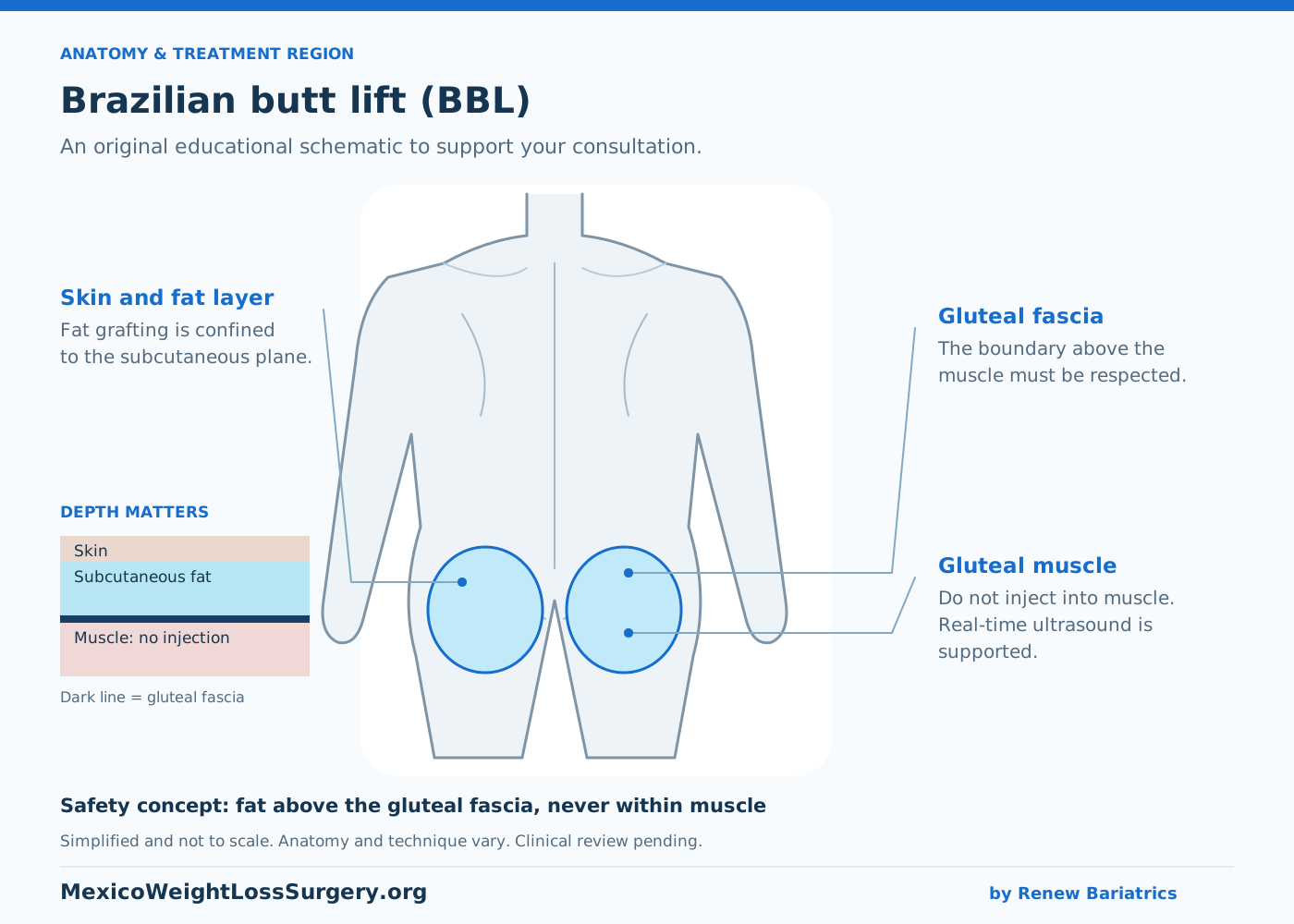
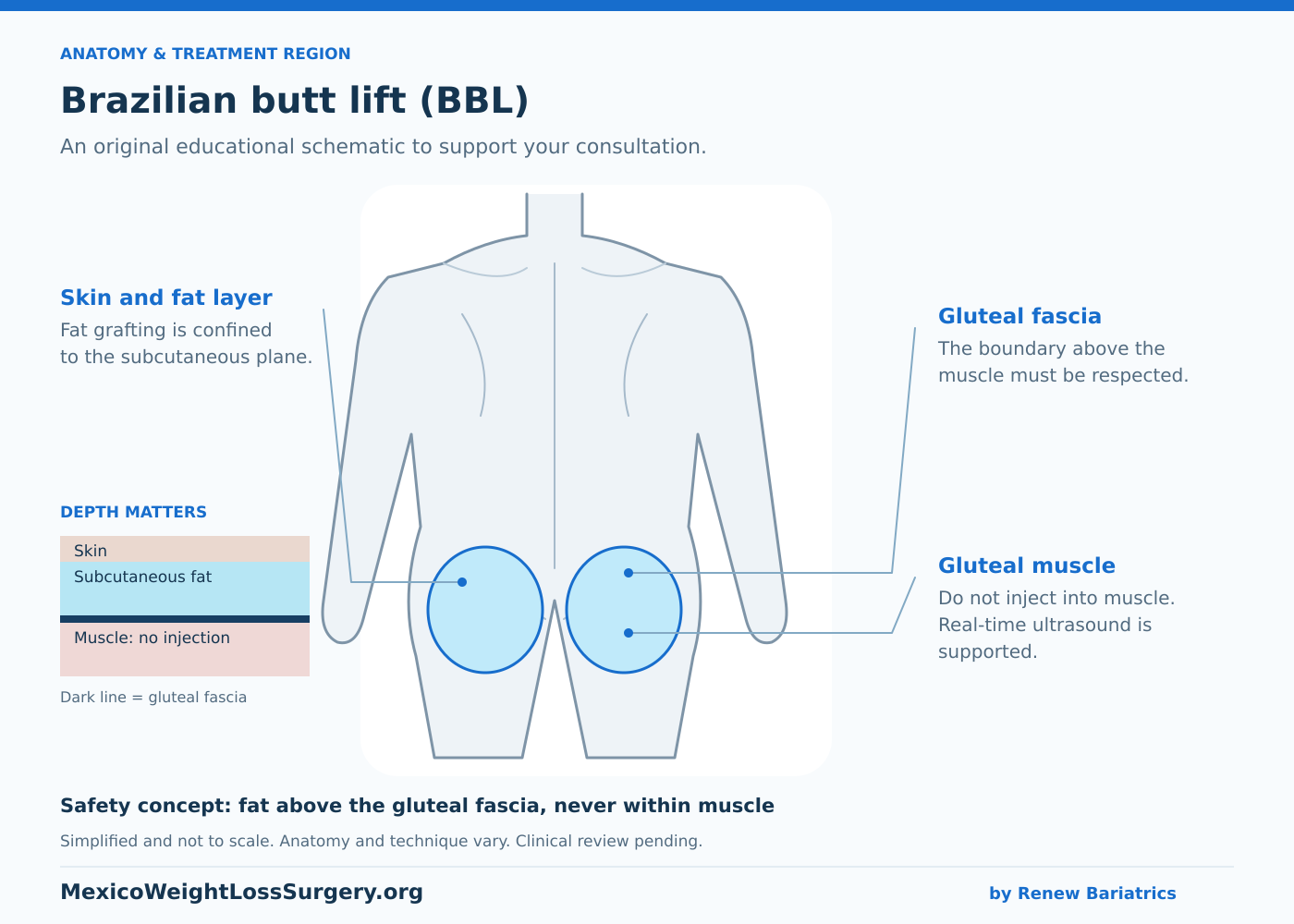
A simplified, labeled view of the structures and treatment area. Select the image to view it at full size.
Anatomy references: ASPS — Brazilian butt lift (BBL) ↗ · ASPS — Liposuction ↗
What is a Brazilian butt lift?
BBL uses liposuction to collect fat from selected areas, processes the collected tissue, and transfers some of that fat to the buttocks. The goal is a change in proportion or contour. It is different from a buttock implant and different from a surgical lift that removes loose skin. The word “lift” can therefore be misleading if your primary concern is hanging skin after major weight loss. [1]
Describe the change you want in practical terms. You might be concerned about asymmetry, a loss of fullness or the relationship between the waist and hips. A photograph can help start a conversation, but another person's anatomy cannot become a template for your operation. Ask which parts of your goal are achievable and which are constrained by your existing tissues.
Fat grafting also involves the donor sites. Discuss those areas with the same care you give the buttocks. Which areas would be treated, what contour changes are intended, and what scars or irregularities could result? You are consenting to a combined process, not an injection considered in isolation.
The amount transferred should follow a clinical plan rather than a social-media trend or a promised maximum volume. Do not judge the quality of a proposal by how much fat a clinic says it can inject. Ask why the surgeon recommends a particular extent of treatment for your body and whether a smaller change would be more appropriate.
The BBL safety issue you should understand first
The 2022 joint statement from ASPS, The Plastic Surgery Foundation, The Aesthetic Society and ASERF describes unusually serious harm and deaths associated with gluteal fat grafting. Fat entering blood vessels can travel to the lungs and cause a fatal embolism. The statement supports keeping injected fat in the subcutaneous space above the gluteal fascia and using real-time ultrasound to monitor cannula position during injection. [2]
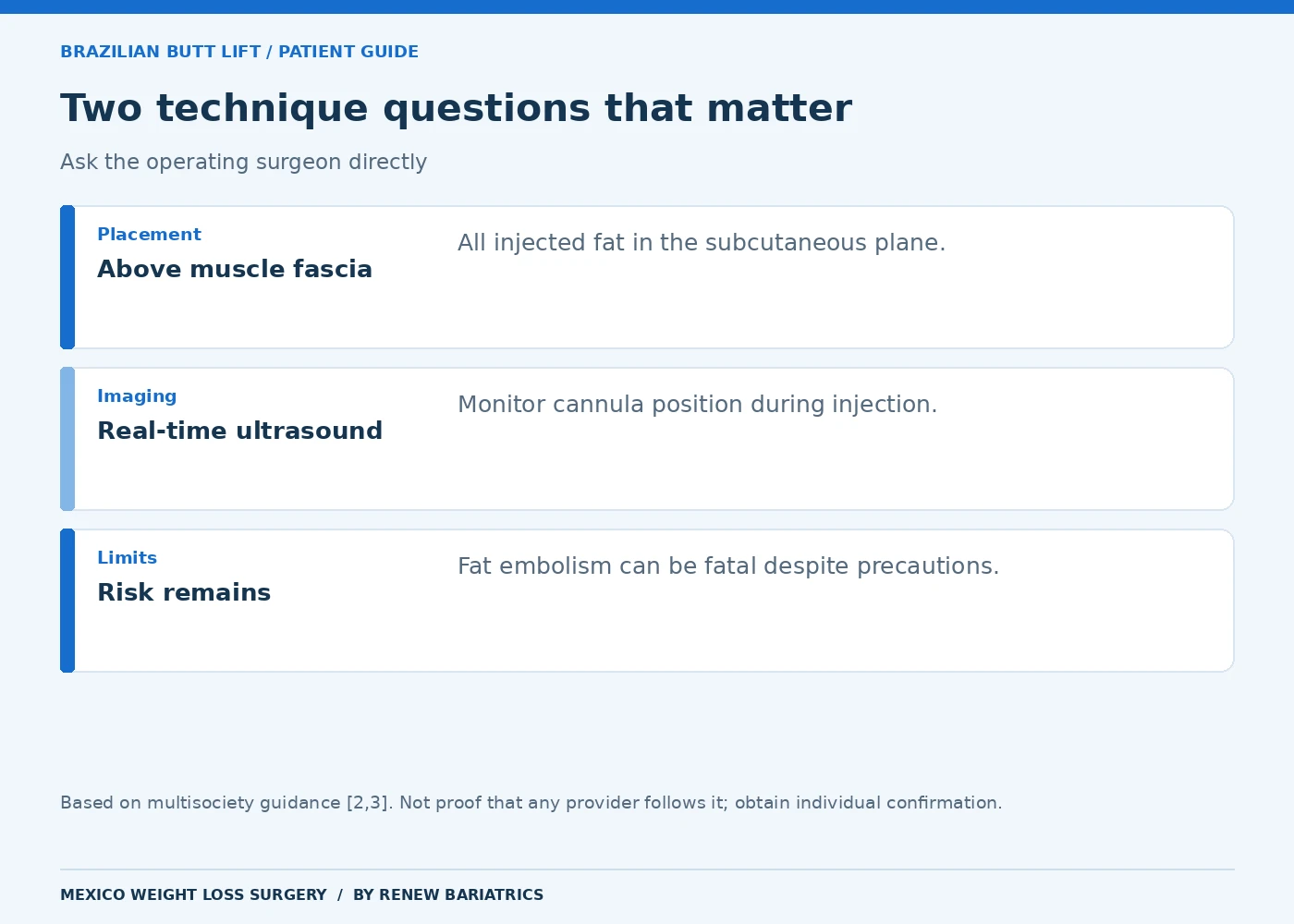
Ask the operating surgeon directly: will all transferred fat remain above the gluteal muscle fascia, and will real-time ultrasound be used during injection? Request a clear explanation of who performs the critical portions of the operation and who monitors the ultrasound image. An answer such as “we have ultrasound equipment” does not explain how it is used.
The societies also emphasize surgeon involvement before and after surgery, appropriate credentials and access to management of complications. These responsibilities remain important when a patient has traveled. Their statement does not certify any particular Mexican clinic or establish that a marketed package meets its recommendations. [2]
Be cautious about “completely safe” or “zero-risk” promises. Ask for the surgeon's own outcome information with the number of patients, time period, follow-up completeness and definition of complications. A percentage without that context cannot tell you much. This guide does not give one mortality estimate because published estimates from different eras, techniques and reporting methods are not interchangeable personal forecasts.
ASPS continues to list its multisociety BBL advisories in its patient-safety resources. Use the guidance as a basis for discussion, and confirm the current rules that apply where you would be treated. U.S. professional recommendations should not be presented as proof of Mexican regulatory compliance. [3]
Who might be a candidate—and who should pause?
A candidate needs suitable donor tissue, realistic expectations and a medical assessment that supports an elective operation. Skin quality and the desired degree of change matter. ASPS describes general physical health and realistic personal goals as key considerations for buttock enhancement. [1],[4]
An online photograph cannot establish your eligibility. The surgeon needs to examine the donor areas and the buttock tissues and understand your medical history. Be open about previous operations, injectable treatments, medications, smoking, alcohol and other substance use. The consultation should also cover what you expect the surgery to change in your daily life. [5]
If you have little available donor fat, ask what that means for the achievable result. Do not deliberately gain weight to qualify without discussing the implications with your clinicians. If you are still losing substantial weight, ask whether to defer the decision until your shape and care plan are more stable.
Someone with significant loose skin may need a different discussion. Adding volume does not automatically solve the problem of excess skin. Ask whether the proposed result depends on an additional skin-removal procedure and whether the scars and recovery of that alternative fit your priorities. Choosing no surgery is also a valid outcome of an assessment.
Consider your ability to manage the recovery restrictions, not just your availability on the surgery date. Who can help you with transport, meals, household responsibilities and follow-up? If you cannot arrange the support the surgeon considers necessary, discuss a different date rather than improvising afterward.
Alternatives worth discussing
Liposuction without fat transfer may address a different contouring goal. A skin-removal operation may be more relevant when lax skin dominates. Implants are another surgical category with their own risks and limitations. Ask the surgeon to explain alternatives separately instead of treating every buttock-enhancement method as interchangeable. [1]
Nonsurgical injections are not an equivalent substitute for a properly assessed operation. FDA information states that dermal fillers, including silicone, are not cleared or approved for body-contouring injections in the United States and warns of serious harm from silicone injections, including embolism and death. This U.S. regulatory information should not be confused with verification of a product's status in Mexico. [6]
If any injectable material other than your own fat is proposed, request the exact product name, indication, regulatory status and a separate explanation of its risks. Do not accept an unlabeled injection or a vague description such as “natural filler.” You should know precisely what is being placed in your body.
Your consultation should produce a written plan
Ask for the full name of the surgeon, the planned facility and the anesthesia provider. Confirm the surgeon's relevant specialist credentials rather than relying solely on a title such as “cosmetic expert.” Ask how you can verify those credentials independently and whether the surgeon has privileges for the procedure at an appropriate facility.
The written clinical proposal should identify donor areas, the intended method, the role of ultrasound, the planned postoperative setting and the follow-up schedule. Record any limitations the surgeon describes. A careful explanation of what cannot be achieved is useful information, not a reason to look for someone who promises more.
Consent should be a conversation you can understand. Ask for an interpreter if needed and request time to review the documents. If a proposed procedure changes after your in-person examination, ask for the revised reasoning and costs before deciding. The inconvenience of travel should not become pressure to accept an operation you have not considered.
Preparing your health and nutrition
Preparation may include medical evaluation, blood tests and individualized medication instructions. Smoking cessation and arranging a responsible adult after outpatient surgery are part of ASPS preparation guidance. Your surgeon and anesthesia team should provide your actual fasting and medication plan. [7]
If you have had bariatric surgery or major medication-associated weight loss, ask whether nutrition needs assessment before another operation. ASPS guidance highlights protein and micronutrient issues after significant weight loss. A tailored nutrition plan is more useful than assuming a standard multivitamin or a high-protein advertisement resolves every concern. [8]
Bring recent records from your bariatric or obesity-care team. Include your current supplements and the foods you can tolerate. Ask who will address an abnormal result and whether it should change the surgery date. Continue the agreed nutrition follow-up rather than treating the cosmetic procedure as the end of your weight-management care.
Make practical arrangements before you travel. Ask about comfortable sleeping positions, assistance with dressing and bathing, access to meals and the equipment the clinic actually recommends. Do not buy an extensive recovery kit from social media without first checking what is relevant to your operation.
What happens on the day of surgery?
Before the operation, you should have an opportunity to review the final plan with the surgeon and anesthesia team. Confirm which areas will receive liposuction and which procedures are included. Ask any remaining questions before receiving medications that could affect your ability to consent.
In broad terms, the operation involves anesthesia, fat collection, processing and transfer. The precise plan depends on your assessment. Fat placement must be discussed in the context of the subcutaneous-only and ultrasound safety recommendations, rather than described simply as “injections into the buttocks.” [1],[2]
Ask what postoperative monitoring is planned and what criteria determine discharge. If overnight observation is recommended, find out whether it is clinical monitoring or accommodation only. A hotel room, recovery residence and hospital bed are not interchangeable descriptions of care.
Your companion should receive the relevant discharge instructions with your permission. Before leaving, make sure both of you know the clinical contact number, the medicines prescribed, the follow-up appointment and the route to urgent care. Written instructions are easier to use than relying on a conversation remembered after anesthesia.
Recovery: protect healing and plan ordinary life
After fat grafting, surgeons commonly restrict prolonged sitting and direct pressure on the buttocks. ASPS describes avoiding prolonged sitting for about two weeks, sometimes longer, and using specified positioning strategies. Your own surgeon must decide the duration and method appropriate for your operation. [9]
Ask how restrictions apply to meals, bathroom use, working at a computer and riding in a car. A generic instruction to “use a pillow” does not resolve all of those situations. Have the team demonstrate the intended positioning and explain how it fits with safe movement and transport.
Dressings, compression garments and sometimes drains may be part of recovery. Ask where compression is intended and where pressure should be avoided. Obtain instructions for garment fit, bathing, drain care and the point at which a concern needs examination. Do not change garment pressure or add massage simply because someone online reports a good experience. [9]
Your return to exercise should be cleared by your surgeon. Early comfort does not necessarily mean the tissues are ready for every activity. Explain your sport or workout rather than asking only when you can “exercise.” Cycling, running, strength training and swimming place different practical demands on a recovering person.
Time away from work also depends on the job. If you sit throughout the day, commute for hours or cannot change position, discuss those details before booking. Ask whether you need modified duties and how to obtain a reassessment if your recovery does not follow the initial estimate.
Results, fat retention and scars
Some transferred fat is reabsorbed, so immediate postoperative fullness is not the final result. NHS guidance describes the appearance evolving over months. Do not interpret early photographs as proof of the amount of fat that will remain. [10]
ASPS notes that results are not guaranteed and another operation may sometimes be needed. Aging, weight changes and tissue quality also affect how an outcome looks over time. A follow-up plan should distinguish normal settling from a concern that requires assessment. [11]
Ask where the liposuction and grafting access scars will be. Even small incisions can leave visible marks. If you have a history of raised or darkened scars, mention it during the consultation and ask what that history means for your choices.
Avoid using another patient's photographs as a promise. Lighting, pose, clothing, time since surgery and the selection of images can all affect what a gallery communicates. Ask to see comparable cases with appropriate consent and follow-up context, while recognizing that your anatomy and recovery remain individual.
Other risks and urgent symptoms
Beyond fat embolism, buttock enhancement can involve bleeding, infection, fluid collections, fat necrosis, poor healing, asymmetry, persistent pain, sensation changes and a need for revision. Blood clots and cardiopulmonary complications are also possible. Ask how your health and any proposed combined procedures change that discussion. [12]
Sudden shortness of breath, chest pain, collapse or an unusual heartbeat require immediate medical attention. Do not wait for an online reply or attempt to travel home for evaluation. Contact the surgical team promptly about worsening pain, concerning swelling, fever or wound changes; ask for written instructions tailored to your operation. [9],[12]
Your recovery plan should identify where you would go for emergency assessment and how the surgeon participates if you are admitted elsewhere. Ask who can provide records quickly. A companion needs this information too, especially if language or an unfamiliar location could make urgent care harder to navigate.
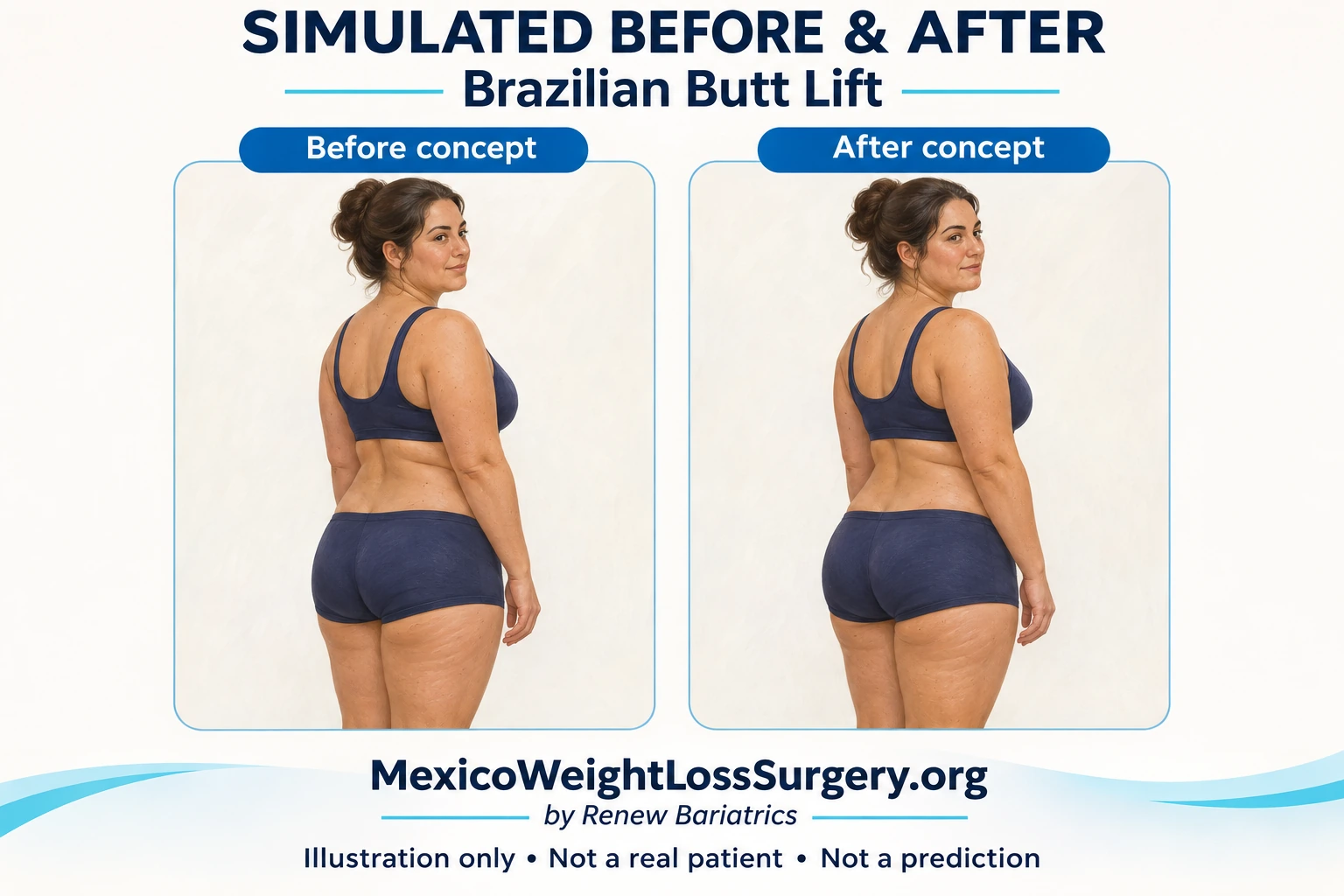
A synthetic illustration of possible changes
This fictional example illustrates a treatment concept. It cannot show the result you would achieve, predict scar healing, or establish a typical outcome.
Brazilian Butt Lift Cost in Mexico
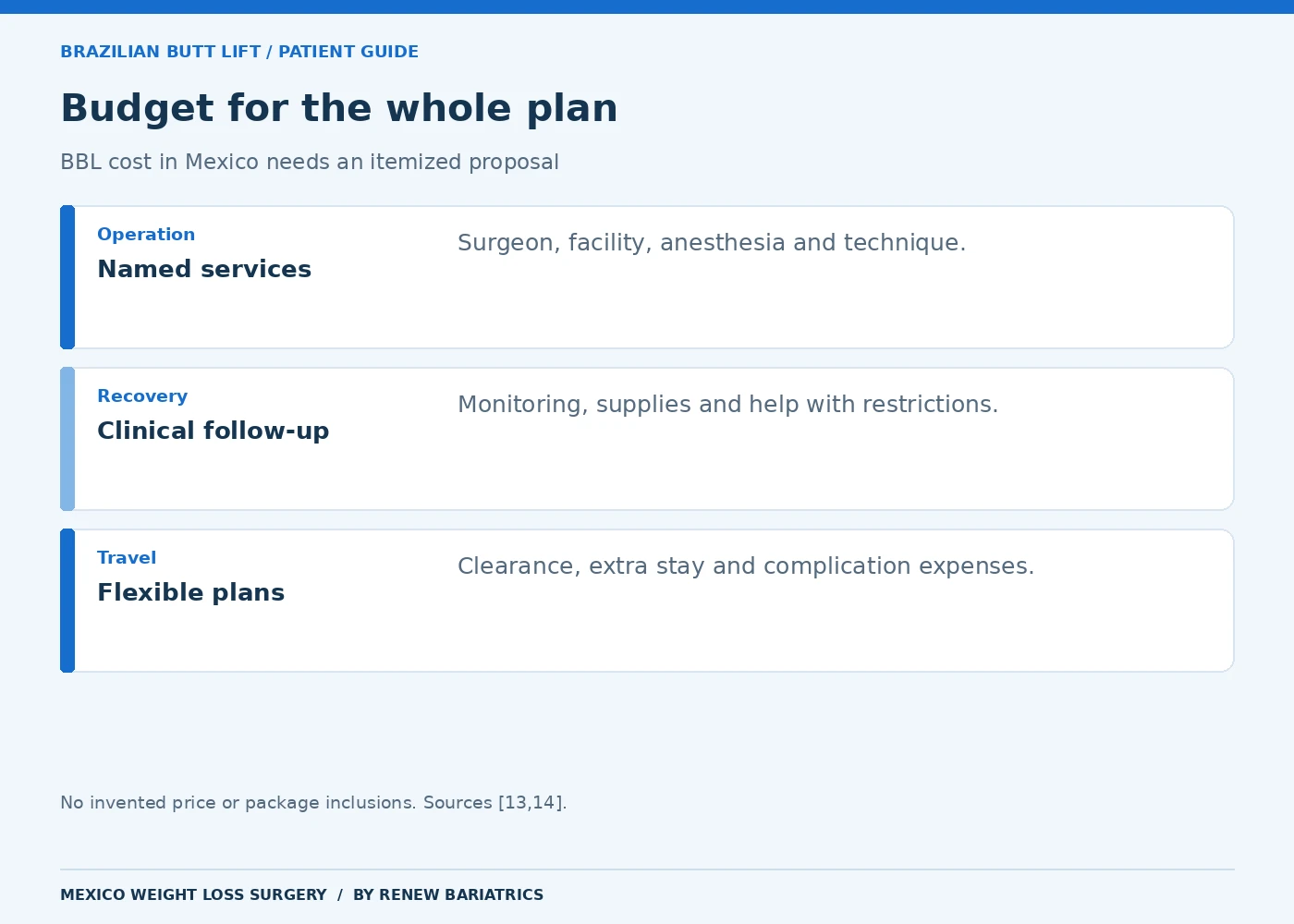
BBL cost in Mexico depends on the surgeon's plan, donor areas, anesthesia, facility and postoperative needs. There is no verified Renew price in this guide. ASPS cost guidance distinguishes the surgeon's fee from the full cost of care and identifies tests, garments and recovery pillows as possible additional expenses. A published U.S. average is not a Mexico quote. [13]
Request an itemized proposal that specifies the fat-harvesting areas, the surgeon and facility, anesthesia, ultrasound-guided treatment, monitoring and scheduled follow-up. Ask whether garments, medicines, tests and any required overnight stay are included. If the quote uses a package name, request the actual components underneath it.
Keep travel expenses separate: transport, accommodation, a companion, meals, time away from work and a possible extended stay. Then ask about complications. Which costs would you pay if you needed imaging, emergency care, admission or another operation? Do not assume a package covers every problem that occurs afterward.
Compare the same clinical plan when reviewing offers. A lower number may reflect fewer treatment areas, different monitoring or excluded services. Ask about deposit terms, changes after examination, cancellation and postponement. Obtain the terms before arranging nonrefundable travel.
Why can't I get an exact BBL price from a guide?
A webpage cannot examine donor tissue, determine whether the operation is appropriate or establish your monitoring needs. Request a current written quote after clinical review. If the plan later changes, ask for an updated total before you agree.
Traveling to Mexico and returning home
Travel should be organized around medical readiness, including the pressure restrictions specific to BBL. Ask how the entire route home will work: vehicle rides, border delays, airport seating, boarding and connections. Do not assume a purchased pillow or a short flight solves the clinical issues.
CDC identifies additional clot risk from postoperative travel and recommends a plan for complications and continuity of care. The surgeon must individualize your clearance; a hotel checkout date is not medical clearance. Obtain operative and discharge records for clinicians who may see you after you return. [14]
Before booking, identify a local clinician willing to provide appropriate follow-up at home. Ask the surgical team how communication will work between appointments and which concerns require an examination rather than a photograph. Keep emergency care separate from routine messaging.
Questions that deserve clear answers
- Will fat be placed only above the gluteal fascia in subcutaneous tissue?
- Will real-time ultrasound guide the injection, and who performs it?
- Who carries out the critical portions of my operation?
- What are the limitations of my donor tissue and skin?
- Which complications can this facility manage, and where would I be transferred?
- Who provides clinical care after discharge and after I return home?
- How will sitting restrictions affect my job and travel?
- What is excluded from the written quote?
Take the answers away and consider whether they are specific enough to support a decision. You do not need to accept a treatment because it is popular, available on your preferred date or bundled with another procedure.
Your next step with Renew Bariatrics
Renew lists Brazilian butt lift among its plastic surgery options. Ask for a current consultation, a named operating surgeon and a detailed written proposal that addresses safety, recovery and total cost. [15] A sensible assessment may lead to a smaller change, a different operation, a delay or no surgery. Your decision should rest on a realistic goal and a care plan you understand, including the serious risks that remain even when precautions are used.
Program information related to this guide
Explore Renew Bariatrics’ procedure options when discussing a plastic surgery plan. Availability, combinations and suitability require individual confirmation.
Brazilian butt lift (BBL) vs. liposuction
These procedures address different concerns and may be combined or staged. A clinical assessment determines which, if either, fits your anatomy and goals.
| What to compare | Brazilian butt lift → | Liposuction → |
|---|---|---|
| Main goal | Adds buttock volume using transferred fat. | Reduces selected fat deposits. |
| What changes | Donor fat removal plus subcutaneous grafting. | Fat beneath the skin. |
| Key distinction | Fat embolism can be fatal. | Does not remove excess skin. |
| Recovery consideration | Pressure restrictions and follow-up are procedure-specific. | Swelling and garment plans vary. |
| Cost comparison | Request an itemized quote for this exact procedure and care plan. | Compare the same inclusions, exclusions and recovery expenses. |
Comparison references: ASPS — Brazilian butt lift (BBL) ↗ · ASPS — Liposuction ↗
These options are not interchangeable for every person. The treating clinician must assess your anatomy, medical history and goals.
Discuss your options with Renew.
Talk with a coordinator about brazilian butt lift, your goals and the information needed for clinical review. The treating team determines suitability and the care plan.
Call 844-736-3963 Ask about plastic surgery ↗The link opens Renew’s plastic surgery health questionnaire. This review site does not collect health information.
References & evidence notes
Sources checked November 2026. Research findings are not a forecast for an individual or outcomes for Renew’s own program. Review study populations, methods and limitations alongside the reported results.
- American Society of Plastic Surgeons. Buttock Enhancement: Procedure ↗Institutional patient education; individual clinical assessment required.
- ASPS, PSF, The Aesthetic Society and ASERF, 2022. Gluteal fat grafting: joint safety statement ↗Multisociety safety statement; subcutaneous-only plane, real-time ultrasound, credentials and postoperative responsibility. Precautions do not eliminate risk.
- American Society of Plastic Surgeons. Patient Safety Advisories ↗Current index retains 2022 gluteal fat-grafting statement; professional guidance is not Mexican regulatory certification.
- American Society of Plastic Surgeons. Buttock Enhancement: Candidates ↗Institutional patient education; individual clinical assessment required.
- American Society of Plastic Surgeons. Buttock Enhancement: Consultation ↗Institutional patient education; individual clinical assessment required.
- U.S. Food and Drug Administration. Non-invasive body contouring technologies ↗U.S. regulatory context; does not establish authorization in Mexico.
- American Society of Plastic Surgeons. Buttock Enhancement: Preparation ↗Institutional patient education; individual clinical assessment required.
- American Society of Plastic Surgeons, 2026. Nutrition recommendations after major weight loss ↗Society summary of nutritional review; not an individualized supplementation protocol.
- American Society of Plastic Surgeons. Buttock Enhancement: Recovery ↗Institutional patient education; individual clinical assessment required.
- NHS. Surgical fat transfer ↗Institutional patient education; individual clinical assessment required.
- American Society of Plastic Surgeons. Buttock Enhancement: Results ↗Institutional patient education; individual clinical assessment required.
- American Society of Plastic Surgeons. Buttock Enhancement: Safety ↗Institutional patient education; individual clinical assessment required.
- American Society of Plastic Surgeons. Buttock Enhancement: Cost ↗Institutional patient education; individual clinical assessment required.
- CDC Yellow Book. Medical tourism ↗Travel, complication planning and continuity of care; does not establish personal flight clearance.
- Renew Bariatrics. Bariatric surgery and plastic surgery options in Mexico ↗Official procedure directory; not independent outcome verification or an individual quote.