
Jump to a section
Anatomy illustrationSynthetic illustrationCompare proceduresRelated ProceduresWhat does torsoplasty mean?What upper-torso contouring can changeWho may be a candidate?Nutrition after bariatric weight lossPlanning the operationScars, closure, and drainsRisks of torsoplasty and upper-back contouringRecovery after upper-torso contouringSymptoms that need prompt attentionTorsoplasty Cost in MexicoTravel planning and follow-upFrequently asked questionsRequest a clearly defined consultationYour next stepReferencesTorsoplasty in Mexico can refer to contouring loose skin around the torso after major weight loss, but the name alone does not tell you which operation is proposed. Renew Bariatrics uses torsoplasty for upper-back and side contouring and lists lower-back lift separately. Understanding that distinction is essential when comparing results, recovery demands, and torsoplasty cost in Mexico.[1]
This guide focuses on upper-back and lateral torso contouring. It explains how to clarify the operation, evaluate scars and risks, and request an itemized quote. It does not assume that a breast lift, tummy tuck, or circular body lift is included. Each additional procedure requires its own assessment and consent.
The illustrations feature fictional fully clothed people and educational concepts. They are not patient testimonials, before-and-after comparisons, or predictions of your result.
Understand the anatomy
A simplified, labeled view of the structures and treatment area. Select the image to view it at full size.
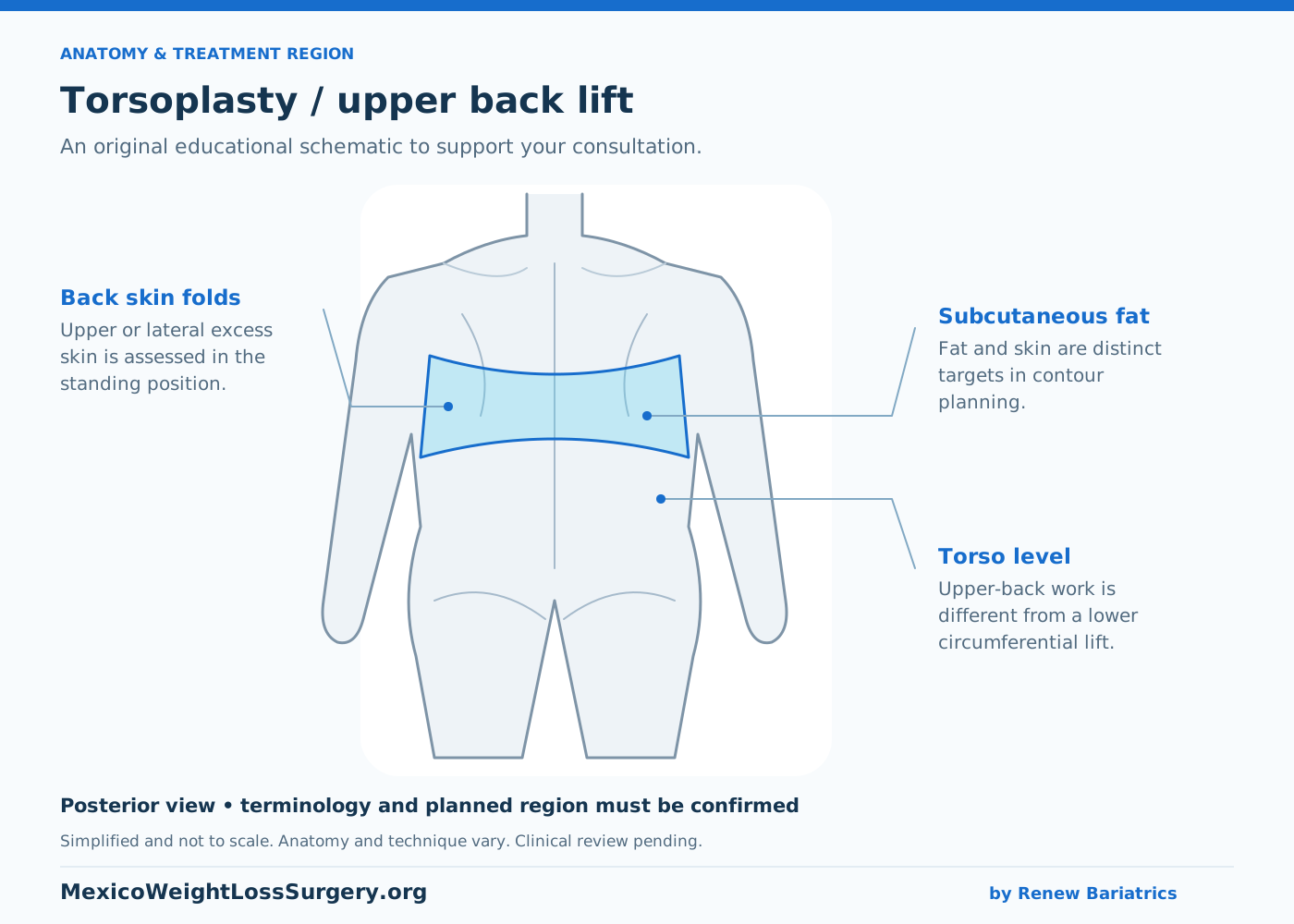
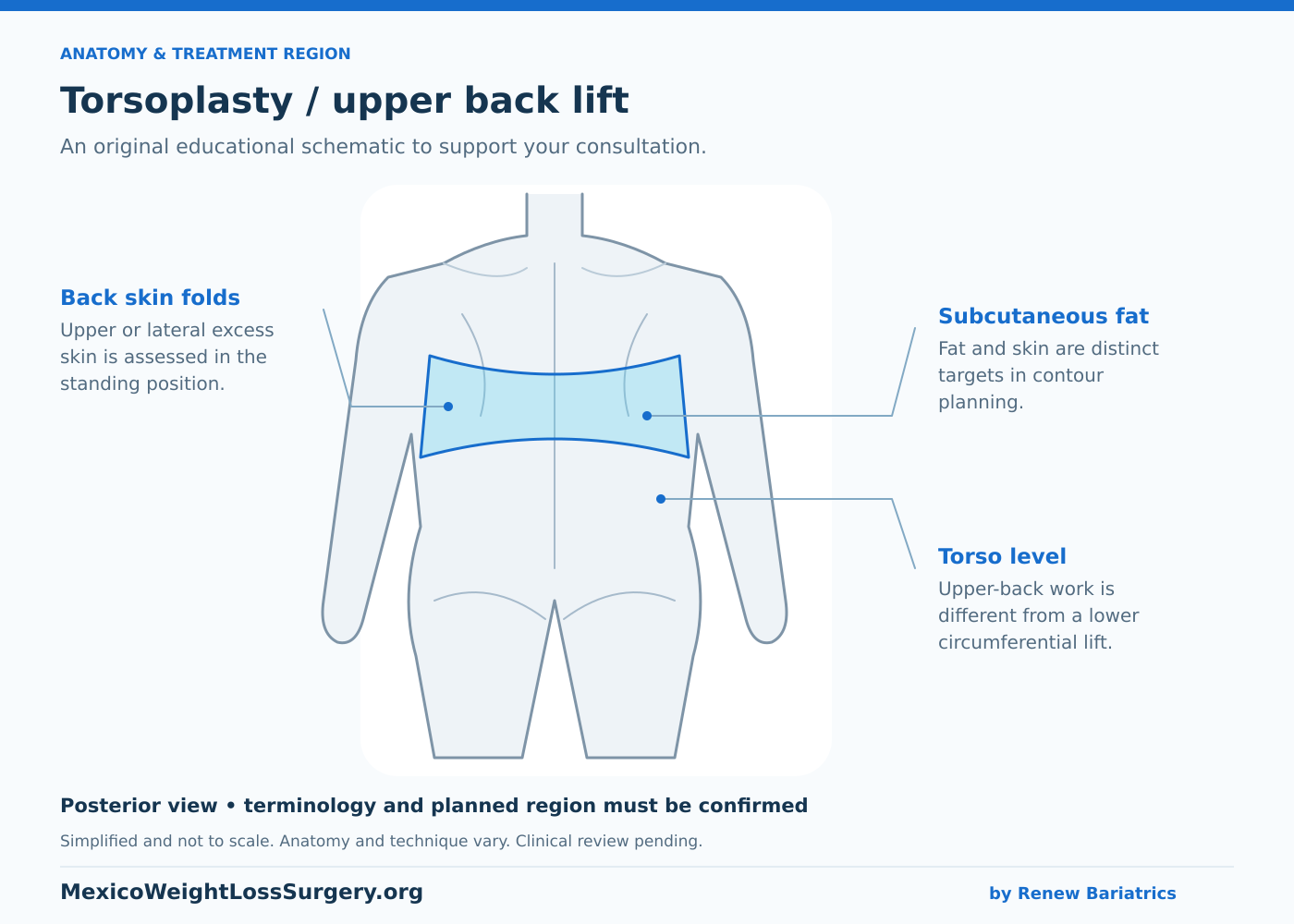
Anatomy references: ASPS — Surgical treatment of skin redundancy ↗ · ASPS — Circular tummy tuck ↗
What does torsoplasty mean?
Terminology varies between surgeons and publications. An ASPS practice parameter uses torsoplasty broadly for a combination of torso procedures, including abdominal, flank, and breast components. In contrast, a clinic may use the same word for a more localized upper-back or side lift. There is no safe way to infer the complete operation from the name alone.[2]
For your consultation, replace the label with three concrete questions: which regions are treated, where will the incisions lie, and which direction will the tissue be moved? Request a drawing that answers all three. A quote and consent form should describe the actual plan in language you can understand.
Upper-back lift or bra-line back lift
A bra-line back lift is a described approach to redundant skin and fat across the upper back. The name refers to a possible scar location, not a procedure exclusively for people who wear bras. Tissue attachment patterns in the upper torso affect where folds form and how they can be treated.[3]
Ask how the proposed scar relates to your usual clothing. A scar cannot be guaranteed to remain hidden under every garment or in every position. If you do not wear a bra, the same practical question applies to shirts, swimwear, and clothing you prefer. Your surgeon should discuss the actual incision rather than using a garment name as a promise of concealment.
Lateral torso lift
Lateral contouring addresses the sides of the upper torso. Depending on your anatomy and the plan, treatment may connect with an arm or breast-region procedure. Ask whether these are separate operations or components of the proposed torsoplasty. Renew's procedure listing also uses lateral torsoplasty in a combined breast-reduction description, which makes clarification especially important.[1]
Lower-back lift and circular body lift
Lower-body procedures commonly address the abdomen, flanks, lower back, buttocks, or adjacent thighs. A belt lipectomy or circumferential lower-body lift is therefore not automatically the same as an upper-back lift. The areas can overlap, but the purpose, scars, and recovery plan may differ.[2],[6]
If your concern spans both the upper and lower back, ask the surgeon to identify what one operation could reasonably improve and what would remain. A longer list of procedure names is not necessarily a clearer plan. A region-by-region drawing is often more useful.
What upper-torso contouring can change
The operation may remove redundant skin and associated fat to reduce folds and change contour. It is not an obesity treatment and does not promise a target weight loss. Liposuction and skin excision address different aspects of a contour problem; the examination should establish whether fat, skin laxity, or both are responsible.[3],[6]
Describe your goals in everyday terms. You may be concerned about a fold visible through clothing, discomfort where fabric presses, or a side contour that remains after weight loss. Identify the issue that matters most and ask how the proposed operation addresses it. This helps avoid treating a larger area simply because it is technically possible.
Limits worth understanding before booking
An upper-back procedure does not automatically lift the breasts, remove abdominal excess, narrow the waist, or correct all skin texture. Each of those goals may involve different anatomy and a different procedure. Ask the surgeon to separate expected improvement from possible incidental changes and from areas that will not be treated.[2],[3]
The result also includes scars. For some people, trading a fold for a visible scar is worthwhile; for others, it is not. Neither preference is wrong. The decision should be based on the tradeoff you can accept, not on an assumption that a skilled surgeon can avoid meaningful scarring altogether.[10]
Who may be a candidate?
General body-lift guidance describes candidates as people with significant soft-tissue laxity, realistic expectations, and health that supports surgery and healing. Nonsmoking and adequate nutrition matter. These principles help frame an assessment, but an upper-torso plan still requires an individual examination.[7]
Discuss your weight trend and treatment history. If you are still losing substantial weight or have recently changed weight-management treatment, ask whether the timing is appropriate. A preoperative review should consider weight stability, medical conditions, nutrition, social support, and clot prevention rather than treating appearance as the only criterion.[12]
Previous operations and existing symptoms
Bring details of prior breast, chest, abdominal, or back surgery and any radiation or lymph-node treatment. Tell the surgeon about existing numbness, swelling, pain, unusual scars, or difficulty healing. The team needs a baseline before deciding what new surgery may change.[8]
Do not assume that a previous scar can be removed or hidden by the next operation. Ask which scars will remain, whether new incisions intersect them, and whether that affects planning. If records from an earlier operation are available, ask whether the surgeon needs them rather than relying on memory alone.
When waiting may be the better plan
Elective contouring can be delayed while health, nutrition, or recovery arrangements improve. Ask what specific finding needs attention and what would demonstrate readiness. A useful answer names the issue and the next assessment rather than leaving you with a vague instruction to become healthier.[7],[12]
You can also decide not to proceed. If the scar position, cost, or support requirements do not fit your priorities, that is a valid outcome of consultation. The purpose of assessment is to identify an appropriate choice, not to ensure that every inquiry ends in surgery.
Nutrition after bariatric weight loss
Your weight-loss history remains relevant even if it has been years since bariatric surgery. Share your current intake, supplements, recent laboratory results, and any persistent food intolerance. Ask who will assess nutrition and how identified problems will be corrected before an elective procedure.[12]
General institutional guidance on body contouring emphasizes evaluating the person and planning procedures around the areas affected after major weight loss. Use that consultation to connect your ongoing bariatric follow-up with the plastic-surgery plan rather than treating them as unrelated episodes of care.[11]
Practical questions are useful: what meals can you tolerate after anesthesia, who will prepare them, and whom should you contact if intake becomes difficult? Ask whether your bariatric clinician and dietitian should contribute to preparation. A supplement list alone does not explain whether your current intake supports the planned recovery.
Planning the operation
ASPS describes consultation as a review of goals, health history, medications, previous surgery, examination, and discussion of treatment options and risks. For torsoplasty, make the terminology question part of that review. Ask the surgeon to state whether the plan is upper-back only, lateral only, combined upper torso, or part of a broader body lift.[8]
Ask to see the incision plan from the back and side, not only the front. Discuss how it may look with arms down and raised. Clinical photographs can support this conversation, but they should be used to document your anatomy and planning rather than imply an exact future appearance.
Combining or staging procedures
A proposed combination deserves a separate explanation. If breast, arm, abdominal, or lower-body surgery is included, ask what each component adds and how the combined recovery differs. Consider which movements will remain available to help you get up, dress, and care for yourself when more than one area is healing.
A staged plan may involve additional travel and cost, but a single combined operation is not automatically preferable. Ask why the surgeon recommends one approach for your health and anatomy. Request an alternative plan if a proposed component is optional, so you can compare both the medical and practical implications.
Facility and anesthesia questions
Preparation can include medical evaluation, laboratory testing, medication review, and addressing smoking. ASPS advises appropriate surgical facilities and arrangements for assistance after outpatient care. Confirm where your operation will occur, who provides anesthesia, and how unexpected needs for higher-level care are managed.[9]
Ask for the names and roles of the clinicians actually involved rather than assuming that a brand name identifies the operating surgeon. Independently verify relevant credentials and facility authorization through appropriate organizations. Marketing descriptions can introduce a service, but they do not replace verification of the person and location providing it.[14]
Scars, closure, and drains
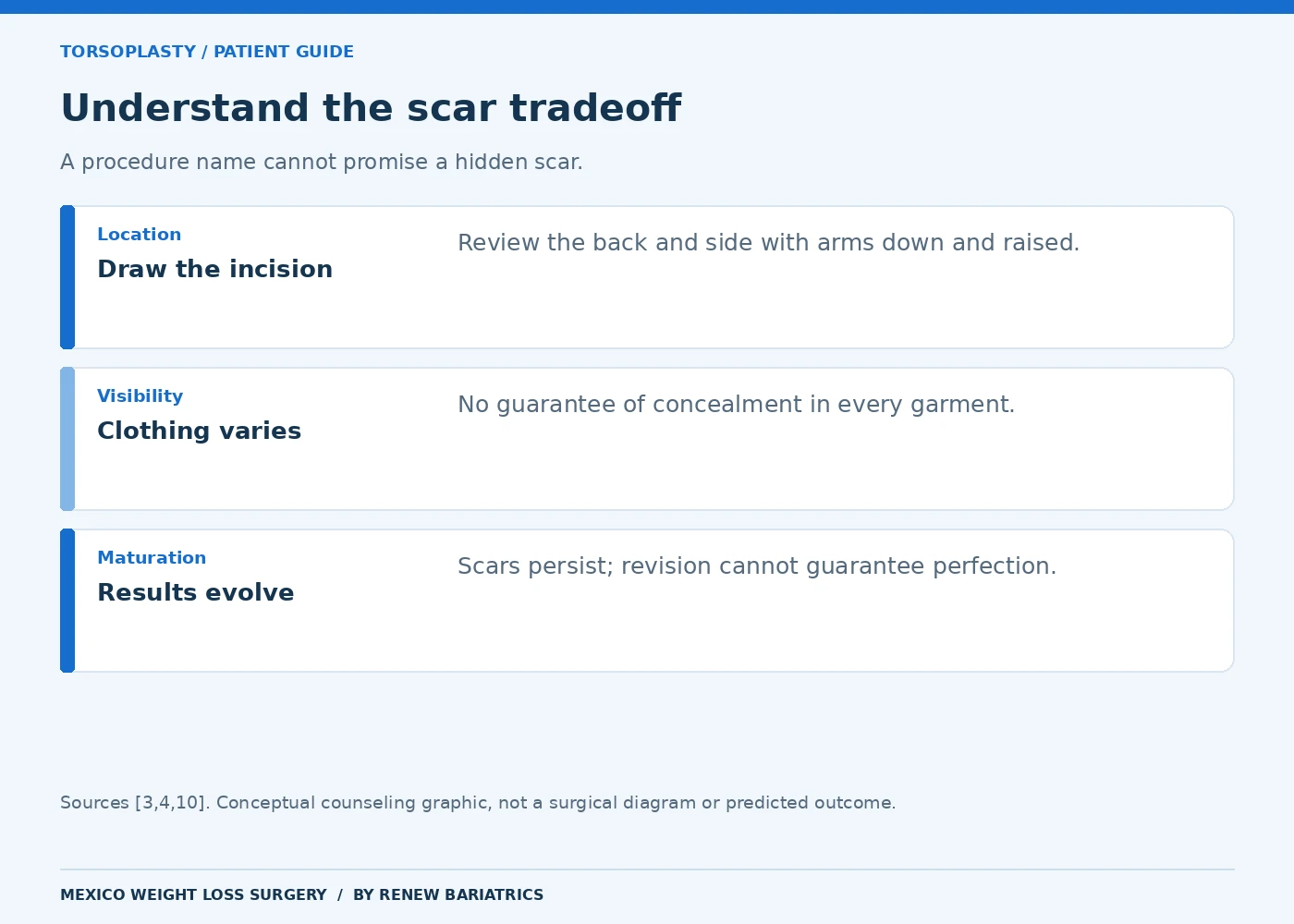
The scar pattern depends on the tissue being removed and the technique. Ask whether the incision runs across the back, along the side, or connects with another surgical region. Have the surgeon explain the likely position and limitations without promising that clothing will always conceal it.[3]
A published technique article describes a layered closure approach for bra-line back lift. That is a description of one method, not proof that every operation can be drain-free or that seroma risk disappears. If a clinic proposes a particular closure method, ask what it changes in your care and what monitoring still remains necessary.[4]
Scars may remain conspicuous, widen, or require further treatment. Early photographs cannot establish how your scar will mature. Discuss what scar review is included and how a possible revision would be assessed. A policy covering revision should also explain costs and timing; it should not be presented as an assurance of a perfect first result.[10]
Risks of torsoplasty and upper-back contouring
Recognized body-lift risks include bleeding, infection, fluid collection, poor wound healing, skin or fat loss, altered sensation, persistent pain, unfavorable scars, asymmetry, recurrent looseness, blood clots, and anesthesia-related complications. The exact risk profile depends on the regions treated and any combined procedures.[13]
Ask about lymphatic drainage and persistent swelling as well as visible wound problems. These are important functional issues to discuss, particularly if you already have swelling or previous treatment affecting the region. A surgeon should explain which findings require further assessment and how postoperative changes will be monitored.[13]
What the research can reasonably support
Upper-back contouring literature includes descriptions of techniques and small clinical series. A report of seven patients undergoing a specific combined upper-body-lift and breast auto-augmentation approach illustrates how narrowly defined some evidence is. Findings from that combination cannot establish the risk of every operation marketed as torsoplasty.[5]
The term itself creates another limitation: studies may group different areas or combinations under similar labels. Before accepting a success or complication statistic, ask whether the patients had the same operation being proposed to you. A number from a lower-body lift cannot automatically describe an isolated upper-back lift.[2],[5]
This page therefore does not present a universal torsoplasty complication percentage or claim a predictable amount of improvement. Ask the surgeon for relevant experience, how outcomes are measured, and what follow-up is available. Evidence should help you understand uncertainty rather than conceal it behind a single reassuring number.
Recovery after upper-torso contouring
Recovery instructions may cover dressings, drains, medication, bathing, activity, and follow-up. Have the team demonstrate any tasks you or your companion must perform. Confirm whom to contact and what to do if an instruction is unclear after discharge.[15]
A back incision can be difficult to inspect or reach yourself. Discuss who will help with the specific care your surgeon prescribes. The plan should work in your actual lodging and at home, including bathroom access, clothing, transport, and a comfortable resting arrangement.
Sleeping, reaching, and daily movement
Ask the surgeon to demonstrate permitted sleeping and resting positions and explain any limits on reaching, twisting, pushing, or lifting. These details depend on the incision and other procedures. Do not assume that instructions for a tummy tuck or another person's back lift apply to your operation.[15]
Plan around tasks rather than the phrase normal activity. Computer work, laundry, lifting a child, overhead shelving, and carrying luggage demand different movements. Ask which you may do independently, which require help, and which must wait. A clear task list is easier to follow than an overly broad restriction.
Compression and medications
If a garment is recommended, ask about fit, duration, skin checks, and what symptoms should trigger a call. More pressure is not automatically better. Obtain a written medication plan that accounts for existing prescriptions and your bariatric history, including who authorizes changes and when medications may resume.[9],[15]
Do not choose anticoagulants, antibiotics, or pain medicines from another patient's schedule. Clot prevention and postoperative surveillance require individual assessment. Tell the team about any difficulty following the plan, including cost, side effects, or inability to manage a prescribed task.[12]
Work, exercise, and longer-term change
Ask for work restrictions based on your actual duties and travel requirements. Return to driving requires safe movement and freedom from impairing medication, with clinical clearance. Exercise should resume according to your wound progress and the treating team's instructions rather than an advertised universal deadline.[15]
Body-lift results evolve as swelling settles and scars mature. Aging and future weight changes can alter the contour, and further surgery may be needed in some circumstances. Stable weight supports durability but does not guarantee a permanent, unchanging shape.[10]
Symptoms that need prompt attention
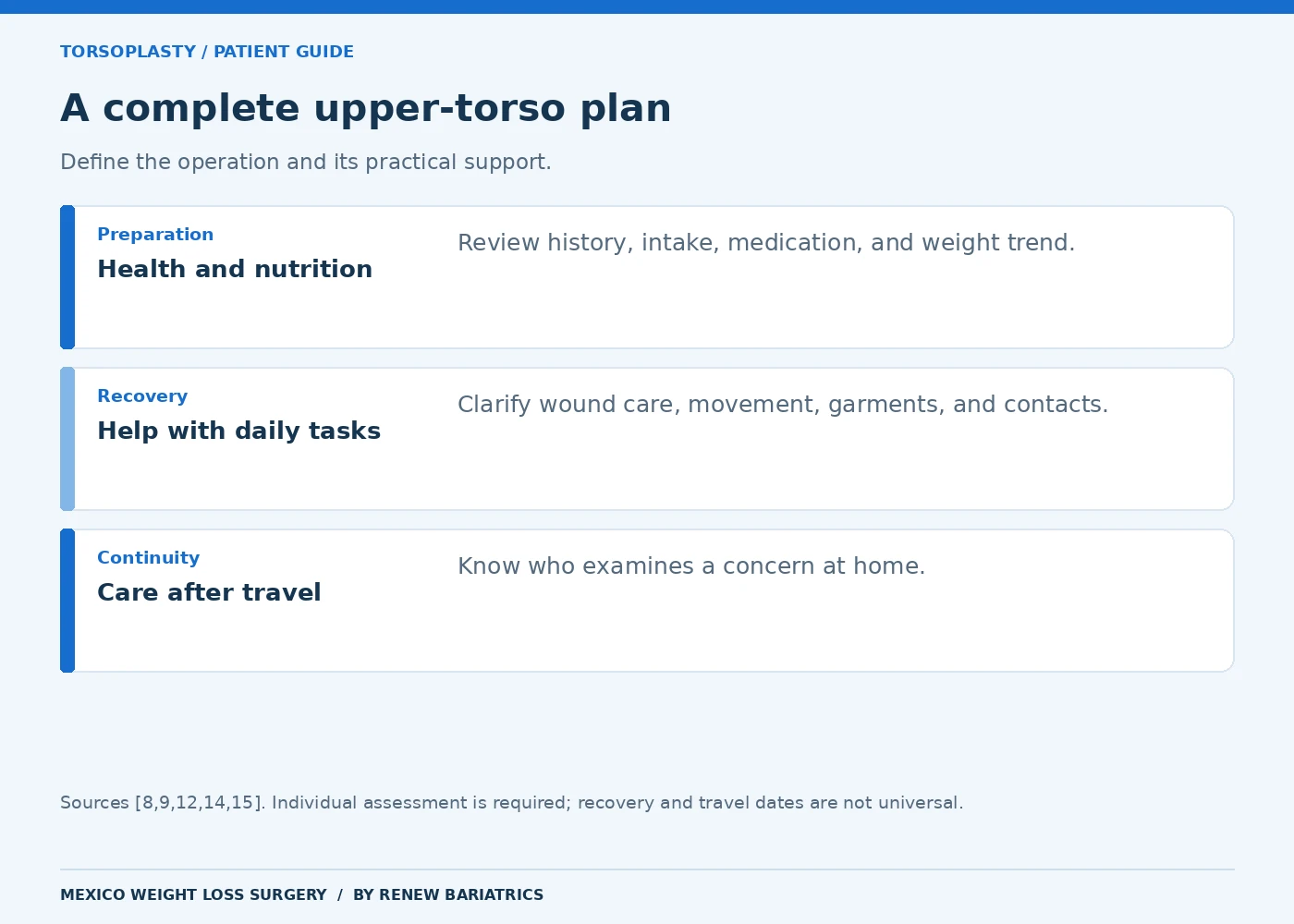
Seek emergency care for sudden shortness of breath, chest pain, fainting, or other severe symptoms. Contact the surgical team promptly about concerning wound changes, fever, increasing redness, or unusual drainage, following the specific discharge instructions. Do not wait for a routine online reply if you may need urgent care.[15],[16]
Before discharge, identify the local facility that can assess an urgent problem and clarify who coordinates that care. After returning home, tell any treating clinician where and when surgery occurred and provide the operative records. A remote photograph may help communication but cannot replace every necessary examination.
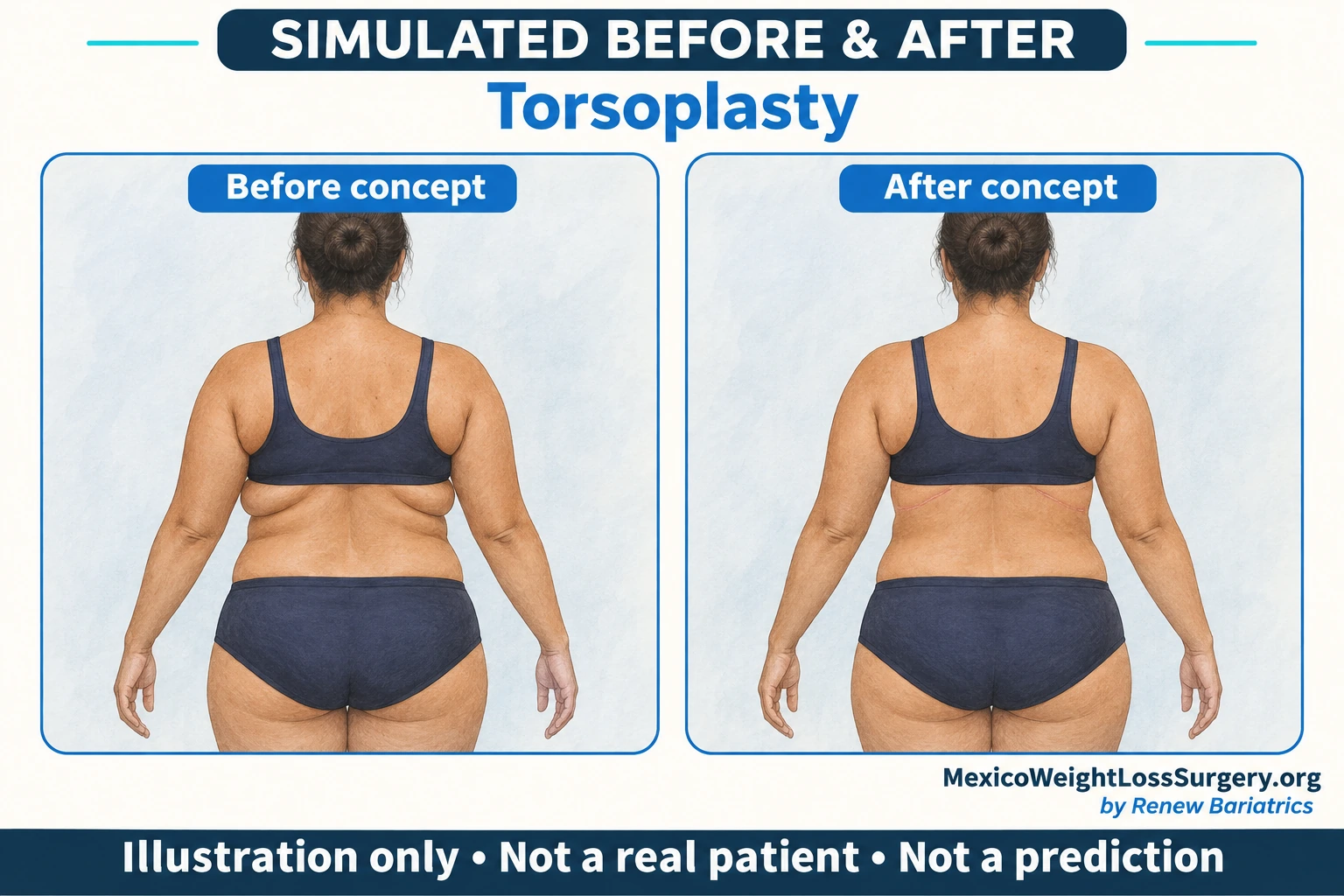
A synthetic illustration of possible changes
This fictional example illustrates a treatment concept. It cannot show the result you would achieve, predict scar healing, or establish a typical outcome.
Torsoplasty Cost in Mexico
Torsoplasty cost in Mexico is especially difficult to compare without a precise definition of the operation. An isolated upper-back lift, lateral torso lift, combined breast-and-side procedure, and circular body lift can involve very different surgical scopes. This page does not quote a price because a current individualized Renew estimate has not been verified.
Start with a written description of regions treated and procedures included. Ask whether liposuction, breast surgery, arm surgery, or lower-back treatment is separate. The estimate should match the surgeon's diagram and consent plan. A package name is not enough to establish that two quotes cover the same care.
Request itemized surgeon, anesthesia, facility, laboratory, garment, medication, scheduled follow-up, and overnight-care charges. Have the team identify exclusions clearly. Separately budget lodging, flights, local transport, companion expenses, meals, time away from work, and possible additional nights.
Ask how unplanned care is billed: wound visits, drainage, hospitalization, another procedure, or revision. Clarify whether any revision policy includes anesthesia and facility fees or only part of the expense. Confirm currency, deposit requirements, cancellation terms, quote validity, and what happens if the examination changes the plan.
A useful cost comparison evaluates the complete operation and its aftercare. It should also reflect your ability to remain near the surgical team if travel is delayed. The lowest headline price cannot establish which choice is appropriate for your anatomy or medical circumstances.
Travel planning and follow-up
Discuss travel clearance with the surgeon before buying inflexible tickets. Surgery and prolonged sitting can increase clot risk, and the operation's extent affects recovery. Confirm insurance coverage and arrange follow-up at home. Obtain your records before departure so another clinician can understand the care you received.[14]
Plan a contingency for an extended stay and identify who will help with luggage and appointments. Medical clearance should guide the return date, not the other way around. Ask how the team will communicate with a clinician at home if a wound problem or other concern develops.
Frequently asked questions
Is torsoplasty the same as a lower body lift?
Not necessarily. The term varies. Renew lists torsoplasty for upper-back and side contouring, while lower-back treatment is separately described. Ask for exact regions and incisions before comparing options.[1],[2]
Does an upper-back lift include a breast lift?
Not automatically. Some published upper-body approaches combine procedures, while others focus on the back. Any breast component should be named, evaluated, and consented separately rather than assumed from the word torsoplasty.[2],[5]
How much does torsoplasty in Mexico cost?
Request a current individualized quote defining the regions treated, associated procedures, and aftercare. Without that scope, a starting price cannot reliably describe your total cost.
Can the scar always be hidden by a bra or shirt?
No. Scar position and visibility vary with anatomy, technique, clothing, and movement. Ask to review the proposed incision in relation to the clothing you actually wear.[3],[10]
Is this surgery a way to lose more weight?
No. It is contouring of excess tissue, not treatment of obesity or a promised scale reduction. Ongoing weight-management care remains a separate issue.[6]
Request a clearly defined consultation
Ask Renew for an upper-torso assessment that identifies your target regions, proposed scars, medical preparation, recovery assistance, total cost, and follow-up responsibilities. A good plan makes the operation understandable without relying on the procedure name alone.
Program information related to this guide
Explore Renew Bariatrics’ procedure options when discussing a plastic surgery plan. Availability, combinations and suitability require individual confirmation.
Torsoplasty / upper back lift vs. circular tummy tuck
These procedures address different concerns and may be combined or staged. A clinical assessment determines which, if either, fits your anatomy and goals.
| What to compare | Torsoplasty → | Circular Tummy Tuck → |
|---|---|---|
| Main goal | Addresses upper or lateral back folds. | Addresses circumferential lower-torso excess. |
| What changes | Selected back skin and associated fat. | Abdomen, flanks and lower back. |
| Key distinction | The exact meaning of torsoplasty varies. | Broader extent means a circumferential scar. |
| Recovery consideration | Back wounds and clothing friction need planning. | More body regions need protection during healing. |
| Cost comparison | Request an itemized quote for this exact procedure and care plan. | Compare the same inclusions, exclusions and recovery expenses. |
Comparison references: ASPS — Surgical treatment of skin redundancy ↗ · ASPS — Circular tummy tuck ↗
These options are not interchangeable for every person. The treating clinician must assess your anatomy, medical history and goals.
Discuss your options with Renew.
Talk with a coordinator about torsoplasty, your goals and the information needed for clinical review. The treating team determines suitability and the care plan.
Call 844-736-3963 Ask about plastic surgery ↗The link opens Renew’s plastic surgery health questionnaire. This review site does not collect health information.
References & evidence notes
Sources checked November 2026. Research findings are not a forecast for an individual or outcomes for Renew’s own program. Review study populations, methods and limitations alongside the reported results.
- Renew Bariatrics. Bariatric & Plastic Surgery in Mexico ↗Offering confirmation only. Individual candidacy, operator, location, price, and surgical scope require confirmation. Reviewed November 2026.
- American Society of Plastic Surgeons. Practice Parameter for Surgical Treatment of Skin Redundancy for Obese and Massive Weight Loss Patients ↗2017 practice parameter; torsoplasty is used broadly for combined torso procedures, illustrating variable terminology.
- Hunstad and Khan, 2014. The bra-line back lift: a simple approach to correcting severe back rolls ↗Technique review describing upper-back anatomy and localized contouring; not a randomized comparison.
- Published clinical literature. Bra-Line Back Lift ↗Technique description; does not establish universal drain-free surgery or eliminate seroma risk.
- Patel and Wong, 2015. Extended fasciocutaneous flaps for autologous augmentation mastopexy with upper body lift after massive weight loss: an early experience ↗Small series: seven patients, 13 flap reconstructions, combined breast auto-augmentation and upper body lift. Not generalizable to every torsoplasty.
- American Society of Plastic Surgeons. Body Lift ↗Professional-society patient education; general guidance, not individualized advice.
- American Society of Plastic Surgeons. Body Lift Candidates ↗Professional-society patient education; general guidance, not individualized advice.
- American Society of Plastic Surgeons. Body Contouring Consultation ↗Professional-society patient education; general guidance, not individualized advice.
- American Society of Plastic Surgeons. Body Contouring Preparation ↗Professional-society patient education; general guidance, not individualized advice.
- American Society of Plastic Surgeons. Body Lift Results ↗Professional-society patient education; general guidance, not individualized advice.
- Johns Hopkins Medicine. Body Contouring ↗Institutional overview of body contouring after substantial weight loss and individualized treatment planning.
- Published clinical literature. Preparing Patients for Body Contouring Surgery and Postoperative Surveillance for Deep Venous Thrombosis ↗Review of preoperative assessment, nutrition, social support, clot prevention, and surveillance; individualized clinical planning.
- American Society of Plastic Surgeons. Body Lift Risks and Safety ↗Professional-society patient education; general guidance, not individualized advice.
- CDC Yellow Book. Medical Tourism ↗Government guidance on travel risk, records, complication planning, credentials, and continuity of care. Does not provide individual flight clearance.
- American Society of Plastic Surgeons. Body Lift Recovery ↗Professional-society patient education; general guidance, not individualized advice.
- MedlinePlus. Considering plastic surgery after a large weight loss ↗Government-hosted patient education on risks, postoperative changes, and symptoms requiring contact.