

Jump to a section
Anatomy illustrationSynthetic illustrationCompare proceduresRelated ProceduresWhat can a tummy tuck change?Standard versus extended tummy tuckTummy tuck, panniculectomy, or liposuction?Who may be a candidate after weight loss?Timing, nutrition, and bariatric follow-upSmoking, medicines, and medical preparationWhat the operation and early recovery may involveRisks: understand the definition behind the numberBlood-clot prevention and travelPlan daily life before you bookScars, appearance, and long-term expectationsTummy Tuck Cost in MexicoQuestions to bring to a Renew Bariatrics inquiryFrequently asked questionsYour next stepReferencesA tummy tuck, or abdominoplasty, reshapes the abdomen by removing selected excess skin and fat; it may also tighten the abdominal wall's supporting fascia. It is body-contouring surgery, not bariatric surgery, and it does not treat obesity or replace long-term weight management. After major weight loss, the central question is whether the remaining problem is loose skin, abdominal-wall laxity, localized fat, or a combination. Those findings help determine whether a standard, extended, or different operation is appropriate.[1],[2]
If you are researching tummy tuck cost in Mexico through Renew Bariatrics, start with a clinical assessment and a written, individualized proposal that defines the operation and its inclusions. This guide explains the questions that proposal should answer. It does not establish that a particular surgeon, technique, combination, facility, or price is currently available through Renew.
Understand the anatomy
A simplified, labeled view of the structures and treatment area. Select the image to view it at full size.
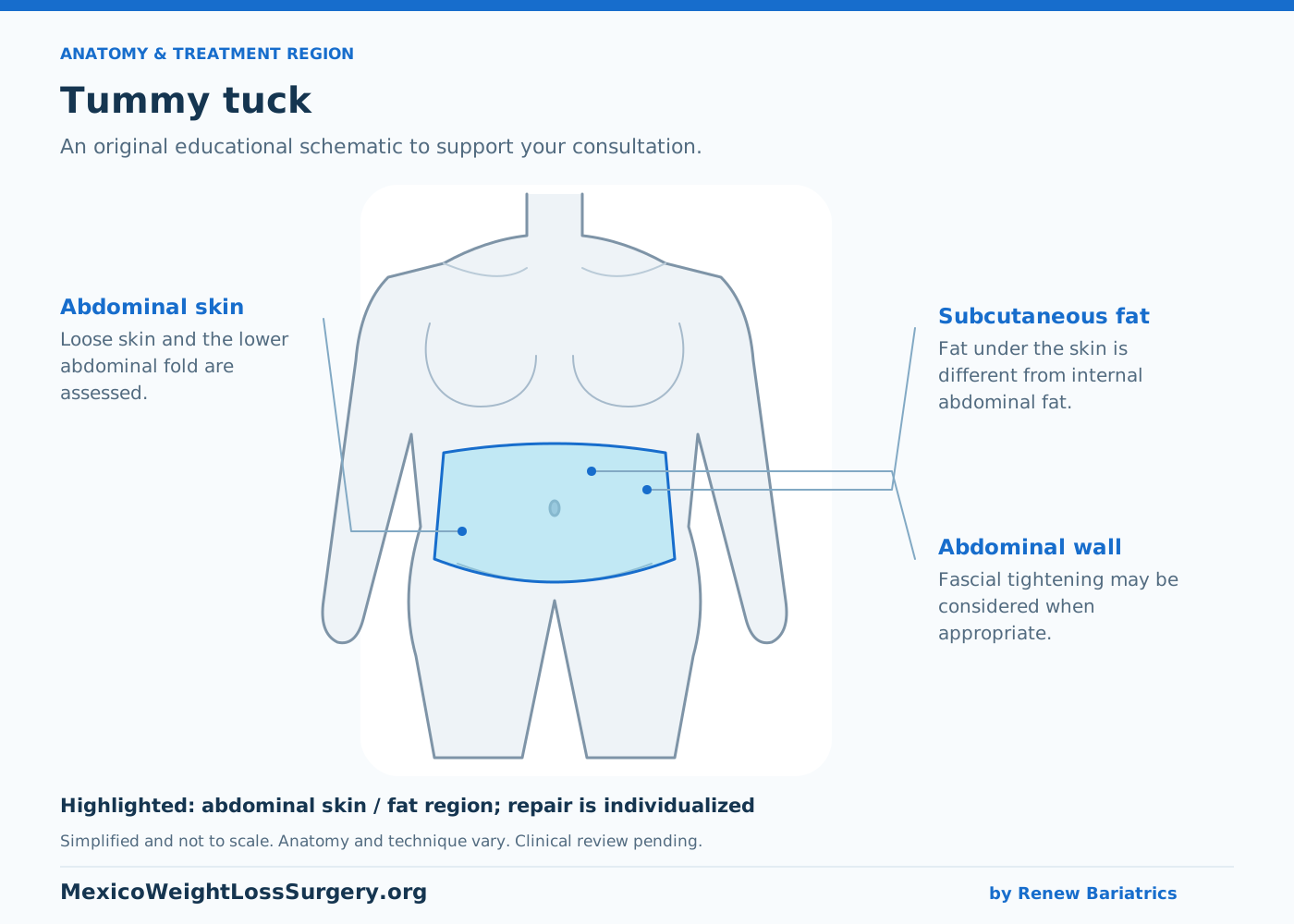
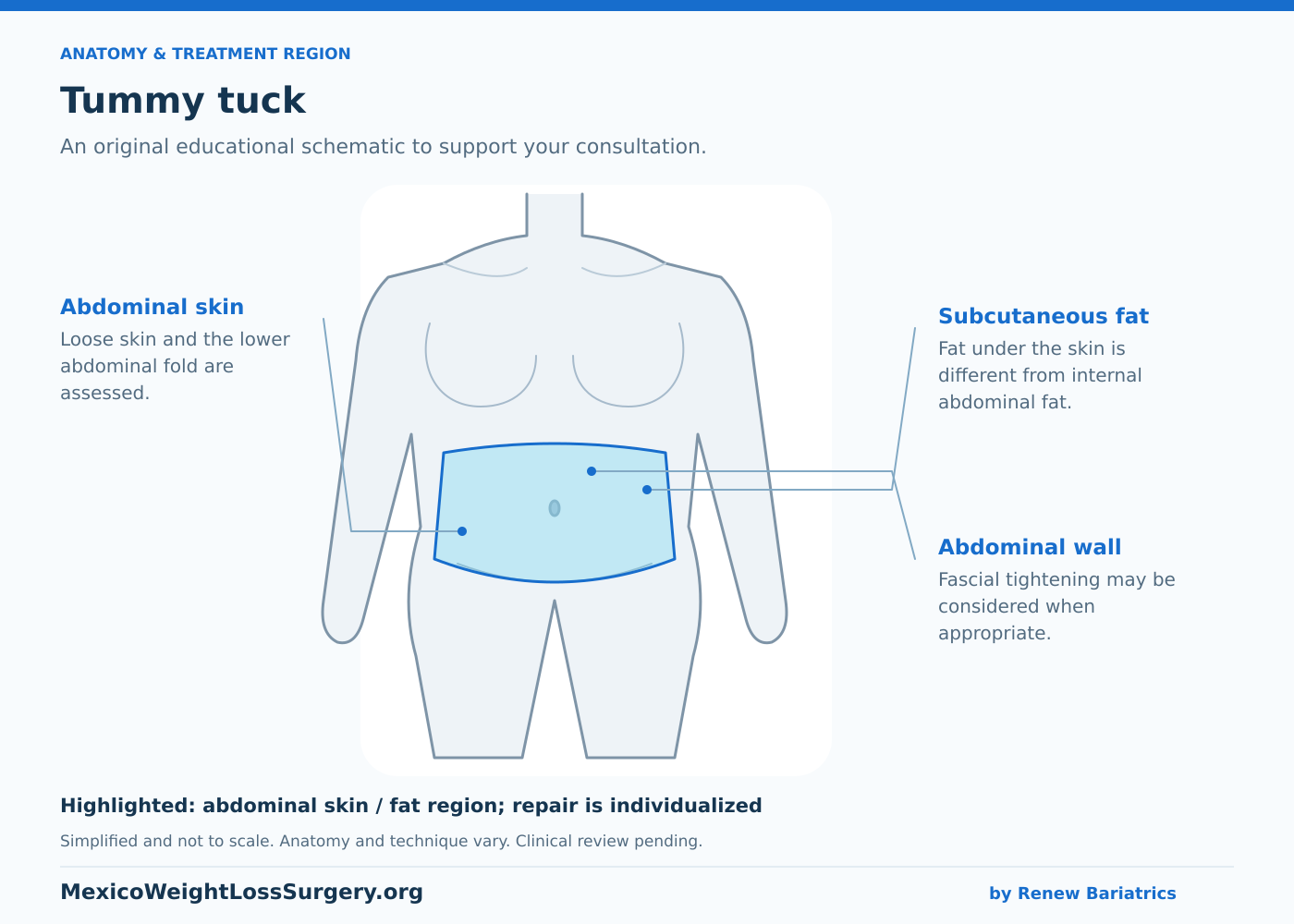
Anatomy references: ASPS — Tummy tuck ↗ · ASPS — Circular tummy tuck ↗
What can a tummy tuck change?
The operation can address a lower abdominal skin overhang and selected contour concerns. In a full abdominoplasty, the surgeon generally works through a lower abdominal incision and creates an opening for the belly button in the repositioned skin. Fascial tightening may be included when appropriate. This is often called “muscle repair,” although the repair generally involves the connective-tissue layer rather than cutting away or strengthening muscle.[1],[2]
A consultation should separate what you see from what the surgeon can change. A hanging fold, a broad waist, a midline bulge, and fullness above the belly button are different observations. Describe which bothers you and whether it affects clothing, skin care, movement, or appearance. Ask the surgeon to identify the likely explanation for each rather than assume that one operation resolves every concern.
The goal is a considered improvement with a permanent scar, not an exact dress size, a specified number of pounds lost, or a perfectly flat abdomen. Photographs can help communicate preferences, but another person's result is not a prediction for your anatomy.
Standard versus extended tummy tuck
“Standard” usually describes an operation focused on the front of the abdomen. “Extended” commonly refers to a longer horizontal excision reaching farther toward the flanks to address lateral excess. However, labels are not completely standardized. Some institutional descriptions group extended and fleur-de-lis approaches differently. Ask for the planned incision on a drawing of your own front, sides, and back rather than relying on a package name.[2],[3]
An extended horizontal scar is not automatically a circular body lift. A circular operation continues around the trunk and addresses a different distribution of excess tissue. A fleur-de-lis technique adds a vertical abdominal excision and scar to address excess in another direction. Neither is simply a premium version of a standard tummy tuck; each involves a different tradeoff.[3],[4]
At consultation, ask where the incision ends, whether the back will be treated, whether a vertical scar is proposed, and what tissue is expected to remain. Ask whether the proposed scar would sit beneath your usual underwear when standing and sitting. Exact placement is a surgical judgment, and clothing coverage cannot be guaranteed.
Tummy tuck, panniculectomy, or liposuction?
Panniculectomy removes an overhanging apron of lower abdominal skin and fat. A tummy tuck generally has broader contouring goals and may include fascial tightening and belly-button repositioning. These terms should not be used interchangeably when discussing consent, price, insurance, or expected appearance.[5]
Liposuction removes selected fat rather than performing the same skin excision as a tummy tuck. It may be an adjunct in an individualized plan, but it is not a substitute for discussing substantial skin excess. Ask what liposuction contributes, which areas are included, and how it changes the proposed operation.[1]
A useful comparison is to request three clearly separated answers: what is medically or functionally troublesome, what is an appearance preference, and what each proposed procedure actually treats. For example, skin irritation under an apron deserves evaluation even if you ultimately decide against cosmetic contouring. A possible hernia deserves its own diagnosis and treatment discussion; it should not be assumed to be corrected by a cosmetic package.
Who may be a candidate after weight loss?
ASPS describes typical candidates as physically healthy, at a stable weight, nonsmokers, and realistic about the outcome. An examination and medical history determine whether those broad criteria apply to you.[6]
Prepare a weight timeline rather than only your current number. Record your highest weight, major weight changes, bariatric procedure and date if applicable, recent medications for weight management, and your current trend. Tell the team whether further weight loss, pregnancy, or another operation is planned. These details help the surgeon assess timing and whether the proposed contour is likely to remain a useful goal.
A BMI number alone is not a personalized clearance decision. Ask how your current health, fat distribution, mobility, prior scars, healing history, and proposed operation affect the recommendation. If a surgeon asks you to postpone surgery, request the specific reason and the measurable condition that should be addressed before reassessment. “Not now” can be a more informative answer than an immediate booking offer.
Timing, nutrition, and bariatric follow-up
Mayo Clinic advises maintaining a stable weight before abdominoplasty and notes that future pregnancy or substantial weight change may affect the result. Its patient guidance mentions an ideal stability period of six to twelve months; that is guidance to discuss, not an automatic rule or a guarantee of eligibility.[1]
Post-bariatric nutritional assessment matters. A prospective study of a nutritional optimization pathway found that wound-related complications remained an important issue despite structured preparation. Nutritional planning is therefore part of risk management, not a promise of uncomplicated healing.[7]
Ask who will review your bariatric history and recent laboratory results, which deficiencies need correction, and how the plastic surgeon will communicate with your usual bariatric clinician or dietitian. Bring your actual supplement list, including doses, rather than simply reporting that you take a multivitamin. Do not start a crash diet to meet a booking deadline or independently change prescribed supplements before assessment.
If eating, hydration, or supplement tolerance is currently difficult, describe the problem before arranging travel. Request a written plan for preparation and a separate plan for maintaining intake during recovery. These are questions for your treating clinicians, not a universal protein target or supplement prescription from this page.
Smoking, medicines, and medical preparation
The American College of Surgeons explains that smoking increases surgical problems and that stopping before an operation can reduce wound complications. Discuss cessation early enough to follow the surgeon's requirements. Disclose cigarettes, vaping, nicotine products, cannabis, and other substances rather than assuming one category is irrelevant.[8]
Make one complete medication list for the surgeon and anesthesia team. Include prescriptions, injections used for weight management, nonprescription pain medicines, hormonal medicines, vitamins, and herbal products. Ask which instructions come from the anesthesiologist and which require coordination with the original prescriber. Do not stop anticoagulants, diabetes treatment, or other essential medication on your own.
Preparation should end with specific instructions you can repeat back: fasting, medicines, arrival time, required tests, support person, and what symptoms should prompt postponement. If written instructions conflict, ask the clinical team to reconcile them. A coordinator's travel itinerary should not be treated as a substitute for a medical preparation plan.
What the operation and early recovery may involve
The exact surgical plan depends on the extent of excision and any additional repair. Ask the surgeon to explain anesthesia, incision pattern, belly-button treatment, possible liposuction, closure, and expected postoperative observation in plain language. The consent should match the operation quoted, including any circumstances in which the plan might change.[1],[2]
ASPS describes dressings, possible compression garments, and temporary drains as elements that may be used during recovery. The team should provide individualized instructions for wound and drain care, medication, activity, and follow-up.[9]
Before leaving the facility, request a demonstration of any task you or your companion will perform. If drains are used, ask who reviews the record and who decides when removal is appropriate. Ask how to contact a clinician outside office hours and where an in-person assessment would occur if a concern arises. Recovery arrangements should be practical enough to use when you are tired and uncomfortable.
Risks: understand the definition behind the number
Recognized risks include bleeding, infection, fluid collections, delayed or poor healing, altered sensation, unfavorable scars, tissue loss, persistent pain, asymmetry, and further surgery. Blood clots and cardiopulmonary complications are also important concerns.[10]
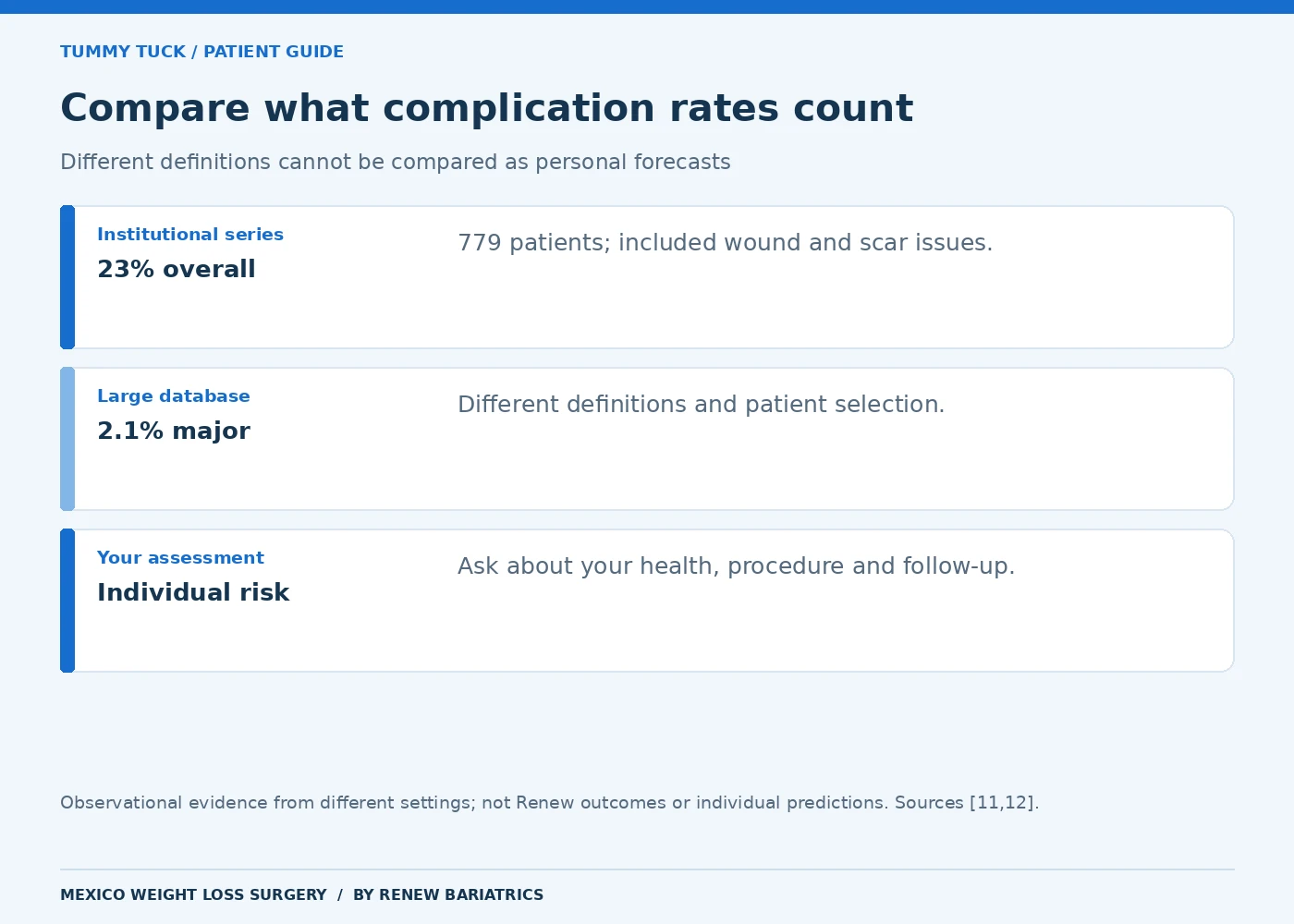
Published complication rates vary because studies count different events. A 779-patient Massachusetts General Hospital series reported a 23% overall complication rate, including wound and scar issues. A much larger database analysis reported a 2.1% overall rate for major complications under its own definitions. Those figures are not interchangeable, and neither is a personal risk estimate or a measure of Renew's outcomes.[11],[12]
Ask a prospective surgeon to distinguish minor wound problems managed in clinic from admission, transfusion, reoperation, or other major events. Ask what their figures include, how long patients are followed, and whether international patients are counted after returning home. A number without a denominator, definition, and follow-up period is difficult to interpret.
Your risk discussion should also explain what happens if an event occurs: who evaluates it, where treatment takes place, and what additional costs might arise. This is a more useful consent conversation than a blanket claim that an operation is “safe.”
Blood-clot prevention and travel
Ask for an individualized assessment of clotting and bleeding risks, including prior clots, family history, mobility, medicines, and planned travel. The surgeon should explain which prevention measures apply and why. A published hospital protocol is not a prescription for your own anticoagulant treatment.[10],[11]
CDC notes that surgery and air travel can both contribute to clot risk. Its Yellow Book advises avoiding flight for ten days after abdominal surgery; this is not automatic clearance to fly on day eleven. The treating team must assess your recovery, and a longer stay may be necessary.[13]
Build flexibility into the itinerary. Ask who can authorize a changed return date, where you would stay, how extra appointments would be handled, and whether a companion can extend their trip. Include transfers and border travel in that discussion, not only flight time. For a long journey, obtain individualized instructions rather than improvising medication, compression, or activity measures.
Plan daily life before you book
Create a practical recovery plan around the tasks you actually perform. Describe work duties, driving, stairs, childcare, pet care, lifting, and exercise to the surgeon. “Back to work” means something different for a remote desk job than for a job requiring prolonged standing or physical assistance to others.
Ask for separate milestones for self-care, desk work, driving, lifting, exercise, and travel. Request the clinical criteria for progression as well as an approximate timeframe. If you need a work certificate, discuss it before departure. Do not interpret an early follow-up appointment or drain removal as permission to resume every activity.
At home, identify who can help and for how long. Confirm that your usual clinicians know you are traveling for surgery and whether they can provide appropriate follow-up. Put emergency contact details, your medication list, operative information, and appointment schedule in one accessible place. The aim is a workable handover, not reliance on memory or a messaging thread.
Scars, appearance, and long-term expectations
A tummy tuck exchanges excess skin for a permanent scar. Ask to discuss the full scar, including the belly button and possible lateral extensions. Scar appearance evolves, and final contour is not judged immediately after surgery.[1],[9]
Bring specific preferences to the consultation: which clothing causes difficulty, where you notice folds, and which changes would matter most. Also state what tradeoffs you would find unacceptable. Someone who strongly wishes to avoid a vertical scar may choose a different operation or accept residual laxity. Someone whose main concern extends around the waist may need a different discussion from someone with a small lower-abdominal apron.
Ask when photographs will be used to assess progress and what the practice considers a revision. Clarify whether revision means a minor office procedure or another operation, when reassessment is appropriate, and which charges would apply. No responsible plan can promise perfect symmetry or eliminate the possibility of a later adjustment.
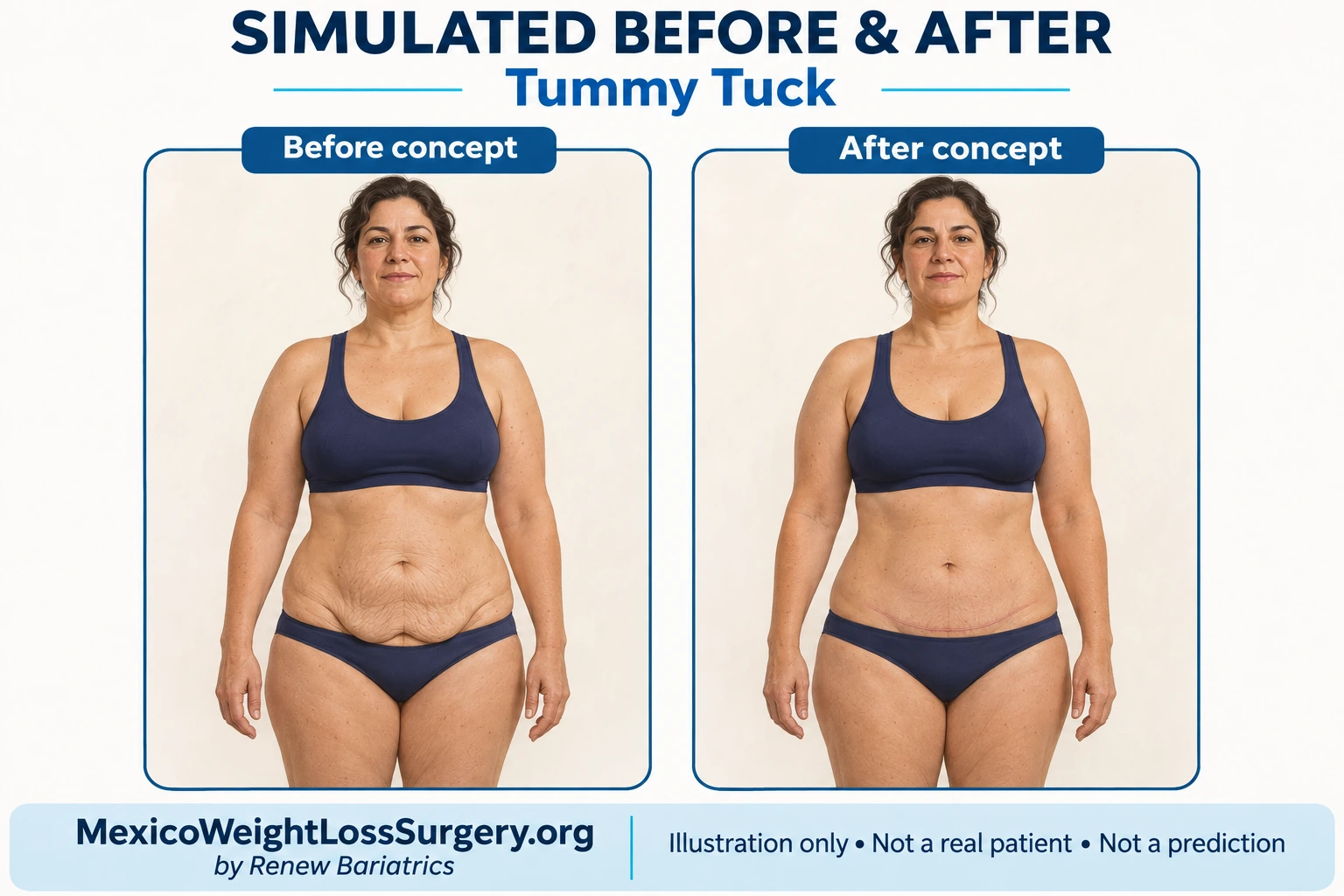
A synthetic illustration of possible changes
This fictional example illustrates a treatment concept. It cannot show the result you would achieve, predict scar healing, or establish a typical outcome.
Tummy Tuck Cost in Mexico
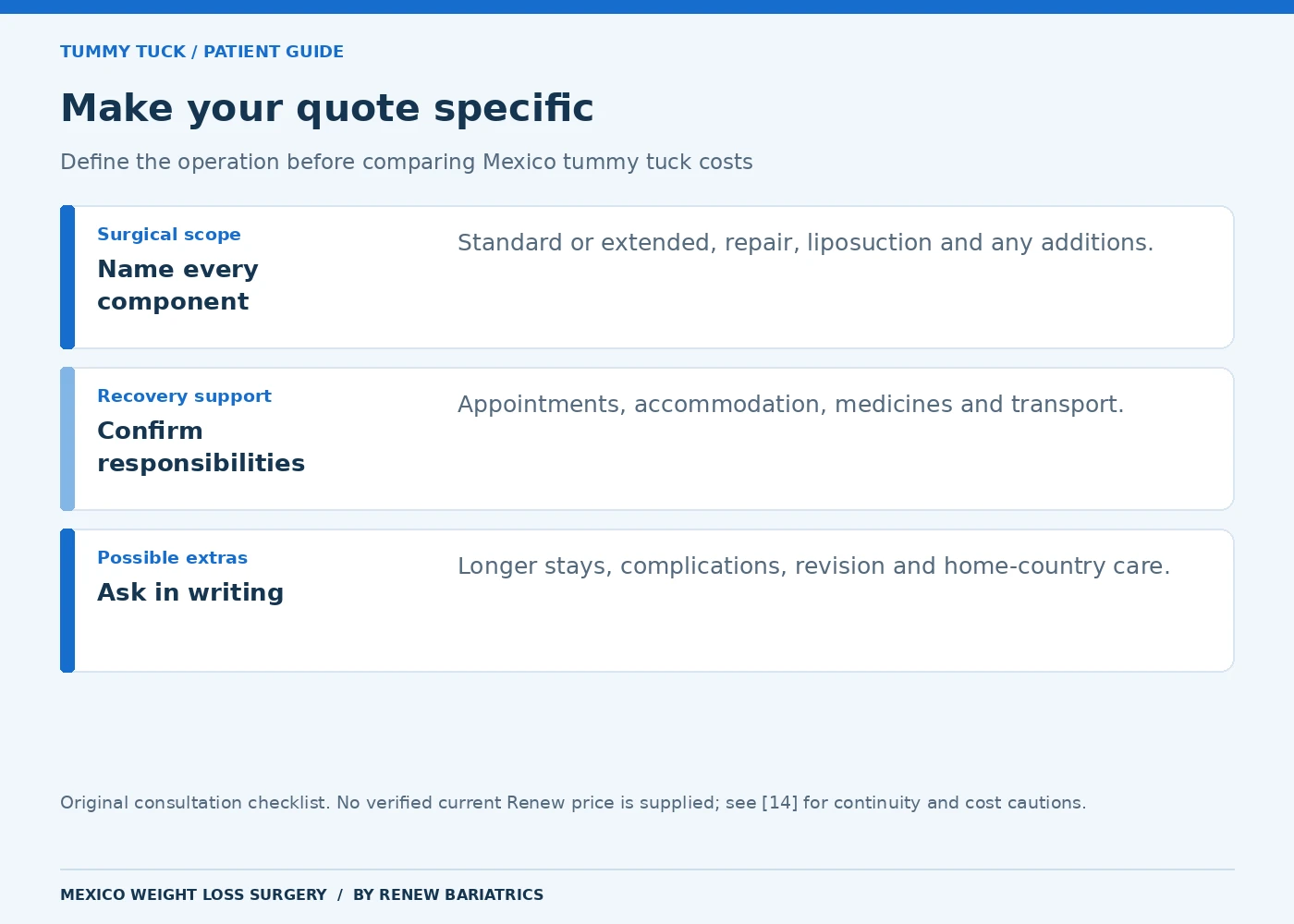
A useful quote names the operation and the surgeon rather than only saying “tummy tuck package.” Ask whether it is standard or extended, whether fascial repair or liposuction is included, and whether any other procedure is proposed. Different scopes should not be compared as though they were identical.
Request separate information about surgeon, anesthesia, facility, testing, garments, medicines, follow-up, transportation, accommodation, and companion expenses. Ask what happens financially if the operation is postponed after assessment, requires a longer stay, or results in treatment for a complication. Confirm currency, deposit, cancellation terms, and the period for which the quote is valid.
Renew’s published tummy tuck guide lists a general Tijuana range of $3,000–$6,000. That page does not establish a current personalized package price or a specific extended, circular, or fleur-de-lis quote. Treat the range as publisher-provided background and request a current individualized estimate after assessment.[15] A lower headline price does not answer whether the proposal includes the same operation or the follow-up you need. CDC specifically advises planning for potentially expensive care after international medical treatment and checking insurance coverage rather than assuming it applies.[14]
Questions to bring to a Renew Bariatrics inquiry
Use your inquiry to obtain a clear clinical pathway. Ask who will perform the assessment, who the operating surgeon would be, and how that surgeon's qualifications and facility credentials can be checked. Request written confirmation of current procedure availability instead of inferring it from an educational article.
Ask for a consultation that addresses these points:
- Which finding makes standard or extended abdominoplasty appropriate for me?
- Where will every incision begin and end?
- What will remain untreated, and what alternatives should I consider?
- What preparation is required after my particular weight-loss treatment?
- Who manages urgent problems during the trip and after I return home?
- What is included in my quote, and what could generate additional charges?
Keep the answers alongside the proposed consent and travel arrangements. If they describe different procedures or different responsibilities, resolve that discrepancy before paying for a plan you do not fully understand.
Frequently asked questions
Will a tummy tuck help me lose more weight?
It is intended for contouring, not obesity treatment. Removal of tissue should not be advertised as a weight-loss strategy or translated into a promised change on the scale. Continue discussing obesity care with the appropriate clinician.[1],[2]
Is an extended tummy tuck always better?
No. Ask what additional tissue the extension would address and what extra scar it creates. The right comparison is between the proposed benefit and tradeoff for your anatomy, not between package names.[3]
Can it be combined with another procedure?
That requires individual assessment. The existence of studies involving combined operations does not establish that a particular combination is suitable for you or offered through Renew. Request an explanation of the total operative plan, recovery demands, and alternatives such as staging.[11],[12]
How soon after weight-loss surgery can I have it?
There is no clearance date that applies to everyone. Weight stability, nutritional status, medical conditions, and the proposed surgery should be reviewed together. Bring your bariatric records and ask what must be resolved before a decision.[6],[7]
What symptoms need urgent attention?
Obtain procedure-specific written instructions before discharge. New shortness of breath or chest pain warrants immediate emergency evaluation rather than waiting for a routine message response. For increasing wound redness, drainage, fever, unexpected swelling, or worsening pain, contact the treating team promptly for assessment and follow its escalation instructions.[9],[10]
How much does a tummy tuck in Mexico cost?
Request a current individualized estimate for the exact standard or extended operation proposed. Compare the surgeon, anesthesia, facility, follow-up, travel costs and exclusions. A general published range should not be treated as a confirmed Renew package price.
What should I do next?
Request an assessment with your weight history, relevant operation records, current medicines, and a short list of your priorities. Ask for a documented recommendation, scar plan, recovery plan, and itemized quote. A considered decision includes the option to wait, choose a different procedure, or decline surgery.
Program information related to this guide
Explore Renew Bariatrics’ procedure options when discussing a plastic surgery plan. Availability, combinations and suitability require individual confirmation.
Tummy tuck vs. circular tummy tuck
These procedures address different concerns and may be combined or staged. A clinical assessment determines which, if either, fits your anatomy and goals.
| What to compare | Tummy Tuck → | Circular Tummy Tuck → |
|---|---|---|
| Main goal | Addresses excess abdominal skin. | Addresses circumferential lower-torso excess. |
| What changes | Front abdominal skin; possible wall repair. | Abdomen, flanks and lower back. |
| Key distinction | Does not remove internal abdominal fat. | Broader extent means a circumferential scar. |
| Recovery consideration | Abdominal wound healing affects activity. | More body regions need protection during healing. |
| Cost comparison | Request an itemized quote for this exact procedure and care plan. | Compare the same inclusions, exclusions and recovery expenses. |
Comparison references: ASPS — Tummy tuck ↗ · ASPS — Circular tummy tuck ↗
These options are not interchangeable for every person. The treating clinician must assess your anatomy, medical history and goals.
Further reading
Discuss your options with Renew.
Talk with a coordinator about tummy tuck, your goals and the information needed for clinical review. The treating team determines suitability and the care plan.
Call 844-736-3963 Ask about plastic surgery ↗The link opens Renew’s plastic surgery health questionnaire. This review site does not collect health information.
References & evidence notes
Sources checked November 2026. Research findings are not a forecast for an individual or outcomes for Renew’s own program. Review study populations, methods and limitations alongside the reported results.
- Mayo Clinic. Tummy tuck ↗Institutional patient education; anatomy, timing, limitations and scars.
- Johns Hopkins Medicine. Tummy Tuck ↗Institutional description of abdominoplasty and candidacy considerations.
- Cleveland Clinic. Tummy Tuck ↗Institutional terminology illustrates why an individualized incision plan matters.
- Friedman et al., 2010. Fleur-de-Lis abdominoplasty: a safe alternative to traditional abdominoplasty for the massive weight loss patient ↗499-patient observational cohort; overall cohort rates are not fleur-de-lis-only estimates.
- Johns Hopkins Medicine. Body Contouring ↗Institutional explanation of post-weight-loss contouring and panniculectomy.
- American Society of Plastic Surgeons. Tummy Tuck Candidates ↗General candidacy criteria; individualized examination required.
- Makarawung et al., 2022. Complications in post-bariatric body contouring surgery using a practical treatment regime to optimise the nutritional state ↗Prospective nutritional pathway study; optimization does not eliminate complications.
- American College of Surgeons. Quit Smoking before Your Operation ↗Smoking and surgical wound risk; discuss an individualized cessation plan.
- American Society of Plastic Surgeons. Tummy Tuck Recovery ↗Postoperative care elements; no universal recovery timetable.
- American Society of Plastic Surgeons. Tummy Tuck Risks and Safety ↗Recognized complications for informed consent.
- Massachusetts General Hospital investigators, 2017. Impact of Patient Subtype and Surgical Variables on Abdominoplasty Outcomes: A 12-Year Massachusetts General Hospital Experience ↗779-patient retrospective series; includes wound and scar complications.
- Aesthetic Surgery Journal investigators, 2024. Complications and Risks Associated With the Different Types of Abdominoplasties: An Analysis of 55,956 Patients ↗Large observational database; major-complication definitions differ from all-event surgical cohorts.
- Centers for Disease Control and Prevention. Medical Tourism — Yellow Book ↗Postoperative travel, clot risk, records and medical clearance considerations.
- Centers for Disease Control and Prevention. Medical Tourism: Travel to Another Country for Medical Care ↗Credential checks, continuity, insurance and potential additional costs.
- Renew Bariatrics. Tummy Tuck in Tijuana, Mexico: Cost and Guide ↗Provider-published general Mexico range; freshness and applicability to a current individual package are not established. Not used for clinical efficacy or safety claims.