

Jump to a section
Anatomy illustrationSynthetic illustrationCompare proceduresRelated ProceduresUnderstanding gynecomastiaMedical assessment comes before booking surgeryWhen surgery may be appropriateLiposuction, gland excision or both?What surgery can and cannot promiseScars and nipple sensationPreparing for an operationRecovery after male breast reductionRisks and warning symptomsGynecomastia Surgery Cost in MexicoTraveling for gynecomastia surgery in MexicoKeeping the result in perspectiveQuestions for your consultationYour next step with Renew BariatricsYour next stepReferencesGynecomastia surgery in Mexico can reduce enlarged male breast tissue, but the first step is understanding why the enlargement is present. A chest that looks fuller may contain excess glandular tissue, excess fat, loose skin or a combination. Medication effects, hormonal changes and other health conditions sometimes need attention before an operation is considered. Cost matters, but diagnosis and the right treatment plan come first. [1],[2]
This guide explains assessment, surgical options, scars, recovery and the questions behind male breast reduction cost in Mexico. MexicoWeightLossSurgery.org is owned by Renew Bariatrics. Renew lists male breast reduction among its plastic surgery options; the surgeon, facility, eligibility and individual quote require confirmation. This page supports an informed consultation and does not diagnose a breast change from its appearance. [16]
Understand the anatomy
A simplified, labeled view of the structures and treatment area. Select the image to view it at full size.
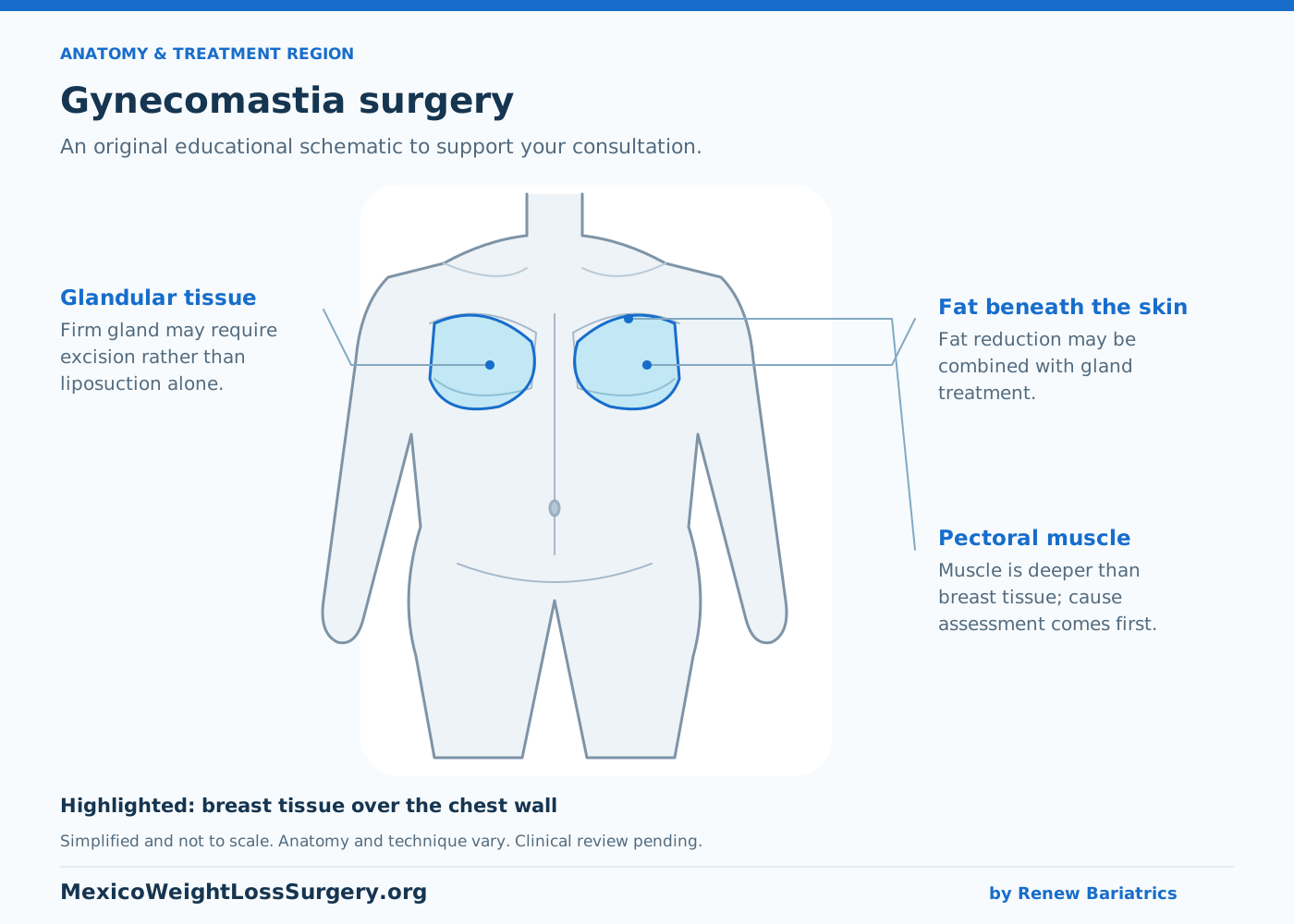
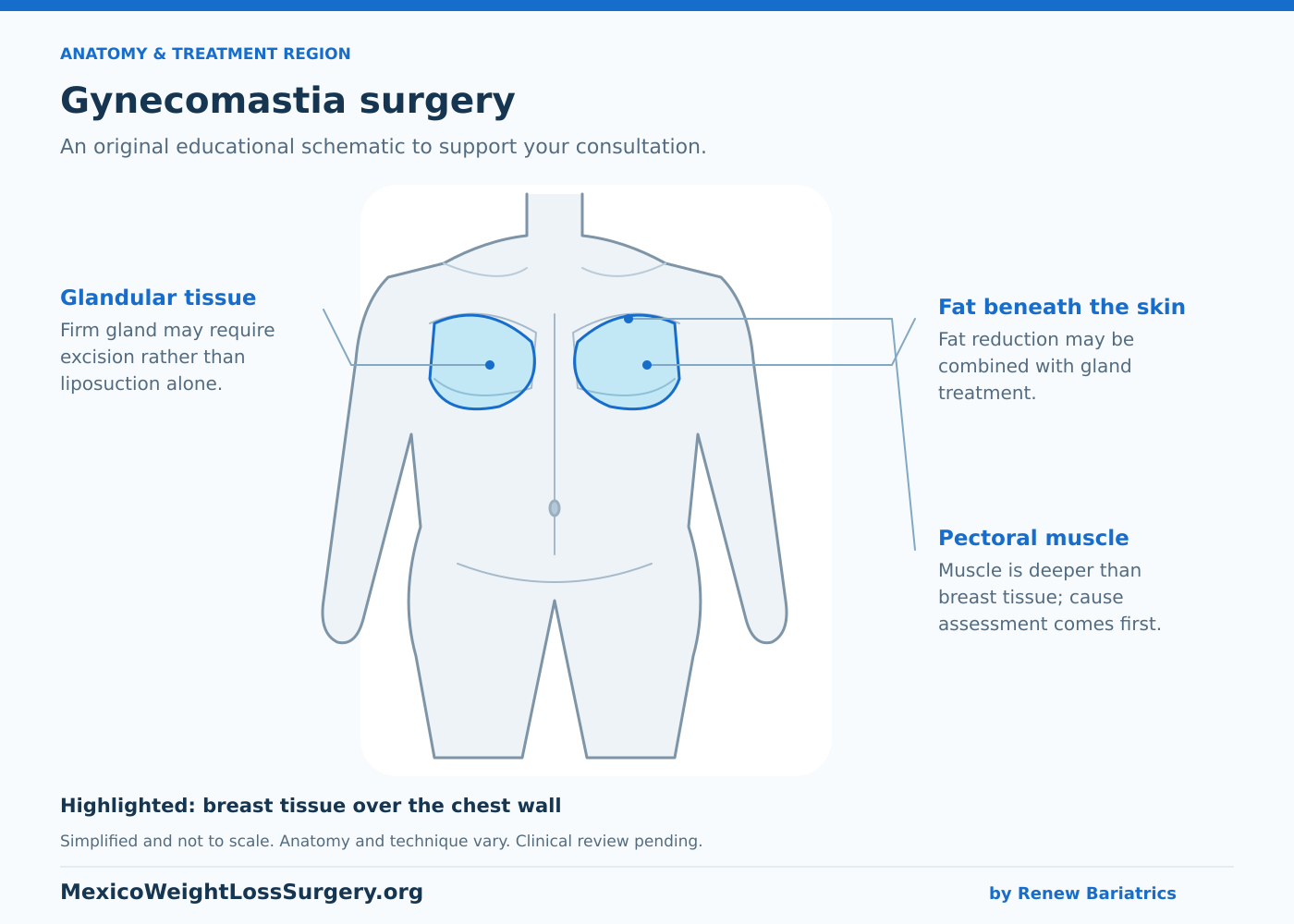
Anatomy references: ASPS — Gynecomastia surgery ↗ · ASPS — Liposuction ↗
Understanding gynecomastia
Gynecomastia means enlargement of breast gland tissue. It can affect one side or both and may be associated with tenderness. Pseudogynecomastia refers to breast fullness caused by fat rather than gland enlargement. The distinction matters because a method that removes fat is not necessarily enough to address a firm glandular component. [1]
Your experience also matters. Perhaps you avoid certain shirts, notice discomfort during exercise or feel self-conscious in situations where your chest is visible. Explain the specific concerns that affect your daily life. There is no need to minimize them, and there is no obligation to pursue surgery simply because the condition has a name.
A useful consultation begins with questions rather than a promise of a flatter chest. When did you first notice the change? Has it been stable? Is there pain, discharge or a new lump? Has one side changed more rapidly? These details help a clinician determine the next appropriate step.
Do not assume that chest enlargement is caused by body weight or lack of exercise. Equally, do not assume every change requires gland removal. An examination is needed to distinguish the tissues involved and decide whether any medical investigation should happen before a cosmetic discussion.
Medical assessment comes before booking surgery
Potential causes include physiological hormone changes, certain medicines, anabolic steroids and conditions involving hormone balance or systemic disease. Endotext emphasizes a careful history and examination, followed by evaluation and treatment of an underlying cause when present. A surgical consultation should not bypass that process. [2]
Bring a complete list of prescriptions, supplements, hormones and performance-enhancing products. Include items you take intermittently and products purchased online. Be candid even if you are concerned about judgment. The purpose is to help the clinician understand the cause and plan appropriate care, not to assign blame.
Never stop a prescription medicine on your own because you read that it may be associated with gynecomastia. Your regular prescriber may need to balance benefits, alternatives and risks. University Hospitals Sussex specifically advises seeking medical advice before changing or stopping prescribed medication. [3]
Assessment can involve blood tests, breast imaging or other investigations, depending on the history and examination. Mayo Clinic describes possible tests that help identify a cause or distinguish similar conditions. Not every patient needs every listed test; ask your clinician which question each test is intended to answer. [4]
Breast changes that should not wait for a cosmetic appointment
A firm lump, nipple discharge, skin dimpling or a new concerning change should be assessed by a healthcare professional. These symptoms should not be assumed to be routine gynecomastia, and a normal-looking photograph cannot exclude a medical problem. [1]
If you are seeking surgery because of a new change, begin with local medical assessment before arranging travel. Tell the plastic surgeon what was evaluated and obtain the relevant records. It is easier to coordinate care when everyone has the same information than when you are trying to reconstruct the investigation after arrival.
When surgery may be appropriate
Surgery may be considered for persistent enlargement after appropriate assessment and when alternatives are unlikely to address the concern adequately. ASPS includes stable breast development, realistic expectations and health compatible with healing among its candidacy considerations. The evaluation should include both the medical cause and your own goals. [5]
For adolescents, ongoing development can change the decision and the chance of needing further treatment. This guide is written for adults planning elective care. A young person needs an age-appropriate assessment rather than being fitted into an adult medical-travel package. Endotext recommends considering the underlying cause and developmental stage before surgery. [2]
You may choose to proceed because the condition causes ongoing discomfort or limits how you dress and participate in activities. You may also decide that the likely benefit does not justify surgery and scars. Both decisions can be reasonable when they follow an informed assessment.
Ask whether the proposed result is achievable with your skin quality and anatomy. If the surgeon expects some residual asymmetry, a longer scar or a staged approach, clarify that before deciding. A plan that acknowledges limitations is more useful than a promise of a perfectly flat, identical chest on both sides.
Liposuction, gland excision or both?
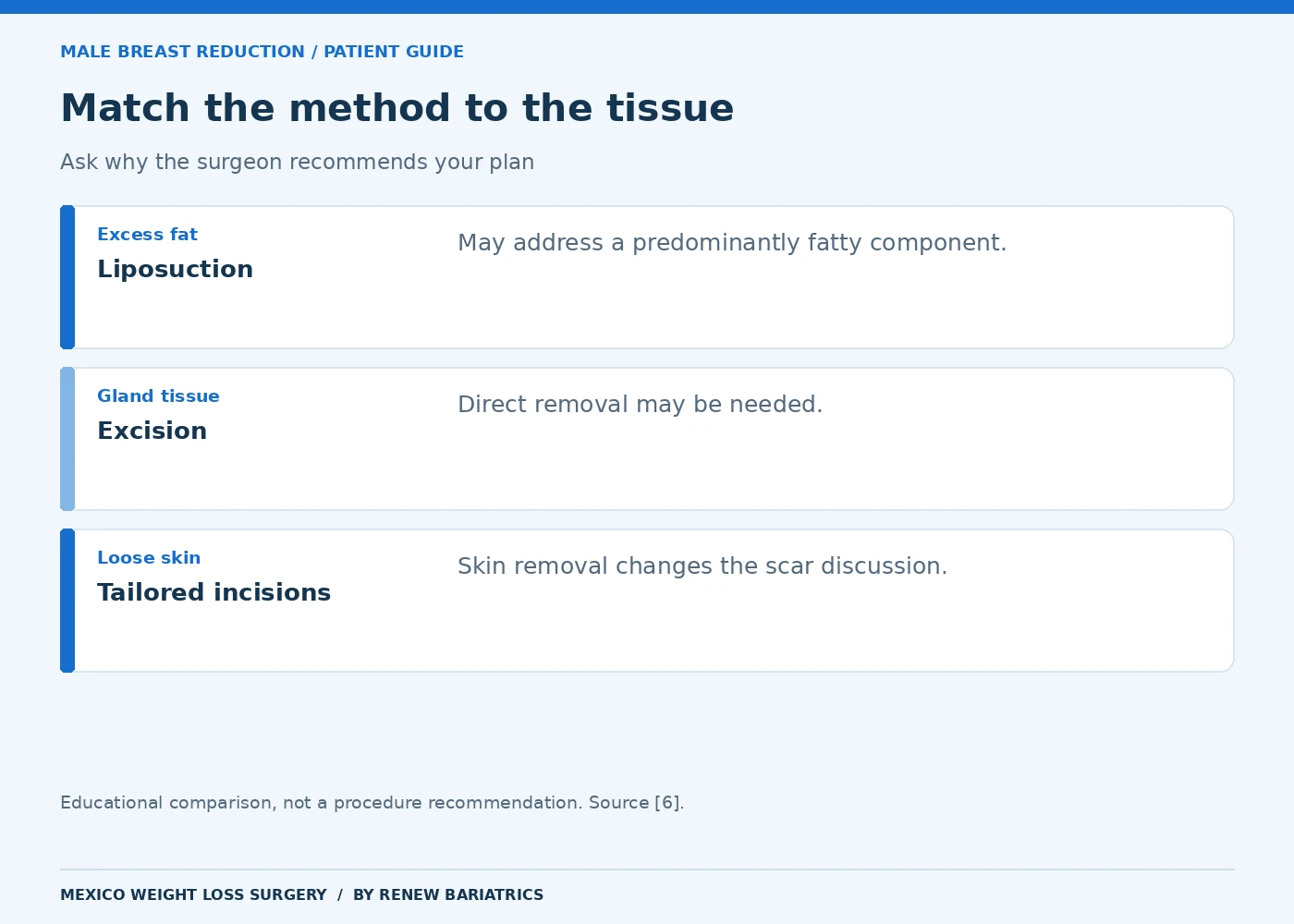
Liposuction removes fatty tissue through small access incisions. Excision directly removes glandular tissue and, when needed, excess skin. A combination may be recommended when both components contribute. Incision patterns depend on the tissue to be removed and whether the nipple or areola needs repositioning. [6]
Ask the surgeon to explain what they feel on examination and how that leads to the recommended technique. If the plan is liposuction alone, ask what will happen to any glandular fullness. If excision is recommended, ask where the scar will be and how the contour around the areola will be managed.
The technique should follow the anatomy rather than the package label. Two patients who both search for “male breast reduction” may need different operations. One might mainly have excess fat, while another has firm tissue and loose skin. Compare written proposals on the basis of what is actually being treated.
Anesthesia options depend on the operation and clinical assessment. ASPS describes sedation and general anesthesia among the possibilities. Ask who provides anesthesia, what preoperative assessment is required and what monitoring is planned after the procedure. [6]
What if I have loose skin after major weight loss?
After substantial weight loss, chest contouring may involve more than reducing volume. Excess skin and nipple position can become central concerns. Ask whether the proposed operation includes skin removal and how that changes the incision pattern. A small-scar promise should not obscure the possibility that a different approach is needed to meet your goal.
Bring your weight-loss history and prior operation records to the assessment. If you are considering several contouring procedures, rank your priorities and ask whether staging would be preferable. The decision should account for your ability to recover and the practical demands of each operation, not just the appeal of one trip.
What surgery can and cannot promise
The aim is an improved chest contour that fits your anatomy and priorities. Surgery cannot promise perfect symmetry, a particular muscular appearance or an end to every concern about your body. ASPS notes that results are not guaranteed and that additional surgery may sometimes be needed. [7]
Ask how the surgeon defines success in your case. Is the main goal reduced projection, better balance between sides, removal of loose skin or less discomfort? A shared definition gives you a more useful way to evaluate the plan than a generic before-and-after gallery.
Photographs can illustrate a surgeon's experience, but ask whether examples involve a similar amount of skin and tissue. Also ask when the after photographs were taken. Early swelling and later settling can make different stages look quite different. The images should support a discussion, not act as a guarantee.
Scars and nipple sensation
All surgical approaches require incisions. Some may be placed near natural boundaries or contours, but scars are permanent even when they fade. Larger skin-removal procedures may require more visible scars. ASPS describes final contour assessment over months and emphasizes that incision lines remain. [7]
Ask the surgeon to mark or draw the expected scar locations during consultation. Consider how those locations relate to the clothing you usually wear and what tradeoffs you are comfortable accepting. If you have previously developed thick, raised or dark scars, mention that history.
Changes in nipple or chest sensation can be temporary or lasting. Contour irregularities and asymmetry are also possible. Discuss these risks directly rather than assuming a smaller incision means a risk-free result. [8]
Ask which scar treatments the surgeon recommends, when they can begin and what should be avoided until the wounds heal. Do not apply products or start massage based on a social-media routine without checking the operating team's instructions.
Preparing for an operation
Preparation may include testing, medical evaluation and a coordinated medication plan. ASPS advises stopping smoking and arranging someone to drive you and remain with you at least the first night after outpatient surgery. Your clinical team must set the actual fasting and medication instructions. [9]
Create one current list of your medications and allergies and share it with the surgeon and anesthesia team. If different clinicians provide conflicting instructions, ask them to reconcile the plan before surgery. Do not guess which instruction takes priority, particularly for prescribed medicines.
Nutrition deserves attention after major weight loss. ASPS guidance on post-weight-loss contouring highlights the importance of identifying protein and micronutrient deficiencies and using an individualized plan. Bring your bariatric supplements and recent follow-up results into the discussion rather than assuming that a stable weight proves nutritional readiness. [10]
Ask who will explain abnormal test results, which results would delay surgery and how any deficiency will be addressed. A postponement to resolve a medical concern can be part of appropriate care. Confirm the associated scheduling and deposit terms before making travel arrangements.
Prepare your home or accommodation for the restrictions your surgeon anticipates. Ask about reaching, lifting, pushing open heavy doors, carrying luggage and getting dressed. Arrange practical help for tasks you cannot safely perform. A specific plan is easier to follow than a general instruction to “take it easy.”
Recovery after male breast reduction
Dressings, a support garment and sometimes drains may be used. Your instructions should explain wound and drain care, prescribed medicines, follow-up and when to contact the team. The first priority is healing, not judging the final chest shape immediately after surgery. [11]
Cleveland Clinic describes soreness in the early days, a gradual return to work and a period of several months before results are fully apparent. Individual timing depends on the operation and recovery. A general estimate cannot clear you for heavy lifting, travel or sport. [12]
Explain your job in concrete terms. Do you carry stock, restrain animals, transfer patients, operate machinery or reach overhead throughout the day? Ask the surgeon which tasks are restricted and for how long. Even if you can work remotely, you may still need a period away from work to rest and attend appointments.
Ask about driving separately. Being comfortable in a chair does not establish that you can steer, react quickly, tolerate a seat belt and drive without medication impairment. Request specific clearance rather than using someone else's recovery story as a benchmark.
Exercise and returning to ordinary activities
Discuss walking, gym training, swimming and contact sports individually. Chest exercises and heavy upper-body work deserve explicit instructions. Do not infer that an incision looking closed means you are ready for every movement. Ask how activity will be increased and when reassessment is needed.
Keep appointments even if you feel well. If drains are used, learn how to record output and how removal is decided. Ask what garment fit should feel like and what to do if it causes skin problems. Report concerns early instead of tightening compression or changing dressings in a way the team has not recommended.
Risks and warning symptoms
Risks include bleeding or hematoma, fluid collection, infection, poor healing, persistent pain, unfavorable scars and uneven contour. Blood clots, anesthesia complications and injury to deeper structures are possible. A revision operation may be needed for a complication or an unsatisfactory result. [8]
Ask which complications are most relevant to the planned technique and your health. Find out who can examine you after hours and where you would go if urgent imaging or hospital care were required. This should be a clinical plan with names and contact details, not only access to a general customer-service number.
Seek emergency care for sudden breathing difficulty, chest pain, collapse or other severe rapidly evolving symptoms. Contact your clinical team promptly for worsening pain, significant new swelling, fever, wound opening or concerning drainage. Cleveland Clinic advises immediate attention for cardiopulmonary symptoms and prompt reporting of wound concerns. [12]
Do not wait to board a flight or cross a border if you believe a complication is developing. The question is where you can receive appropriate assessment now. Keep your operation details and medication list accessible to any clinician who sees you.
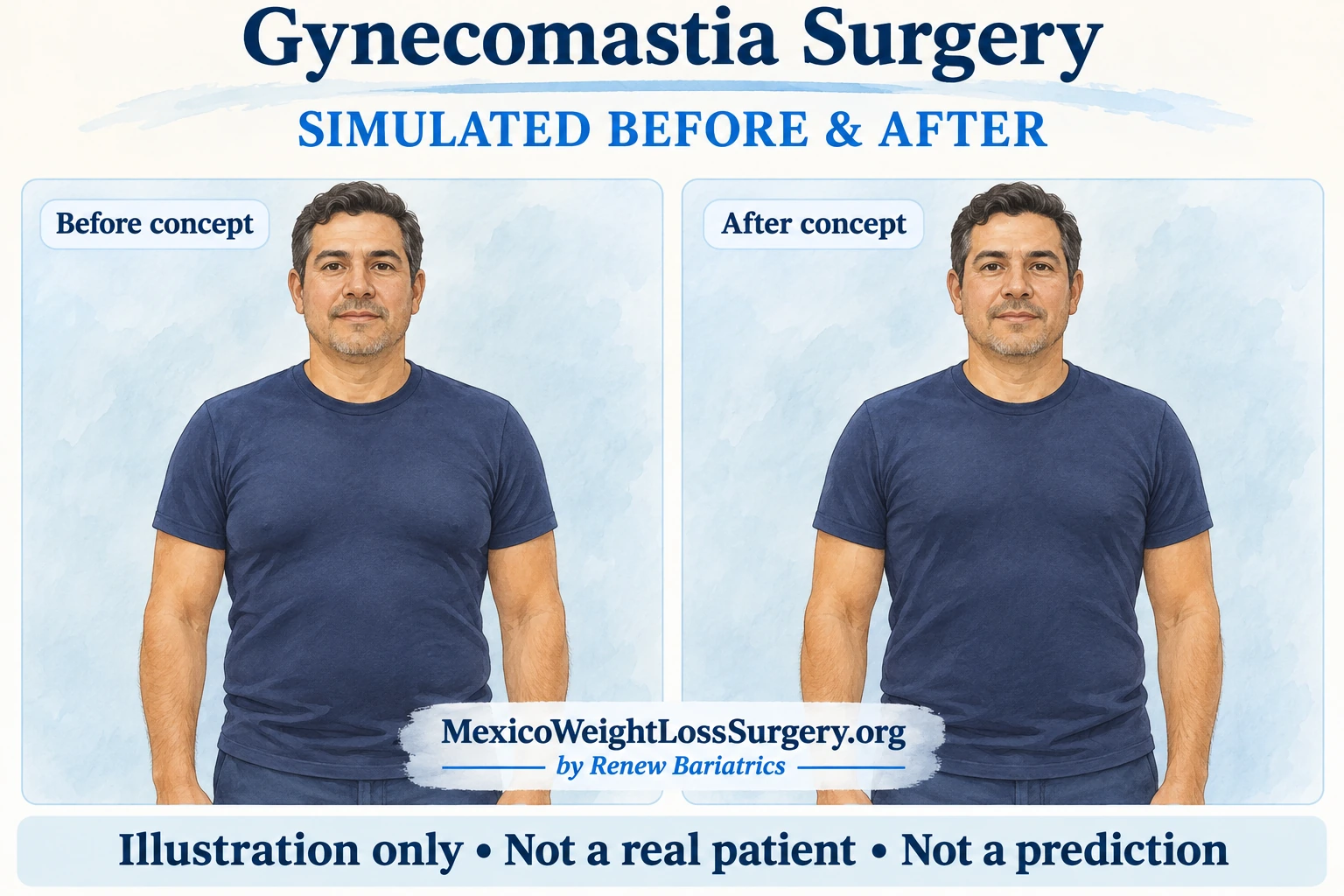
A synthetic illustration of possible changes
This fictional example illustrates a treatment concept. It cannot show the result you would achieve, predict scar healing, or establish a typical outcome.
Gynecomastia Surgery Cost in Mexico
Gynecomastia surgery cost in Mexico depends on what must be treated: fatty tissue, glandular tissue, excess skin or a combination. The surgeon, anesthesia, facility and follow-up arrangements also affect the total. This guide does not invent a Renew price or imply that every patient needs the same operation.
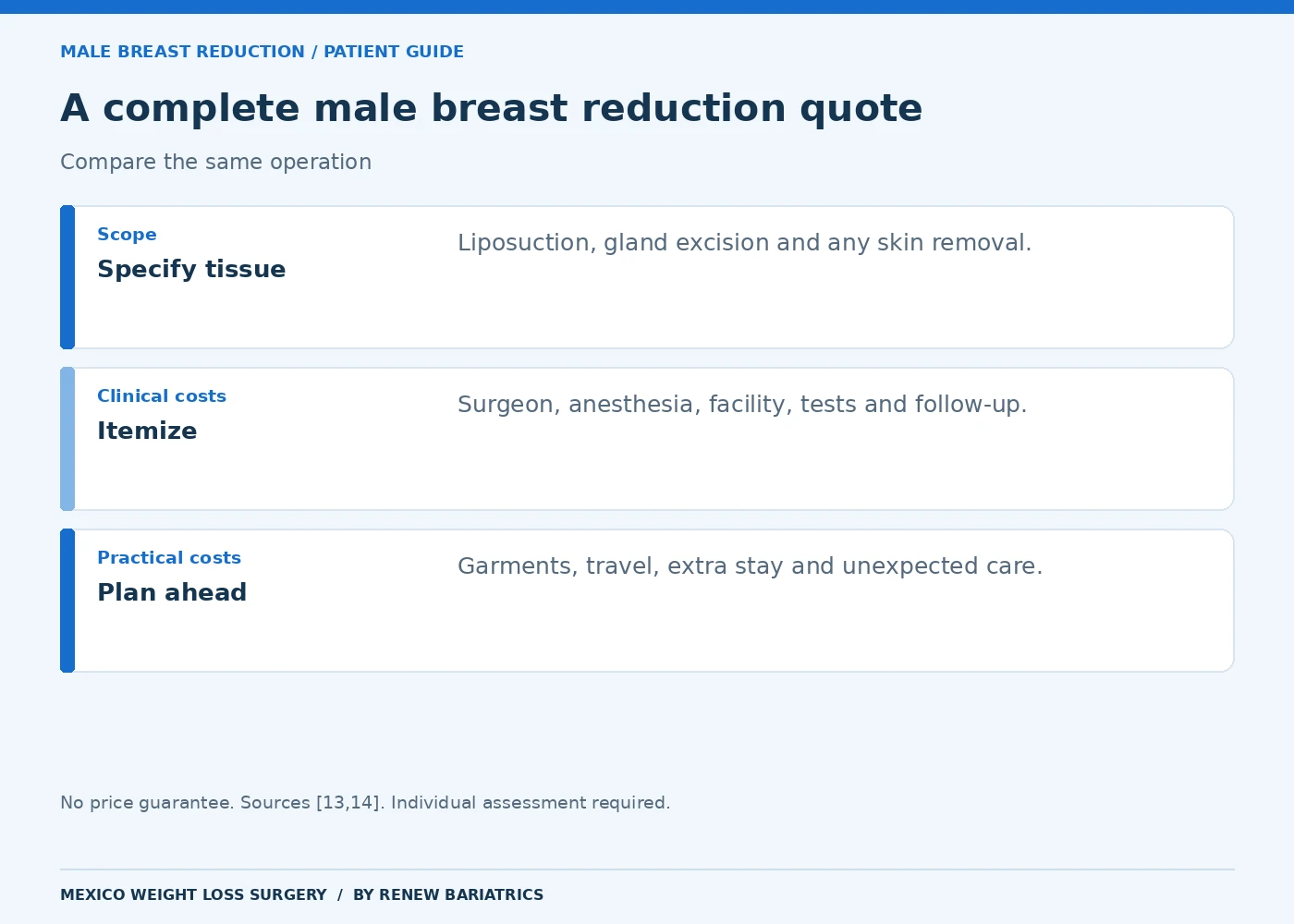
ASPS explains that a reported surgeon's fee is only one component of male breast reduction cost. Anesthesia, facility charges, tests, garments and prescriptions may be additional. A U.S. fee average is not a quote for surgery in Mexico. [13]
Request an itemized proposal naming the procedure, surgeon and facility. Ask whether the quoted amount includes gland excision, skin removal, tissue examination when indicated, anesthesia, medicines, garments and planned follow-up. Clarify what changes if the in-person examination leads to a different recommendation.
Budget separately for travel, accommodation, a companion and time away from work. Ask about the cost of an extended stay or unexpected assessment. Confirm deposit and cancellation terms and what happens if medical findings mean you should postpone or decline the operation.
Does insurance cover male breast reduction?
Coverage depends on the policy and the circumstances. ASPS notes that many plans do not cover the procedure and that criteria can vary. Ask your insurer directly about eligibility, documentation, treatment abroad and complication coverage; do not assume that a diagnosis guarantees payment. [13]
Why do male breast reduction quotes differ?
A liposuction-only plan is not the same operation as gland excision with skin removal. Compare the clinical scope and included services before comparing the total. Request clarification if a quote uses a package name without describing the actual surgery.
Traveling for gynecomastia surgery in Mexico
Confirm the surgeon's relevant credentials, the operating facility and the anesthesia arrangements before booking. Ask who provides the first postoperative examinations and how long you should remain nearby. A fixed hotel package should not determine when you are medically ready to travel.
CDC cautions that postoperative travel adds concerns, including clot risk, and recommends planning continuity of care and obtaining medical records. Your surgeon must individualize your return journey and clearance. [14]
Consider luggage, border waits, airport transfers and connections as part of that journey. Arrange a clinician at home who can help with appropriate follow-up, and obtain your operation and discharge records. Ask how the Mexican team will communicate if that clinician has a question.
Keeping the result in perspective
An operation removes tissue but does not necessarily remove every influence that caused enlargement. Medication effects, further weight changes or another underlying issue may affect long-term appearance. Discuss maintenance with the clinician managing any relevant condition and never discontinue prescribed medication on your own. [11]
Make room for the emotional side of the decision. It is reasonable to want relief from a longstanding concern, but surgery should not be expected to resolve every social or personal difficulty. NHS decision guidance recommends taking time and avoiding pressure from time-limited offers. [15]
Questions for your consultation
- Has the cause of my breast enlargement been adequately assessed?
- Is the fullness gland, fat, excess skin or a combination?
- Which technique addresses my main concern, and why?
- Where will the scars be, and might nipple sensation change?
- What would make you recommend a delay or a different treatment?
- Who provides clinical follow-up in Mexico and after I return home?
- What work, exercise and travel restrictions should I plan for?
- What is included in my written quote, and what is excluded?
Your next step with Renew Bariatrics
Start with medical assessment of any new or unexplained breast change. When surgery is appropriate to consider, ask Renew for a consultation and a current male breast reduction proposal. Its directory confirms the service category, not an individual outcome or price. [16] Bring your records, your practical goals and your questions about scars, recovery and total cost. A worthwhile plan should make the decision clearer without making you feel rushed.
Program information related to this guide
Explore Renew Bariatrics’ procedure options when discussing a plastic surgery plan. Availability, combinations and suitability require individual confirmation.
Gynecomastia surgery vs. liposuction
Liposuction can be one part of gynecomastia surgery. The distinction is whether fat, glandular tissue, excess skin or a medical cause is involved.
| What to compare | Male breast reduction → | Liposuction → |
|---|---|---|
| Main goal | Reduces enlarged male breast tissue. | Reduces selected fat deposits. |
| What changes | Gland excision, fat reduction or both. | Fat beneath the skin. |
| Key distinction | Medical causes need evaluation first. | Does not remove excess skin. |
| Recovery consideration | Recovery depends on excision and skin work. | Swelling and garment plans vary. |
| Cost comparison | Request an itemized quote for this exact procedure and care plan. | Compare the same inclusions, exclusions and recovery expenses. |
Comparison references: ASPS — Gynecomastia surgery ↗ · ASPS — Liposuction ↗
These options are not interchangeable for every person. The treating clinician must assess your anatomy, medical history and goals.
Discuss your options with Renew.
Talk with a coordinator about male breast reduction, your goals and the information needed for clinical review. The treating team determines suitability and the care plan.
Call 844-736-3963 Ask about plastic surgery ↗The link opens Renew’s plastic surgery health questionnaire. This review site does not collect health information.
References & evidence notes
Sources checked November 2026. Research findings are not a forecast for an individual or outcomes for Renew’s own program. Review study populations, methods and limitations alongside the reported results.
- Mayo Clinic. Enlarged breasts in men: symptoms and causes ↗Institutional patient education; individual clinical assessment required.
- Endotext / NCBI Bookshelf. Gynecomastia: Etiology, Diagnosis, and Treatment ↗Clinical reference on etiology, evaluation and treatment sequencing.
- University Hospitals Sussex NHS Foundation Trust. What is gynaecomastia? ↗Institutional patient education; individual clinical assessment required.
- Mayo Clinic. Enlarged breasts in men: diagnosis and treatment ↗Institutional patient education; individual clinical assessment required.
- American Society of Plastic Surgeons. Gynecomastia Surgery: Candidates ↗Institutional patient education; individual clinical assessment required.
- American Society of Plastic Surgeons. Gynecomastia Surgery: Procedure ↗Institutional patient education; individual clinical assessment required.
- American Society of Plastic Surgeons. Gynecomastia Surgery: Results ↗Institutional patient education; individual clinical assessment required.
- American Society of Plastic Surgeons. Gynecomastia Surgery: Safety ↗Institutional patient education; individual clinical assessment required.
- American Society of Plastic Surgeons. Gynecomastia Surgery: Preparation ↗Institutional patient education; individual clinical assessment required.
- American Society of Plastic Surgeons, 2026. Nutrition recommendations after major weight loss ↗Society summary of nutritional review; not an individualized supplementation protocol.
- American Society of Plastic Surgeons. Gynecomastia Surgery: Recovery ↗Institutional patient education; individual clinical assessment required.
- Cleveland Clinic. Gynecomastia Surgery (Male Breast Reduction) ↗Institutional patient education; individual clinical assessment required.
- American Society of Plastic Surgeons. Gynecomastia Surgery: Cost ↗Institutional patient education; individual clinical assessment required.
- CDC Yellow Book. Medical tourism ↗Travel, complication planning and continuity of care; does not establish personal flight clearance.
- NHS. Is a cosmetic procedure right for me? ↗Institutional patient education; individual clinical assessment required.
- Renew Bariatrics. Bariatric surgery and plastic surgery options in Mexico ↗Official procedure directory; not independent outcome verification or an individual quote.