

Jump to a section
Anatomy illustrationSynthetic illustrationCompare proceduresRelated ProceduresWhat liposuction does—and where its limits matterLiposuction versus weight-loss surgery and skin removalWho may be a candidate?Liposuction after bariatric surgery or major weight lossTechniques, treatment areas and combination proceduresRisks deserve a specific discussionPreparing for surgeryRecovery: what should you plan around?Scars, swelling and long-term expectationsPlanning liposuction in MexicoLiposuction Cost in MexicoQuestions to bring to your consultationFrequently asked questionsYour next stepYour next stepReferencesLiposuction in Mexico may be an option when your weight is stable and you want to change a specific area of persistent fat. Liposuction cost in Mexico depends on the treatment areas and complete care plan; request an itemized quote rather than assuming a package fits every patient. It is a body-contouring operation, not an obesity treatment. It cannot promise a particular number on the scale, erase stretch marks, or remove an apron of loose skin. The useful first question is therefore what tissue is causing the concern: fat, skin, or a combination. That distinction helps you compare procedures that actually address your goal. [1],[2]
This guide explains the decisions behind liposuction, from examining skin quality to planning recovery after travel. MexicoWeightLossSurgery.org is owned by Renew Bariatrics. Renew lists liposuction among its plastic surgery options; availability, the operating surgeon, facility, treatment areas and individual eligibility still require confirmation. A website description is not a surgical assessment or a personalized quote. [16]
Understand the anatomy
A simplified, labeled view of the structures and treatment area. Select the image to view it at full size.
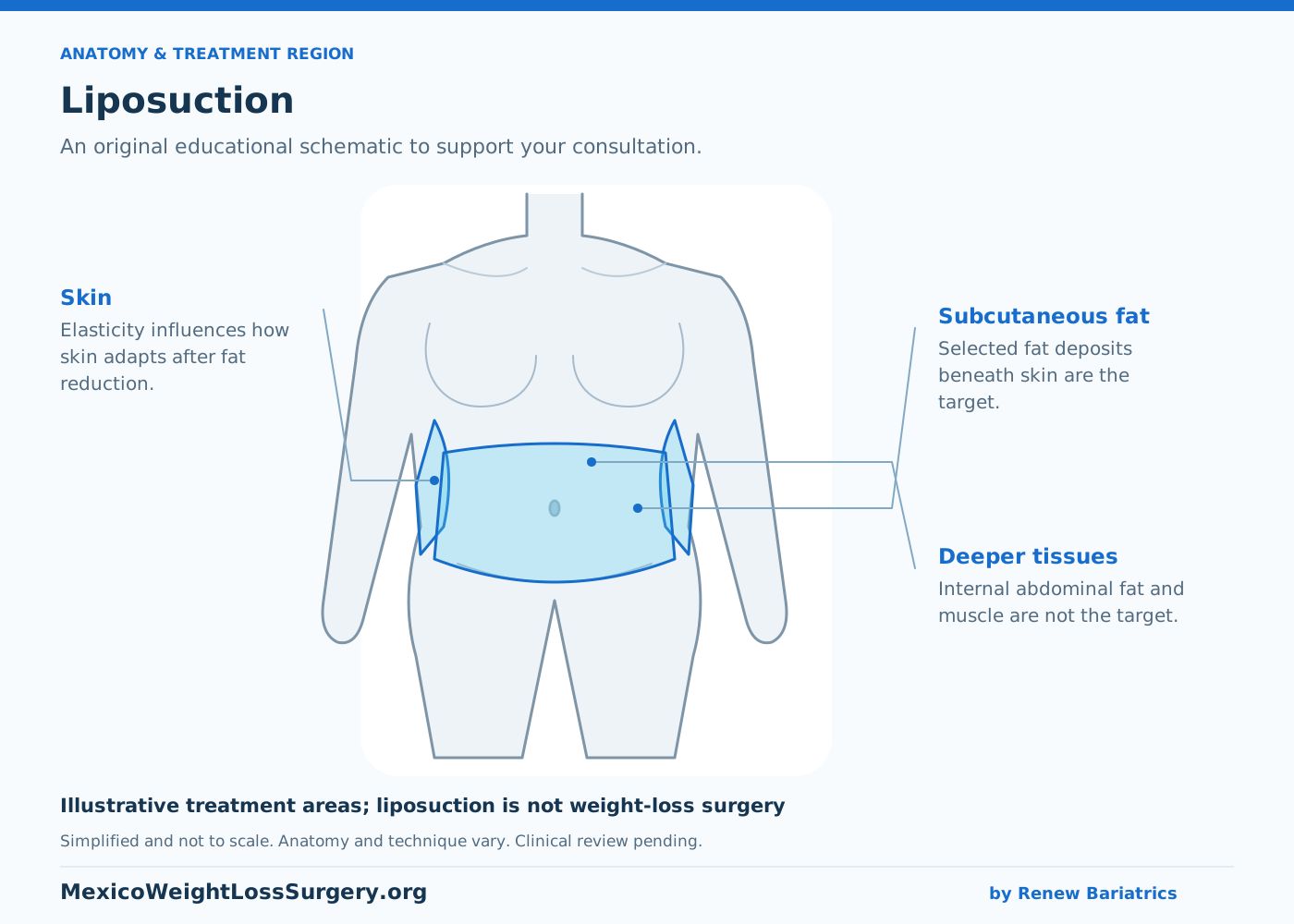
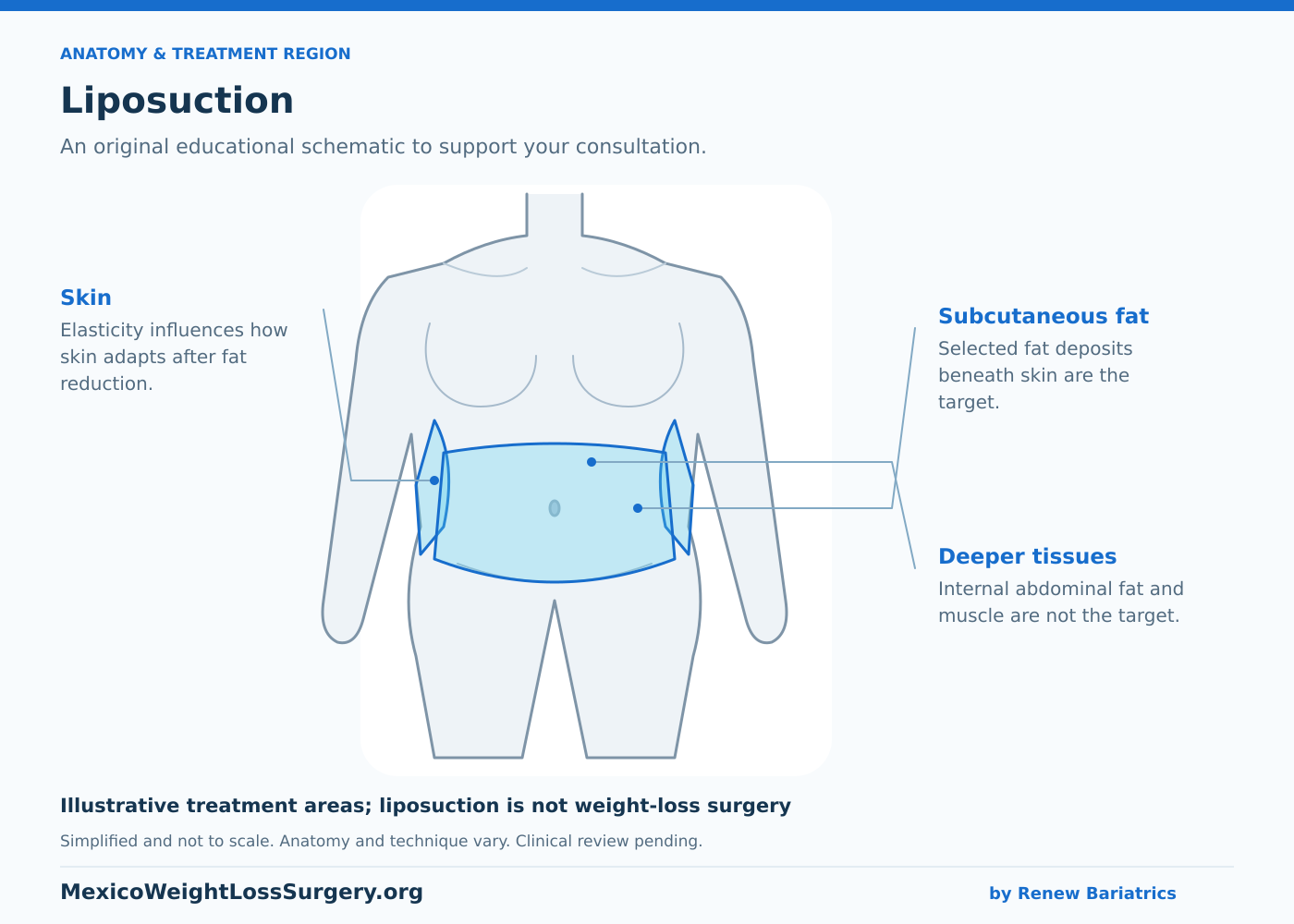
Anatomy references: ASPS — Liposuction ↗ · ASPS — Tummy tuck ↗
What liposuction does—and where its limits matter
During liposuction, a surgeon introduces a thin tube called a cannula through small incisions and uses suction to remove selected fat beneath the skin. Common treatment areas include the abdomen, waist, thighs, upper arms and neck. The operation changes local proportions rather than the way your digestive system handles food. Sedation or general anesthesia may be used, depending on the planned treatment and clinical assessment. [3]
Think of the procedure as a question about shape. A person might want a waistband to sit differently, less fullness along the flanks, or a smoother transition between adjacent areas. None of those goals establishes that surgery is suitable. They do, however, give the surgeon something more specific to discuss than “make me smaller.” Bring your priorities to the consultation in your own words rather than trying to select a technical method in advance.
Liposuction does not reliably tighten loose skin. Someone who has lost substantial weight may have both residual fat and stretched skin, and removing fat alone can leave the skin looking looser. Cellulite and stretch marks are also different problems. Ask the surgeon to show you which parts of your concern liposuction might improve and which would remain. [1],[4],[15]
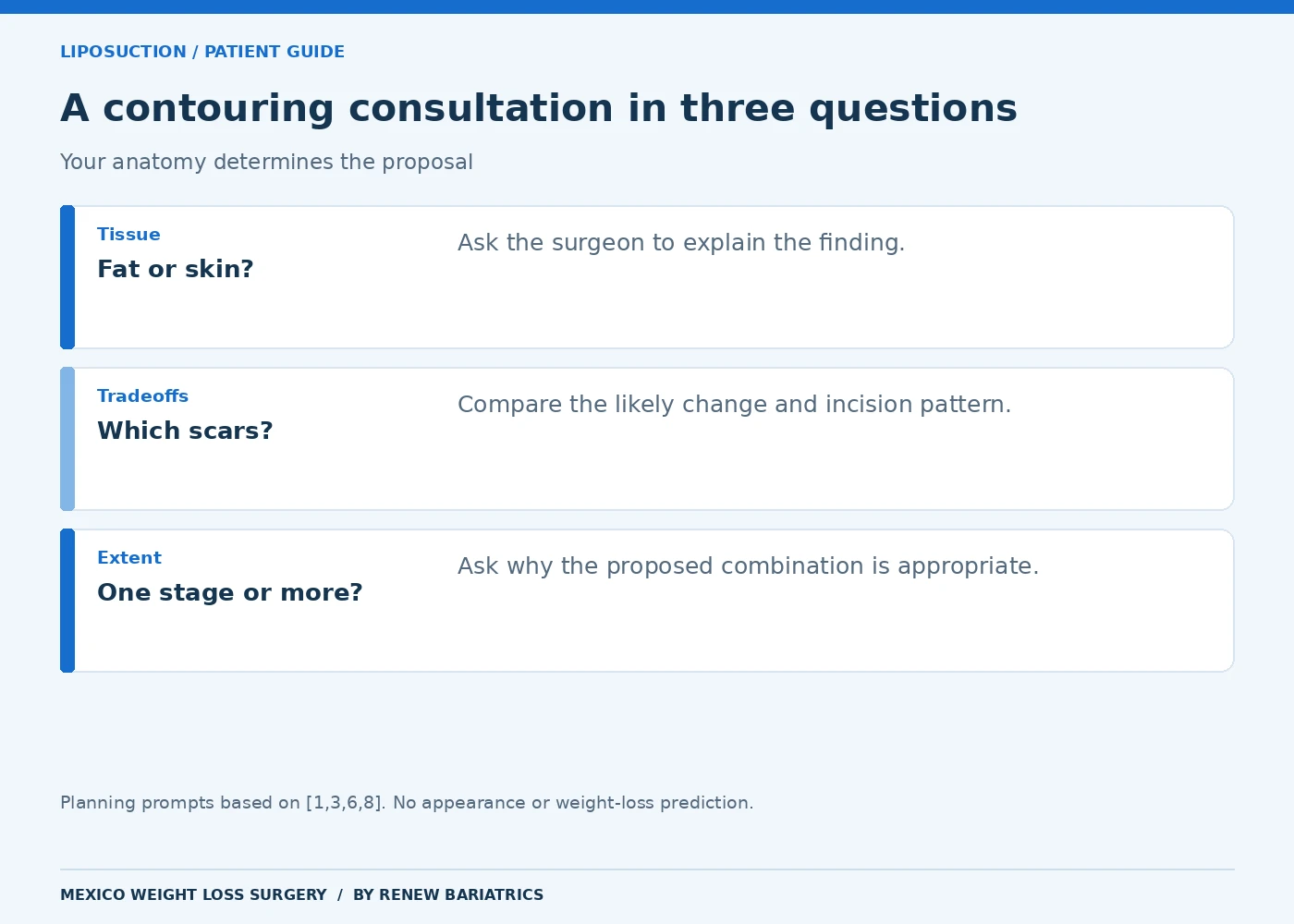
A useful consultation should also identify the tradeoff you are willing to accept. Would you prefer a modest improvement with small access scars, or would you consider longer incisions to remove excess skin? Would you still choose surgery if your clothing size did not change? Answering these questions early makes it easier to judge the recommendation on its own terms.
Liposuction versus weight-loss surgery and skin removal
Bariatric procedures and liposuction solve different problems. Liposuction is not a substitute for treatment of obesity or a method for achieving major weight loss. If your main goal is a substantial reduction in body weight, start with an obesity-care assessment rather than a contouring package. If you are still losing weight, discuss when it would make sense to reassess your shape. [1]
Skin-removal procedures address tissue that suction cannot take away. The choice may involve liposuction alone, an operation that removes skin, a carefully selected combination, or no operation. A surgeon should explain why the proposed treatment fits your actual anatomy. “More procedures” is not automatically a more complete solution.
For example, imagine two fictional adults with a similar waist measurement. One has a localized fat deposit and relatively firm skin. The other has a fold of loose skin after substantial weight loss. The same advertised package might be offered to both, but the tissue concerns are different. Use this example to ask for an examination-based explanation, not to diagnose yourself from a photograph.
Nonsurgical contouring is another category. The FDA explains that these treatments do not treat obesity and that effects may be limited or temporary. Their technologies and risks differ from surgical liposuction. A device brand is not evidence that a treatment will meet your particular goal. Ask what improvement is realistically expected, how many sessions are involved, and what happens if the result is disappointing. [5]
Who may be a candidate?
ASPS describes suitable candidates as people in good health with localized fat concerns, realistic goals and adequate skin elasticity. Smoking and vaping are relevant because of healing concerns. A screening form can organize information, but it cannot assess tissue quality, anesthesia risk or whether the proposed change is achievable. [2]
Your consultation should cover previous surgery, illnesses, medication and supplement use, allergies and your reasons for seeking treatment. Mention prior body contouring, previous problems with anesthesia, scarring concerns and any past difficulty recovering from an operation. ASPS includes health assessment and an open discussion of expected outcomes in its consultation guidance. [6]
Bring a complete medication list rather than relying on memory during a video call. Include the name, dose, how often you take it, and who prescribes it. Add weight-management medicines, nonprescription products and nicotine use. Ask which clinician will provide the final instructions and how changes will be coordinated with your regular prescriber. Do not make prescription changes based on a general webpage.
Eligibility may change after an in-person examination or test result. Before paying a deposit, ask how the program handles a finding that makes surgery unsuitable or changes the recommended operation. A good decision process allows for postponement without making you feel that travel arrangements oblige you to proceed.
Liposuction after bariatric surgery or major weight loss
After major weight loss, preparation should include more than a current weight. Nutrition, the pattern of weight change and the amount of excess skin may influence the plan. Recent ASPS guidance highlights nutritional screening and an individualized approach to protein, vitamins and minerals before body contouring. The goal is to identify and address deficiencies, not simply add an arbitrary supplement. [7]
For your appointment, assemble a brief timeline: original weight-loss procedure, approximate weight changes, current eating pattern and the date of recent follow-up. If you use a GLP-1 medication, include it. Ask whether your bariatric clinician or dietitian should participate in preparing for another operation. Avoid assuming that reaching a preferred appearance or scale number establishes readiness.
It is reasonable to ask for the purpose of every requested test. Which result would change the operation date? Who will interpret the test? How will an abnormal result be treated, and when will it be checked again? This turns a preoperative checklist into a plan you understand.
If your main difficulty is a hanging fold, friction or trouble fitting clothing around loose skin, say so explicitly. Liposuction is not skin removal. Ask to compare the relevant contouring options and the scars associated with each. You do not need to accept an operation that addresses a secondary concern while leaving your primary goal unresolved.
Techniques, treatment areas and combination procedures
Traditional suction, power-assisted methods and energy-assisted methods may be discussed. The important issue is the surgeon's rationale for your treatment rather than the marketing name. Ask what the selected method is intended to improve and which additional risks come with it. ASPS notes that ultrasound-assisted liposuction can cause heat injury. [3],[8]
Terms such as “360” describe a treatment pattern in advertising, but they should not replace an itemized surgical plan. Request a written list of areas and ask how the boundaries are defined. Does “abdomen” include the flanks? Does a quoted area cover both sides? Will the surgeon reassess the plan while examining you? Those details are necessary for comparing quotes fairly.
Removing a larger amount or adding operations can change the risk profile. Mayo Clinic notes that complications become more likely when larger body surfaces or multiple procedures are treated in one session. There is no universal volume target that makes sense for every patient. [1]
If several concerns matter to you, rank them. Ask the surgeon to compare doing the highest-priority procedure first with combining treatments. Discuss what you gain, what recovery becomes harder, and why the proposed duration is appropriate. A staged plan may be worth considering even when a combined package initially looks more convenient.
Risks deserve a specific discussion
Liposuction risks include infection, bleeding, fluid collections, persistent sensation changes, poor healing, uneven contours and a need for further surgery. Serious complications can include blood clots, injury to deeper structures, and heart or lung problems. Energy-assisted techniques may add thermal injury risk. Your individual risk depends on your health and the actual operation. [8]
Ask how the team prevents, recognizes and treats the complications most relevant to your case. “Complications are rare” does not tell you who will examine new symptoms after discharge. Find out who makes clinical decisions overnight, whether the facility can provide the intended level of monitoring, and where you would be transferred if higher-level care were needed.
An outcome can also be medically uncomplicated but aesthetically disappointing. You may notice asymmetry, residual fullness, visible contour transitions or loose skin that was not obvious beforehand. ASPS notes that results cannot be guaranteed and that some patients need another procedure. [4]
Before surgery, ask what the surgeon considers a normal healing variation, when an aesthetic concern can be assessed, and how revision decisions are made. Request the written financial terms as well as the clinical explanation. A promise to “take care of you” is less useful than knowing who provides care, where it happens and what charges may apply.
Preparing for surgery
Preparation may include laboratory testing, medical evaluation, medication instructions and stopping smoking or vaping. ASPS also recommends arranging transport and someone to remain with you at least the first night. Your treating team must set your instructions; a general guide cannot supply your medication or fasting schedule. [9]
Make a simple document with three columns: task, responsible person and completion date. Include tests, consent questions, medication instructions, transport, accommodation and follow-up appointments. Keep clinical instructions separate from the travel itinerary so that an airline change does not accidentally determine your medical plan.
Ask for instructions in language you understand. If an interpreter is needed, arrange one for clinical discussions as well as routine coordination. You should be able to explain back the planned operation, its main risks and your alternatives before signing consent.
Prepare your recovery space around the limitations your surgeon anticipates. Ask whether stairs, reaching, getting into bed or carrying bags will be difficult for your planned treatment areas. Arrange assistance with childcare, pets and household tasks. These are practical questions to resolve beforehand, not signs that you are overthinking an elective procedure.
Recovery: what should you plan around?
Compression garments, dressings and sometimes drainage tubes are part of postoperative care. Instructions should explain wound care, medicines, garment use, activity restrictions and follow-up. Swelling and bruising can obscure the early appearance; recovery should be evaluated as a clinical process rather than a daily comparison with a promotional photograph. [10]
Published timelines are general guides. ASPS describes gradual improvement over several weeks, while NHS guidance notes that settling can take months and restrictions depend on the work and activity involved. These ranges cannot establish your return-to-work or flight date. [10],[11]
Explain your actual job. Working at a computer from home is different from standing for a shift, driving long distances, lifting patients or climbing ladders. Ask for task-specific restrictions and a plan for reassessment if your recovery is slower than expected. A vague “back to work soon” estimate is difficult to use responsibly.
Keep a written record of the instructions you receive. If the team asks you to track drainage, medications or symptoms, use the format they prefer. Before leaving the facility, make sure you know which questions can be handled routinely and which require immediate assessment. Do not start massage, aggressive compression or other add-on treatments without the operating team's guidance.
When to seek help
Sudden shortness of breath, chest pain, fainting or other rapidly worsening symptoms require emergency assessment. Increasing pain, spreading redness, fever, concerning drainage or a new swelling also warrant prompt clinical contact. Do not wait for a travel coordinator or an online message when you believe there may be an emergency. [8],[11]
Ask your team to write down the local emergency route and the clinical contact for nonemergency concerns. Share this information with the person helping you. A companion should not have to search a website for instructions while you are unwell.
Scars, swelling and long-term expectations
Liposuction requires incisions, even when they are small. Ask where the access points would be, whether any scars are likely to show in your usual clothing and how your own scar history affects expectations. A realistic conversation includes what will remain visible, not only where a surgeon hopes to conceal an incision.
Results become easier to judge as swelling settles. ASPS emphasizes maintaining a stable weight and notes that aging can change firmness over time. The operation does not freeze the body at a single moment. [4]
For your own records, agree with the clinic on consistent photographs and follow-up milestones. Ask permission and privacy questions before sharing identifiable images. You should understand the difference between photographs needed for medical care and photographs requested for marketing. A decision about publicity should not be confused with consent for treatment.
Planning liposuction in Mexico
Choose the surgeon and care arrangements before choosing a flight. Confirm the surgeon's full name, relevant specialist credentials, operating facility and who provides anesthesia. Ask for the actual clinical follow-up schedule, not just the number of hotel nights in a package.
CDC cautions that surgery and prolonged travel can increase blood-clot risk and recommends planning for complications and obtaining medical records. Clearance to travel must be individualized. Ask what findings would delay departure and how you would extend accommodation if necessary. [12]
Consider the entire trip home, including car rides, border waits, airport queues, connections and carrying luggage. Ask your surgeon how to manage those demands. Arrange a clinician at home who can help if follow-up is needed and provide that clinician with the operation record and discharge instructions.
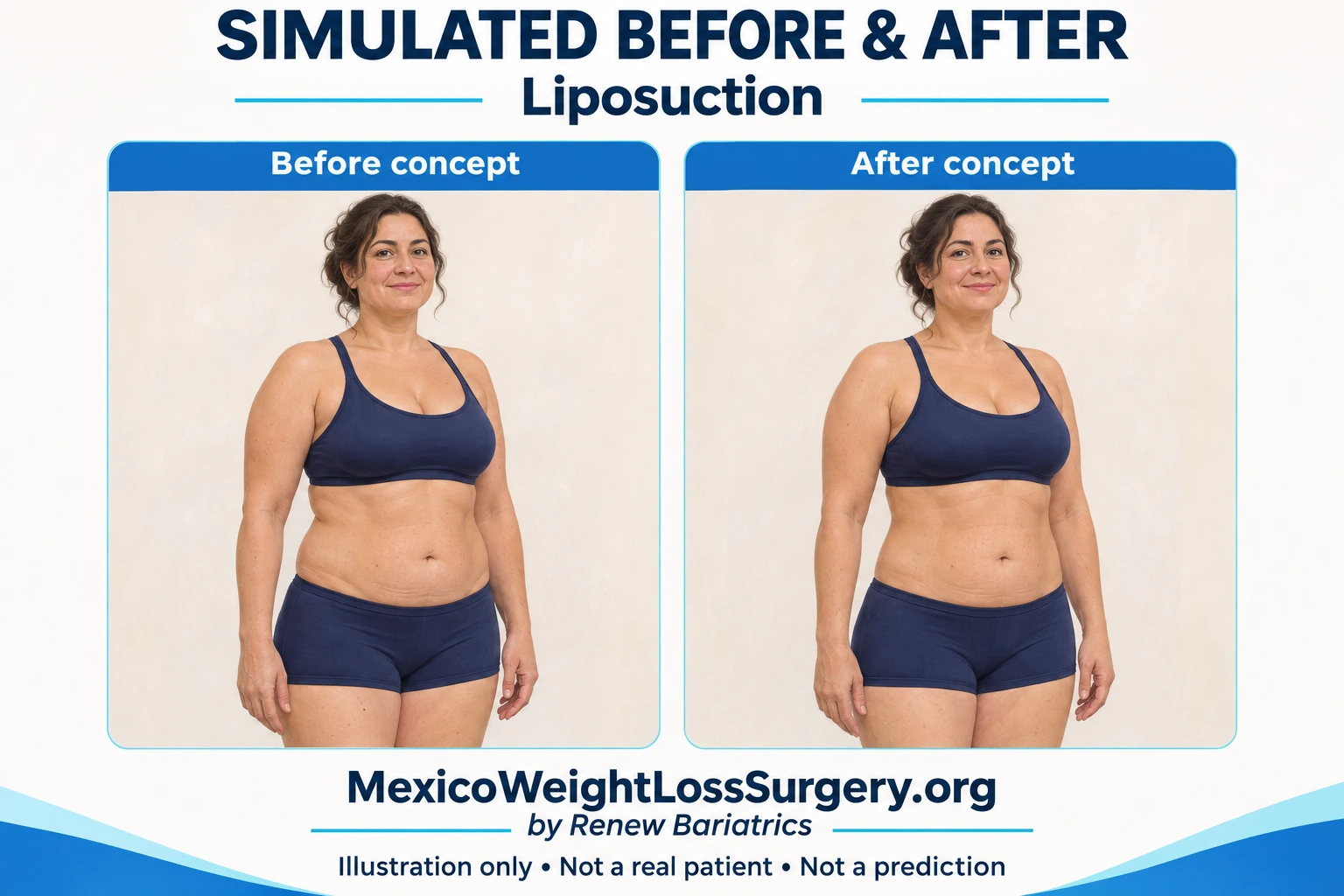
A synthetic illustration of possible changes
This fictional example illustrates a treatment concept. It cannot show the result you would achieve, predict scar healing, or establish a typical outcome.
Liposuction Cost in Mexico
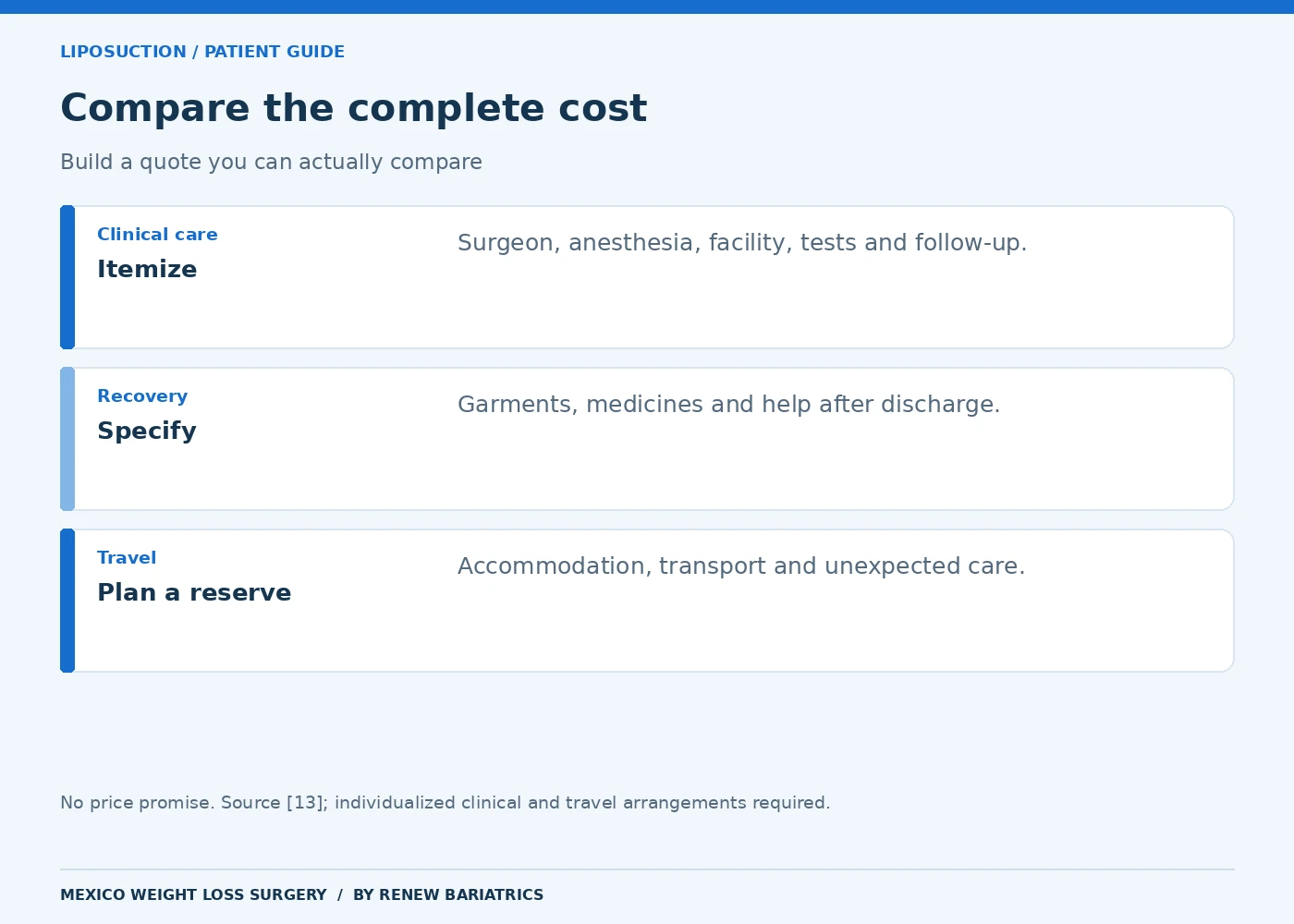
A surgeon's fee is not necessarily the total cost. ASPS lists anesthesia, facility charges, tests, garments and prescriptions among possible expenses. A U.S. average surgeon fee does not establish a Mexico package price or your eventual total. [13]
Request a written quote that identifies the treatment areas and whether the following are included: surgeon and anesthesia fees, facility care, testing, garments, medications, follow-up and any planned overnight monitoring. Separately list transport, accommodation, companion costs and time away from work. Ask which items change if the procedure is modified after examination.
Then ask about the less predictable costs. Who pays for an extra stay, urgent assessment, imaging, readmission or revision? What does your own insurance cover after elective surgery abroad? Obtain answers in writing instead of assuming that an “all-inclusive” label covers every possible event.
Questions to bring to your consultation
- Which part of my concern is fat, and which is excess skin?
- What improvement is realistic if I choose liposuction alone?
- Which areas and methods are included in the proposed operation?
- Why is this plan preferable to a smaller or staged procedure?
- What makes my personal risk higher or lower?
- Who will provide clinical care after discharge and after I return home?
- What would make you postpone surgery or delay my journey home?
- What costs remain outside the written quote?
Use the answers to decide whether the proposed operation meets your priorities. You should feel able to ask for clarification, seek another opinion or choose no treatment. NHS decision guidance encourages taking time and avoiding pressure from short-lived deals. [14]
Frequently asked questions
Will liposuction help me reach my goal weight?
It is not a treatment for substantial weight loss. If the number on the scale is your main concern, discuss obesity-treatment options first. A contouring consultation can then address localized shape concerns when the timing is appropriate. [1]
Will it tighten my stomach after weight loss?
It cannot reliably correct lax skin. Ask the surgeon to distinguish fat from skin and explain whether a skin-removal operation would better address the concern. You should not be promised the same outcome from different procedures. [4]
Is nonsurgical fat reduction the same thing?
No. It uses different technologies and does not surgically remove tissue. Ask about the expected degree of change, risks, repeat treatments and limitations of the particular device. [5]
What affects liposuction cost in Mexico?
The planned treatment areas, surgeon, anesthesia, facility and postoperative needs affect the total. Compare an itemized clinical plan and ask about exclusions, travel expenses and unexpected care. No single advertised fee can establish your personal cost. [13]
Does Renew offer liposuction?
Renew's procedure directory lists liposuction. Request a current consultation to confirm who would perform it, at which facility, and whether the treatment is suitable for you. The listing does not establish a particular technique, price or recovery protocol. [16]
Your next step
Start with a clear description of the change you want and a candid account of your health. Ask Renew Bariatrics for an assessment of your options and an itemized plan. Compare liposuction with relevant skin-removal procedures and, if major weight loss remains your priority, with obesity care. The best next step is the one that matches your medical needs, practical support and expectations—not the largest package you can book.
Program information related to this guide
Explore Renew Bariatrics’ procedure options when discussing a plastic surgery plan. Availability, combinations and suitability require individual confirmation.
Liposuction vs. tummy tuck
These procedures address different concerns and may be combined or staged. A clinical assessment determines which, if either, fits your anatomy and goals.
| What to compare | Liposuction → | Tummy Tuck → |
|---|---|---|
| Main goal | Reduces selected fat deposits. | Addresses excess abdominal skin. |
| What changes | Fat beneath the skin. | Front abdominal skin; possible wall repair. |
| Key distinction | Does not remove excess skin. | Does not remove internal abdominal fat. |
| Recovery consideration | Swelling and garment plans vary. | Abdominal wound healing affects activity. |
| Cost comparison | Request an itemized quote for this exact procedure and care plan. | Compare the same inclusions, exclusions and recovery expenses. |
Comparison references: ASPS — Liposuction ↗ · ASPS — Tummy tuck ↗
These options are not interchangeable for every person. The treating clinician must assess your anatomy, medical history and goals.
Discuss your options with Renew.
Talk with a coordinator about liposuction, your goals and the information needed for clinical review. The treating team determines suitability and the care plan.
Call 844-736-3963 Ask about plastic surgery ↗The link opens Renew’s plastic surgery health questionnaire. This review site does not collect health information.
References & evidence notes
Sources checked November 2026. Research findings are not a forecast for an individual or outcomes for Renew’s own program. Review study populations, methods and limitations alongside the reported results.
- Mayo Clinic. Liposuction ↗Institutional patient education; individual clinical assessment required.
- American Society of Plastic Surgeons. Liposuction: Candidates ↗Institutional patient education; individual clinical assessment required.
- American Society of Plastic Surgeons. Liposuction: Procedure ↗Institutional patient education; individual clinical assessment required.
- American Society of Plastic Surgeons. Liposuction: Results ↗Institutional patient education; individual clinical assessment required.
- U.S. Food and Drug Administration. Non-invasive body contouring technologies ↗U.S. regulatory context; does not establish authorization in Mexico.
- American Society of Plastic Surgeons. Liposuction: Consultation ↗Institutional patient education; individual clinical assessment required.
- American Society of Plastic Surgeons, 2026. Nutrition recommendations after major weight loss ↗Society summary of nutritional review; not an individualized supplementation protocol.
- American Society of Plastic Surgeons. Liposuction: Safety ↗Institutional patient education; individual clinical assessment required.
- American Society of Plastic Surgeons. Liposuction: Preparation ↗Institutional patient education; individual clinical assessment required.
- American Society of Plastic Surgeons. Liposuction: Recovery ↗Institutional patient education; individual clinical assessment required.
- NHS. Liposuction ↗Institutional patient education; individual clinical assessment required.
- CDC Yellow Book. Medical tourism ↗Travel, complication planning and continuity of care; does not establish personal flight clearance.
- American Society of Plastic Surgeons. Liposuction: Cost ↗Institutional patient education; individual clinical assessment required.
- NHS. Is a cosmetic procedure right for me? ↗Institutional patient education; individual clinical assessment required.
- Cleveland Clinic. Liposuction: Plastic Surgery ↗Institutional patient education; individual clinical assessment required.
- Renew Bariatrics. Bariatric surgery and plastic surgery options in Mexico ↗Official procedure directory; not independent outcome verification or an individual quote.