

Jump to a section
Anatomy illustrationCompare proceduresRelated ProceduresWhat SADI-S changesSADI-S is not the same as other bypass operationsWho may be considered for SADI-S?What does the weight-loss evidence show?Why study quality mattersIntestinal length is a clinical decision, not a shopping featureRisks that deserve an explicit conversationReflux, bowel changes and quality of lifeNutrition is part of the operationWhat if supplements or food become difficult?Preparing for the procedureRecovery and return to ordinary lifeChoosing care in MexicoWhat should the quote include?Questions to bring to clinical reviewCommon questions about SADI-SYour next stepReferencesSADI-S can produce substantial weight loss, but choosing it means accepting a more demanding lifelong nutrition plan. The important question is not simply whether it removes more weight than another operation. It is whether its potential benefits, digestive changes and follow-up requirements make sense for your health and your life.
This guide explains single-anastomosis duodeno-ileal bypass with sleeve gastrectomy, often shortened to SADI-S or called single-anastomosis duodenal switch. It separates this operation from traditional duodenal switch and mini gastric bypass, explains the limitations of the research, and provides questions for discussing care in Mexico. Renew’s current availability, surgeon, facility and individualized package must be confirmed through clinical review rather than assumed from this educational page.
Understand the anatomy
A simplified, labeled view of the structures and treatment area. Select the image to view it at full size.
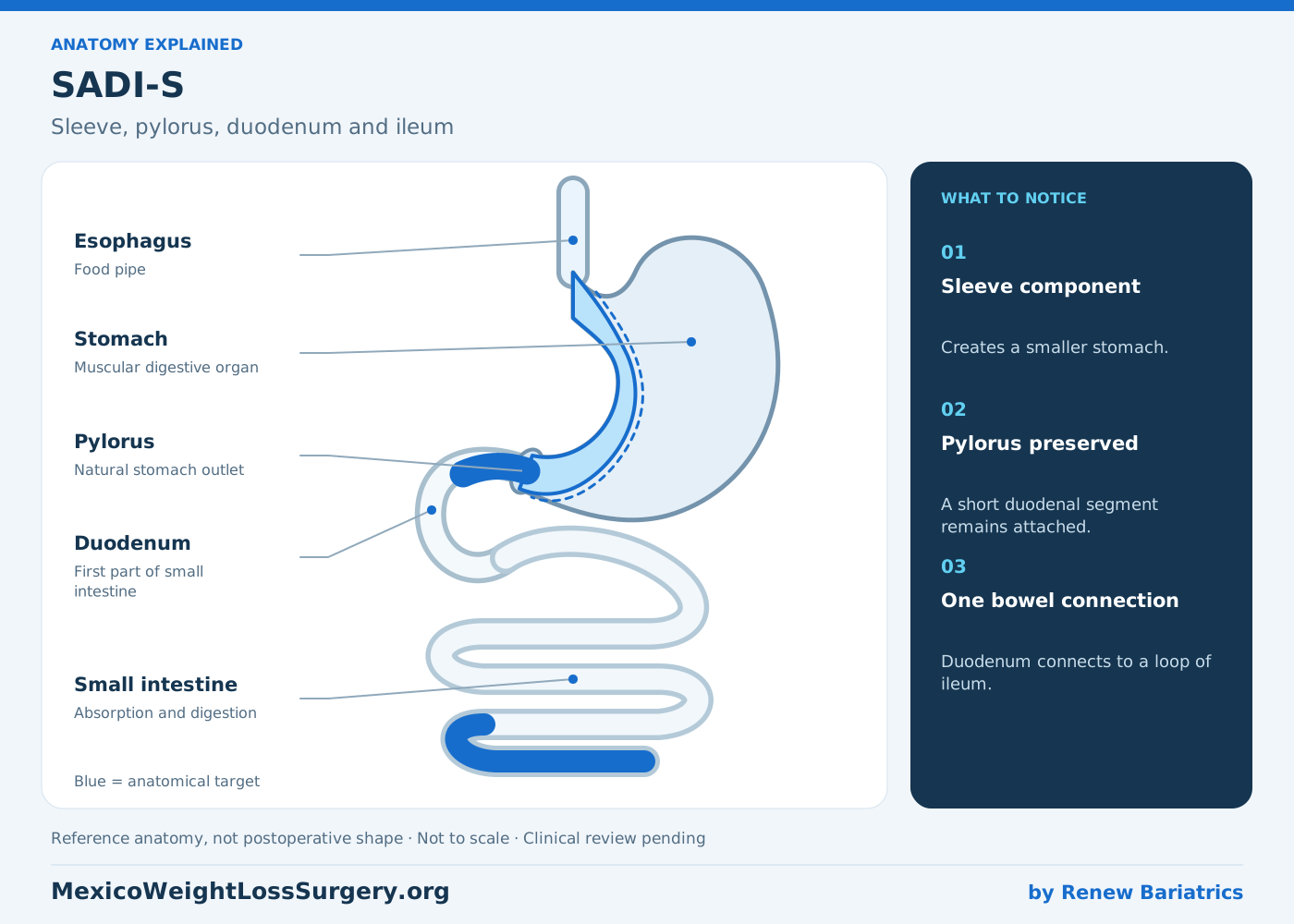
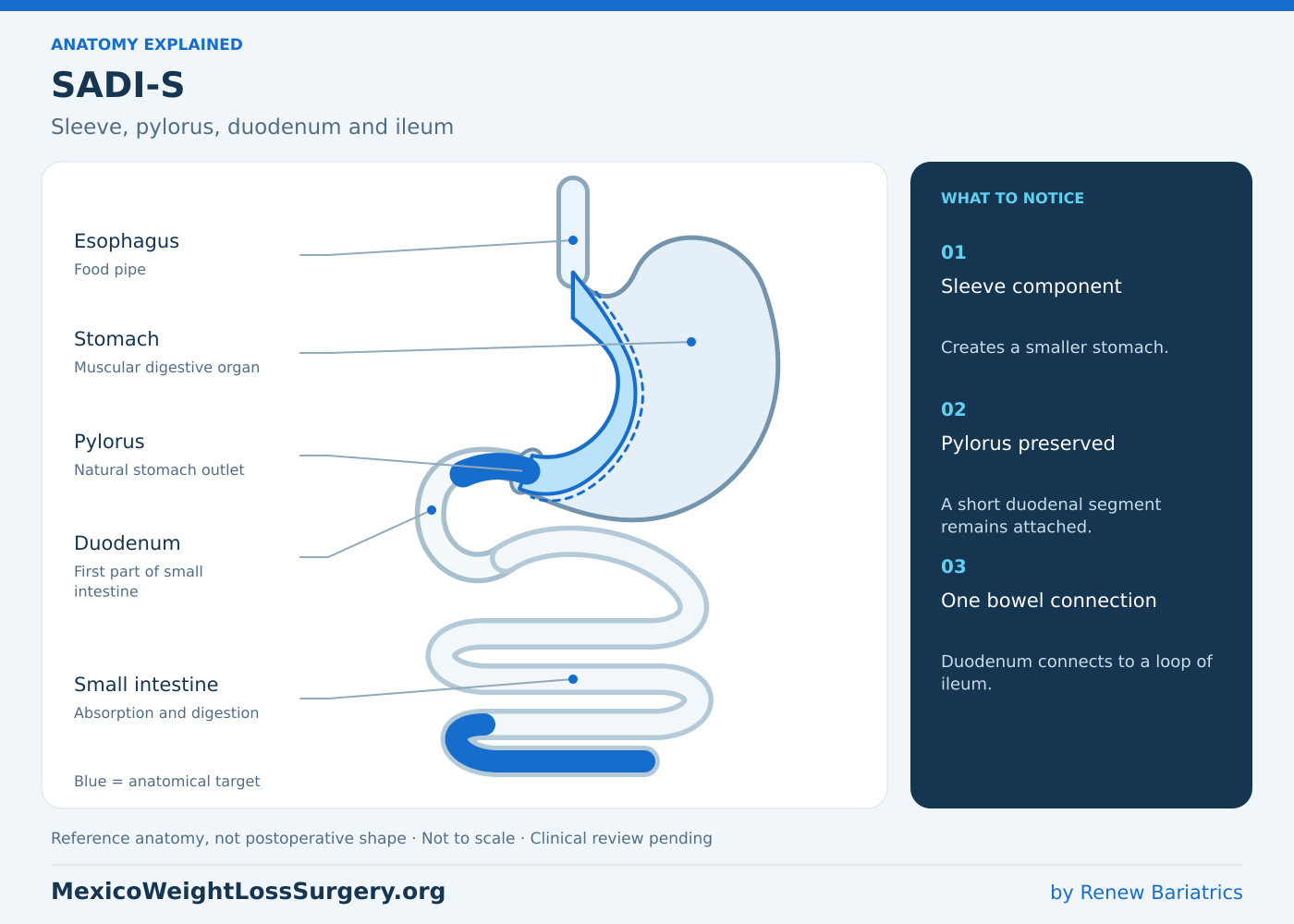
Anatomy references: ASMBS: Single Anastomosis Duodeno-Ileal Bypass with Sleeve Gastrectomy ↗ · Mayo Clinic: Biliopancreatic diversion with duodenal switch ↗
What SADI-S changes
SADI-S combines a sleeve-shaped stomach with a bypass of part of the small intestine. The stomach outlet valve, called the pylorus, is retained. The duodenum is divided beyond that valve and connected to a loop of the lower small intestine. This changes the route food follows and where it meets digestive fluids. Unlike the conventional duodenal switch, SADI-S uses one intestinal connection. It affects food intake, absorption and metabolic signaling. [1]
An anatomical explanation should identify three separate things: the stomach that remains, the intestine food travels through, and the length over which food and digestive juices mix. Ask your surgeon to draw your proposed reconstruction. If you previously had a sleeve, ask what will be retained and whether anything else needs correction. A generic drawing is useful for orientation, but it cannot show your adhesions, previous surgical details or individual anatomy.
SADI-S is not the same as other bypass operations
The words “switch,” “bypass” and “mini” are sometimes used loosely in marketing. They should not be interchangeable in your consent documents. Traditional biliopancreatic diversion with duodenal switch separates the intestine into distinct pathways and reconnects them downstream. SADI-S uses a loop reconstruction. Roux-en-Y gastric bypass uses a small upper stomach pouch and a different intestinal arrangement. One-anastomosis gastric bypass connects a long gastric pouch directly to the intestine; it is not a duodenal switch. [2],[3]
The practical implication is straightforward: ask for the full operation name, not only a brand name or abbreviation. Your future clinicians will need to know which reconstruction was performed. “Weight loss surgery in Mexico” is not enough information for an emergency department or a dietitian deciding which nutritional risks to investigate.
SASI is also a different operation. If it appears in a quote, ask for a separate explanation rather than assuming that a one-letter difference means the same anatomy or evidence. This guide addresses SADI-S only.
Who may be considered for SADI-S?
Eligibility for metabolic surgery is broader than eligibility for this particular procedure. The 2022 ASMBS/IFSO recommendations support metabolic surgery at a BMI of at least 35, with additional recommendations for certain people at lower BMI. Those thresholds do not make SADI-S the automatic choice, and local clinical criteria or coverage rules may differ. [4]
A useful assessment examines the reason for treatment: severe obesity, difficult-to-control metabolic disease, or an inadequate response after an earlier sleeve. It should also examine what could make a more malabsorptive operation difficult to manage. Bring information about anemia, nutritional deficiencies, chronic diarrhea, reflux, previous abdominal surgery, kidney or liver disease, and current medicines. The clinical team decides which factors matter and whether additional investigations are needed.
Before accepting a recommendation, ask the team to describe the alternative they considered most seriously. Why would SADI-S fit better than Roux-en-Y bypass, a different revision, medication-supported treatment, or continuing nonoperative care? A clear comparison should relate to your actual problem rather than a general claim that one surgery is “strongest.”
What does the weight-loss evidence show?
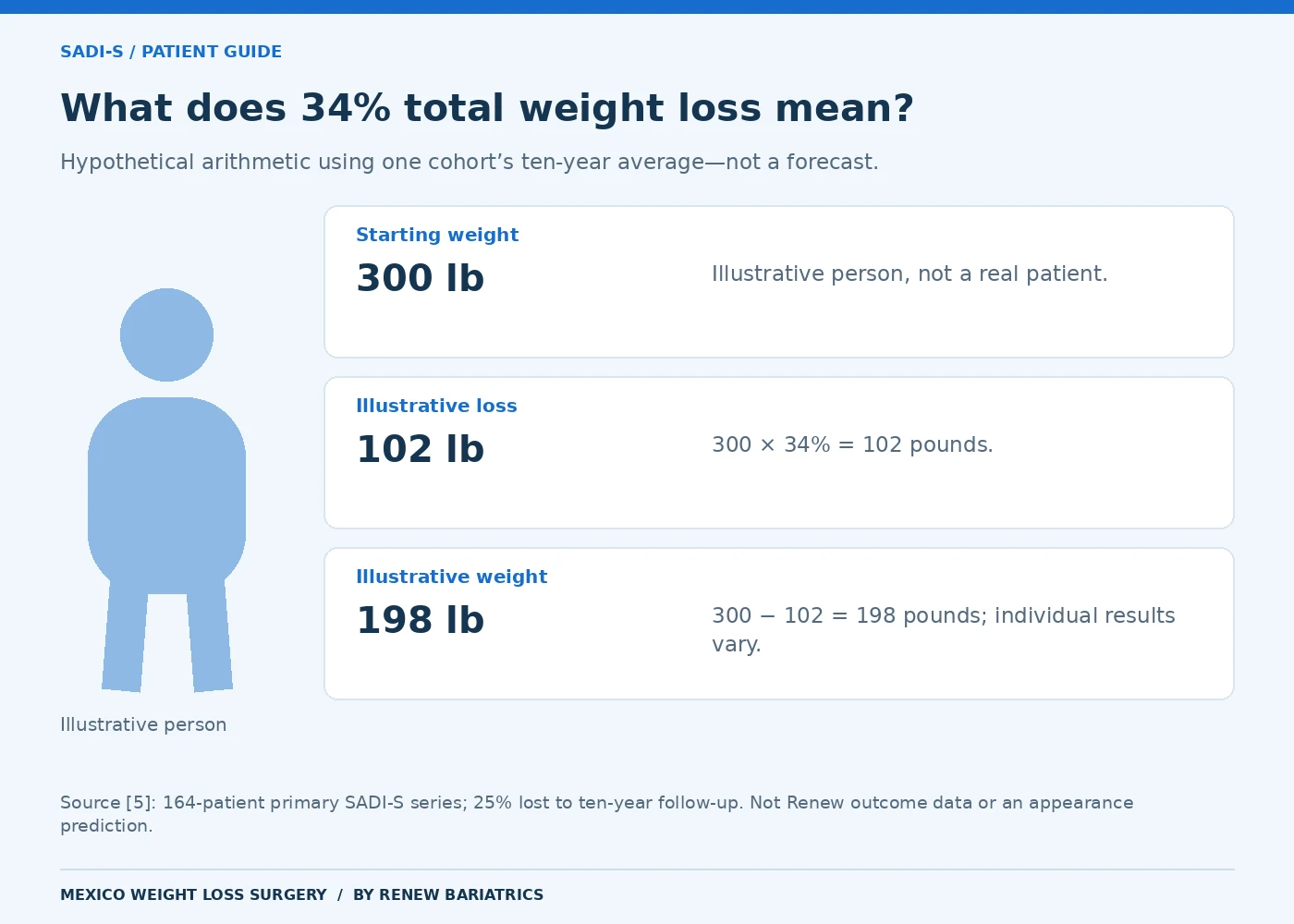
A long-term single-center series followed 164 people who underwent primary SADI-S. Reported total weight loss averaged 38% at five years and 34% at ten years. One quarter of those eligible for ten-year assessment were lost to follow-up. The series also included different intestinal lengths, and 12 patients required revision for low blood protein. These are study results, not a forecast for every patient or outcomes from Renew’s program. [5]
Total weight loss describes the percentage of starting body weight lost. It differs from excess weight loss, which depends on a reference weight. A hypothetical 300-pound person losing 34% of starting weight would lose 102 pounds and weigh 198 pounds. That is arithmetic illustrating the published measure, not a promise of an individual result or a prediction of body shape.
A more recent multicenter cohort included 103 patients, mostly undergoing SADI-S after a prior sleeve. At five years, reported total weight loss was 34.8% for primary operations and 15.9% for secondary operations, measured from the relevant SADI-S baseline. Only 53% completed five-year follow-up, which increases uncertainty. The small primary group and retrospective design also limit direct comparison. [6]
These findings explain why a primary-surgery percentage should not be pasted into a revision advertisement. Ask which starting weight a clinic uses, whether additional treatments were involved, and how many patients were actually measured at the stated time point.
Why study quality matters
The IFSO position statement update published in 2024 reviewed 93 studies. It supported SADI-S as an effective option while emphasizing the shortage of high-quality evidence, frequent nutritional deficiencies, and the need for lifelong supplementation and monitoring. The authors called for stronger long-term data and randomized trials. [7]
For a patient, this is a reason to ask better questions rather than reject or accept the procedure automatically. A large published percentage can come from an experienced specialist center, a selected population, or patients who remained engaged with follow-up. Your relevant comparison includes the surgeon’s experience with your type of case and the support available after you return home.
Ask whether results represent primary surgery or revision, whether the operation has changed since the study began, and whether the clinic reports complications alongside weight loss. A before-and-after photograph cannot answer these questions. A study can provide useful context without proving that one individual will have the same experience.
Intestinal length is a clinical decision, not a shopping feature
The length of intestine available for mixed food and digestive fluids is an important technical variable. Published SADI-S cohorts have used different lengths, and the balance between weight response and nutritional problems is still being studied. A multicenter five-year study found signals of greater nutrient problems with shorter common channels, although several comparisons were not statistically significant. [6]
Do not ask for the shortest channel because it sounds more powerful, or assume that the longest is best for everyone. Instead ask: “What length are you proposing for me, how do you measure it, and what makes that appropriate?” Request that the final measurements appear in the operative report.
If two surgeons propose different approaches, compare their reasoning. The decision may reflect different priorities or assessments, not a simple contest over technique. A useful discussion includes what happens if you lose too little weight, but also what happens if you cannot maintain adequate nutrition.
Risks that deserve an explicit conversation
SADI-S is abdominal surgery, with risks including bleeding, infection, leaks, blood clots and anesthesia-related problems. Complications can require procedures, hospitalization or another operation; rarely, bariatric complications can be fatal. [8] A smaller number of intestinal connections does not eliminate these risks or establish that SADI-S is safer for a particular person.
Longer-term concerns include nutritional deficiencies, difficulty maintaining adequate protein, and changes in bowel habits. Ask the surgeon which complications they monitor most closely in their own SADI-S patients. Ask for numbers with a denominator and follow-up period: “How many cases, over what dates, and how were complications identified after patients returned home?”
Be cautious with an unqualified “zero complications” statement. It does not tell you whether the program counts readmissions elsewhere, late deficiencies, endoscopic treatments or revisions. The quality of the explanation matters more than a reassuring adjective. Your consent discussion should make room for both the expected course and the plan if recovery does not follow it.
Reflux, bowel changes and quality of life
SADI-S can cause or worsen reflux and can be associated with looser, more frequent stools. [1] Tell the team about heartburn, regurgitation, trouble swallowing, bowel urgency and symptoms that disturb sleep or work. “I take something occasionally” is worth explaining, including the medication and how often you need it.
A patient-reported study of 283 people found reflux symptoms and loose stools in roughly three in ten respondents more than three years after surgery. It was a single-center cross-sectional study, so it does not establish a universal complication rate or prove that symptoms increased within each individual over time. [9]
Consider what symptoms would mean for your daily routine. Do you drive for long periods, work without convenient bathroom access, or travel frequently? Ask how the program investigates persistent symptoms and who provides treatment locally. These are legitimate quality-of-life questions, not reasons to feel embarrassed. A successful outcome should include being able to live comfortably, not only achieving a lower number on a scale.
Nutrition is part of the operation
SADI-S requires a lifelong plan for protein intake, supplements and laboratory monitoring. The OMA clinical practice statement describes procedure-specific testing that includes iron, B vitamins, vitamin D and additional attention to fat-soluble vitamins in SADI-S and duodenal switch patients. Individual testing and replacement depend on the patient and findings. [10]
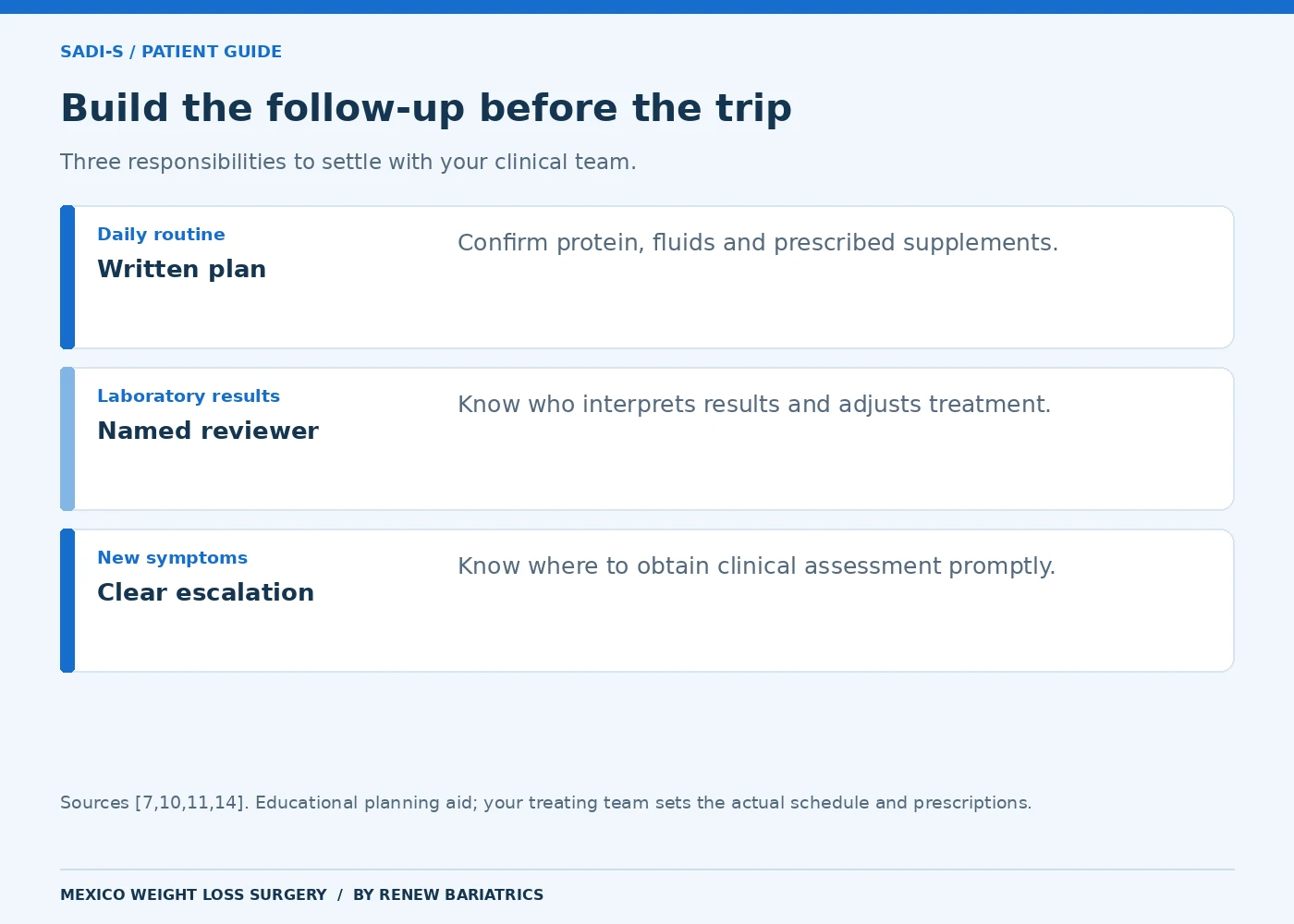
Before surgery, ask for a written plan in plain language. It should explain what to take, when to take it, which products meet the prescription, and what to do if a product is unavailable or causes nausea. A shopping list without doses or a schedule is not enough. Bring all your existing supplements so the clinician can identify duplication rather than adding new products on top of an unclear routine.
Also ask who receives laboratory results and who acts on them. “Get bloodwork every year” leaves an important gap if nobody has accepted responsibility for interpreting it. Arrange access to a clinician experienced with the procedure, not simply a laboratory that can collect blood.
What if supplements or food become difficult?
Being unable to tolerate a supplement or protein source should trigger a conversation, not silent discontinuation. Explain whether the problem is taste, vomiting, cost, swallowing, diarrhea or availability. Each creates a different practical problem, and the team needs accurate information to adjust the plan.
Prolonged vomiting and poor intake can lead to urgent nutritional problems, including thiamine deficiency. BOMSS guidance emphasizes early assessment and prompt treatment when deficiency is suspected. Do not wait for a routine appointment if you cannot keep fluids down or develop concerning neurological symptoms. [11]
Create a fallback plan before travel: whom to contact outside normal hours, where to seek urgent care near home, and how to share your operative report. A messaging service can help communication, but it cannot replace examination, intravenous treatment or emergency assessment when needed. If you seek local care, tell the team exactly which operation you had and when.
Preparing for the procedure
Ask the treating team for individualized instructions about medicines, smoking or nicotine, alcohol, fasting and the preoperative diet. Do not use another patient’s checklist to decide when to stop prescribed treatment. Your anesthesia team and prescribing clinician may need to coordinate a plan, especially for diabetes medicines, anticoagulants or drugs that affect gastric emptying.
Make an accurate medication list that includes doses, supplements and nonprescription products. Add allergies, previous anesthesia problems and relevant surgical records. If you use a device such as CPAP, ask whether to bring it and how it will be used during your stay.
Preparation also means arranging practical support: transportation, help with lifting or caregiving, access to the recommended foods, and enough flexibility if discharge or travel is delayed. Ask the team to describe what must be true before they clear you to leave the hospital. A calendar date is not a substitute for a clinical discharge assessment.
Recovery and return to ordinary life
Bariatric recovery generally moves from liquids toward more substantial foods in stages, with activity increasing according to the treating team’s advice. [12] Your SADI-S protocol should specify the actual schedule and targets. Do not advance food texture because another patient did, and do not assume a sleeve-only handout covers all your nutritional needs.
Discuss your work in concrete terms. Desk work from home, standing for an entire shift, frequent driving and lifting children are different demands. Ask when you may resume each activity and what symptoms should delay the plan. If your job has limited breaks, discuss how you will manage hydration, eating and bathroom access.
Keep a simple recovery record if the team finds it useful: fluid intake, food tolerance, symptoms, medicines and questions. The purpose is to communicate accurately, not to turn recovery into a competition. Contact the clinical team about a concerning change rather than trying to meet a target while feeling increasingly unwell.
Choosing care in Mexico
A destination does not determine whether an operation is appropriate. Evaluate the named surgeon, exact hospital, anesthesia arrangements, emergency resources and follow-up system. Ask whether the clinician recommending SADI-S will perform it and how frequently they handle similar cases.
For international care, request an English-language operative report and an explicit plan for complications after returning home. CDC guidance also highlights the additional risks of travel after surgery, including blood clots. Obtain individualized travel clearance and discuss any conflict between a proposed package itinerary and conservative travel guidance before buying nonchangeable tickets. [13]
Ask who can make a clinical decision if a coordinator is unavailable. Coordinators can help with logistics and communication; they are not a substitute for the treating clinician. Confirm the address where surgery actually occurs, because an office address, hotel and hospital may be different locations.
What should the quote include?
This page intentionally does not assign a universal SADI-S price. A meaningful quote needs the correct procedure and an individualized assessment. Ask whether the amount covers the surgeon, anesthesia, hospital, routine testing, medications, accommodation and transportation, and list exclusions alongside inclusions.
Request written answers about additional hospital nights, unexpected testing, endoscopy, treatment of a leak, intensive care, readmission and transfer. Ask whether any complication policy has limits, exclusions or an expiration date. Do not treat a general promise of support as an insurance contract.
Budget separately for long-term supplements, specialist visits, laboratory testing and time away from work. Compare total care arrangements rather than the advertised surgical fee alone. A lower initial cost may still be attractive, but you should understand which future expenses remain yours before committing.
Questions to bring to clinical review
- Why does SADI-S fit my goals better than the alternatives you considered?
- Is this primary surgery, a planned second stage or a revision, and which outcomes apply to my situation?
- What anatomy and intestinal length do you propose, and what will be documented?
- How do my reflux history, bowel symptoms and existing nutritional results affect the decision?
- Who will manage my supplements and laboratory results after I return home?
- What would cause you to postpone or change the operation?
- How are urgent complications handled locally and after international travel?
- What are the likely ongoing costs, and what is excluded from the package?
You do not need to arrive knowing the answer to every question. The purpose of review is to turn uncertainty into a specific plan, including a decision not to proceed if the balance does not fit your circumstances.
Common questions about SADI-S
Is SADI-S reversible?
The sleeve component removes stomach tissue. Although surgeons can revise intestinal anatomy when necessary, that does not make the entire procedure simply reversible. Ask what a proposed revision would involve and what problem it would address. [1],[2]
Can I have SADI-S after a sleeve?
It is used as a secondary procedure in selected patients, but previous sleeve surgery does not by itself establish suitability. The reason for revision and current anatomy matter, and published secondary-procedure outcomes differ from primary-operation outcomes. [6]
Will I need specialist follow-up forever?
Plan for continuing specialist input. BOMSS identifies SADI among the procedures needing specialist bariatric care rather than relying solely on its routine primary-care follow-up pathway. [14] Agree on the actual provider and communication process before surgery.
What if I want pregnancy in the future?
Discuss timing and nutritional planning before surgery. Pregnancy after bariatric surgery requires coordinated care and careful supplementation; standard prenatal products may not meet individual requirements. The exact plan should be agreed with obstetric and bariatric clinicians. [15]
What is the next step with Renew?
Begin with a coordinator conversation and the health questionnaire so your history can reach the clinical team. Ask specifically about SADI-S availability, the proposed surgeon and facility, and whether your case needs additional records. A procedure page helps you prepare for that review; it cannot approve you for surgery or replace informed consent.
Program information related to this guide
For information about care through our parent organization, explore Renew’s duodenal switch and SADI-S information. Ask the team to confirm availability, your eligibility and the written scope of care.
SADI-S vs. traditional duodenal switch
These options change different structures. Your anatomy, symptoms, health history and follow-up needs guide the choice; neither is automatically better for everyone.
| What to compare | SADI-S → | Duodenal switch → |
|---|---|---|
| Shared feature | Sleeve plus a pylorus-preserving intestinal bypass. | Sleeve plus a pylorus-preserving intestinal bypass. |
| Connections | One duodeno-ileal connection. | Duodeno-ileal and downstream bowel connections. |
| Nutritional care | Lifelong supplementation and monitoring. | Substantial malabsorption needs close lifelong monitoring. |
| Planning | Ask about bowel lengths and nutritional follow-up. | Ask about bowel lengths and nutritional follow-up. |
Comparison references: ASMBS: Single Anastomosis Duodeno-Ileal Bypass with Sleeve Gastrectomy ↗ · Mayo Clinic: Biliopancreatic diversion with duodenal switch ↗
These options are not interchangeable for every person. The treating clinician must assess your anatomy, medical history and goals.
Discuss your options with Renew.
Talk with a coordinator about sadi-s, your goals and the information needed for clinical review. The treating team determines suitability and the care plan.
Call 844-736-3963 Complete health questionnaire ↗The questionnaire opens Renew’s existing intake. This review site does not collect health information.
References & evidence notes
Sources checked November 2026. Research findings are not a forecast for an individual or outcomes for Renew’s own program. Review study populations, methods and limitations alongside the reported results.
- ASMBS. Single Anastomosis Duodeno-Ileal Bypass with Sleeve Gastrectomy ↗Professional society patient education; anatomy and tradeoffs.
- Mayo Clinic. Biliopancreatic diversion with duodenal switch (BPD/DS) ↗Patient education; traditional DS anatomy, risks and follow-up.
- BOMSS. One-anastomosis (Mini) Gastric Bypass (OAGB) ↗Patient information; general outcome range has no specified time horizon and is not an individual forecast.
- Eisenberg et al., 2022. ASMBS/IFSO Indications for Metabolic and Bariatric Surgery ↗Professional recommendations; general surgical eligibility is not procedure-specific approval.
- Sánchez-Pernaute et al., 2022. Long-Term Results of SADI-S ↗164-patient single-center series; differing limb lengths, 25% lost at ten years; 12 revisions for hypoproteinemia.
- Multicenter cohort, 2025. Five year outcomes of primary and secondary SADI-S ↗Retrospective 103-patient cohort: 19 primary and 84 secondary operations; outcomes use SADI-S baseline.
- Ponce de Leon-Ballesteros et al., 2024. SADI-S/SADS IFSO Position Statement—Update 2023 ↗93-study review; limited high-quality evidence, nutritional risks and lifelong surveillance. doi:10.1007/s11695-024-07490-0.
- NIDDK. Weight-loss Surgery Side Effects ↗General bariatric risks; not an operation-specific complication estimate.
- Single-institution study, 2023. Patient-Reported Outcomes and Quality of Life After SADI-S ↗283-patient cross-sectional study; symptom reports are not a universal incidence estimate.
- Obesity Medicine Association, 2024. Bariatric nutrition and evaluation of the metabolic surgical patient ↗Clinical practice statement update; procedure-specific monitoring and individualized nutritional care.
- BOMSS, 2020. Perioperative and postoperative biochemical monitoring and micronutrient replacement guidelines ↗Clinical guidance; prolonged vomiting and poor intake require early assessment, including thiamine risk.
- NIDDK. Types of Weight-loss Surgery ↗General postoperative diet/activity education; does not establish a Renew procedure-specific protocol.
- CDC Yellow Book, 2026 edition. Medical Tourism ↗Travel, complication planning, medical records and continuity of care; published April 2025.
- BOMSS, 2023. Post-bariatric surgery nutritional guidance for GPs ↗Defines limitations of routine primary-care guidance and need for specialist care after malabsorptive procedures.
- Shawe et al., 2019. Pregnancy after bariatric surgery: consensus recommendations ↗Consensus guidance; coordinate pregnancy planning and nutritional care rather than self-prescribing supplements.