

Jump to a section
Anatomy illustrationSynthetic illustrationCompare proceduresRelated ProceduresWhat thighplasty treatsCandidacy after major weight lossNutrition and medication preparationConsultation questions that change the decisionIncision choices and scar tradeoffsThigh lift risksWhat studies tell us—and what they do notRecovery after thigh lift surgeryWarning signs and unplanned careThigh Lift Cost in MexicoTravel and continuity of careFrequently asked questionsRequest a plan you can evaluateYour next stepReferencesA thigh lift in Mexico is a body-contouring option for excess skin that remains around the thighs after weight loss. It may address hanging folds and improve shape, but it involves scars and a recovery period that deserves careful planning. Thigh lift cost in Mexico also depends on which part of the thigh needs treatment and how extensive the operation will be; a groin-only procedure and an extended thighplasty are not interchangeable.[1],[4]
Renew Bariatrics lists extended thigh lift among its post-weight-loss plastic surgery services. A listing is a starting point for consultation, not confirmation that you qualify or that a particular surgical plan is available. Ask for an examination-based recommendation, current quote, and explicit aftercare arrangements.[14]
The illustrations on this page use fictional people and educational concepts. They do not show real patients, predicted outcomes, or evidence that an individual will achieve a particular appearance.
Understand the anatomy
A simplified, labeled view of the structures and treatment area. Select the image to view it at full size.
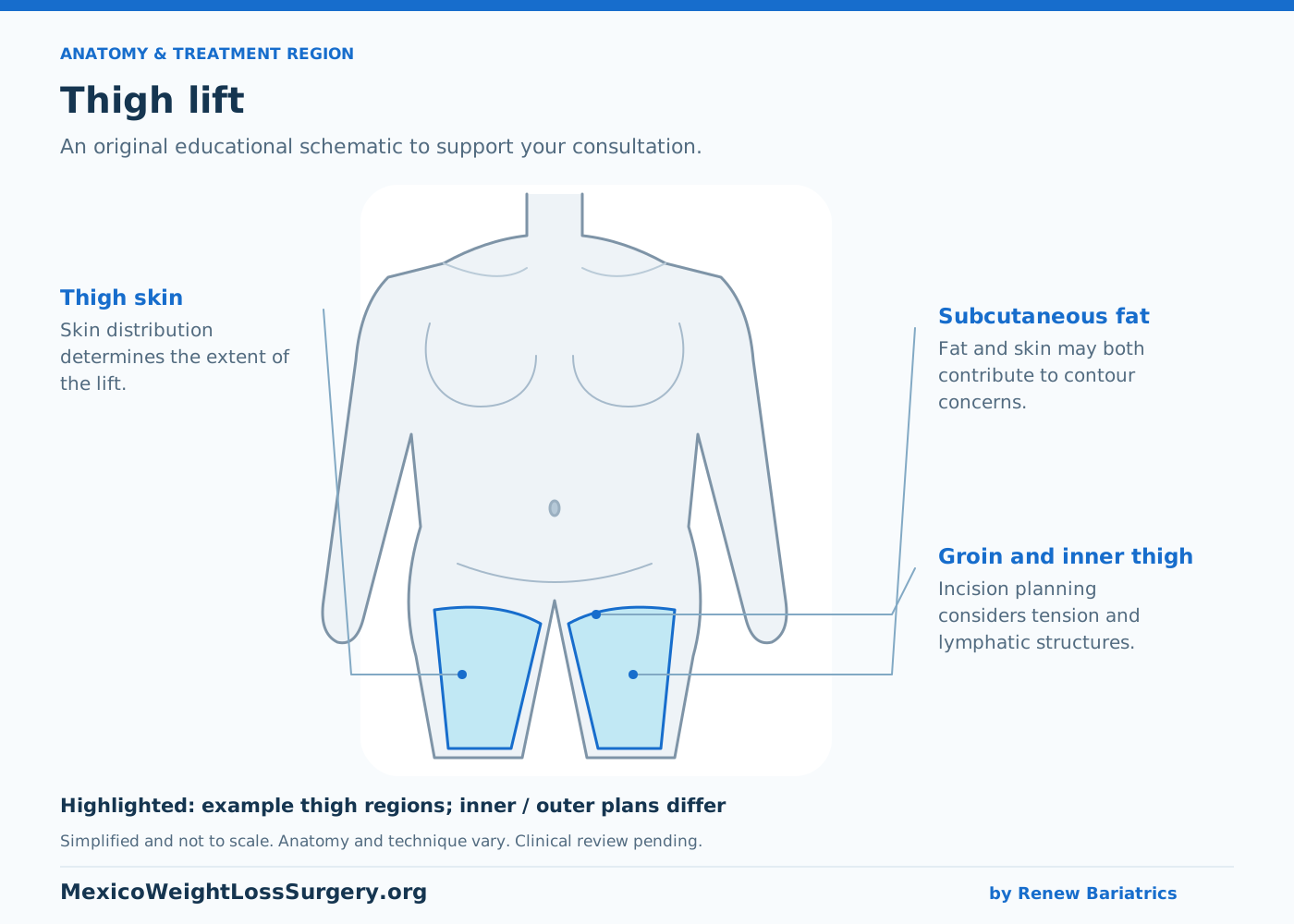
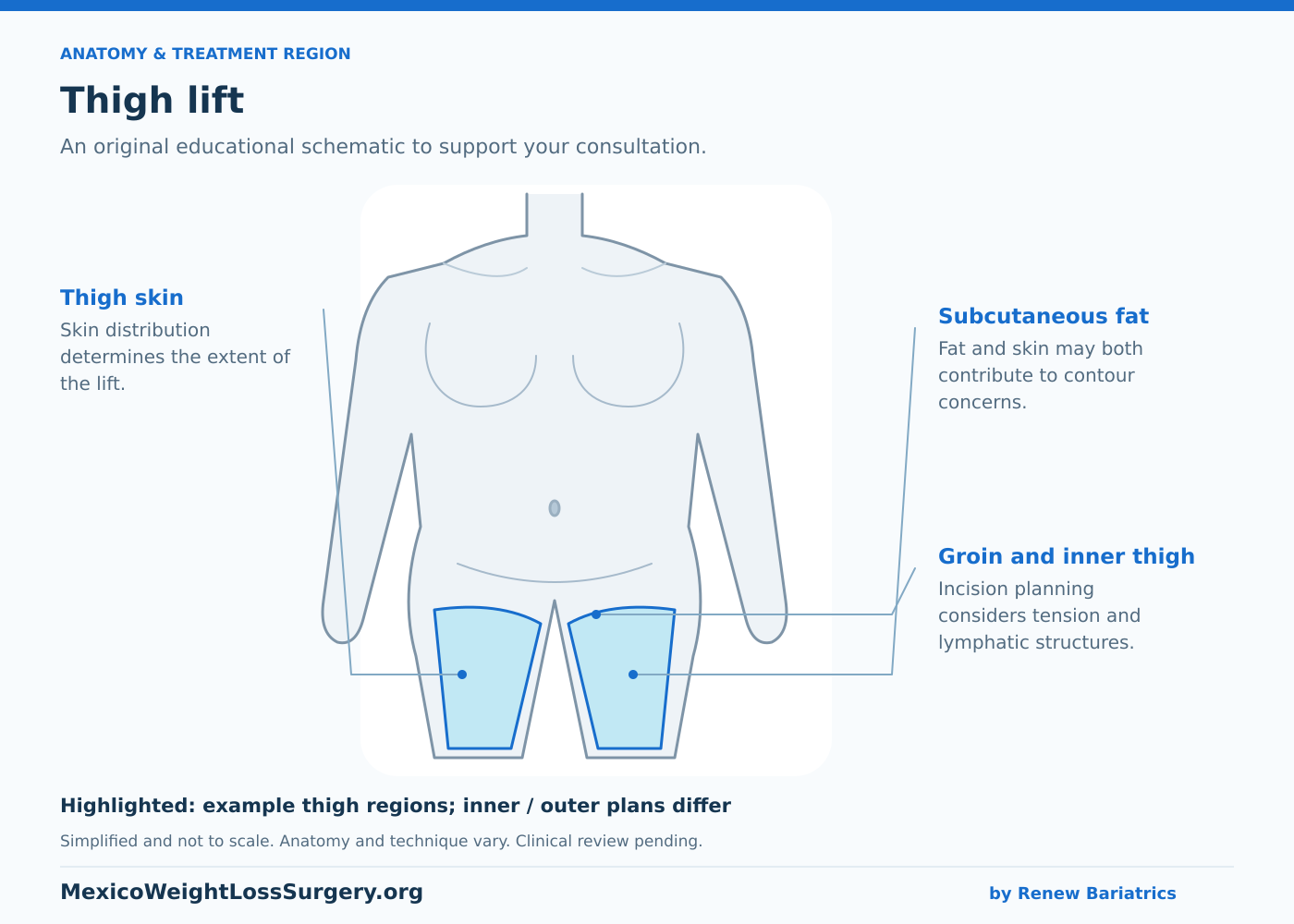
Anatomy references: ASPS — Thigh lift ↗ · ASPS — Liposuction ↗
What thighplasty treats
Thighplasty removes excess skin, sometimes with fat, to reshape the thigh. It is principally a contouring operation. Liposuction may help when skin can retract adequately, but fat removal alone does not address substantial skin redundancy. The examination should distinguish those problems before selecting a technique.[1]
Describe your concern in terms of location and daily impact. Is the excess mainly high on the inner thigh, along the whole inseam, on the outer thigh, or close to the knee? Does it affect clothing or produce rubbing? These details help the surgeon explain whether one operation can address your priorities and which areas would remain unchanged.
A thigh lift is not designed to deliver a target amount of weight loss, create a guaranteed gap between the thighs, or remove every surface irregularity. Your anatomy, skin quality, and scar tolerance shape the available choices. A useful plan identifies a realistic improvement rather than promising that your legs will match a reference photograph.[1],[7]
Why the location of loose skin matters
An inner-thigh fold close to the groin differs from loose skin extending toward the knee. The latter may require an incision continuing down the inner thigh. Outer-thigh lifting can involve different incisions, sometimes extending around the hip. Ask the surgeon to draw the proposed area rather than relying on a name such as mini or extended.[4]
Ask to see the plan with your legs in different positions. A scar that sits in a crease while standing can behave differently when you sit or move. The point is not to predict every detail but to understand how scar placement relates to your own clothing, movement, and preferences.
Candidacy after major weight loss
ASPS describes suitable candidates as people with relatively stable weight, excess soft tissue in the thigh region, realistic goals, and health that supports healing. Nonsmoking and a commitment to nutrition and healthy habits are part of the assessment. There is no universal online checklist that makes surgery safe for every person.[2]
Bring your recent weight history, including weight-loss medication changes and any continuing downward trend. Ask what stability means for your surgeon's plan and how further weight change could affect the result. A consultation should explain whether the timing fits your current health and goals.[2]
The decision also depends on recovery support. Consider whether you can arrange help with dressing, transport, household tasks, and follow-up. A person who lives alone may need a different discharge arrangement from someone with reliable assistance. Tell the team about stairs, mobility limitations, and the distance between your bedroom and bathroom before travel.
Existing swelling and skin problems
Report persistent swelling, prior blood clots, leg infections, previous surgery, and problems with sensation or circulation. Ask the surgeon whether any finding requires further assessment before contouring. An unexplained symptom should not be dismissed as part of the cosmetic concern.[5],[8]
Active irritation in a skin fold deserves examination. Do not assume that removing the fold is the only treatment or that surgery can proceed through an untreated problem. The consultation should separate immediate skin care from the longer-term decision about contouring.[3],[8]
Nutrition and medication preparation
People who have lost weight through bariatric surgery or medication can still have nutritional needs that require attention. A recent clinical review describes protein and micronutrient concerns after sleeve gastrectomy and with appetite-suppressing therapies. Reduced intake can matter even without an intestinal bypass. The appropriate response is individualized assessment, not a universal supplement package.[12]
Bring your current supplements, relevant laboratory results, and details of food intolerance, vomiting, or difficulty meeting intake goals. Ask who will review the findings, what must be corrected, and how readiness will be documented. Do not change prescription medicines independently to qualify for surgery.[12]
For GLP-1 medicines, anticoagulants, diabetes treatment, and other prescriptions, request a coordinated perioperative plan from the surgical and anesthesia teams with the prescribing clinician where needed. Instructions should identify the medication, action, timing, and restart criteria. A generic instruction to stop all medications is not an adequate individualized plan.[12],[13]
Make nutrition practical. Identify meals you tolerate, establish who will prepare them, and discuss what happens if you cannot eat or drink as directed after surgery. A companion should know how to contact the team when intake becomes a problem. Avoid buying a large collection of supplements before the team has reviewed what is actually needed.
Consultation questions that change the decision
The consultation should review health history, medications, prior operations, expectations, and the thigh examination. Ask how the proposed technique addresses the skin pattern and which limitations are expected. Clinical photographs can support planning, but consent for medical documentation should be separate from permission for promotional use.[3]
Bring the clothing you are most concerned about or describe its fit. Ask where the scar is likely to sit relative to that clothing. If your priority is a particular area near the knee, have the surgeon explain whether the proposed incision reaches it or only improves tissue higher up.
Ask whether liposuction is part of the operation and what it contributes. If another procedure is proposed, request a reason for combining it and an alternative staged plan. A combined itinerary may seem convenient, but convenience alone does not establish that the combined operation is appropriate.
Before booking, you should be able to answer four questions: what tissue is being treated, where the scars will be, what assistance recovery requires, and who manages problems after you return home. If any answer remains vague, the plan is not yet complete enough for a meaningful cost comparison.
Incision choices and scar tradeoffs
A limited medial approach may use a groin-area incision in selected patients. More extensive inner-thigh laxity may require an incision extending down the inner leg, sometimes approaching the knee. Outer-thigh approaches can involve the hip region. These are different operations with different scars, not merely different names for one standard package.[4]
The shortest incision is not always capable of treating the largest area. Ask what remains if you choose a more limited approach. Equally, ask whether a longer scar offers a meaningful benefit for the area that bothers you. The goal is an informed tradeoff, not automatically maximizing tissue removal.
What scars can and cannot do
Scars are permanent and may widen or remain visible. Early swelling can make the contour difficult to judge, while later tissue changes can alter appearance. Ask how scar concerns will be assessed and when discussion of revision would be appropriate. A guarantee of invisible scars is not a realistic basis for consent.[7]
Ask about scar position near the groin and how the surgeon addresses tension and nearby structures. These are particularly important topics if a previous operation has already left scars or if you have a history of difficult healing. The consultation should explain technique choices without suggesting that any method eliminates risk.[4],[5]
Thigh lift risks
Potential complications include bleeding, infection, fluid collections, wound separation, delayed healing, fat or skin loss, altered sensation, persistent swelling, blood clots, asymmetry, and revision. The location of the operation makes wound care and movement planning especially relevant. A complication can require additional visits, dressings, procedures, or hospitalization.[5],[8]
Risk assessment should consider your history and the proposed operation rather than rely only on a published average. Ask what specific factors the team sees in your case and how they affect the plan. An explanation that acknowledges uncertainty is more useful than a blanket statement that the procedure is safe.
What studies tell us—and what they do not
A 2015 retrospective series followed 106 people undergoing medial thighplasty after major weight loss. About 68% had at least one recorded complication; many were wound-related and relatively minor. Wound separation occurred in 51% and seroma in 25%, with overlapping categories. Full-length vertical procedures were associated with more prolonged edema. This was one selected clinical series, not a universal prediction.[9]
A different database study of 1,493 thighplasties found a 6.6% major-complication rate within 30 days. Its definition required an emergency visit, hospital admission, or another operation. Most procedures were combined with others. That narrower endpoint misses many minor wound problems and cannot be compared directly with a study counting all complications.[10]
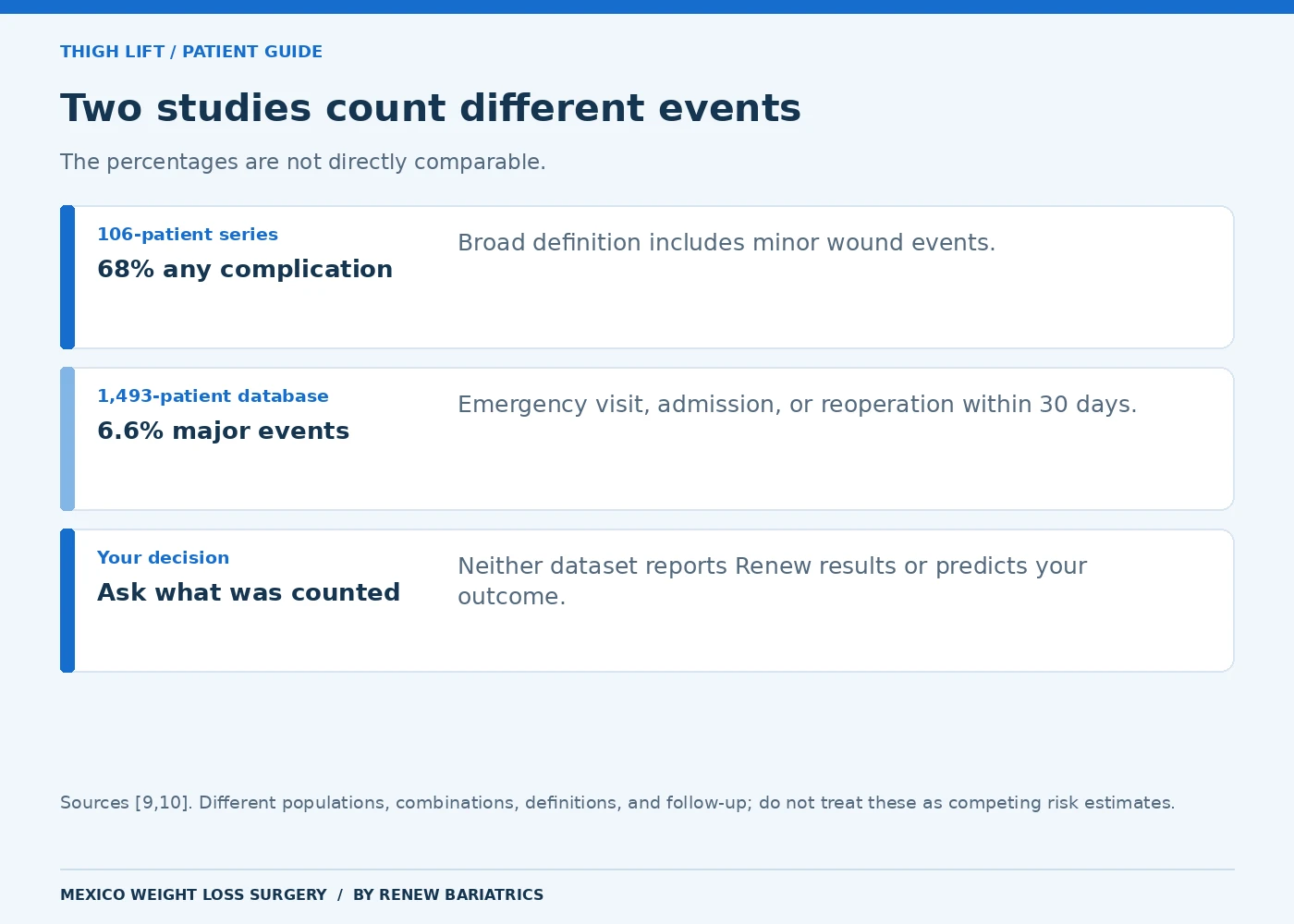
The practical lesson is to ask what a number measures. A small opening treated with dressings and a complication requiring hospital care are both important, but they are different events. Neither study reports Renew Bariatrics outcomes. These figures should support questions about risk and aftercare, not be used as a personal probability calculator.[9],[10]
A recent systematic review of post-bariatric thigh techniques illustrates that multiple approaches are described in the literature. It does not establish one technique as the best choice for every patient. Ask why a particular method fits your skin pattern and what limitations remain despite the chosen technique.[11]
Recovery after thigh lift surgery
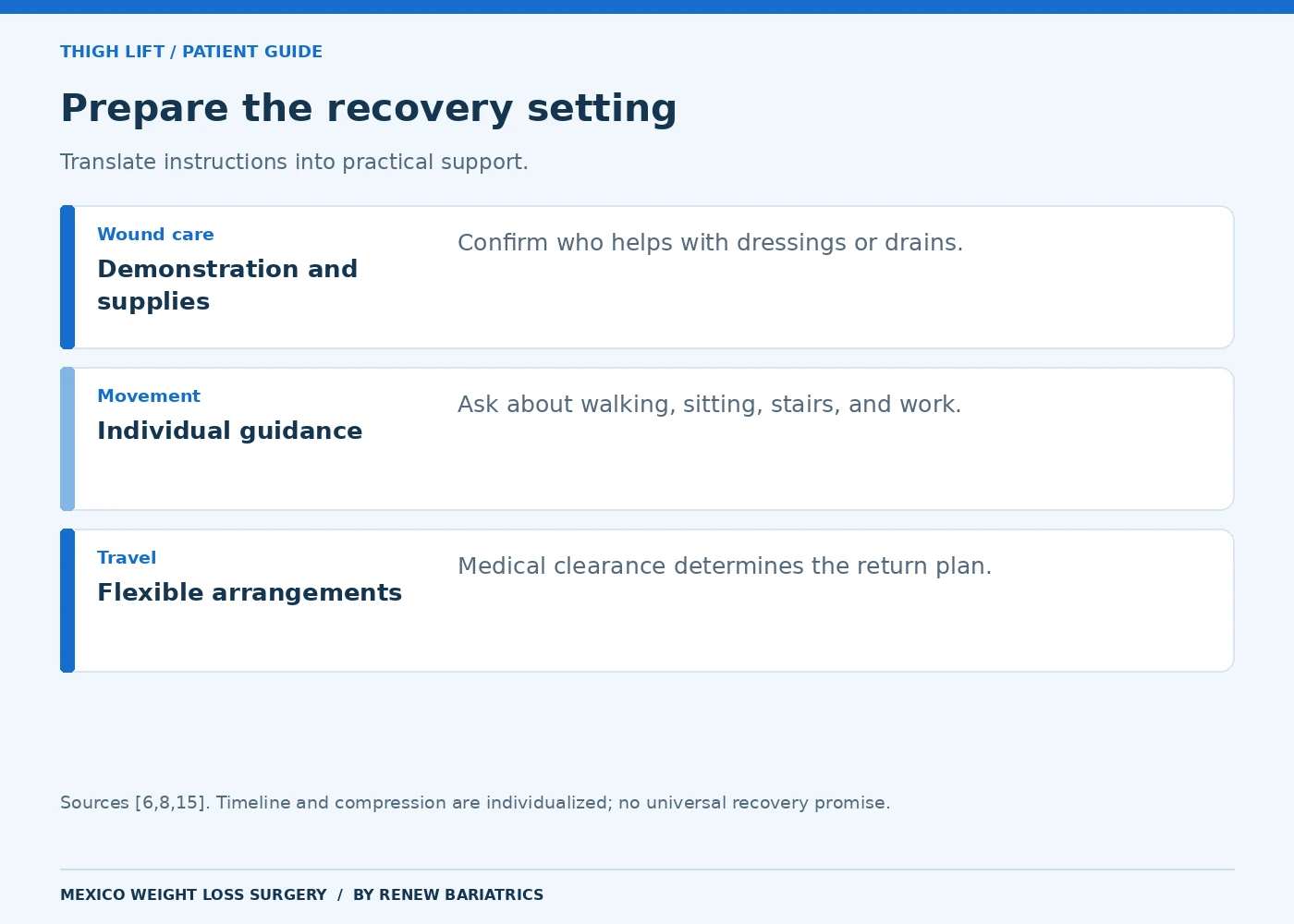
Dressings and temporary drains may be part of recovery. The team should explain wound care, medication, bathing, warning signs, follow-up, and the return to activity. Avoid applying another patient's schedule to your own procedure; the incision and extent of surgery can differ substantially.[6]
Before discharge, ask for a demonstration of any dressing or drain care. Your companion should know which observations to record and which changes require a call. Confirm that you have the prescribed supplies and can contact a clinician outside routine office hours.
Moving without turning recovery into bed rest
Ask for clear guidance on walking, sitting, getting into bed, using the bathroom, and climbing stairs. The plan must balance protecting healing incisions with the movement your team recommends. Do not invent a program of prolonged bed rest or strenuous exercise based on internet advice.[6],[13]
Clothing and the recovery setting deserve attention. Ask whether a garment is required, how it should fit, and how the team will address rubbing or discomfort. Arrange a sleeping and bathroom setup that fits your restrictions. If you expect to need help, test the practical arrangement before the procedure rather than discovering a problem after discharge.
Work, driving, and exercise
There is no single return-to-work date suitable for every thigh lift. Desk work, prolonged standing, commuting, and lifting create different demands. Ask the surgeon to describe allowed tasks and restrictions in writing so you and your employer can plan around actual function.[6],[8]
Driving requires more than being able to sit: you must safely enter and exit the vehicle, react quickly, and operate pedals without impairing medication or prohibited movement. Ask for explicit clearance. Exercise should return in stages determined by your team and wound progress, not by a date promised before surgery.[6]
Swelling and the longer recovery
Swelling and contour changes can persist beyond the earliest recovery period. Follow-up should assess both the wound and the way swelling evolves. New or worsening symptoms should be evaluated rather than automatically attributed to normal healing. Ask when the team expects to reassess the result and what would prompt an earlier visit.[7],[9]
Photographs taken immediately after surgery are not a reliable picture of the final outcome. They may also hide scars or use flattering positioning. When reviewing results, ask about timing, whether the same procedures were performed, and whether images include relevant scar views. Even well-documented photographs cannot guarantee your outcome.
Warning signs and unplanned care
Seek emergency help for sudden breathlessness, chest pain, fainting, or other severe symptoms. A newly painful swollen leg, rapidly worsening wound appearance, fever, or concerning drainage needs prompt clinical assessment. Follow the specific discharge instructions rather than waiting for a scheduled appointment.[5],[6]
Before surgery, establish who assesses a suspected problem, where you would go, and how costs are handled. An aftercare promise is useful only if it names a reachable service and a workable process. Ask whether an in-person wound visit is available if a remote review cannot answer the question.
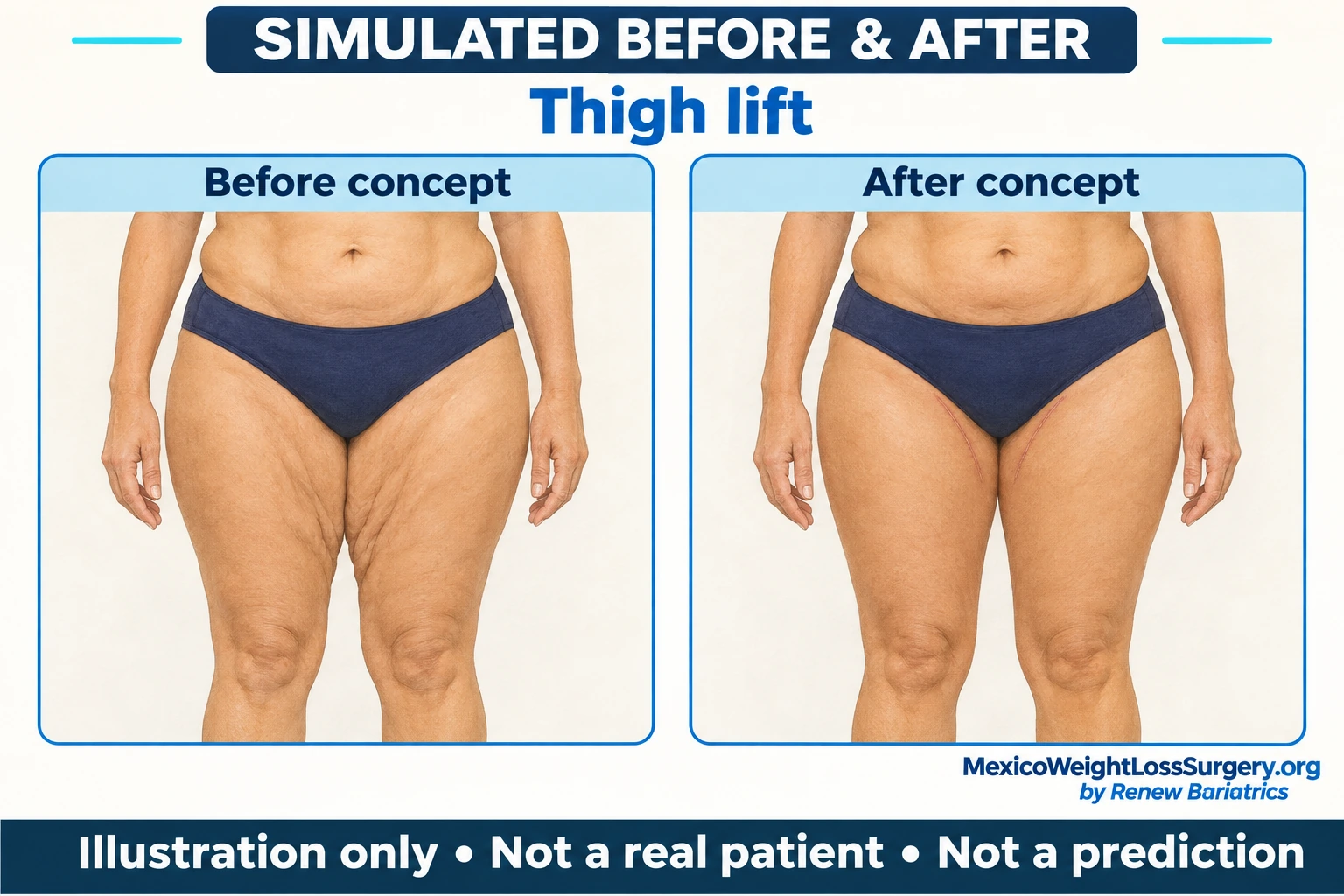
A synthetic illustration of possible changes
This fictional example illustrates a treatment concept. It cannot show the result you would achieve, predict scar healing, or establish a typical outcome.
Thigh Lift Cost in Mexico
Thigh lift cost in Mexico varies with the area treated, incision length, liposuction, combination procedures, anesthesia, facility care, and postoperative needs. A current individualized Renew quote has not been verified for this page, so no starting price or savings percentage is presented.
Request a quote that names the procedure precisely: limited medial thigh lift, extended medial thighplasty, outer-thigh treatment, or another specified plan. Ask whether both sides, associated liposuction, and any planned extensions are included. Without this description, comparing two prices can mean comparing different operations.
The written estimate should identify surgeon and anesthesia fees, operating facility, laboratory assessment, garments, medications, planned follow-up, and any overnight care. Separately list lodging, transport, flights, companion costs, meals, and time away from work. Ask how an extended stay or additional wound-care visit changes the budget.
Confirm what happens financially if surgery is postponed after assessment, if a different operation is recommended, or if a complication requires treatment. Ask whether a revision policy covers only the surgeon's fee or also anesthesia, facility, travel, and lodging. Obtain deposit, cancellation, currency, and quote-expiration terms in writing.
A useful comparison pairs the price with the same clinical questions: which areas are treated, who performs the operation, where it occurs, and how follow-up works. A lower advertised figure cannot answer those questions. Choose on the basis of the complete plan and your ability to manage its recovery demands.
Travel and continuity of care
Medical travel requires a plan for care at both ends of the trip. The CDC emphasizes advance planning for complications and continuity of care. Ask your surgeon when you may travel and how your individual clot risk affects the itinerary; a prepaid return date should not determine clearance.[15]
Build flexibility into lodging and transport. Identify who will carry luggage, accompany you to appointments, and help if travel is delayed. Request the operative report, medication list, and follow-up instructions before leaving. Arrange a local option for assessment at home rather than assuming every concern can be managed by messaging.
Frequently asked questions
Is a thigh lift a weight-loss procedure?
No. Its purpose is to remove excess tissue and reshape an area after weight loss or other changes. It does not replace obesity treatment or promise a particular scale change.[1]
Will liposuction alone be enough?
That depends on the balance of fat and skin laxity. Skin that cannot retract adequately may remain loose after fat removal. An examination should establish the problem before a procedure is recommended.[1]
How much does a thigh lift in Mexico cost?
Ask for an individualized written estimate specifying the exact regions, incisions, included services, and excluded costs. Extended thighplasty and a limited procedure should not be compared as though they were identical.
Is a long inner-thigh scar always necessary?
No, but a limited incision may not adequately treat loose skin extending far down the leg. Ask the surgeon to explain the likely contour difference between the available options and show where each scar would lie.[4]
Does a low major-complication rate mean wound problems are rare?
No. Studies define complications differently. A database counting emergency visits, admission, or reoperation will not capture every minor wound issue. Ask for definitions and a plan for both minor and major problems.[9],[10]
Can the procedure be combined with other contouring?
It may be considered, but the decision should account for the whole operation and recovery. Ask why combining or staging is preferred for you and how the plan changes your help, mobility, and follow-up needs.[13]
Request a plan you can evaluate
For a thigh-lift consultation, prepare your medical and weight history, previous procedures, medication list, and specific areas of concern. Ask Renew for the proposed surgical scope, scar map, itemized cost, and follow-up responsibilities. The strongest plan makes both the desired improvement and the practical tradeoffs understandable before you travel.
Program information related to this guide
Explore Renew Bariatrics’ procedure options when discussing a plastic surgery plan. Availability, combinations and suitability require individual confirmation.
Thigh lift vs. liposuction
These procedures address different concerns and may be combined or staged. A clinical assessment determines which, if either, fits your anatomy and goals.
| What to compare | Thigh lift → | Liposuction → |
|---|---|---|
| Main goal | Addresses loose thigh skin. | Reduces selected fat deposits. |
| What changes | Skin excision tailored to thigh region. | Fat beneath the skin. |
| Key distinction | Groin and thigh scars may be extensive. | Does not remove excess skin. |
| Recovery consideration | Walking, wound care and swelling need planning. | Swelling and garment plans vary. |
| Cost comparison | Request an itemized quote for this exact procedure and care plan. | Compare the same inclusions, exclusions and recovery expenses. |
Comparison references: ASPS — Thigh lift ↗ · ASPS — Liposuction ↗
These options are not interchangeable for every person. The treating clinician must assess your anatomy, medical history and goals.
Discuss your options with Renew.
Talk with a coordinator about thigh lift, your goals and the information needed for clinical review. The treating team determines suitability and the care plan.
Call 844-736-3963 Ask about plastic surgery ↗The link opens Renew’s plastic surgery health questionnaire. This review site does not collect health information.
References & evidence notes
Sources checked November 2026. Research findings are not a forecast for an individual or outcomes for Renew’s own program. Review study populations, methods and limitations alongside the reported results.
- American Society of Plastic Surgeons. Thigh Lift ↗Professional-society patient education; general guidance, not individualized advice.
- American Society of Plastic Surgeons. Thigh Lift Candidates ↗Professional-society patient education; general guidance, not individualized advice.
- American Society of Plastic Surgeons. Thigh Lift Consultation ↗Professional-society patient education; general guidance, not individualized advice.
- American Society of Plastic Surgeons. Thigh Lift Procedure Steps ↗Professional-society patient education; general guidance, not individualized advice.
- American Society of Plastic Surgeons. Thigh Lift Risks and Safety ↗Professional-society patient education; general guidance, not individualized advice.
- American Society of Plastic Surgeons. Thigh Lift Recovery ↗Professional-society patient education; general guidance, not individualized advice.
- American Society of Plastic Surgeons. Thigh Lift Results ↗Professional-society patient education; general guidance, not individualized advice.
- Cleveland Clinic. Thigh Lift (Thighplasty) ↗Institutional explanation of assessment, techniques, risks, and recovery.
- Gusenoff et al., 2015. Medial thigh lift in the massive weight loss population: outcomes and complications ↗Retrospective series of 106 patients; broad complication definition includes minor wound events. Categories overlap; not directly comparable with major 30-day endpoints.
- Afshari et al., 2016. Preoperative Risk Factors and Complication Rates of Thighplasty: Analysis of 1,493 Patients ↗CosmetAssure database: 6.6% major complications within 30 days, defined by emergency visit, admission, or reoperation. Most operations combined; not all wound events.
- Susini et al., 2024. Thighs lift in the post-bariatric patient - A systematic review ↗Systematic review of 17 reports and 496 patients; heterogeneous techniques do not establish one universally best operation.
- Published clinical literature. Nutritional Challenges in Post-Massive Weight Loss Body Contouring: Guidance for Plastic Surgeons on GLP-1 Agonists and Sleeve Gastrectomy ↗Clinical review, not a comparative trial. Highlights nutritional assessment and medication-related preparation considerations.
- Published clinical literature. Preparing Patients for Body Contouring Surgery and Postoperative Surveillance for Deep Venous Thrombosis ↗Review of preoperative assessment, nutrition, social support, clot prevention, and surveillance; individualized clinical planning.
- Renew Bariatrics. Bariatric & Plastic Surgery in Mexico ↗Offering confirmation only. Individual candidacy, operator, location, price, and surgical scope require confirmation. Reviewed November 2026.
- CDC Yellow Book. Medical Tourism ↗Government guidance on travel risk, records, complication planning, credentials, and continuity of care. Does not provide individual flight clearance.