

Jump to a section
Compare proceduresRelated ProceduresFirst, describe the pattern accuratelyThe same pounds can tell different storiesRegain does not erase every earlier benefitWhy weight can returnWhat a careful reassessment should establishNutrition and behavioral support are treatment, not punishmentMedication may be appropriate after surgeryWhat randomized medication evidence showsWhat newer medication studies can and cannot tell youWhen endoscopy may help after gastric bypassSleeve revision requires a different discussionHow to compare options without a misleading league tablePlanning assessment or treatment in MexicoYour appointment preparation worksheetCommon questions about weight recurrenceYour next stepReferencesWeight returning after bariatric surgery can feel discouraging, especially when you worked hard to prepare, recover and change your routines. It deserves a medical assessment, not a character judgment. The American Society for Metabolic and Bariatric Surgery recognizes weight recurrence and inadequate initial response as reasons to consider individualized treatment, including nutrition support, medication, endoscopy or revision surgery. These choices address different problems; they are not interchangeable upgrades. [1]
This guide is for someone who has already had a sleeve, bypass, band or another bariatric operation and wants a sensible next step. It explains how to describe your weight history, what an assessment may investigate, and how to compare treatment claims. It does not assume that another procedure is necessary or that a particular treatment is available through Renew. A coordinator can help organize an inquiry; clinical review determines which options fit your health and anatomy.
First, describe the pattern accurately
Weight recurrence means weight returning after an earlier loss. Inadequate initial response means that the first treatment produced less weight loss or health improvement than expected. A plateau is a period when weight is relatively stable. These patterns may overlap, but the timeline matters. Studies use different definitions and denominators, so a headline saying someone regained a certain percentage can be misleading without the calculation. Research comparing regain measures found meaningful differences in how well they related to clinical outcomes. [2]
Bring three dated weights: weight before the original operation, the lowest reasonably stable weight afterward, and current weight. Add the approximate point when the trend changed. If you do not know the exact numbers, say so; an honest estimate is more useful than false precision. Include changes in blood pressure, diabetes control, sleep, mobility and quality of life. A treatment discussion should not be reduced to whether you reached a number you selected years earlier.
The same pounds can tell different stories
Consider a fictional person who weighed 300 pounds before surgery, reached 200 pounds, and later weighed 230 pounds. They lost 100 pounds initially and regained 30 pounds. That is 30% of the maximum weight they lost, 15% of their lowest weight, or 10% of their original weight. They remain 70 pounds below their original weight. Those statements all describe the same arithmetic, not four different outcomes.
This example is not a definition of when treatment is required, a patient testimonial or an estimate of what will happen to you. Its purpose is to help you question comparisons. Ask a clinic to identify the starting point, follow-up period and denominator for every quoted result. Ask whether the result describes people who completed follow-up or everyone who started treatment. Clear reporting prevents an impressive percentage from hiding a different question than the one you are trying to answer. [2]
Regain does not erase every earlier benefit
Long-term weight trajectories vary. In the multicenter LABS observational study, average weight loss seven years after Roux-en-Y gastric bypass was 28.4% of original body weight. Average regain between years three and seven was 3.9% of original body weight. Different patterns occurred within the cohort, and these averages do not predict an individual's course. The study also included adjustable gastric banding, with different results; it should not be used as a direct forecast for a modern sleeve patient. [3]
The useful message is that some regain can coexist with substantial maintained loss. That does not mean you must simply accept a worsening trend. It means the assessment should preserve what has improved while addressing what is returning. Tell the clinician if symptoms or metabolic conditions are worsening, even if your weight is still below its starting point. Conversely, feeling disappointed about appearance is a different issue from having a surgical complication, and the two need different conversations.
Why weight can return
Mayo Clinic describes behavioral, medical and anatomical contributors to regain. Appetite, eating patterns and changes in the outlet after gastric bypass may all matter. There is rarely enough information in a single photograph, food diary or scale reading to identify the cause. A person can need help with eating structure and also have an anatomical problem; finding one factor does not rule out the others. [4]
Prepare a timeline rather than an explanation you feel you must defend. Note whether hunger changed, portions became easier to tolerate, grazing increased, work hours changed, sleep deteriorated, an injury limited movement or a medication was started. Include events such as pregnancy, bereavement or loss of access to follow-up if relevant. These are assessment clues, not admissions of wrongdoing.
A useful opening statement is: “My weight began increasing around this date, and these things changed at roughly the same time.” That gives the team something concrete to investigate. Avoid accepting a diagnosis such as “your stomach stretched” until a qualified clinician has explained what evidence supports it.
What a careful reassessment should establish
A complete review starts with knowing the exact operation and whether it was ever revised. Operative records can clarify anatomy that a patient-facing label does not. The clinician may review symptoms, medicines, nutrition, laboratory results and earlier complications, and decide whether imaging or endoscopy is needed. ASMBS emphasizes case-by-case multidisciplinary treatment because the evidence and available approaches vary substantially. [1]
Ask the clinician to distinguish observations from hypotheses. “The outlet is enlarged on endoscopy” is different from “an enlarged outlet may be contributing to hunger.” Likewise, a medication associated with weight gain is not proof that it explains the entire change. A good plan should state what is known, what remains uncertain and which finding would change the recommendation.
Before an international procedure, clarify whether the necessary tests can be completed locally, who interprets them, how long results remain acceptable, and what happens if the final assessment changes the planned treatment. Do this before making nonrefundable arrangements.
Nutrition and behavioral support are treatment, not punishment
A dietitian or behavioral-health professional can help examine patterns without turning every meal into a moral test. Mayo Clinic discusses structured behavioral care as one component of managing recurrence. That can be especially relevant when grazing, eating past fullness or difficulty maintaining routines is part of the history. It is not evidence that someone lacks effort, and it should not be presented as a guaranteed substitute for medical treatment. [4]
Make the consultation practical. Bring examples of a workday, a weekend and a difficult day rather than trying to produce a perfect diary. Explain food access, cultural preferences, intolerances, budget and who shares meals with you. Ask what one or two changes would be most useful to test first, how you will judge whether they help, and when the plan will be reviewed.
If recording food or weight worsens distress, say so. The monitoring approach should be workable for you. Support should help you understand decisions and regain consistency, not make you avoid appointments because you are worried about being criticized.
Medication may be appropriate after surgery
Prescription obesity medicines can be considered after bariatric surgery, subject to medical assessment. Selection depends on the medicine's indications, contraindications, other conditions, interactions, affordability and the ability to continue treatment. These are long-term treatment decisions. NIDDK explains that weight can return after medication stops and that medicines work alongside a broader health plan; they should not be taken only to change appearance. [5]
Ask who will prescribe and monitor treatment in your home country, what follow-up is required, and what happens if your insurer or pharmacy cannot continue supply. A short introductory price is not the cost of a full treatment course. Do not obtain a medicine simply because a friend used it after the same operation.
For an upcoming procedure, medication instructions must come from the treating and anesthesia teams. Do not independently start, stop or change a dose based on an online article. The question is not merely which drug produces the biggest average loss; it is which plan is safe, sustainable and relevant to your circumstances.
What randomized medication evidence shows
BARI-OPTIMISE enrolled 70 selected adults with poor weight loss and a suboptimal GLP-1 response at least one year after sleeve or bypass. At 24 weeks, estimated mean body-weight change was approximately −8.8% with liraglutide versus −0.5% with placebo, alongside a lifestyle intervention. Gastrointestinal adverse events were more frequent with liraglutide. This was a small, selected population with short follow-up; it was not a trial of every person experiencing regain or of every obesity medicine. [6]
A separate 56-week randomized trial specifically studied recurrence after Roux-en-Y bypass. It reported approximately 8.8% weight loss with liraglutide compared with 1.1% weight gain with placebo. Pandemic-related disruption and incomplete follow-up limit interpretation: about 65% of the liraglutide group and 53% of the placebo group completed the trial. These results support discussing medication as a real treatment option, while leaving uncertainty about individual response and longer-term durability. [7]
What newer medication studies can and cannot tell you
In a retrospective study of 115 people treated for recurrence after sleeve, average six-month weight loss was 10.3% with semaglutide and 15.5% with tirzepatide. Treatment was not randomly assigned. The groups differed, follow-up was short, and the findings do not prove that one medicine will outperform another for a particular patient or remain equally effective indefinitely. [8]
Another retrospective academic-center study included 207 patients with several prior bariatric operations. At 12 months, regimens containing semaglutide 1.0 mg weekly were associated with greater average weight reduction than liraglutide 3.0 mg daily. This comparison involved specific regimens and real-world prescribing; it is not a randomized comparison of today's maximum obesity doses. [9]
When a clinic quotes drug results, ask whether the participants had your operation, whether the dose matches the proposed regimen, and whether the statistic represents an average or a best-case example. Avoid adding results from separate studies to estimate the combined benefit of medication and a procedure.
When endoscopy may help after gastric bypass
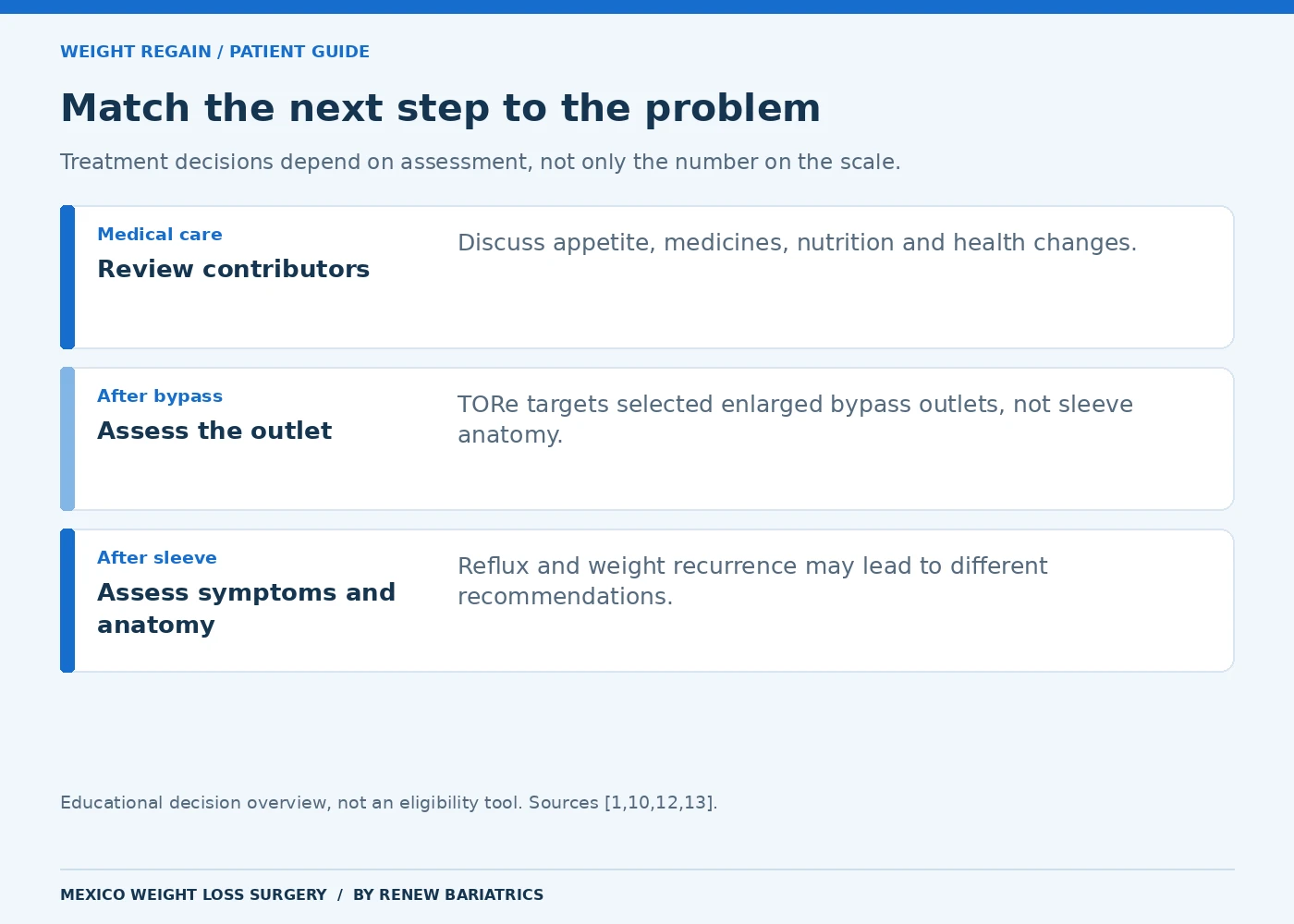
TORe, or transoral outlet reduction, treats an enlarged connection between a gastric bypass pouch and the small intestine in selected patients. An endoscope passes through the mouth, and sutures narrow the outlet. It does not create a new bypass and is not the same treatment as revising a gastric sleeve. Its effect can diminish, and some people need further treatment. [10]
A 55-patient single-center series illustrates why technique and follow-up matter: average total-body-weight loss was 5.5% at one year, repeat treatments were common, and adverse events occurred. This should not be generalized to every contemporary TORe program, but neither should a clinic present only the highest published result. [11]
Ask what the endoscopic examination shows, why outlet reduction is expected to help, and what other contributors will be treated. Review our TORe guide for a fuller discussion of evidence and risks. A procedure without skin incisions still requires appropriate anesthesia, recovery instructions and a plan for complications.
Sleeve revision requires a different discussion
After a sleeve, possible approaches depend on symptoms, anatomy and goals. Conversion to bypass, another surgical revision, medication or selected endoscopic treatment may be discussed. An observational study comparing revisional endoscopic sleeve gastroplasty with medication included only 22 endoscopic patients and 68 medication patients. Some medication doses were below target, and refill difficulties were common. It does not establish a universal ranking between those approaches. [12]
If reflux is a major problem, the assessment must address reflux rather than treating weight as the only endpoint. In a large Michigan conversion cohort, sleeve-to-bypass conversion was associated with improved reflux and additional loss, but only a minority had complete one-year reflux or weight data. Complications and emergency visits also occurred. These findings support individualized risk-benefit discussion, not a promise that conversion fixes every symptom. [13]
Ask which problem the proposed revision is intended to solve first. If the answer is reflux, request reflux-specific evidence. If it is weight recurrence, ask how the proposed change relates to your actual anatomy and previous treatment response.
How to compare options without a misleading league table
Published weight-loss percentages are not automatically comparable. A six-month medication cohort, a one-year revision series and a five-year endoscopy study involve different patients, follow-up and definitions. A study that loses many participants may describe the people who remain engaged more accurately than the entire starting group. A randomized trial helps reduce certain biases but may enroll a narrower population than routine practice.
For each option, write down the same questions: What is the target problem? What evidence supports it for my original operation? What are the common burdens and serious risks? What follow-up is necessary? What happens if the result is insufficient? What is the total continuing cost?
Then ask the clinician to explain the recommendation in plain language. “This procedure gives the most weight loss” is incomplete. A useful recommendation connects your anatomy, symptoms, prior response, nutritional status and priorities to an expected balance of benefit and risk. You should understand the reasoning well enough to describe it to a trusted person afterward.
Planning assessment or treatment in Mexico
Travel adds logistical questions to the medical ones. Before booking, identify the treating clinician and facility, the tests required, who provides after-hours advice, and where urgent care is available. The CDC recommends arranging continuity of care, obtaining records and discussing how complications will be handled before medical travel. These arrangements matter even when the procedure itself is familiar. [14]
Ask for an individualized written quote. Confirm whether it includes evaluation, anesthesia, devices, hospital care, medicines, transport and follow-up, and which items may be charged separately. Clarify what happens financially if the assessment identifies a different problem or the planned intervention is not appropriate. Do not assume a revision is priced or scheduled like a first-time operation.
Returning home should have a named clinical handoff. A messaging number can help coordinate information, but it does not replace a local clinician who can examine you, order testing or treat an urgent problem. Confirm the roles rather than assuming that “support included” answers every aftercare question.
Your appointment preparation worksheet
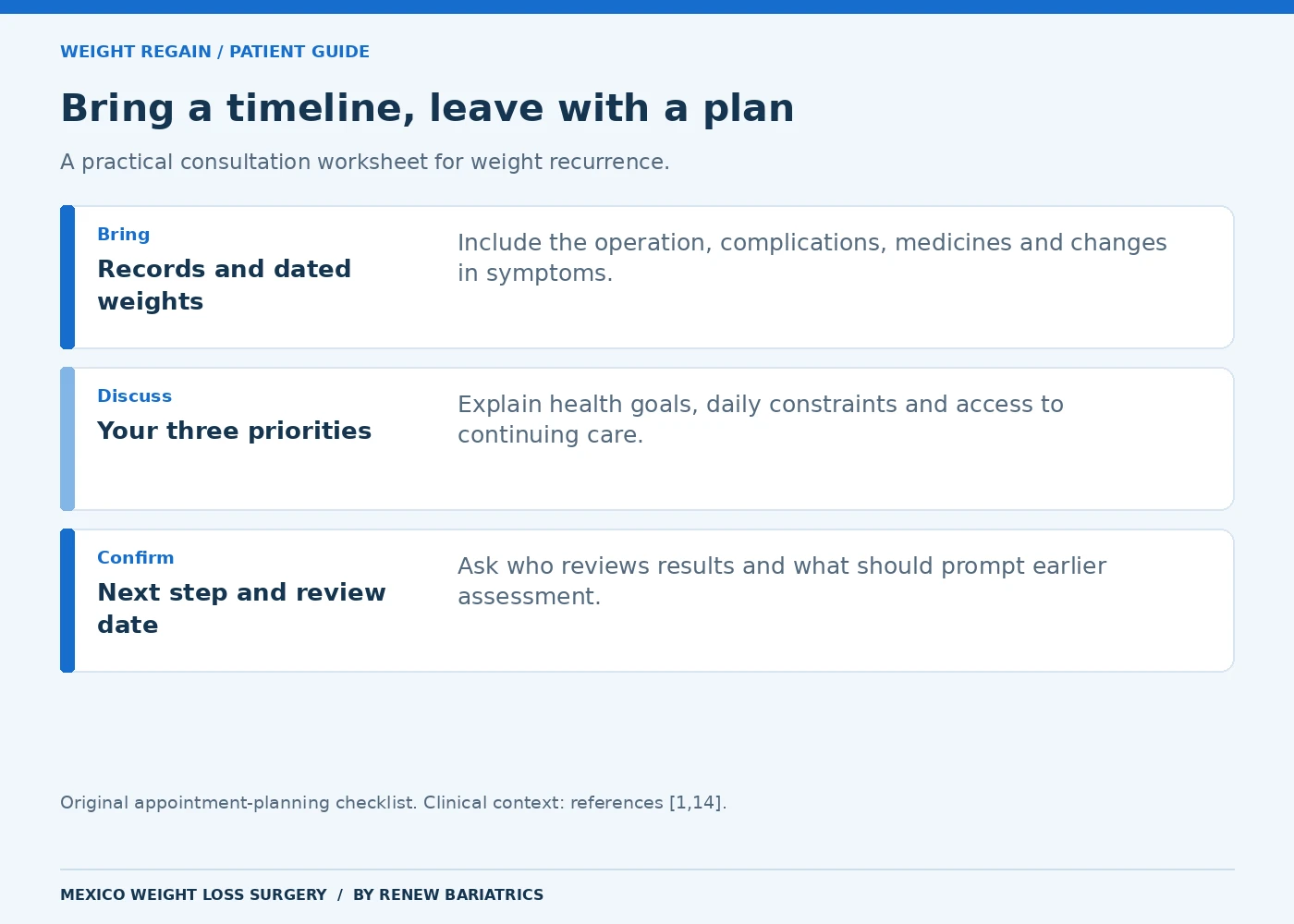
Prepare a short document with the date and type of every bariatric procedure, important complications, current medicines and supplements, and your three dated weights. Add the symptoms that concern you most and any recent tests. Keep original reports available; a summary is useful, but it does not replace the operative note or laboratory result.
Choose three goals in order of importance. They might include improving diabetes control, reducing reflux, recovering mobility, addressing persistent hunger or stabilizing the weight trend. Add practical constraints such as travel, work, cost and access to local care. Being explicit helps avoid a recommendation that sounds attractive but does not fit your life.
At the end of the appointment, request a written next step and review date. Ask what will be measured, who will contact you about results, and what would prompt earlier reassessment. If a procedure is suggested, ask about the alternative of medical treatment and the consequences of waiting. A thoughtful plan should make uncertainty understandable rather than hide it.
Common questions about weight recurrence
Does regain mean my surgery failed?
Not necessarily. Weight trajectories and health effects vary, and substantial earlier benefits may remain. The useful question is what has changed and what can be treated now. Long-term cohort evidence shows that maintained loss and some regain can occur together. [3]
Do I have to regain a certain number of pounds before asking for help?
You do not need to wait for a dramatic change to request an assessment. Bring a persistent trend, returning symptoms or concerns about eating and follow-up to your clinician. The decision to treat depends on the whole clinical picture, not an internet threshold. [1]
Is TORe suitable after a sleeve?
Standard TORe targets the outlet created by gastric bypass. Sleeve anatomy is different. A clinician may discuss other endoscopic or surgical approaches after sleeve, but they should be named accurately and evaluated on their own evidence. [10],[12]
Can I combine medicine and a procedure?
A clinician may recommend a combined plan, but suitability and monitoring are individualized. Do not assume that two separate study averages can be added together or that a combined plan is automatically safer or better. Ask what evidence supports the proposed combination for you. [1]
What is the next step with Renew?
Start by explaining which operation you had, when it was performed and what has changed. Ask the coordinator how to submit records for clinical review and which assessment options are currently available. The goal of that first contact is a clear evaluation pathway, not a promise that another operation will be recommended.
Program information related to this guide
Compare Renew’s gastric sleeve surgery program and gastric bypass at Renew Bariatrics, or explore all Renew procedure options before requesting an assessment.
Compare related options: TORe vs. Revision surgery
These options change different structures. Your anatomy, symptoms, health history and follow-up needs guide the choice; neither is automatically better for everyone.
| What to compare | TORe → | Revision surgery → |
|---|---|---|
| Access | Endoscopic access through the mouth. | Surgery; the approach depends on the required correction. |
| Target | An enlarged pouch-to-bowel outlet in selected bypass patients. | A broader range of structural problems may be addressed. |
| Scope | Does not replace every type of revisional operation. | Not one standard operation for all patients. |
| Assessment | Endoscopy and multidisciplinary weight-regain assessment. | Prior records, anatomy, symptoms and nutritional status. |
Comparison references: Johns Hopkins Medicine: Transoral Outlet Reduction ↗ · ASMBS: Scientific evidence for updated indications for metabolic and bariatric surgery ↗
These options are not interchangeable for every person. The treating clinician must assess your anatomy, medical history and goals.
Further reading
Read Renew’s approach to weight regain ↗. Confirm the current care arrangements and your individual quote with the team.
Discuss your options with Renew.
Talk with a coordinator about weight regain, your goals and the information needed for clinical review. The treating team determines suitability and the care plan.
Call 844-736-3963 Complete health questionnaire ↗The questionnaire opens Renew’s existing intake. This review site does not collect health information.
References & evidence notes
Sources checked November 2026. Research findings are not a forecast for an individual or outcomes for Renew’s own program. Review study populations, methods and limitations alongside the reported results.
- American Society for Metabolic and Bariatric Surgery. Statement on treatment options for non-response and weight recurrence after metabolic and bariatric surgery ↗Society review; individualized treatment and evidence limitations.
- King et al., 2018. Comparison of common measures of weight regain after bariatric surgery ↗JAMA. doi:10.1001/jama.2018.14433. Regain definitions and clinical associations.
- Courcoulas et al., 2018. Seven-year weight trajectories and health outcomes in the LABS study ↗JAMA Surgery. doi:10.1001/jamasurg.2017.5025. Observational bypass/band cohort; not a sleeve forecast.
- Mayo Clinic. Weight regain after bariatric surgery ↗Clinical overview of behavioral, medical and anatomical factors.
- NIDDK. Prescription medications to treat overweight and obesity ↗Patient education on eligibility, monitoring, continuing therapy and access.
- BARI-OPTIMISE investigators, 2023. Safety and efficacy of liraglutide versus placebo after metabolic surgery ↗Randomized trial; 70 selected patients, 24 weeks. Poor initial response and suboptimal GLP-1 response.
- Lofton et al., 2025. Randomized trial of liraglutide for weight recurrence after Roux-en-Y gastric bypass ↗Surgery for Obesity and Related Diseases. doi:10.1016/j.soard.2024.08.037. Incomplete follow-up during pandemic.
- Jamal et al., 2024. Semaglutide and tirzepatide for weight recurrence after sleeve gastrectomy ↗Obesity Surgery. doi:10.1007/s11695-024-07137-0. Retrospective 115-patient cohort; six-month results.
- Retrospective academic-center study, 2023. Effectiveness of semaglutide versus liraglutide for post-bariatric weight recurrence ↗207 patients; specific medication regimens; not randomized.
- Johns Hopkins Medicine. Transoral outlet reduction ↗Patient education on bypass outlet reduction; sleeve anatomy differs.
- Single-center series, 2019. Insurance-based algorithm using running sutures for transoral outlet reduction ↗55 patients; repeat treatment, one-year efficacy and adverse events. Technique-specific observational evidence.
- Comparative cohort, 2025. Revisional endoscopic sleeve gastroplasty versus semaglutide and tirzepatide ↗22 endoscopic and 68 medication patients; retrospective; dose and refill limitations.
- Michigan multicenter cohort, 2024. Conversion of sleeve gastrectomy to Roux-en-Y gastric bypass: impact on reflux and weight loss ↗2133 conversions; incomplete one-year reflux/weight data and reported complications.
- CDC Yellow Book. Medical tourism ↗Travel, records, complications and continuity-of-care planning.