

Jump to a section
Anatomy illustrationCompare proceduresRelated ProceduresHow one-anastomosis gastric bypass worksHow OAGB differs from Roux-en-Y bypassWho may be considered?What the YOMEGA trial tells usEarly and late findings need to be read togetherUnderstanding weight-loss percentagesBile reflux deserves a direct discussionUlcers, smoking and medication reviewNutrition and intestinal lengthA supplement list is not a follow-up systemOther risks to understandWhen symptoms should not waitPreparing for surgery and the tripRecovery is more than the hospital stayPlanning international follow-upWhat should a Mexico package quote cover?Questions to ask before choosing OAGBCommon questions about mini gastric bypassYour next stepReferences“Mini gastric bypass” is another name for one-anastomosis gastric bypass, or OAGB. The word “mini” describes an approach with one surgical connection; it does not mean minor surgery, minimal consequences or a procedure without long-term risks. If you are comparing weight loss surgery in Mexico, understanding that distinction is a useful first step.
OAGB can achieve substantial weight loss, but reflux, ulcers and nutritional problems require an honest discussion. This guide explains the operation, the strongest comparative evidence, and the questions to resolve before scheduling. Renew’s availability, treating surgeon, exact technique and individualized package must be confirmed. Published studies cited here do not establish outcomes for Renew’s own patients.
Understand the anatomy
A simplified, labeled view of the structures and treatment area. Select the image to view it at full size.
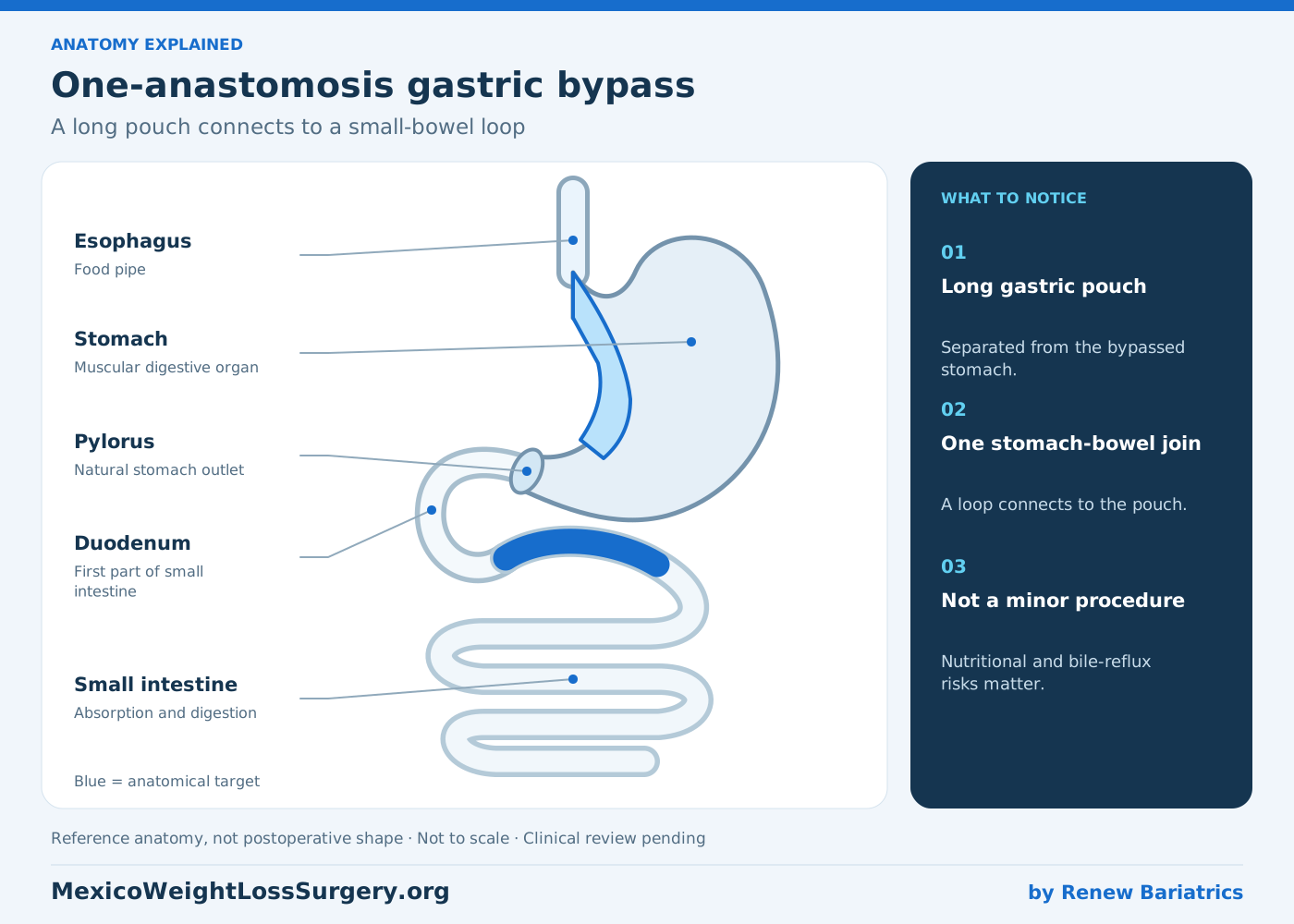
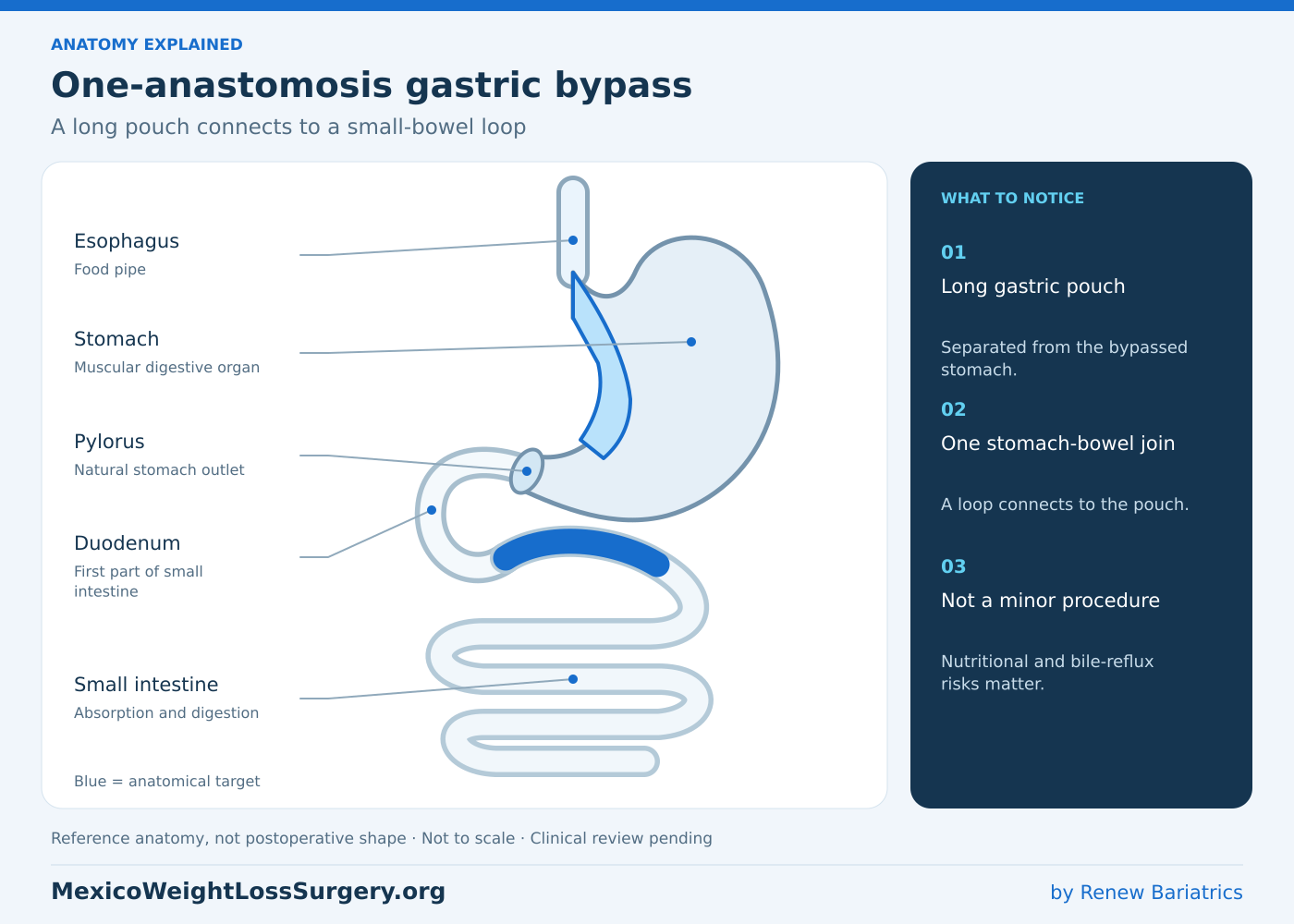
Anatomy references: BOMSS: One-anastomosis (Mini) Gastric Bypass ↗ · ASMBS: Roux-en-Y Gastric Bypass ↗
How one-anastomosis gastric bypass works
The surgeon creates a long, narrow stomach pouch and connects it to a loop of small intestine. Food travels through that new route, bypassing the rest of the stomach and an initial section of intestine. The excluded stomach remains in the body. The operation changes intake and gut signaling and can reduce absorption. Lifelong follow-up and supplementation are required. [1]
The full name is more useful than the nickname. “One anastomosis” means one surgically created connection. It does not tell you how long the bypassed intestinal segment will be, what your reflux risk is, or how nutritional monitoring will be organized. Those details belong in your clinical discussion.
Ask for a drawing of your proposed reconstruction. Identify the stomach pouch, where food enters the intestine, and how bile travels. If the clinician proposes a modification, ask what is different and whether the evidence being discussed matches that version of the procedure.
How OAGB differs from Roux-en-Y bypass
Roux-en-Y gastric bypass creates a different intestinal arrangement, with two connections and a Y-shaped reconstruction. OAGB connects the gastric pouch to an intestinal loop. The distinction matters when discussing reflux and absorption; it is not simply a question of which operation takes fewer steps. [2]
It also differs from SADI-S. SADI-S uses a sleeve-shaped stomach and a connection beyond the pyloric valve, while OAGB uses a gastric pouch connected directly to the intestine. [3] Do not combine the two names in a quote or assume their follow-up instructions are interchangeable.
When comparing surgeons, ask each to explain the option they recommend and the option they would avoid for you. A good answer connects your medical history to the choice. “This is our most popular package” is not a clinical rationale. The same operation can be reasonable for one patient and less suitable for another with a different reflux history or nutritional risk.
Who may be considered?
General eligibility for metabolic surgery and suitability for OAGB are separate questions. The ASMBS/IFSO recommendations support surgery for many adults with BMI at least 35 and consideration at lower BMI in selected circumstances. [4] Those recommendations do not establish that one particular bypass is appropriate for everyone meeting a threshold.
Prepare to discuss weight history, diabetes and other obesity-related conditions, previous treatments, medications, prior abdominal operations and nutrition. Reflux deserves particular attention. Tell the team about heartburn, regurgitation, swallowing problems, nighttime symptoms, previous endoscopy and any diagnosis of esophagitis or Barrett’s esophagus.
Ask which findings would change the recommendation. The answer may involve additional assessment or a different procedure. A clinical review should also explore whether long-term supplements and specialist follow-up are accessible to you. An operation that looks attractive on a comparison chart still needs to fit the practical circumstances in which you will live afterward.
What the YOMEGA trial tells us
YOMEGA is an important randomized comparison of OAGB and Roux-en-Y bypass. At five years, OAGB met the study’s criterion for non-inferior weight loss measured as percentage excess BMI loss. However, clinical reflux was reported in 41% of 66 assessed OAGB patients versus 18% of 76 assessed bypass patients. Ten of 127 OAGB patients underwent conversion to Roux-en-Y. Overall, 68% of the 253 randomized patients were followed at five years. [5]
The trial excluded people with severe reflux or Barrett’s esophagus and used a specific OAGB configuration. Therefore, it should not be treated as proof that OAGB is suitable for someone with those conditions or that every technique has identical outcomes.
“Non-inferior” is a research term about a specified endpoint and margin. It does not mean identical safety, identical symptoms or superiority on every measure. When you hear that two operations produce comparable weight loss, ask what happened to reflux, nutrition, revisions and quality of life as well.
Early and late findings need to be read together
At two years, YOMEGA also met its weight-loss non-inferiority criterion. The study reported more surgery-associated serious adverse events in the OAGB group, including nutritional complications, with the 200-centimeter biliopancreatic limb used in the trial. [6] These findings should be discussed alongside the later results rather than selecting whichever time point sounds most reassuring.
Research evolves, and operative techniques can differ. Ask whether the surgeon’s proposed limb length matches the evidence they cite. If it does not, ask what information supports their approach. The purpose is not to ask you to choose the length yourself, but to understand the reasoning and tradeoffs.
Published data are useful context. They are not a substitute for asking how a program tracks its own patients, including those who return home internationally. A clinic should distinguish a literature estimate from its own verified outcome data and avoid treating a lack of reported problems as proof that none occurred.
Understanding weight-loss percentages
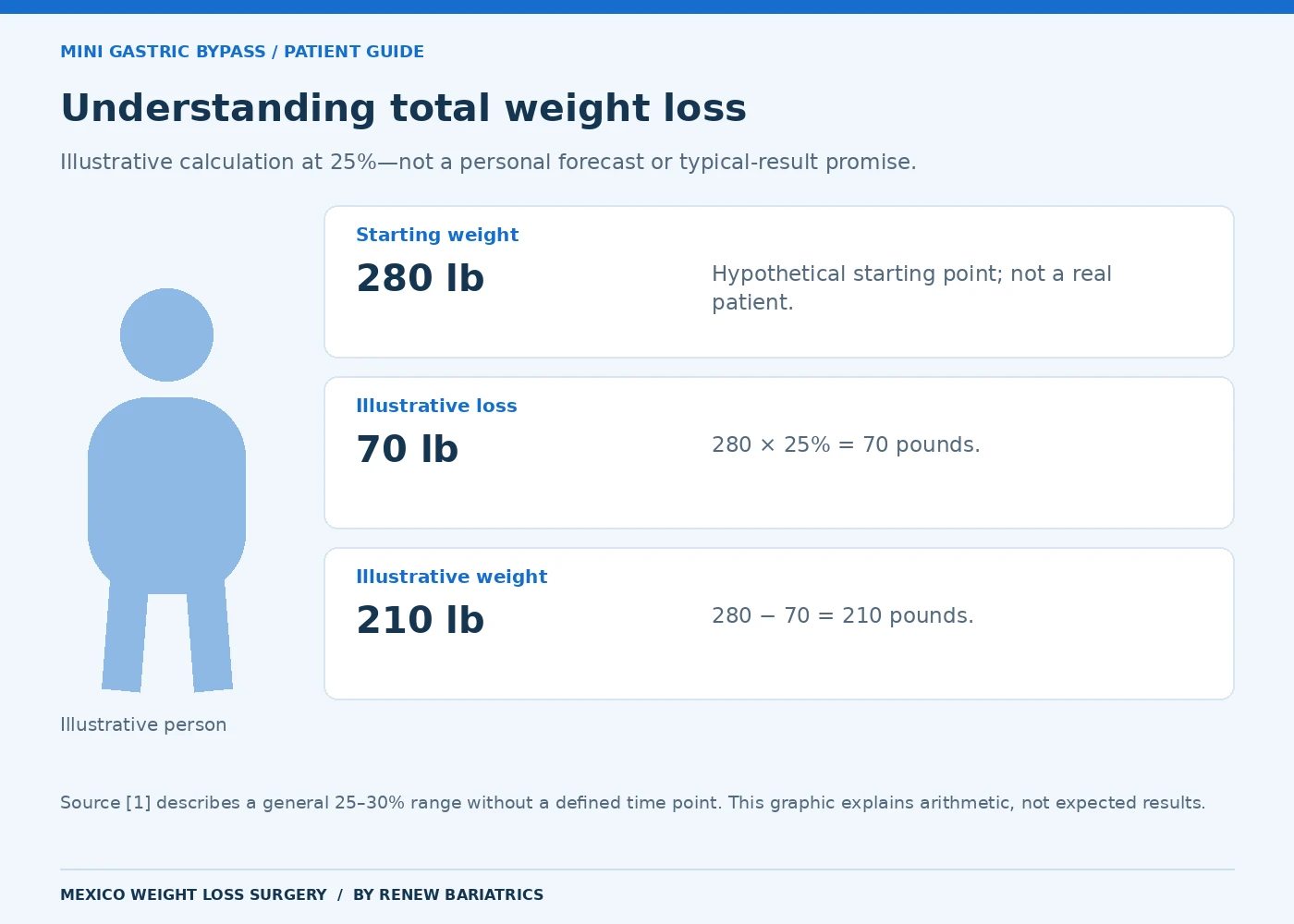
A patient information resource from BOMSS describes average total weight loss after OAGB of about 25–30%, without presenting that as a personal forecast. [1] A percentage must always be interpreted with its time horizon, patient population and follow-up completeness. Ask for those details when comparing claims.
For an illustration only, 25% of a starting weight of 280 pounds is 70 pounds; the resulting weight would be 210 pounds. At 30%, the arithmetic would be 84 pounds lost and a resulting weight of 196 pounds. These examples explain the metric, not the range you should expect. They do not predict appearance, health improvement or the result of treatment through Renew.
Excess weight loss and excess BMI loss use different denominators from total weight loss. A claim of 70% excess weight loss does not mean losing 70% of your starting body weight. Ask the team to translate a study’s measure into plain language before comparing it with another operation’s advertised percentage.
Bile reflux deserves a direct discussion
OAGB’s loop arrangement can allow bile to reach the stomach pouch and potentially the esophagus. Bile reflux is not the same as ordinary acid reflux, and persistent symptoms may require investigation or a change in treatment. An NHS patient resource identifies bile reflux as an important disadvantage of OAGB. [2]
A recent single-center cohort of 150 patients reported clinically important reflux and conversions for bile reflux. Because it was retrospective and reflects one center’s selection, testing and technique, its rates should not be generalized to every program. It does reinforce that this is a real clinical issue rather than a purely theoretical concern. [7]
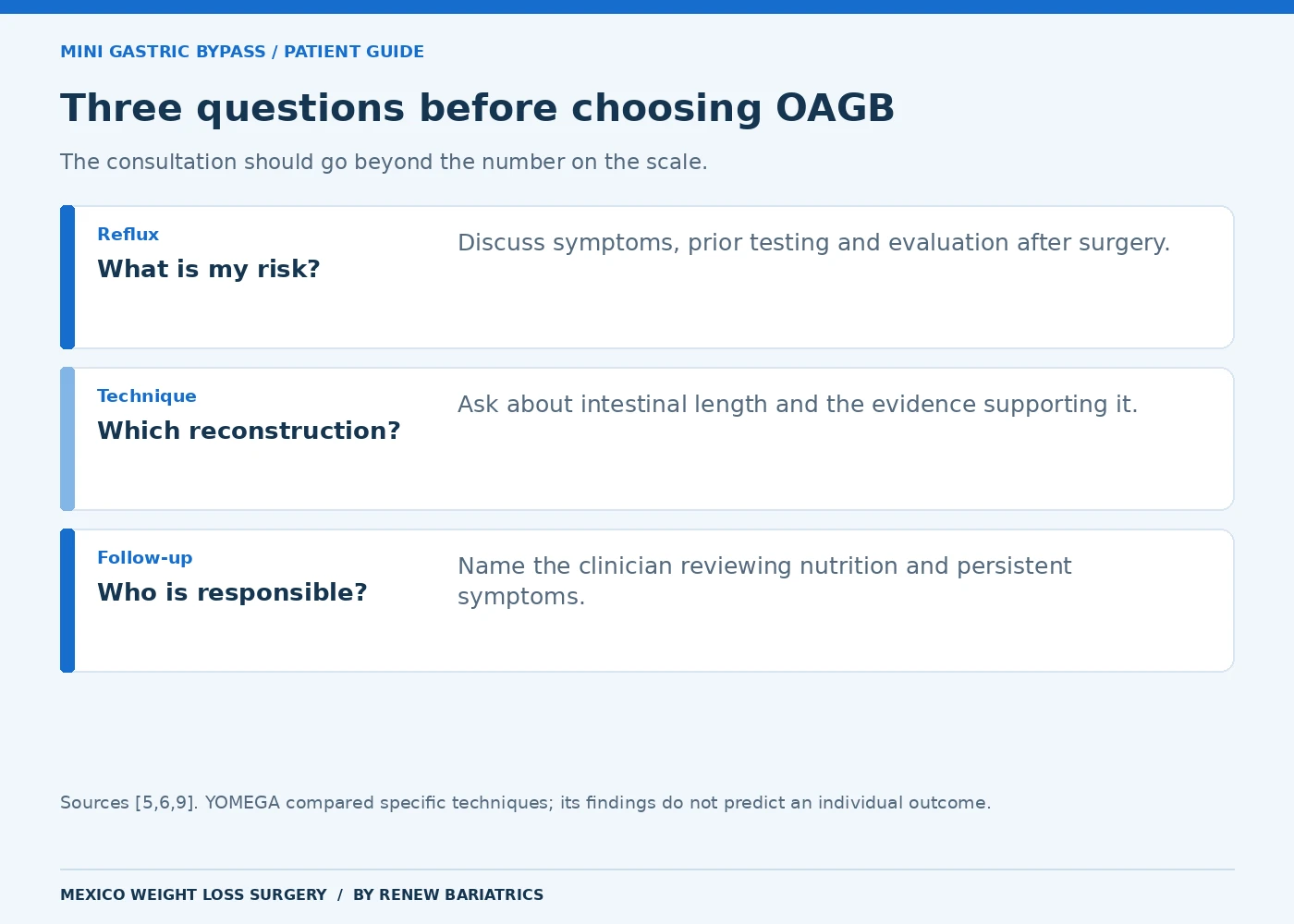
Ask what symptoms the team wants reported, whether endoscopic or other testing is indicated before surgery, and how persistent symptoms will be evaluated afterward. Do not accept a blanket assurance that all reflux will be prevented by a medication. Also avoid the opposite assumption that any postoperative discomfort necessarily means bile reflux; diagnosis requires clinical assessment.
Ulcers, smoking and medication review
Ulcers can develop at the pouch-to-intestine connection. Smoking and certain anti-inflammatory medicines are important topics to discuss before a bypass, and the treating team may prescribe ulcer-prevention treatment. [2] Bring an accurate list of prescribed medicines, nonprescription pain relievers, supplements and nicotine products.
If you need regular anti-inflammatory treatment for another condition, say so before choosing the procedure. Ask how the bariatric team will coordinate with the clinician managing that condition. Do not independently stop a necessary prescribed medicine; resolve the plan with the appropriate professionals.
Ask what to do if a new clinician later prescribes a medicine that could be problematic after bypass. Your surgical record and medication list should make the procedure visible. A one-time preoperative review cannot anticipate every future prescription, so you need a continuing way to obtain advice.
Nutrition and intestinal length
The bypassed length is one of the important details in OAGB planning. Nutritional consequences depend on more than the number of connections. The original YOMEGA findings illustrate why technique-specific evidence matters when evaluating malabsorption. [6]
The ASMBS published a formal OAGB position statement based on available scientific evidence, clinical knowledge and expert opinion. [8] A society statement is useful context, but it does not certify an individual surgeon or replace assessment of your case. Ask the clinician to explain their own nutritional protocol and the evidence behind it.
Your plan should identify daily supplements, protein and fluid targets, laboratory testing and the person responsible for interpreting results. Discuss the practical cost and availability of those products. If you already have low iron or another deficiency, ask how it will be addressed and whether it changes timing or treatment choice.
A supplement list is not a follow-up system
BOMSS identifies OAGB and other malabsorptive procedures as situations requiring appropriate specialist care rather than assuming its routine primary-care pathway fits every reconstruction. [9] The exact needs depend on the operation and individual clinical circumstances.
Ask who will order your tests, where they can be performed, who reviews the results, and how you will be told to change treatment. A laboratory report sitting in an email inbox does not provide follow-up. Request a process with named responsibilities and a backup if your usual contact is unavailable.
Keep records of the product names and doses you actually take. Bring labels or photographs to appointments. If nausea, cost or difficulty obtaining a product leads you to miss doses, explain that promptly. The goal is a workable replacement plan, not a conversation in which you feel you must report perfect adherence.
Other risks to understand
Bariatric surgery can involve bleeding, infection, leaks, clots and later problems such as narrowing or hernia. [10] Discuss risks in the context of your health and the proposed operation, including what treatment would involve if a complication occurred.
Ask the surgeon about their experience with OAGB specifically. How many cases have they performed? How do they collect information about patients who seek treatment elsewhere? Do their figures include late endoscopy, ulcer treatment, conversion and nutritional problems? A rate without a definition or follow-up period is difficult to interpret.
You should also know where emergency care is available during your stay. If your procedure is performed in a facility without a particular service, ask how transfer is arranged. The presence of a reassuring brochure or hotel recovery plan cannot answer questions about clinical resources.
When symptoms should not wait
Before discharge, obtain written instructions for urgent symptoms and emergency contacts. Severe or worsening abdominal pain, chest pain, trouble breathing, fainting, persistent vomiting or inability to keep fluids down warrant prompt assessment. Do not rely exclusively on a messaging thread when you may need examination or treatment.
BOMSS guidance emphasizes that prolonged vomiting and poor intake can lead to thiamine deficiency and require timely clinical action. [11] Symptoms should not be dismissed as a normal consequence of becoming accustomed to a smaller stomach.
If you seek care after returning home, tell the clinician that you had OAGB, not simply “bariatric surgery.” Share the operation date, operative report and medication list. If the report is unavailable, provide the surgeon’s contact details. Clear information helps the receiving team understand your anatomy and obtain further records.
Preparing for surgery and the trip
Preparation should be individualized. Ask for instructions covering medicines, fasting, nicotine, alcohol, preoperative nutrition and necessary investigations. Tell the anesthesia team about previous anesthesia problems, sleep apnea, allergies and any recent change in health.
Make the plan practical. Arrange help with caregiving and lifting, reserve time away from work, and decide who can assist if you need a longer stay. Ask whether your companion will be included in discharge teaching and whether language support is available when needed.
Keep copies of the quote, clinical instructions, emergency contacts and travel documents in an accessible place. These are not substitutes for clinical care, but they reduce avoidable confusion when you are tired or recovering. Before booking, confirm which arrangements are handled by Renew, which are handled by the hospital and which remain your responsibility.
Recovery is more than the hospital stay
A typical bariatric recovery plan progresses through food textures while activity gradually increases, guided by the treating team. [12] Your instructions should specify the actual timing and targets for your operation. Do not borrow another patient’s schedule or advance food because you feel ready without checking the protocol.
Ask about returning to each part of your routine separately: working at a desk, commuting, standing for long shifts, lifting children and exercising. A single “back to normal” date can conceal important differences. It is reasonable to want a planning estimate, but it should remain flexible if recovery is slower.
Arrange food and fluids you can tolerate within the prescribed plan. If a suggested product is unfamiliar, ask about alternatives before leaving Mexico. Know who answers routine diet questions and who assesses symptoms that could indicate a medical problem. Those are related but different roles.
Planning international follow-up
CDC travel guidance recommends planning continuity of care and obtaining medical records before returning home. It also explains that surgery and travel can both increase clot risk. [13] Discuss travel clearance with the clinician and review any mismatch between the proposed itinerary and conservative guidance before purchasing nonchangeable flights.
Ask for the operative report in English, including the procedure name and intestinal measurements. Confirm how your local clinician can contact the surgical team. If you do not have a local provider willing to assist with follow-up, address that gap before scheduling rather than assuming one will be easy to find later.
Think beyond the first week. Who will help at three months if iron levels decline? Who will investigate persistent reflux at a year? What happens if you move? A durable plan should remain usable after the trip and the initial period of frequent coordinator contact have ended.
What should a Mexico package quote cover?
This guide does not assign one universal mini gastric bypass price. Request a current individualized quote tied to the exact operation and clinical assessment. Ask whether it includes surgeon, anesthesia, facility, routine testing, medicines, accommodation and transportation, and obtain a separate list of exclusions.
Clarify the cost of extra hospital nights, unexpected procedures, intensive care, readmission and care after returning home. If a complication policy is mentioned, ask for its limits and exclusions in writing. Confirm whether flights, companion expenses and changes to travel arrangements are covered rather than assuming “all-inclusive” means everything.
Add the continuing costs of supplements, laboratory testing and follow-up to your comparison. It is possible to prefer a lower-priced option while still asking demanding questions about care. The purpose of transparency is to let you compare the complete plan, not only the number used in an advertisement.
Questions to ask before choosing OAGB
- Why is OAGB preferable to Roux-en-Y bypass for my situation?
- How does my reflux history affect the recommendation?
- What intestinal length do you propose, and what evidence supports it?
- Which outcomes and complications have you recorded in similar patients?
- How will persistent reflux or an ulcer be investigated and treated?
- Who manages supplements, testing and abnormal results after I return home?
- What could lead to conversion to a different reconstruction?
- What emergency resources, records and travel guidance will I receive?
Bring the answers back to your personal goals. A procedure recommendation should explain how it supports those goals while acknowledging the obligations and uncertainty. You are allowed to take time, compare options and ask for clarification when the terminology is inconsistent.
Common questions about mini gastric bypass
Does “mini” mean lower risk?
No. It remains a major operation with a changed digestive pathway. Comparative evidence must be evaluated by outcome, rather than assuming one connection establishes better overall safety. [5],[6]
Is it reversible?
Revisional surgery can sometimes change the reconstruction, but that is a separate operation with its own risks. The possibility of revision should not be treated as a simple undo button. Ask what a proposed revision would involve in your anatomy and why it might become necessary.
Will it cure diabetes?
Metabolic surgery can improve diabetes, and some patients achieve remission, but remission is not a guarantee or a permanent cure. OAGB and bypass had similar diabetes remission findings in the five-year YOMEGA comparison. [5] Medication changes and continued monitoring belong with the clinical team.
Can I choose based on before-and-after photos?
Photos can describe an individual experience when consented and accurately labeled. They cannot establish typical weight loss, reflux risk or nutritional safety. Ask for procedure-specific evidence and a clinical assessment alongside any patient story.
How do I start with Renew?
Discuss your goals with a coordinator and provide your history through the health questionnaire. Ask specifically whether OAGB is available for clinical consideration, who would perform it, and how reflux and nutrition are assessed. A coordinator can explain the process; suitability and informed consent require the treating clinical team.
Program information related to this guide
For information about care through our parent organization, explore mini gastric bypass at Renew Bariatrics. Ask the team to confirm availability, your eligibility and the written scope of care.
Mini gastric bypass vs. Roux-en-Y bypass
These options change different structures. Your anatomy, symptoms, health history and follow-up needs guide the choice; neither is automatically better for everyone.
| What to compare | Mini gastric bypass → | Gastric bypass → |
|---|---|---|
| Configuration | Long pouch with one gastrojejunal connection. | Small pouch with a Roux-en-Y bowel configuration. |
| Reflux discussion | Bile can reach the pouch and esophagus. | Often used when reflux is a major consideration. |
| Follow-up | Lifelong supplementation and monitoring. | Lifelong supplementation and monitoring. |
| Quote | Confirm the exact operation and follow-up plan. | Confirm the exact operation and follow-up plan. |
Comparison references: BOMSS: One-anastomosis (Mini) Gastric Bypass ↗ · ASMBS: Roux-en-Y Gastric Bypass ↗
These options are not interchangeable for every person. The treating clinician must assess your anatomy, medical history and goals.
Read Renew’s mini gastric bypass program information ↗. Confirm the current care arrangements and your individual quote with the team.
Discuss your options with Renew.
Talk with a coordinator about mini gastric bypass, your goals and the information needed for clinical review. The treating team determines suitability and the care plan.
Call 844-736-3963 Complete health questionnaire ↗The questionnaire opens Renew’s existing intake. This review site does not collect health information.
References & evidence notes
Sources checked November 2026. Research findings are not a forecast for an individual or outcomes for Renew’s own program. Review study populations, methods and limitations alongside the reported results.
- BOMSS. One-anastomosis (Mini) Gastric Bypass (OAGB) ↗Patient information; general outcome range has no specified time horizon and is not an individual forecast.
- Chelsea and Westminster Hospital NHS Foundation Trust. Weight loss (bariatric) surgery—information for patients ↗Institutional patient education, including OAGB anatomy, bile reflux and ulcer considerations.
- ASMBS. Single Anastomosis Duodeno-Ileal Bypass with Sleeve Gastrectomy ↗Professional society patient education; anatomy and tradeoffs.
- Eisenberg et al., 2022. ASMBS/IFSO Indications for Metabolic and Bariatric Surgery ↗Professional recommendations; general surgical eligibility is not procedure-specific approval.
- Robert et al., 2024. YOMEGA: five-year randomized extension study ↗253 randomized; 68% followed at five years. Specific limb configuration; severe reflux and Barrett’s esophagus excluded.
- Robert et al., 2019. YOMEGA: randomized comparison at two years ↗200-cm OAGB biliopancreatic limb; nutritional adverse events important. Same trial as five-year extension. doi:10.1016/S0140-6736(19)30475-1.
- Single-center retrospective cohort, 2026. Gastroesophageal and bile reflux after one-anastomosis gastric bypass ↗150 patients; center-specific selection, testing and technique limit generalizability.
- Ghiassi et al., 2024. ASMBS position statement on one-anastomosis gastric bypass ↗Position statement, not certification of an individual program. doi:10.1016/j.soard.2023.11.003.
- BOMSS, 2023. Post-bariatric surgery nutritional guidance for GPs ↗Defines limitations of routine primary-care guidance and need for specialist care after malabsorptive procedures.
- NIDDK. Weight-loss Surgery Side Effects ↗General bariatric risks; not an operation-specific complication estimate.
- BOMSS, 2020. Perioperative and postoperative biochemical monitoring and micronutrient replacement guidelines ↗Clinical guidance; prolonged vomiting and poor intake require early assessment, including thiamine risk.
- NIDDK. Types of Weight-loss Surgery ↗General postoperative diet/activity education; does not establish a Renew procedure-specific protocol.
- CDC Yellow Book, 2026 edition. Medical Tourism ↗Travel, complication planning, medical records and continuity of care; published April 2025.