

Jump to a section
Anatomy illustrationCompare proceduresRelated ProceduresUnderstand the device you already haveWhy a gastric band may need removalWhen to seek urgent careWhat the assessment may involveWhat happens during removal?Removal alone: what it does and does not accomplishConverting a band to gastric sleeveConverting a band to Roux-en-Y gastric bypassOne operation or two stages?What weight-loss numbers can and cannot tell youRisks to discuss before agreeingPreparing for removal or conversionRecovery depends on the actual operationPlanning care and travel in MexicoA written quote should answer these questionsCommon questions about band removalYour next stepReferencesIf your gastric band is causing problems or no longer meeting your needs, the next decision is not simply which new operation to buy. First establish why the band needs attention. Then separate two questions: how to address the device or complication, and how to manage weight and health afterward.
Removal alone, removal with a later conversion, and removal with an immediate conversion are different treatment plans. Each can be appropriate in particular circumstances. This guide explains the questions that help distinguish them, with special attention to planning care in Mexico. Renew's clinicians must review your history and confirm the available procedure, surgeon and facility; this page does not promise eligibility or a fixed package.
Understand the anatomy
A simplified, labeled view of the structures and treatment area. Select the image to view it at full size.
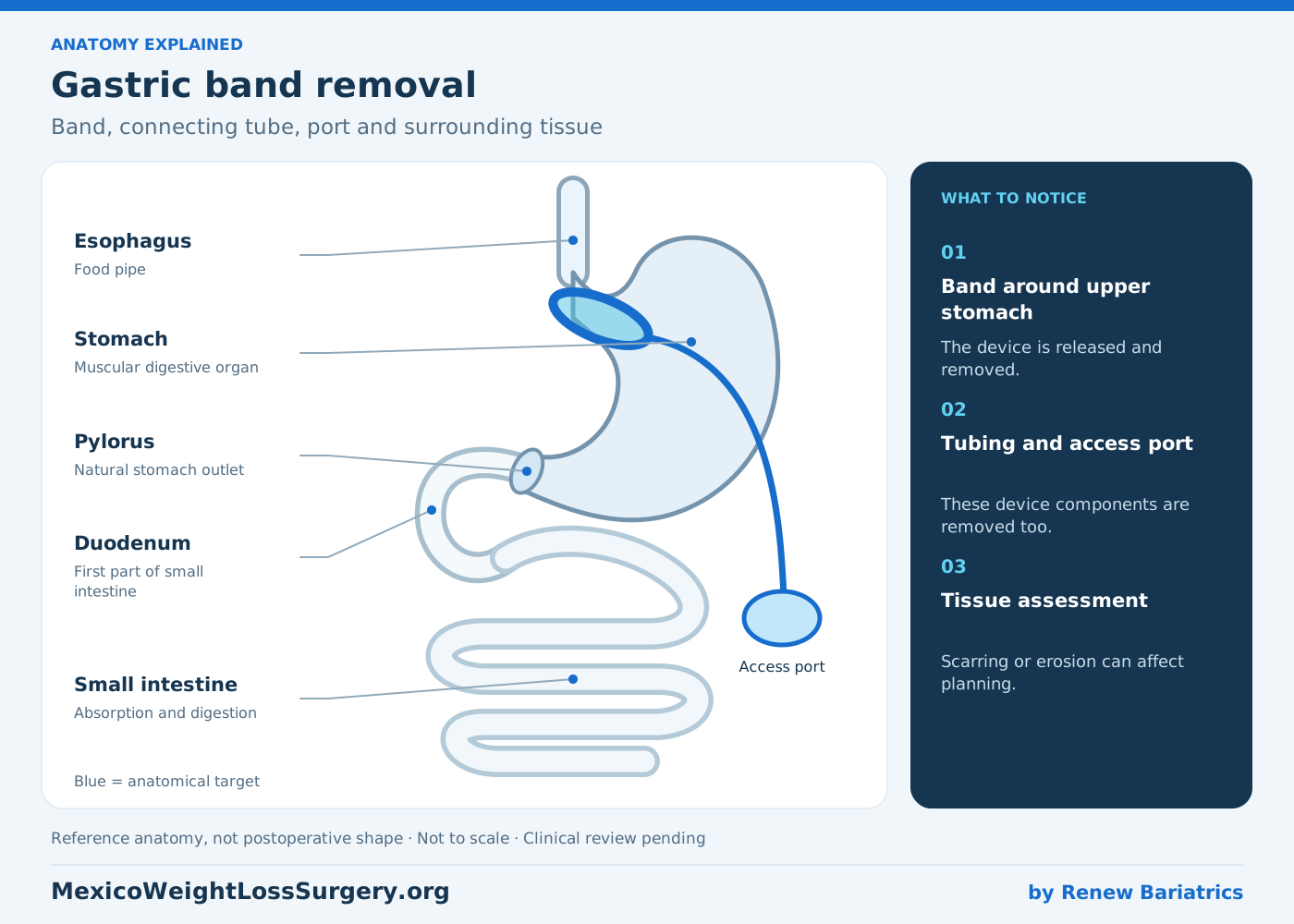
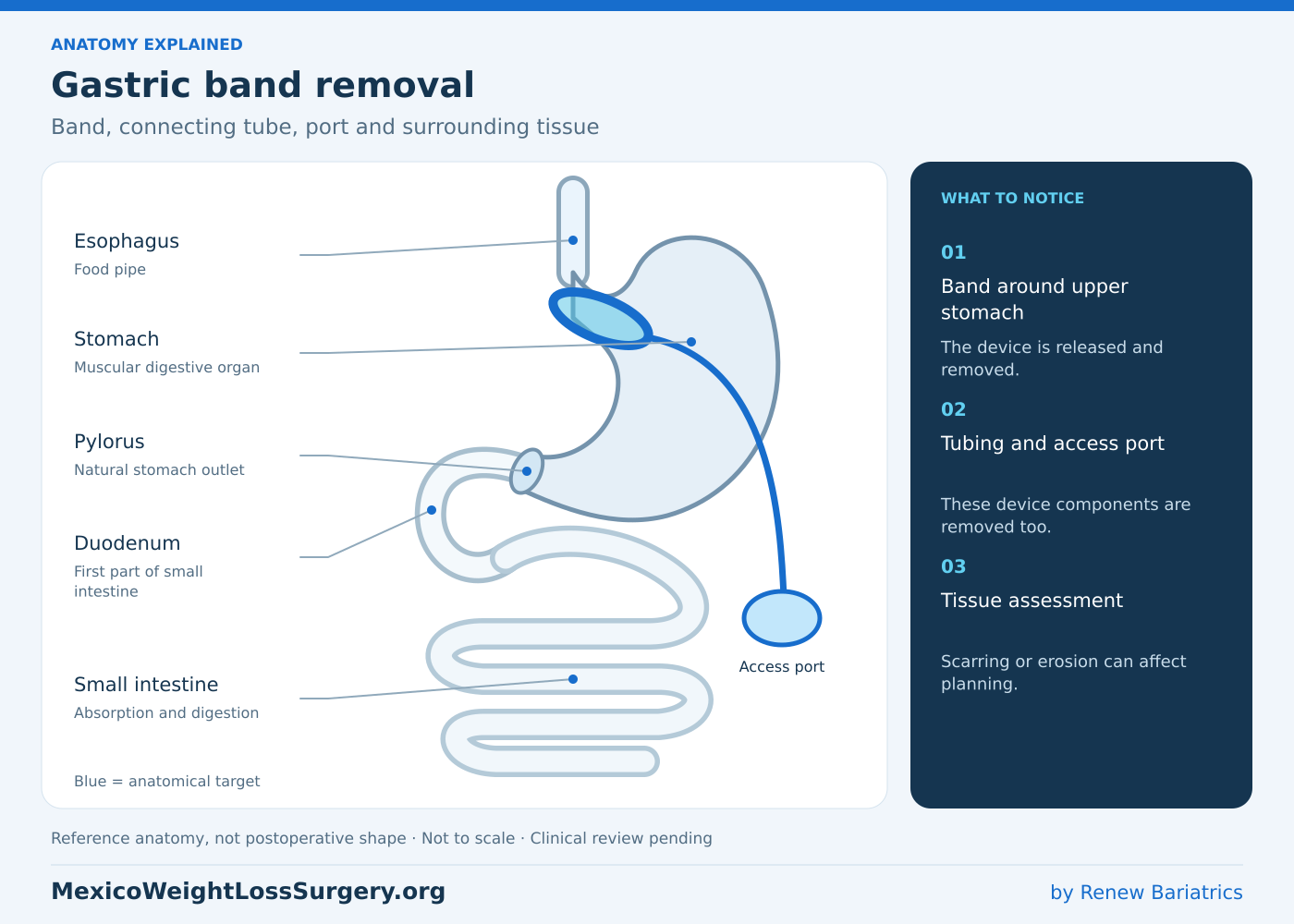
Anatomy references: UCLA Health: Lap Band Removal ↗
Understand the device you already have
An adjustable gastric band is a ring placed around the upper stomach, connected by tubing to a port beneath the skin. Fluid added or removed through the port changes the opening. Unlike sleeve gastrectomy, the original band operation generally does not remove stomach tissue or reroute the intestine. [1]
However, “removable” does not mean that taking the device out is always simple or that every symptom disappears immediately. The reason for removal, the condition of surrounding tissue, previous operations and any complications affect the plan. Ask the surgeon to explain what is known about your band before discussing a replacement procedure.
Bring the implant card or operative report if you have it. If you do not know the brand, date or amount of fluid in the band, say so. Also describe the last adjustment and any changes that followed it. Accurate uncertainty is more useful than an incorrect detail copied from another patient's experience.
Why a gastric band may need removal
Reasons can include swallowing difficulty, persistent vomiting, reflux, device problems, slippage, erosion or an unsatisfactory weight response. Slippage refers to a change in the band's position; erosion involves the device moving into the stomach wall or lumen. These problems require assessment rather than a diagnosis based on symptoms alone. [2]
A patient who cannot tolerate food should not be told simply to try harder to eat less. Repeated regurgitation, pain with eating or worsening food avoidance deserves review. Conversely, weight recurrence without discomfort does not prove that the band has slipped. Your symptoms and test findings need to be considered together.
Tell the team about any redness, drainage, pain or repeated infection around the port, even if it seems unrelated to eating. Describe whether symptoms are continuous or intermittent, whether liquids are easier than solids, and whether nighttime regurgitation occurs. A clear history helps determine the urgency and type of evaluation.
When to seek urgent care
Severe abdominal or chest pain, breathing difficulty, vomiting blood or other substantial bleeding need urgent medical care. Persistent vomiting, fever, worsening swallowing difficulty or inability to maintain fluid intake should also prompt assessment. Do not wait for a planned international trip if symptoms suggest a serious complication. [3]
An online message cannot reliably rule out obstruction, a slipped band or another urgent problem. If you are unwell, contact local medical services and tell them you have an adjustable gastric band. Bring available records, but do not delay care while trying to retrieve them.
For a stable elective review, ask how quickly the specialist should see you and what to do if symptoms worsen while waiting. Your plan should include an escalation route rather than only the date of a future appointment. A travel coordinator should not be the only person deciding whether a new symptom can wait.
What the assessment may involve
The clinician will want to understand the original operation, adjustments, symptoms, weight history, previous investigations and other medical conditions. Testing may include imaging or upper endoscopy depending on the suspected problem. These tests can help assess device position, obstruction, erosion or other findings, but the exact combination is individualized. [4]
Ask what the team needs before recommending surgery. Does the proposed plan depend on confirming erosion? Is a swallowing problem likely to need additional assessment? Will the surgeon review original images or only a written report? If tests are planned after arrival, ask how unexpected findings could change the operation and cost.
Prepare a timeline with four separate items: when the band was placed, when problems began, when adjustments were made, and what happened afterward. Add the lowest sustained weight and current weight if weight treatment is also a goal. This gives the consultation more useful detail than saying that the band “never worked.”
What happens during removal?
Many removals can be performed laparoscopically through small abdominal incisions. The surgeon addresses tissue around the device and removes the band system, including the relevant tubing and port. Scar tissue, erosion or other complications can make the operation more involved. Occasionally an open operation is required. [2],[5]
Ask exactly what will be removed and whether another treatment is planned during the same anesthetic. Confirm what would make the surgeon stop after removal instead of proceeding to conversion. Consent should allow a discussion of realistic contingencies rather than presenting the advertised operation as unavoidable regardless of findings.
If erosion is suspected, ask whether it changes the removal technique, need for additional expertise, hospital stay or timing of later weight treatment. This page cannot determine which approach fits a particular eroded band. A personalized plan should explain the reasoning and who is equipped to carry it out.
Removal alone: what it does and does not accomplish
Removing the device can address a band-related problem, but it is not automatically a new weight-loss treatment. Ask which symptoms are expected to improve and what further assessment is planned if they do not. Do not assume every episode of reflux or swallowing difficulty must be caused solely by the band.
Weight management after removal deserves its own plan. A small retrospective study followed 21 patients after removal without another bariatric operation. At roughly five years, average regain was 17.3 kilograms. This limited study does not predict what will happen to every individual, but it illustrates why removal and long-term obesity treatment should be discussed separately. [6]
Removal alone may still be the right decision. A complication may take priority, a person may not want another bariatric operation, or further assessment may be needed before choosing one. Ask what nutritional, medical and behavioral support will be available afterward instead of treating the absence of immediate conversion as the end of care.
Converting a band to gastric sleeve
A sleeve conversion removes part of the stomach and leaves a narrower stomach without the band. Unlike band removal alone, it creates a permanent change because removed tissue cannot be restored. There is no implanted adjustment port, but there are new surgical and long-term considerations, including reflux and nutritional monitoring. [7]
Ask whether your reflux, swallowing history, anatomy and reason for removal make sleeve a reasonable option. It should not be selected simply because it is advertised at a lower price than bypass or because a friend recovered quickly. The factors that made the band difficult to live with may be important to the next choice.
Discuss how the surgeon evaluates tissue near the former band and how that affects timing. If conversion is delayed, ask what needs to improve before proceeding. If immediate conversion is proposed, ask what findings would lead to a safer staged approach instead.
Converting a band to Roux-en-Y gastric bypass
Bypass creates a small stomach pouch and reroutes part of the small intestine. Compared with a band, it introduces different risks and ongoing responsibilities, including nutritional deficiencies, ulcers, dumping symptoms and potential intestinal complications. It may be considered when the overall clinical picture favors bypass rather than sleeve. [7]
Ask the team to explain the proposed anatomy, expected benefits for your main problem, and the follow-up burden. If reflux is a major concern, ask specifically how it influences the recommendation. If long-term supplement access is difficult, raise that before deciding on a procedure that requires ongoing monitoring.
A retrospective study of 108 people undergoing single-stage band-to-bypass conversion reported improved quality-of-life scores during follow-up. It was a single-center study, not a randomized comparison of every possible treatment. It suggests that the experience can improve for selected patients, but it does not guarantee a particular result or establish outcomes for Renew. [8]
One operation or two stages?
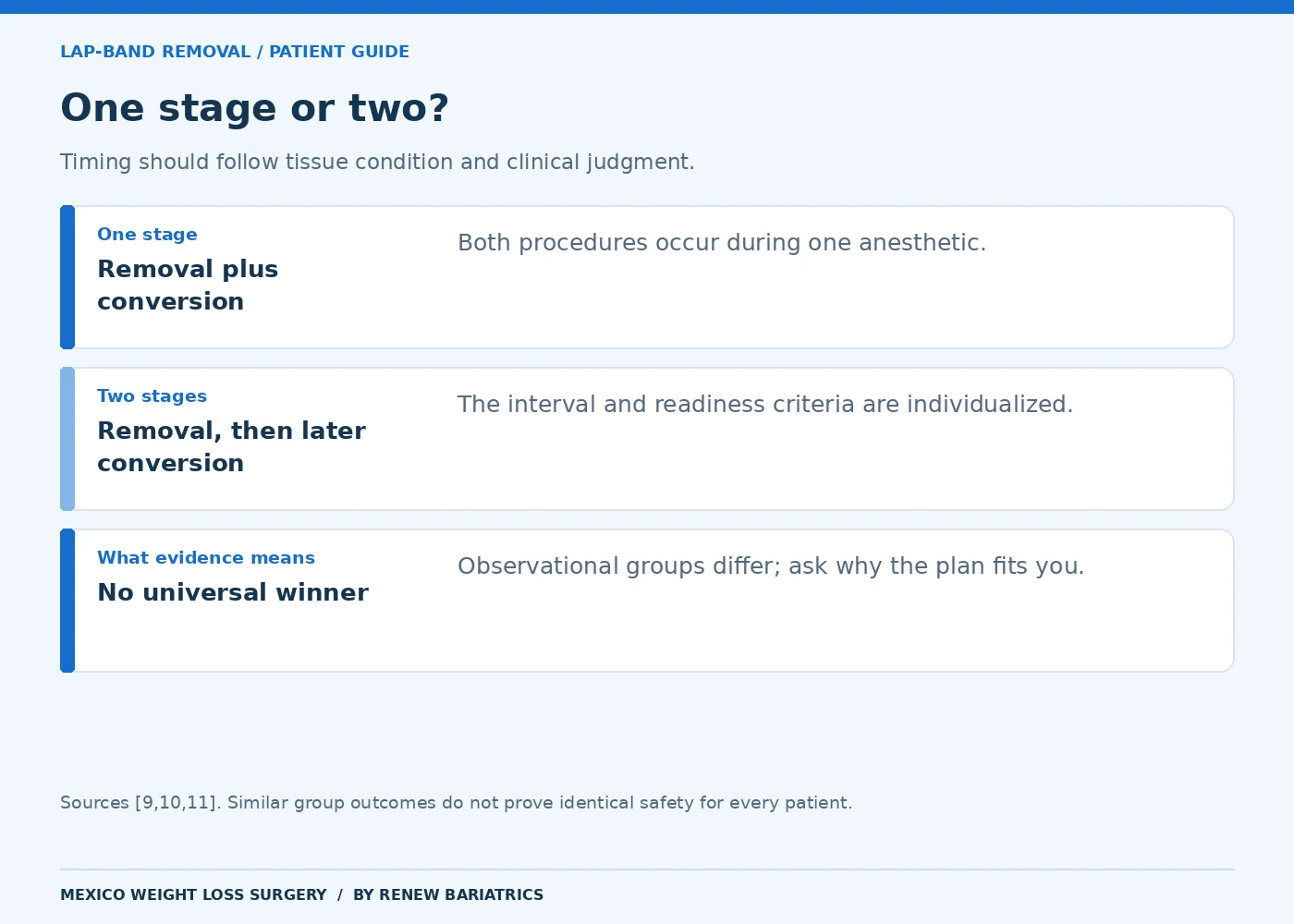
One-stage conversion removes the band and performs the new bariatric operation during the same anesthetic. Two-stage treatment removes the band first and performs the later operation after an interval determined by the team. A second stage can mean another recovery period and additional travel, but convenience must be balanced against tissue condition and clinical risk.
An analysis of 12,085 band conversions in a surgical registry found similar 30-day serious-complication rates for one-stage and two-stage approaches within the sleeve and bypass groups. Overall serious complications were more frequent with bypass conversion than sleeve conversion, 5.2% versus 3.3%. The study was observational, so the groups were not interchangeable and the findings do not prove either timing is best for every patient. [9]
A systematic review of leak rates also found no statistically significant overall difference between one-stage and two-stage conversion. Subgroup estimates were imprecise, reinforcing the need for individualized decisions rather than declaring one approach universally safest. [10]
Ask for the reason behind the staging recommendation in your case. Is it erosion, inflammation, anatomy, another health issue or a planned reassessment? Ask what would change that recommendation and how the period between stages would be managed.
What weight-loss numbers can and cannot tell you
Published results depend on the new procedure, starting point, follow-up duration and who returns for assessment. A percentage measured from the original band date is not the same as additional loss measured from conversion. Ask where the calculation starts before comparing clinics or studies.
In a multicenter cohort of 832 band-to-bypass conversions, average total weight loss was 30.4% in the one-stage group and 26.8% in the two-stage group at a mean follow-up of 33 months. Patients selected for two stages more often had technical band complications, and follow-up declined over time. Those differences prevent a simple conclusion that one-stage surgery inherently causes better weight loss. [11]
For a purely illustrative calculation, 10% of a 250-pound starting weight is 25 pounds. The percentage means nothing clinically unless the procedure, timing and source are specified. The neutral graphic on this page focuses on decision pathways rather than inventing a body transformation or predicting your weight.
Ask for a range of outcomes and a maintenance plan, not only the largest loss. Find out how the team responds to modest weight change, weight recurrence or difficulty meeting nutritional needs. The aim is a sustainable treatment strategy rather than replacing one device with another promise.
Risks to discuss before agreeing
Band removal has surgical and anesthesia risks. Conversion adds risks associated with the new anatomy. Bleeding, infection, injury, leaks, blood clots and later nutritional problems may be relevant; the exact risk depends on what is being done and why. Do not apply a primary-surgery complication rate to a complicated band revision without asking whether it is comparable. [12]
Ask who will manage a leak, obstruction or unexpected finding and whether the planned facility has the required resources. Ask whether an additional specialist or transfer could be needed. Find out how after-hours concerns are assessed and how the surgeon communicates with clinicians at home if you need care after the trip.
A useful risk discussion includes your own health conditions, previous operations, medicines and nutritional status. It should also explain what can be improved before elective treatment. A short list of exclusions on a booking page cannot replace that discussion.
Preparing for removal or conversion
Obtain written instructions tailored to the planned operation. Ask about prescribed medicines, fasting, any preparation diet and when to report a new illness. Your band-related symptoms may affect preparation, so do not follow a generic diet plan without telling the team if eating or drinking is difficult.
Make a records folder containing the operative report, implant information, adjustment history, test results and medication list. Keep a copy available to your companion. Include emergency contacts and the written proposed plan. If you need language assistance, arrange it for consent and discharge discussions, not only for airport transfers.
Before traveling, ask which decisions are final and which remain conditional. A team may need new information before confirming conversion. Understanding that distinction helps prevent pressure to proceed simply because flights and accommodation have already been paid for.
Recovery depends on the actual operation
A straightforward removal and a removal with bypass conversion should not be assumed to have identical recovery. Ask about food progression, wound care, activity, work, lifting and driving separately. If conversion occurs, follow the new procedure's nutrition and follow-up plan rather than returning to the old band routine.
Bariatric recovery commonly involves gradual food progression and continued follow-up, but schedules vary. Use your team's written instructions and ask for clarification when they differ from a friend's experience or an online calendar. Persistent problems with intake deserve assessment rather than simply repeating the same advice. [13]
Plan a realistic home setup: help with heavy tasks, appropriate food and fluids, access to prescribed medicines and a way to attend appointments. Consider the physical requirements of your work. Ask for a clear contact route for routine questions and a separate emergency plan so you do not confuse a delayed message response with reassurance.
Planning care and travel in Mexico
Confirm the surgeon, facility and procedure before comparing packages. Ask whether the team routinely treats the particular band complication suspected in your case. Verify credentials through the relevant organizations and request clarity about emergency resources. A polished website does not answer these clinical questions.
Travel arrangements should follow the treatment plan. Ask who authorizes the return date and how an extended stay would be handled. CDC notes that surgery and postoperative travel create additional risks and recommends planning for follow-up and complications. Obtain the records needed for continuing care after the trip. [14]
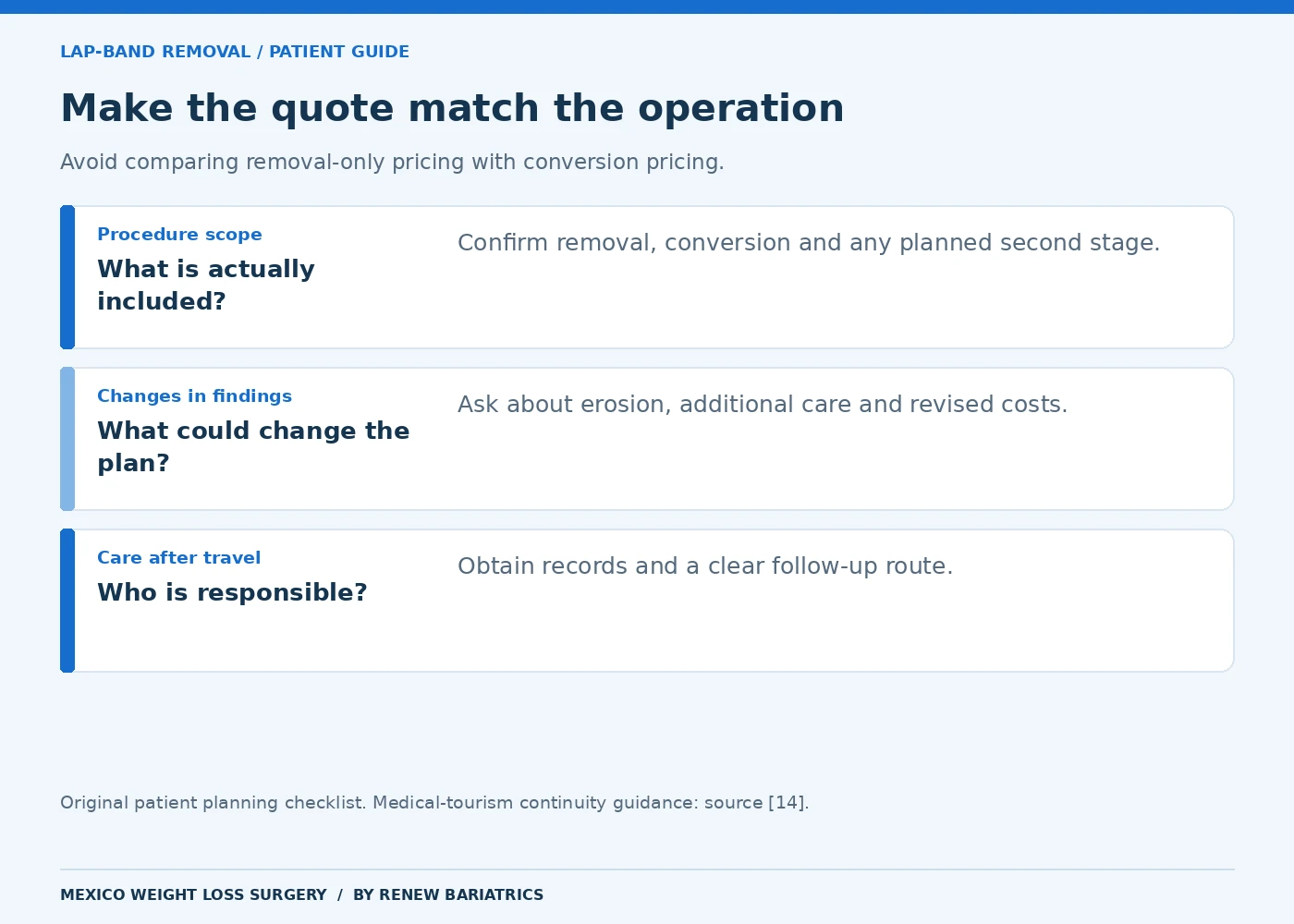
If two stages are recommended, compare the full plan: both operations, both periods away from work, travel, testing and care between stages. Ask whether the first quote covers only removal. A lower first-stage price may not represent a lower total cost, and one trip should not be preferred solely because it is easier to schedule.
A written quote should answer these questions
- Does the price cover removal only, removal plus conversion, or the first stage of a staged plan?
- Are the band, tubing and port all included in the planned removal?
- Which tests, anesthesia services, hospital nights and routine medicines are included?
- Is another procedure, such as hernia repair, anticipated and priced separately?
- What happens financially if erosion or another finding changes the plan?
- Who pays for extra nights, readmission, complications or treatment at home?
- What are the cancellation, postponement and refund terms?
Request the answers before nonrefundable travel commitments. If the clinical plan is still uncertain, the quote should say so. Ask for a revised written plan after additional records or tests are reviewed rather than relying on a verbal estimate made before the team understood your case.
Common questions about band removal
Can the band simply be loosened instead?
Sometimes adjustment or other management is considered, but that depends on the problem. Slippage, erosion and device intolerance are not the same diagnosis. Ask a clinician experienced with gastric bands to assess the issue; do not attempt to access or adjust the port yourself. [2]
Will removal return my stomach to normal?
The device can be removed, but previous surgery and complications may leave changes that need attention. Ask what the surgeon expects to find and whether persistent symptoms would require further investigation. “Reversible” should not be interpreted as a guarantee that nothing remains to manage. [5]
Must I have another bariatric operation?
No automatic rule applies. Removal and ongoing obesity treatment are separate decisions. You may need time for healing, further assessment or consideration of medical treatment. Ask for a plan that respects your goals while addressing the reason the band needs attention.
Is bypass always better than sleeve after a band?
No. The comparison depends on reflux, anatomy, weight-related goals, other health conditions and willingness and ability to maintain follow-up. Studies compare selected patient groups; they cannot identify the best operation for every individual from an online description alone. [9],[11]
What is the first step with Renew?
Ask how to submit your band history, symptoms and available records for clinical review. Make clear whether you are seeking removal because of a complication, a new weight-loss treatment, or both. A coordinator can explain the process; the treating clinical team determines the medical plan. Confirm availability and a case-specific quote before booking travel. This researched guide remains a clinical-review draft.
Program information related to this guide
For information about care through our parent organization, explore Renew’s revision surgery assessment. Ask the team to confirm availability, your eligibility and the written scope of care.
Band removal alone vs. conversion surgery
These options change different structures. Your anatomy, symptoms, health history and follow-up needs guide the choice; neither is automatically better for everyone.
| What to compare | Lap-band removal → | Revision surgery → |
|---|---|---|
| Main purpose | Remove the band and associated components. | Remove the band and consider another operation. |
| Anatomy afterward | No new bariatric reconstruction is necessarily created. | Depends on the chosen sleeve or bypass operation. |
| Timing | Can be performed without immediate conversion. | May be combined or staged depending on tissue condition. |
| Long-term plan | Ongoing obesity treatment still matters. | Recovery and nutritional needs follow the new operation. |
Comparison references: UCLA Health: Lap Band Removal ↗
These options are not interchangeable for every person. The treating clinician must assess your anatomy, medical history and goals.
Further reading
Discuss your options with Renew.
Talk with a coordinator about lap-band removal, your goals and the information needed for clinical review. The treating team determines suitability and the care plan.
Call 844-736-3963 Complete health questionnaire ↗The questionnaire opens Renew’s existing intake. This review site does not collect health information.
References & evidence notes
Sources checked November 2026. Research findings are not a forecast for an individual or outcomes for Renew’s own program. Review study populations, methods and limitations alongside the reported results.
- NIDDK. Types of Weight-loss Surgery ↗Government patient education; anatomy and tradeoffs of procedures.
- UCLA Health. Lap Band Removal ↗Institutional patient education; band complications and removal/conversion options. UCLA-specific protocols are not Renew protocols.
- NHS. Complications of weight loss surgery ↗Patient education on complications and symptoms requiring urgent assessment; use local emergency services.
- Homerton Healthcare NHS Foundation Trust. GP information: post-bariatric complications ↗Clinical overview of investigations and referral for band complications.
- University Hospitals Coventry and Warwickshire NHS Trust. Removal of laparoscopic adjustable gastric banding: the surgical procedure ↗Patient leaflet; reasons for removal and possibility of open surgery. Local stay estimates are not used as Renew promises.
- 2017 retrospective cohort. Long-term outcomes of gastric band removal without additional bariatric surgery ↗Only 21 patients, approximately five-year follow-up; limited generalizability.
- ASMBS. Bariatric Surgery Procedures ↗Procedure anatomy, benefits and long-term tradeoffs.
- 2022 single-center cohort. Mid-term quality of life after gastric band removal and single-stage conversion to gastric bypass ↗108 patients; retrospective analysis of a prospective database, not randomized.
- 2023 MBSAQIP analysis. One- versus two-stage conversions of adjustable gastric bands ↗12,085 conversions; observational comparison of 30-day outcomes, subject to selection differences.
- 2020 systematic review. Safety of adjustable gastric band conversion surgery: a systematic review and meta-analysis of the leak rate in 1- and 2-stage procedures ↗No significant overall leak-rate difference; subgroup estimates imprecise.
- 2020 multicenter database study. Conversion of Adjustable Gastric Banding to Roux-en-Y Gastric Bypass in One or Two Steps: What Is the Best Approach? ↗832 patients at seven centers; baseline differences and declining longer-term follow-up limit causal comparisons.
- NIDDK. Weight-loss Surgery Side Effects ↗Government patient education; general risks, not a procedure-specific complication estimate.
- NHS. Recovering from weight loss surgery ↗General recovery framework; local protocols and individual timelines vary.
- CDC Yellow Book. Medical Tourism ↗Travel, complication planning and continuity-of-care guidance; not a Renew itinerary.