
Jump to a section
Anatomy illustrationSynthetic illustrationCompare proceduresRelated ProceduresWhat a breast lift is designed to addressWhy weight-loss patients need an individual planLift alone, lift with implants or reduction?Incision patterns and permanent scarsConsultation: what information actually helps?Breast lift risks: understand severity as well as frequencyImplants change the long-term discussionBreastfeeding, pregnancy and future changePreparing for your operationRecovery after a breast liftTravel and continuity of careBreast Lift Cost in MexicoMake the consultation a decision, not a sales deadlineYour next stepReferencesA breast lift, or mastopexy, reshapes the breasts by removing excess skin and repositioning breast tissue and the nipple-areola complex. It addresses position and shape; it does not automatically add the volume of an implant. For people considering a breast lift in Mexico after weight loss, the decision should connect the desired change, the scars involved, recovery support and the complete cost of care.[1],[2]
Renew Bariatrics lists breast lift among its procedures.[14] A listing does not establish that you are a candidate or identify the exact operation you need. Breast lift cost in Mexico should be quoted after an assessment, with a clear distinction between lift alone, lift with implants and any other planned surgery. This guide helps you prepare for that conversation without promising a particular appearance.
Understand the anatomy
A simplified, labeled view of the structures and treatment area. Select the image to view it at full size.
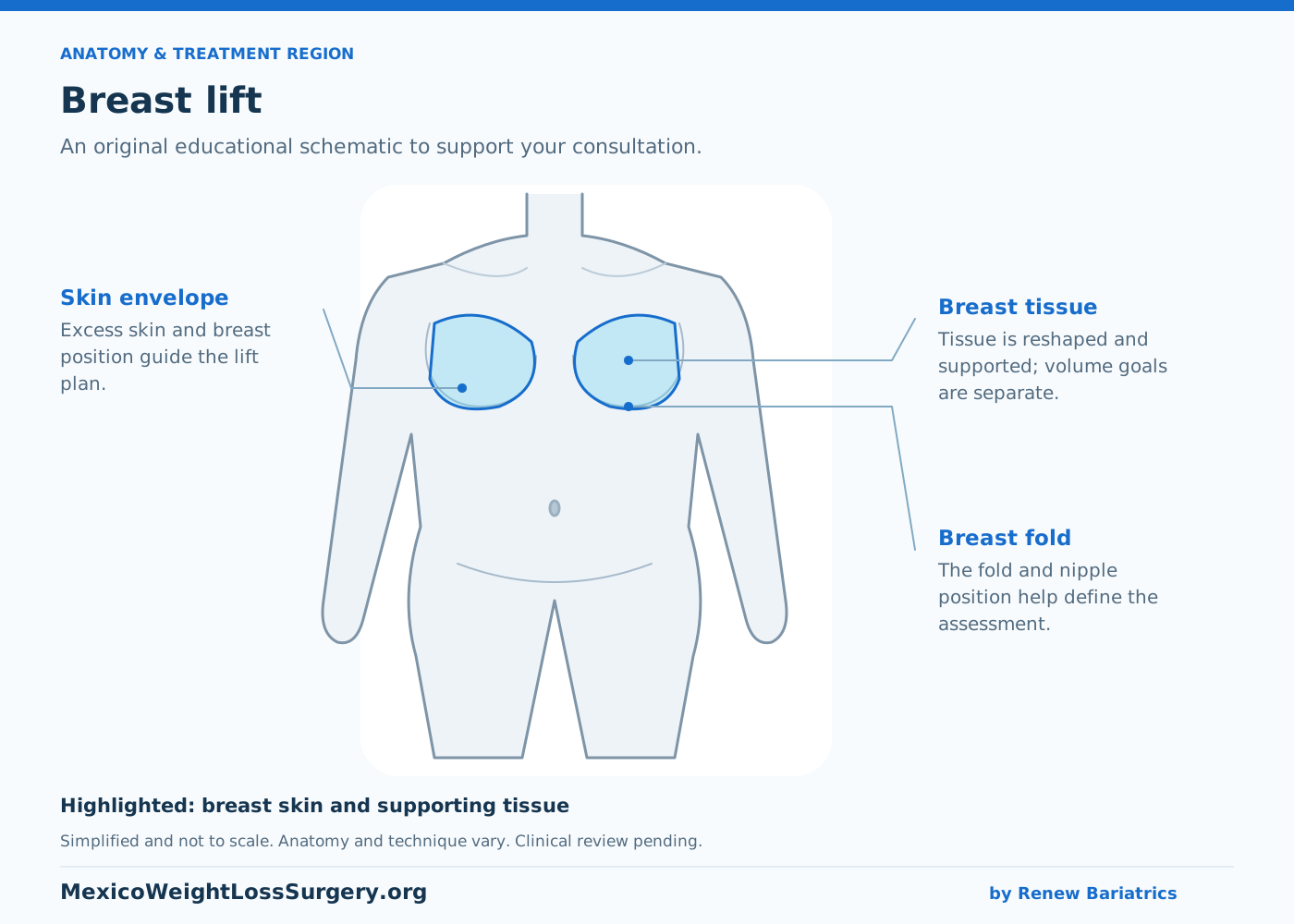
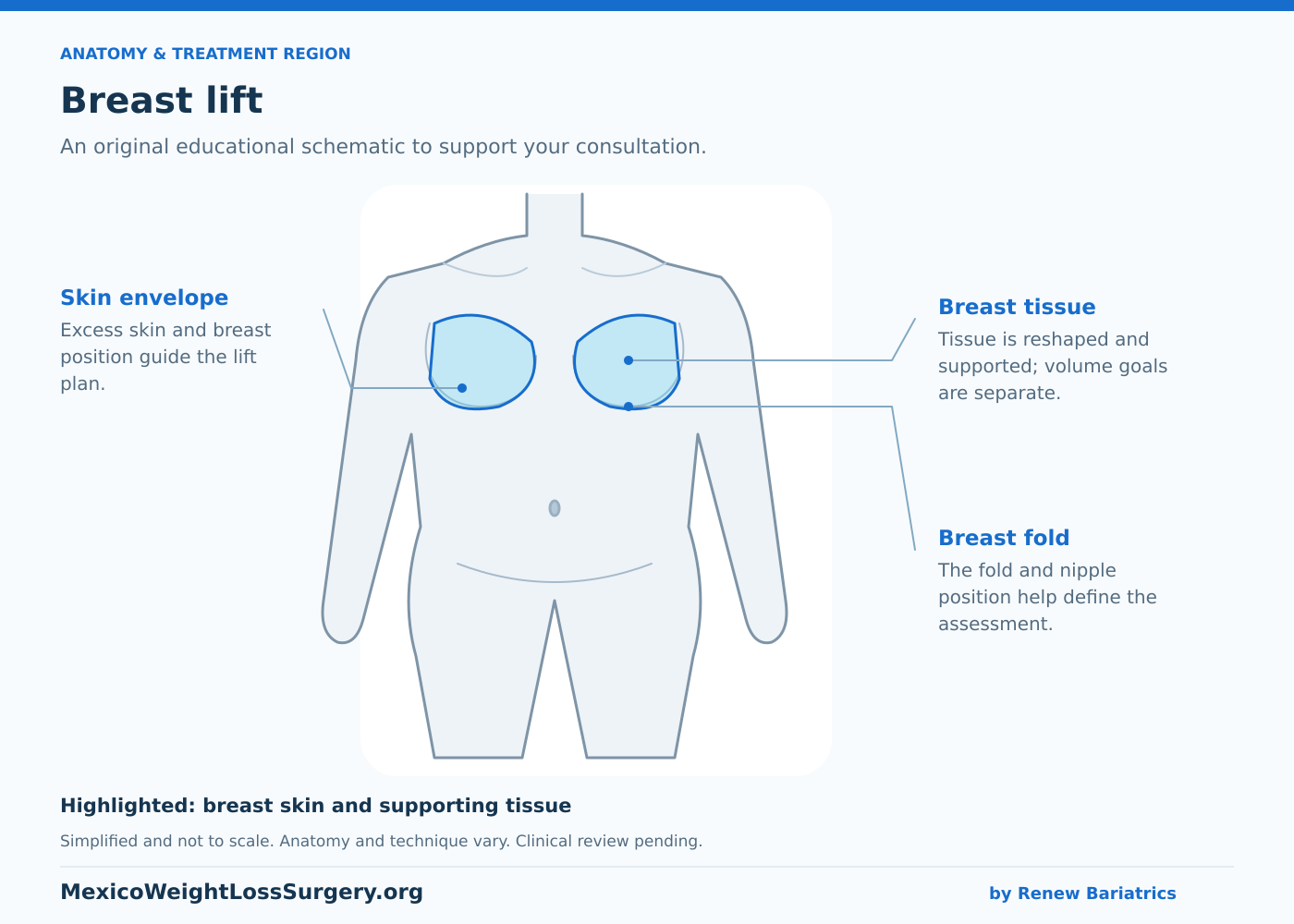
Anatomy references: ASPS — Breast lift ↗ · ASPS — Breast augmentation ↗
What a breast lift is designed to address
A lift may be considered when breasts have become lower, elongated or less supported, when nipples point downward, or when one breast sits lower than the other. ASPS includes stable weight, health and not smoking among the considerations for candidacy.[1] A physical examination is necessary because similar concerns can reflect different combinations of tissue volume and loose skin.
Describe the concern that matters in your daily life. Is it the position of the nipple, excess skin inside a bra, the shape without support, or a difference between sides? “I want a lift” names an operation; it does not tell the surgeon which of those problems you most want addressed. Your priorities may change the recommended approach.
A lift does not create identical breasts. Ask the surgeon to point out existing asymmetry before treatment and explain how much correction is reasonably achievable. It is easier to have that discussion with examination findings and clinical photographs than with an expectation of perfect symmetry that nobody has defined.
Why weight-loss patients need an individual plan
After substantial weight loss, a breast can have both a loose skin envelope and less internal volume. Lifting the remaining tissue may improve position without creating the upper fullness some patients want. Others may welcome reshaping without adding an implant. These are different preferences; neither should be assumed from your weight-loss history.[2],[3]
Prepare a short timeline of your bariatric surgery, major weight changes and current treatment. Include whether you expect further weight loss, changes in medication or pregnancy. Ask what level and duration of weight stability the surgeon wants in your situation. Avoid treating a social media rule or another patient's schedule as your own eligibility standard.
Bariatric nutrition and follow-up continue to matter. Maintain the protein, hydration and supplementation plan prescribed for you, and ask your clinicians to review any concerns before elective surgery.[10] The plastic surgeon should know about difficulty eating, recurrent vomiting, missed supplements or previous deficiency treatment rather than discovering those details during recovery.
Create a shared list of outstanding preparation tasks. It might include getting old operative records, arranging a medical review or repeating tests requested by your clinician. Assign each task to a person and a deadline. A coordinator can help organize information, but clinical interpretation and clearance belong to the treating professionals.
Lift alone, lift with implants or reduction?
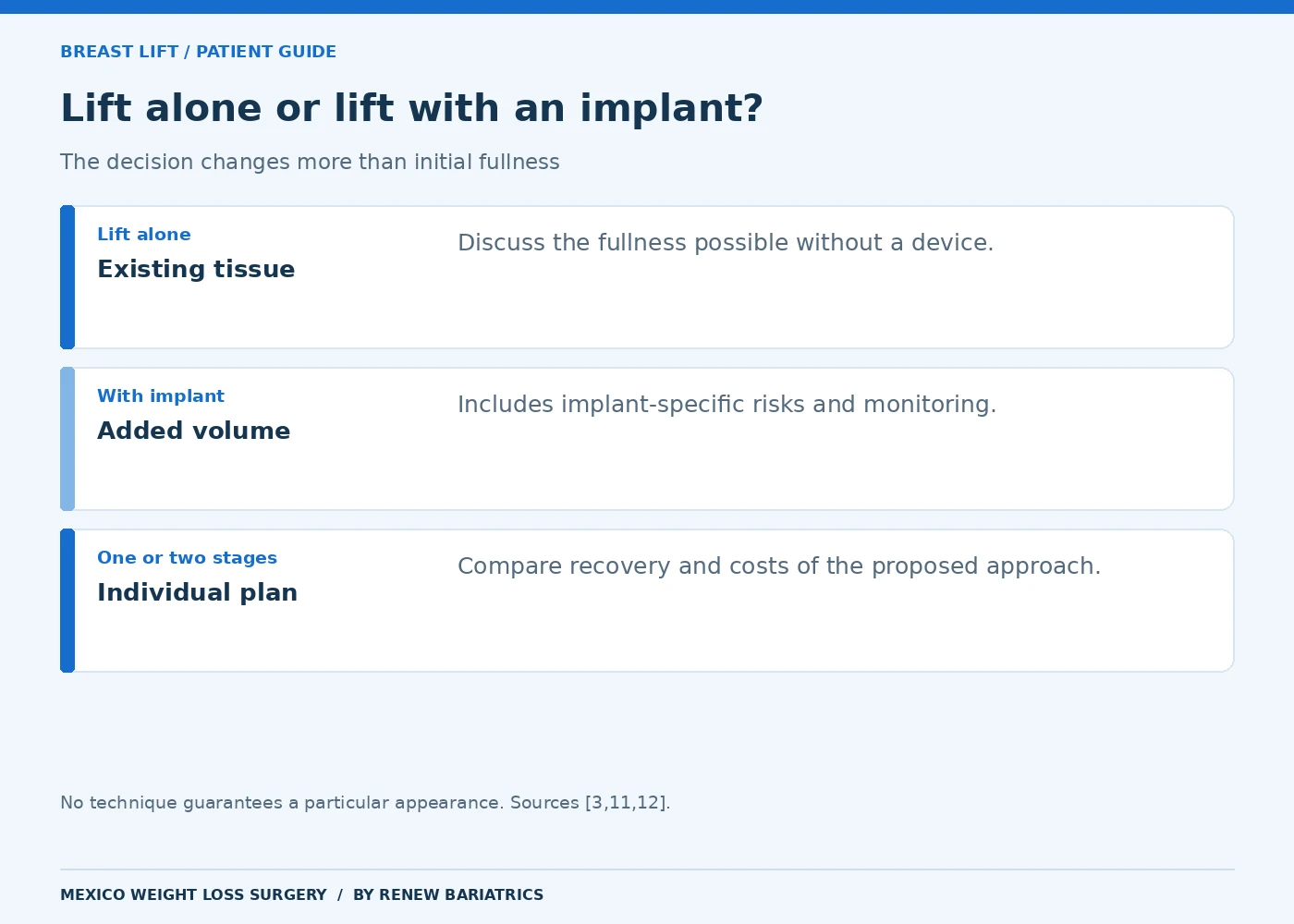
A lift reshapes and raises existing tissue. An implant can add volume, including upper breast fullness, but brings its own device-related risks and future monitoring. Surgeons may consider a combined operation or separate stages depending on the assessment.[3] Ask to see the reasoning behind the recommendation rather than accepting “lift plus implant” as a default package.
If your main concern is breast heaviness or excessive volume, ask whether a reduction better matches your goals. Reduction removes breast tissue as well as reshaping the breast. Conversely, if volume is the main concern and skin position is acceptable, a discussion about augmentation may be more relevant. The operations overlap in appearance goals but are not interchangeable.
An implant-free lift can be an important option for someone who is comfortable with their existing volume and does not want an implant. Ask what fullness the surgeon expects from rearranging your own tissue and what will remain limited. “Natural” is not a complete explanation of either technique or result; request a concrete description.
Staging can mean more than one recovery period, anesthetic and trip. Combining treatment can mean a larger single operation. Ask for both options to be explained when clinically relevant, including their practical consequences and separate quotes. Convenience alone should not decide which plan is appropriate.
Incision patterns and permanent scars
Common lift incision patterns include a circle around the areola, an areolar incision plus a vertical line to the breast crease, or those incisions with an additional line along the crease. The choice depends on breast shape, skin excess, nipple position and the changes required. The shortest scar is not necessarily the technique that adequately addresses the problem.[2]
Ask the surgeon to mark the proposed pattern on a diagram and explain where scars would sit in your usual clothing. If your breasts differ substantially, ask whether the incisions or reshaping may differ between sides. You should understand the plan before comparing it with a photograph of a person whose anatomy is different.
Scars are permanent, although their appearance can change and often fade over time. Breast shape also settles over the months after surgery.[4] A good consultation addresses the possibility of visible scars directly. It should not rely on phrases such as “scarless lift” to avoid discussing the tradeoff between skin removal and incision length.
Discuss previous scars, including any that became thick, raised or uncomfortable. Ask when scar care may begin and which products or techniques the surgeon recommends for your healing stage. Do not apply adhesives, creams or massage to a fresh incision simply because they were useful for another patient.
Consultation: what information actually helps?
Bring your medical history, current medications and supplements, allergies, prior surgery details, breast imaging reports and any biopsy results. Family breast cancer history and tobacco or vaping use also belong in the discussion. The consultation generally includes examination, measurements, discussion of goals and an explanation of options and risks.[5]
A new breast concern deserves its own assessment. Tell the team about a lump, unexplained discharge, a new skin change or an unresolved imaging recommendation. Do not assume that the operation will diagnose or resolve an unrelated breast problem. Ask whether additional evaluation is needed before elective surgery can be planned.
Bring questions about decisions you find difficult. For example: “I prefer to avoid an implant, but I am worried a lift will leave me smaller than I want.” That is a useful tradeoff to discuss. It gives the surgeon something more specific to work with than an instruction to make the breasts look “better.”
If consultation begins remotely, ask which recommendations are provisional until an in-person examination. Find out what happens to the quote or booking if the examination changes the plan. You should not feel that a deposit obliges you to accept an operation you did not intend to have.
Breast lift risks: understand severity as well as frequency
Potential complications include bleeding, infection, fluid collection, poor incision healing, contour irregularity, asymmetry, fat necrosis and temporary or permanent changes in sensation. Partial or complete loss of nipple-areola tissue is a serious possibility. Anesthesia complications and blood clots also require consideration.[3]
A generic list cannot determine your personal risk. Ask the surgeon which complications are most relevant to your health, proposed technique and any combined procedures. Ask how the practice defines a complication and how long patients are followed when it quotes a rate. A number without a denominator or time period can be misleading.
Discuss what treatment would involve if healing is delayed. Would you need extra dressing visits, another operation, a longer stay or local wound care at home? Ask which clinician would make those decisions and how you would reach them. The financial terms for complication care should be as clear as the routine recovery schedule.
Implants change the long-term discussion
A lift without an implant does not introduce implant-specific risks. If an implant is included, informed consent should cover rupture, capsular contracture, possible further surgery and the fact that implants are not lifetime devices.[11] Ask for a separate explanation even if the package is described mainly as a breast lift.
BIA-ALCL is an implant-associated lymphoma reported more often with textured devices. Reports of squamous cell carcinoma and other cancers in the implant capsule involve a different set of concerns. FDA guidance acknowledges uncertainties; a report count should not be converted into a personal risk estimate without an appropriate denominator.[11],[12]
For silicone implants, ask about surveillance for silent rupture and how it differs from breast cancer screening. The proposed device, monitoring schedule and possible future expenses belong in your decision about whether added volume is worth the commitment. If you prefer no implant after that discussion, ask the surgeon to explain the realistic lift-only alternative.
Breastfeeding, pregnancy and future change
A lift can affect nipple sensation and the ability to breastfeed. Discuss future pregnancy plans before selecting an operation and ask how the proposed technique may affect breastfeeding.[6] No technique should be presented as a guarantee that feeding will be unaffected.
Pregnancy, aging and later weight changes can alter the breasts after a lift. The result is not a permanent freeze on breast shape.[4] Ask whether waiting would make sense if a major change is anticipated soon. Waiting is an option to weigh against your current concerns rather than a judgment about whether those concerns are legitimate.
If preserving breastfeeding potential is a priority, state it early and document the conversation. Ask what is known, what remains uncertain and whether postponing surgery better fits your plans. A cosmetic preference should not be allowed to obscure a functional priority you have clearly expressed.
Preparing for your operation
Preparation may involve medical review, breast imaging where indicated, medication instructions and stopping smoking. Arrange someone to help after surgery. The specific instructions should come from your treating team, with enough time to ask questions and resolve conflicting advice.[7]
Do not independently stop essential medications or start a supplement regimen advertised to accelerate healing. Give each clinician the same complete medication list, including weight-loss treatments, hormones and nonprescription products. Ask who is responsible for the final perioperative medication plan so that different instructions do not remain unresolved.
Think through the first few days in concrete terms. Who will pick up prescriptions? Who carries bags? Can you comfortably access food, drinking water and the bathroom? Does your support person understand whom to contact? Good preparation is often a collection of small arrangements rather than one expensive recovery product.
Before paying, request the surgeon's identity, relevant training and certification, the planned facility and anesthesia arrangements. Ask how you can independently verify them. This educational page does not certify a provider's credentials or establish that a particular facility meets a specific accreditation standard.
Recovery after a breast lift
Dressings, a support bra and sometimes drains form part of early postoperative care. The surgeon should specify wound care, medications, follow-up and activity restrictions.[8] Ask for a written schedule that separates routine appointments from circumstances requiring earlier assessment.
Recovery should be matched to the work you do. “Back to work” could mean short periods at a computer or a full day of lifting, reaching and driving. Describe those tasks accurately and request guidance for each. If you work remotely, you may still need time away rather than assuming that being at home makes work appropriate immediately.
Plan help with childcare, groceries and housework. Do not assume that you can lift a child because you can manage personal care. Ask when driving is appropriate, including how pain medication and movement restrictions affect that decision. The treating team should set the milestones; a website cannot clear you for activity.
Swelling and changing shape can make early comparison with expectations difficult. Use scheduled examinations to discuss progress, and ask what changes are expected versus concerning. Keep photographs only as requested by the team through its agreed secure channel. A photo may assist communication but cannot replace an examination when one is needed.
When to seek help
Contact the clinical team promptly for worsening pain, rapidly increasing swelling, spreading redness, fever, unusual drainage or a concerning wound change. Difficulty breathing, chest pain, fainting or new concerning leg symptoms require urgent medical assessment rather than waiting for a routine follow-up response.[3],[13],[15]
Before discharge, ask for a clear contact hierarchy: emergency services, the treating clinician and routine coordination. Your support person should have the same information. If you are uncertain whether a problem is urgent, seek clinical advice promptly rather than trying to diagnose it from a patient discussion group.
Travel and continuity of care
Postoperative travel needs clinical planning because surgery and prolonged immobility can contribute to clot risk. CDC recommends arranging follow-up and addressing medical tourism risks before travel.[13],[15] Ask the surgeon to assess your full return journey, including ground transfers and airport waiting, rather than only the time in the air.
Choose accommodation and a schedule that allow attendance at follow-up appointments. Confirm whether transport assistance is available and what happens if the surgeon recommends a longer stay. A promised departure date should remain subject to clinical reassessment, not treated as an automatic clearance.
Arrange home follow-up in advance. Ask what records your local clinician requires and who will manage a wound issue if it arises. Keep the operative report, discharge instructions and medication list. If implants were used, obtain the device details as well. The point is to make the next clinician's job possible without reconstructing your care from messages.
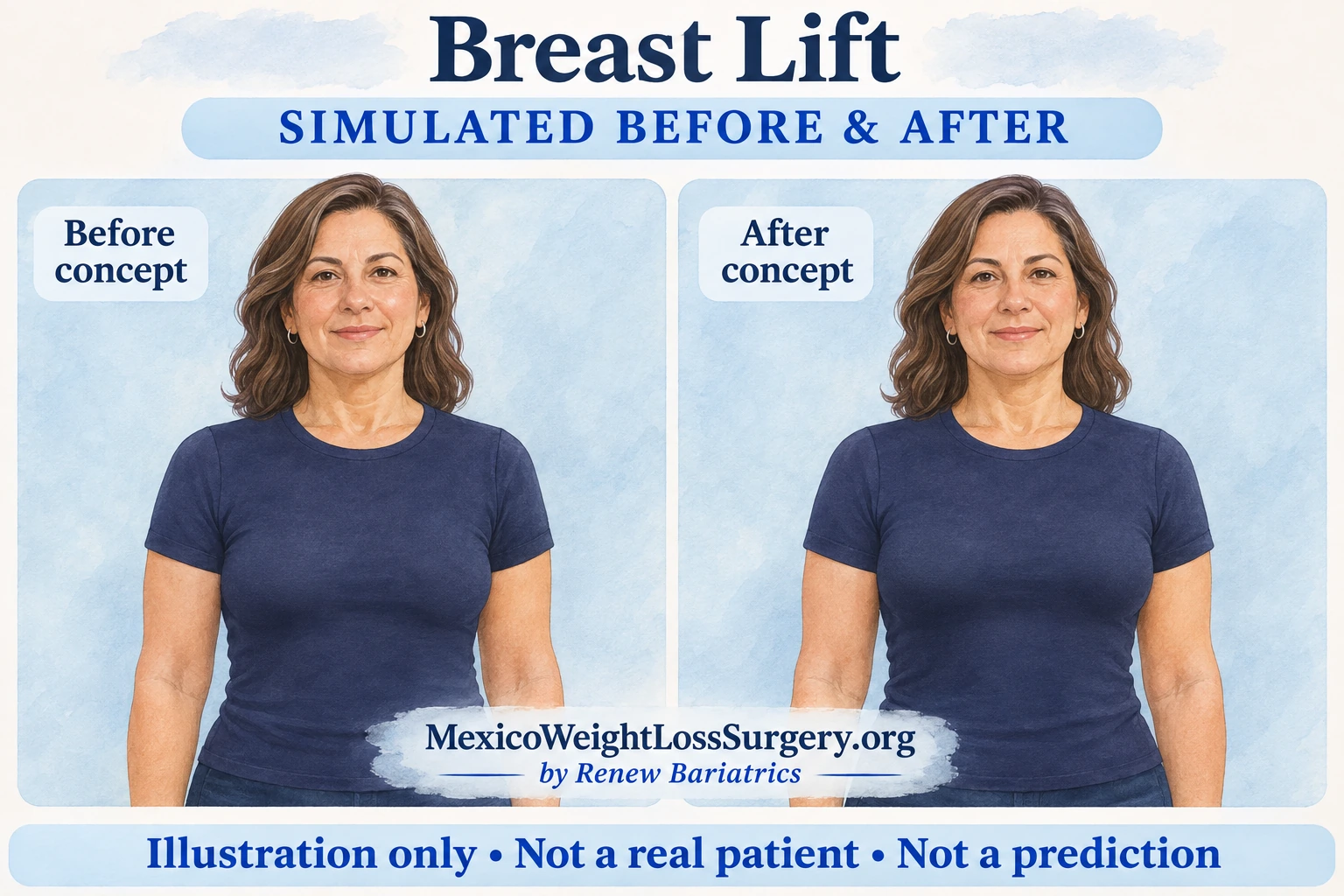
A synthetic illustration of possible changes
This fictional example illustrates a treatment concept. It cannot show the result you would achieve, predict scar healing, or establish a typical outcome.
Breast Lift Cost in Mexico
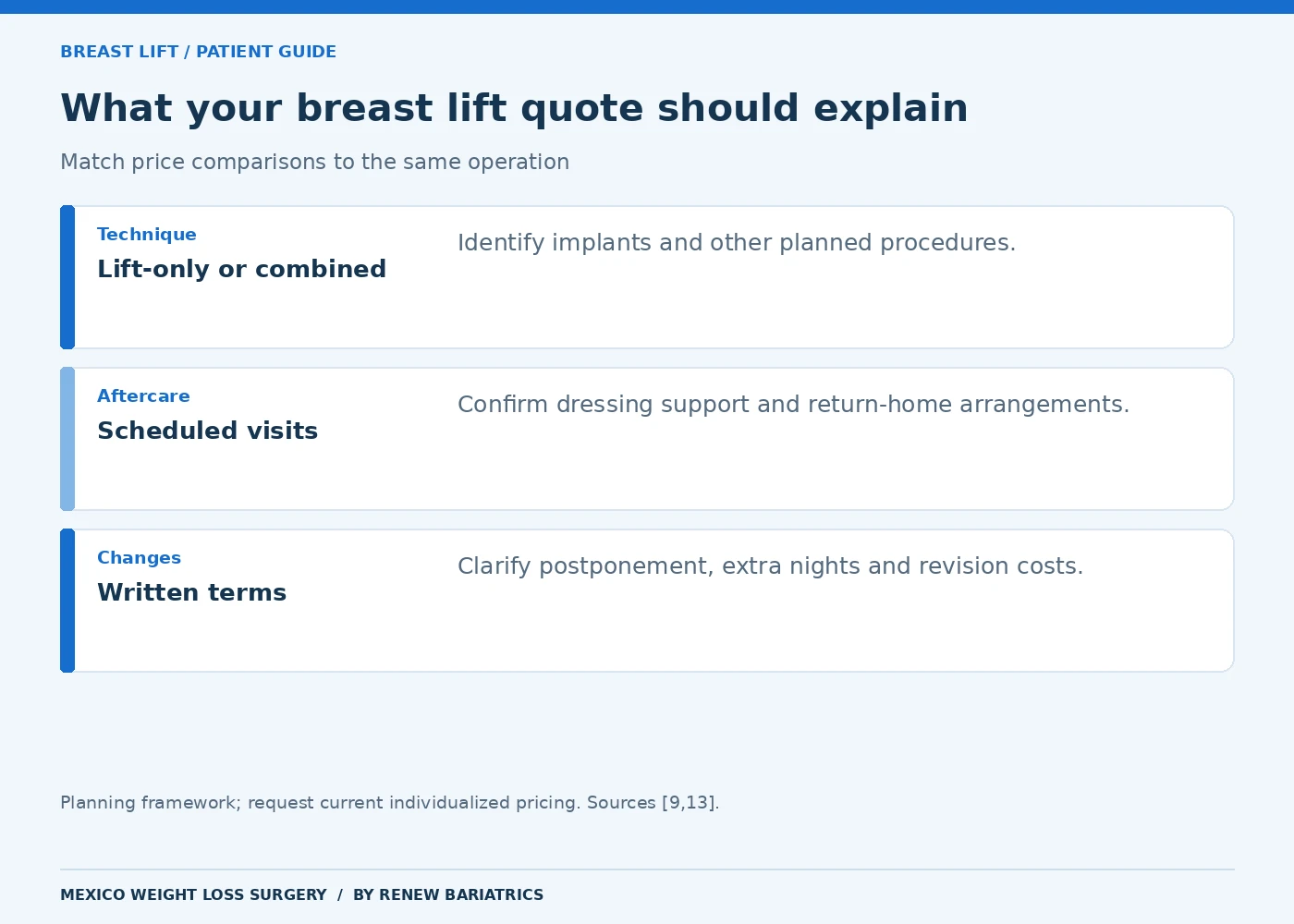
Breast lift cost in Mexico depends on the recommended operation and the scope of services. A lift alone, lift with implants and lift combined with another body procedure are different quotations. This page does not give a guessed price or imply that a published starting price will apply after examination.
Ask for an itemized quote covering surgeon and anesthesia fees, facility costs, tests, garments, medications and planned follow-up. If implants are proposed, identify the device charge and any related follow-up expenses. These are common cost categories, but only the provider can confirm its actual inclusions.[9]
Separately list travel, lodging, companion costs, time away from work and care after returning home. Ask how extra nights, unscheduled visits, treatment of complications or later revision are billed. A lower initial quote can be difficult to compare if one plan includes services another leaves out.
Before paying a deposit, obtain cancellation, postponement and refund terms. Ask whether a medically necessary delay is handled differently from a personal cancellation. If financing is involved, review the total repayment obligation and what happens if the operation changes. Financial pressure should not decide whether you accept an implant or an added procedure.
Is an implant included in the quoted cost?
Do not assume so. Ask whether the quote is for mastopexy alone or augmentation-mastopexy and request the exact intended device when applicable. If the surgeon offers both options, ask for separate totals and a comparison of the follow-up commitments, not just the difference on surgery day.
Does insurance cover breast lift in Mexico?
Coverage depends on the policy and circumstances; cosmetic lift is commonly excluded.[9] Obtain a written answer from your insurer about overseas elective surgery, related complications and subsequent local care. A provider's payment estimate is not an insurance authorization.
How do I compare two quotes fairly?
Create a single checklist of the operation, provider, facility, anesthesia, aftercare and exclusions, then ask both practices to fill the gaps. Compare clinical plans first. Two prices cannot be meaningfully compared if one is for a lift alone and the other includes implants or another procedure.
Make the consultation a decision, not a sales deadline
Before booking, you should be able to explain the proposed lift, expected scar pattern, whether implants are included, important risks, recovery arrangements and complete quoted scope. If one of those remains unclear, request another conversation. A clear plan can include postponement or a different operation.
Ask Renew Bariatrics to confirm current breast lift availability and the treating team.[14] Review breast augmentation if volume is central to your goals and breast reduction if you want less breast volume. Mommy makeover, skin removal after weight loss, aftercare and cost and pricing can help organize a broader plan. Each additional procedure needs its own clinical justification and recovery discussion.
Program information related to this guide
Explore Renew Bariatrics’ procedure options when discussing a plastic surgery plan. Availability, combinations and suitability require individual confirmation.
Breast lift vs. breast augmentation
These procedures address different concerns and may be combined or staged. A clinical assessment determines which, if either, fits your anatomy and goals.
| What to compare | Breast Lift → | Breast Augmentation → |
|---|---|---|
| Main goal | Raises and reshapes the breast. | Adds breast volume. |
| What changes | Skin tailoring and tissue reshaping. | Implant or selected fat transfer. |
| Key distinction | Does not primarily add volume. | Does not reliably correct substantial sagging. |
| Recovery consideration | Permanent incision scars require healing. | Implants require ongoing monitoring. |
| Cost comparison | Request an itemized quote for this exact procedure and care plan. | Compare the same inclusions, exclusions and recovery expenses. |
Comparison references: ASPS — Breast lift ↗ · ASPS — Breast augmentation ↗
These options are not interchangeable for every person. The treating clinician must assess your anatomy, medical history and goals.
Further reading
Discuss your options with Renew.
Talk with a coordinator about breast lift, your goals and the information needed for clinical review. The treating team determines suitability and the care plan.
Call 844-736-3963 Ask about plastic surgery ↗The link opens Renew’s plastic surgery health questionnaire. This review site does not collect health information.
References & evidence notes
Sources checked November 2026. Research findings are not a forecast for an individual or outcomes for Renew’s own program. Review study populations, methods and limitations alongside the reported results.
- American Society of Plastic Surgeons. Breast Lift Candidates ↗Professional society patient guidance; individual assessment required.
- American Society of Plastic Surgeons. Breast Lift Procedure Steps ↗Professional society patient guidance; individual assessment required.
- American Society of Plastic Surgeons. Breast Lift Risks and Safety ↗Professional society patient guidance; individual assessment required.
- American Society of Plastic Surgeons. Breast Lift Results ↗Professional society patient guidance; individual assessment required.
- American Society of Plastic Surgeons. Breast Lift Consultation ↗Professional society patient guidance; individual assessment required.
- American Society of Plastic Surgeons. Breast Lift Questions ↗Professional society patient guidance; individual assessment required.
- Mayo Clinic. Breast lift ↗Preparation, pregnancy, breastfeeding and individual surgical assessment.
- American Society of Plastic Surgeons. Breast Lift Recovery ↗Professional society patient guidance; individual assessment required.
- American Society of Plastic Surgeons. Breast Lift Cost ↗Fee components and coverage considerations; no Mexico price extrapolation.
- ASMBS. Life After Bariatric Surgery ↗Ongoing nutrition, supplementation and bariatric follow-up; not a plastic surgery clearance protocol.
- U.S. Food and Drug Administration. What to Know About Breast Implants ↗Device counseling, patient checklist, durability and systemic symptom uncertainty.
- U.S. Food and Drug Administration, March 2023. Update: Reports of Squamous Cell Carcinoma in the Capsule Around Breast Implants ↗Dated safety communication; case reports do not establish an incidence or individual risk.
- CDC Yellow Book. Medical Tourism ↗Travel, continuity, record transfer and financial planning; individual travel clearance required.
- Renew Bariatrics. Procedures ↗Used only to establish that the procedure is advertised; not evidence of eligibility, prices or outcomes.
- CDC Yellow Book. Deep Vein Thrombosis and Pulmonary Embolism ↗Travel-related clot risk and clinical assessment.