

Jump to a section
Anatomy illustrationCompare proceduresRelated ProceduresWhat traditional duodenal switch doesHow it differs from SADI-S and gastric bypassWho may consider this operation?What long-term research showsWeight loss is only one outcomeProtein and micronutrient risksBuild a follow-up system before surgeryBone health and deficiencies can be quietDigestive changes and daily lifeSurgical risks and warning signsPersistent vomiting needs attentionPreparation should be individualizedEating and activity during recoveryPregnancy and future health planningPlanning duodenal switch care in MexicoComparing prices without losing the clinical pictureA consultation checklist worth keepingCommon questions about traditional DSYour next stepReferencesTraditional duodenal switch can be an effective treatment for severe obesity. It also creates a substantial lifelong responsibility to protect nutrition. A thoughtful decision considers weight response, metabolic health, digestive symptoms, supplements, laboratory testing and access to experienced care together.
If you are researching duodenal switch in Mexico, start by confirming the exact operation. Traditional biliopancreatic diversion with duodenal switch, abbreviated BPD/DS, is different from SADI-S. A clinic may discuss both, but their anatomy and evidence should not be merged. This guide addresses traditional BPD/DS. It does not confirm that a particular Renew surgeon or facility currently offers it; availability and the proposed treatment require direct confirmation.
Understand the anatomy
A simplified, labeled view of the structures and treatment area. Select the image to view it at full size.
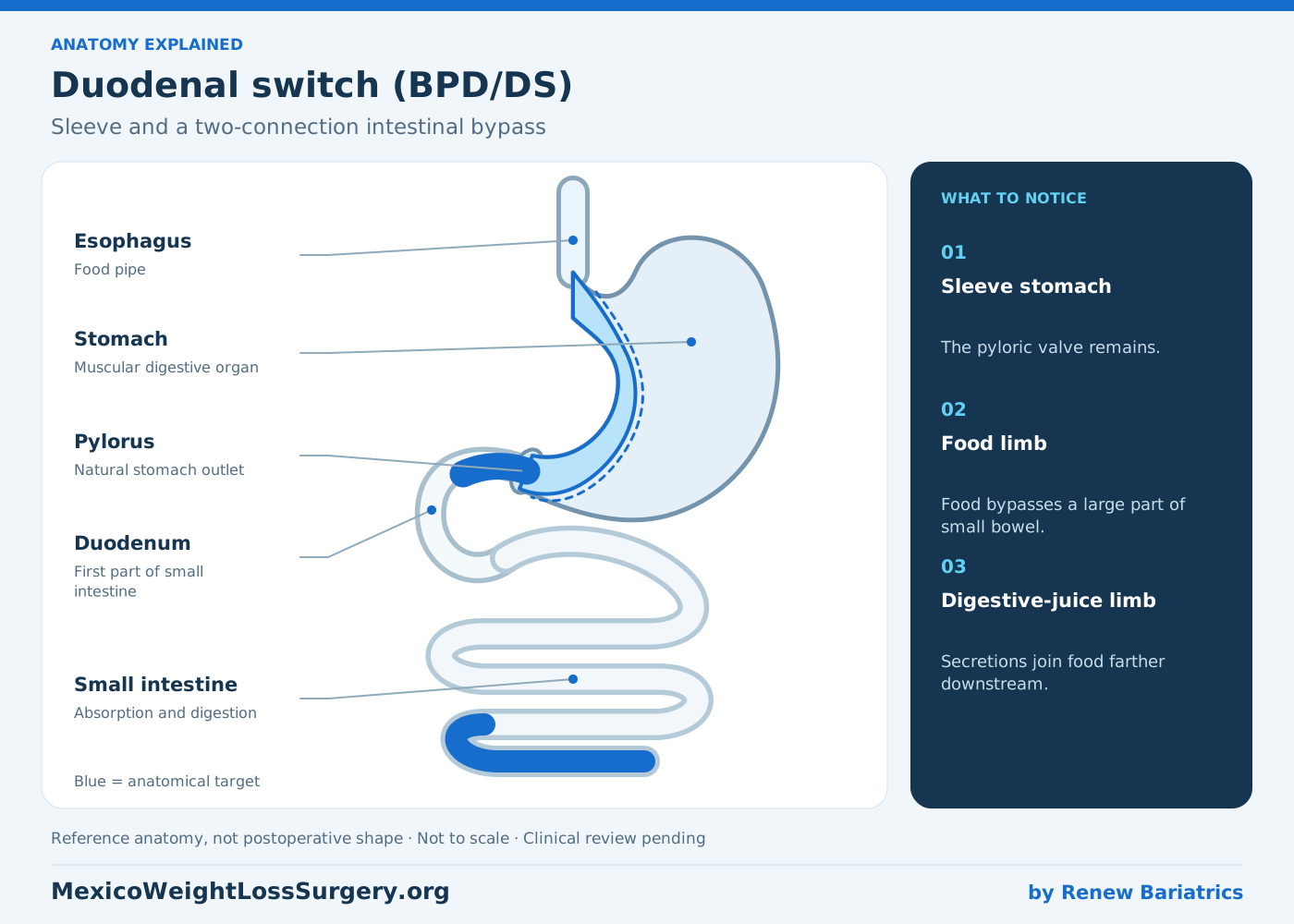
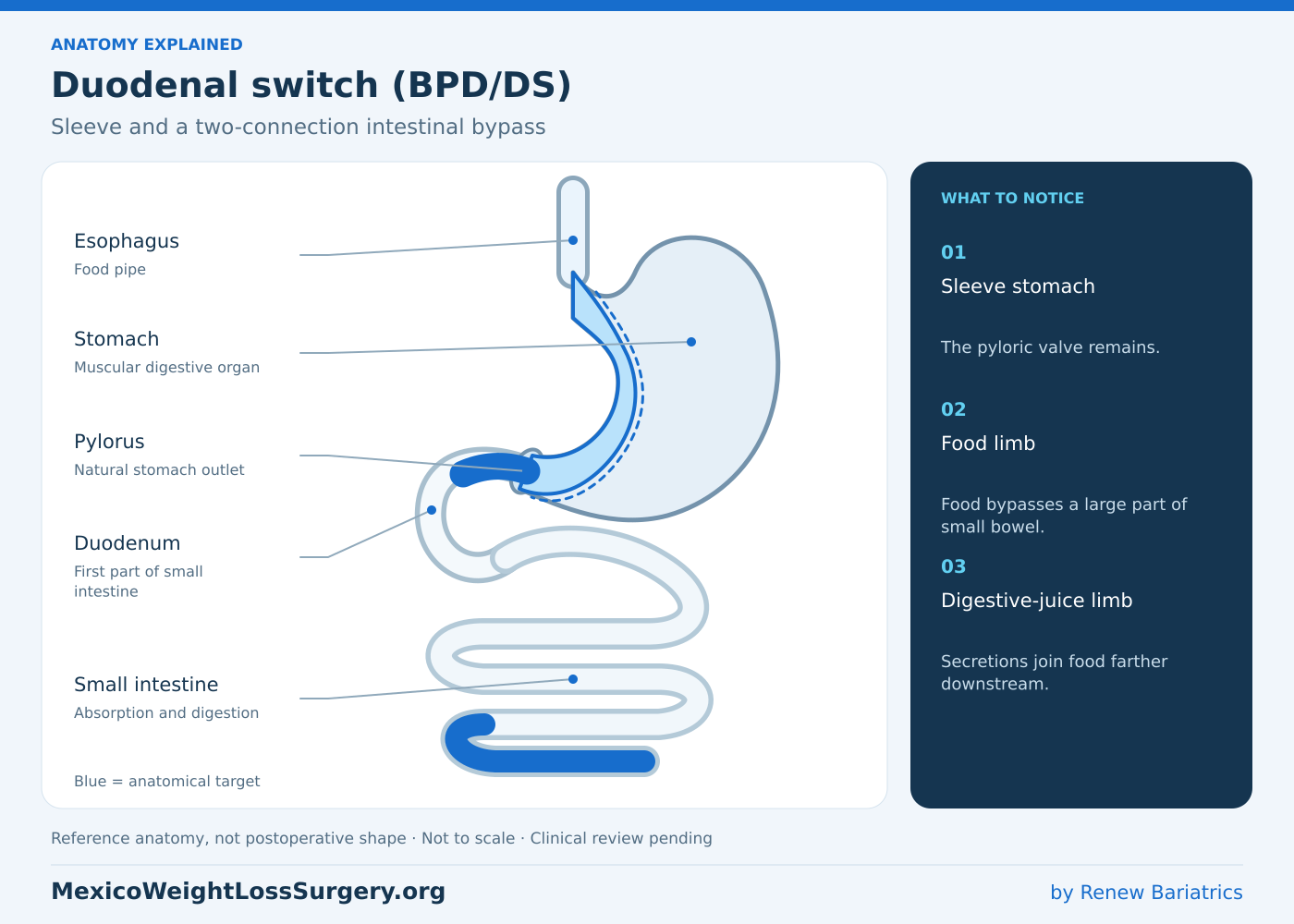
Anatomy references: Mayo Clinic: Biliopancreatic diversion with duodenal switch ↗ · ASMBS: Single Anastomosis Duodeno-Ileal Bypass with Sleeve Gastrectomy ↗
What traditional duodenal switch does
BPD/DS combines a sleeve-shaped stomach with a substantial intestinal bypass. The pylorus, the valve at the stomach outlet, remains. Food passes into a lower section of small intestine while digestive fluids follow a separate route before the two streams join. This arrangement changes both intake and absorption. The operation may be performed in one stage or, for selected patients, after an earlier sleeve. [1]
The bypassed intestine is not simply removed. It remains part of the digestive system, carrying secretions along a different pathway. Ask the surgeon to show where food travels, where bile and pancreatic juices travel, and where they meet. The point where those streams join helps define the “common channel,” a term you may encounter in your consultation.
You do not need to memorize an anatomical diagram. You should leave understanding why the operation can affect nutrient absorption and why your records will matter for future care. If the explanation focuses only on the smaller stomach, ask for the intestinal part of the discussion as well.
How it differs from SADI-S and gastric bypass
SADI-S is a related but distinct reconstruction using one intestinal connection. Traditional DS uses a different arrangement with separate intestinal pathways. Both can require intensive nutritional follow-up, but an outcome percentage for one is not automatically valid for the other. [2]
Roux-en-Y gastric bypass also changes the route of food, but it uses a small upper stomach pouch rather than the sleeve-and-duodenum configuration. Sleeve gastrectomy alone does not add an intestinal bypass. These differences can influence risks, follow-up and the reasons a clinician recommends one procedure over another. [3]
When comparing quotations, put the full procedure name at the top of each document. If one says “duodenal switch” and another says “SADI-S,” ask whether they describe the same proposed treatment. A similar price or a shared word does not settle that question. Your informed consent, operative report and aftercare instructions should all identify the actual reconstruction.
Who may consider this operation?
Duodenal switch is often considered in people with particularly severe obesity or substantial metabolic disease. It is not selected from BMI alone. Current professional recommendations address eligibility for metabolic surgery broadly; the choice of operation still requires assessment of health, risk and the capacity to maintain follow-up. [4]
The decision should include what has already been tried, what benefit is realistically sought, and what might make a highly malabsorptive procedure difficult. Existing nutritional deficiencies, persistent diarrhea, previous surgery, reflux symptoms and access to long-term specialty care deserve specific discussion. Bring actual results and records when available rather than relying on memory.
Ask the clinician to describe what would make them recommend a different operation. This is especially useful if you arrived convinced that the procedure with the greatest average weight loss must be the best choice. The right comparison is the expected balance for you, including the consequences of complications and the work required to maintain nutrition over decades.
What long-term research shows
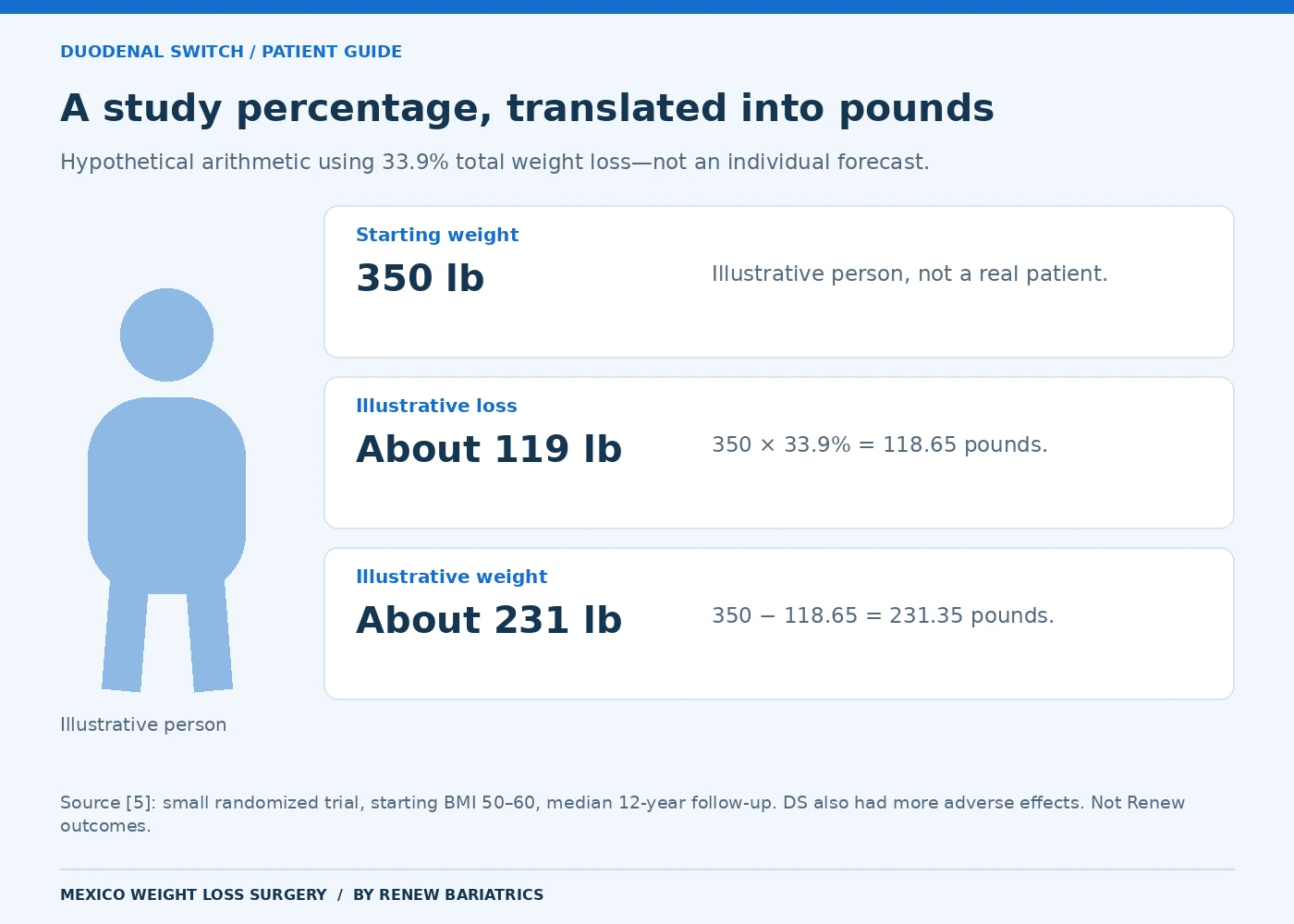
A randomized trial compared traditional DS with Roux-en-Y bypass in 60 people whose starting BMI was 50–60. At a median follow-up of 12 years, 48 participants were assessed. Average total weight loss was 33.9% after DS and 20.0% after bypass. DS produced greater weight reduction, but more adverse events and nutritional complications; quality-of-life scores were similar. Four of 29 DS patients developed severe protein-calorie malnutrition, and three underwent revision. [5]
This is valuable evidence because patients were randomized and followed for many years. It is still a small trial from two academic centers using specific techniques. It does not establish your personal probability of weight loss or a complication, and it does not describe Renew’s outcomes.
For an arithmetic illustration, 33.9% of a hypothetical starting weight of 350 pounds is about 119 pounds. Subtracting that amount gives approximately 231 pounds. The graphic below explains the metric; it is not a prediction, a real patient result or an illustration of how a person will look.
Weight loss is only one outcome
The same randomized program previously reported five-year findings showing more weight loss after DS but more surgical, nutritional and gastrointestinal adverse effects than after bypass. [6] That is the central tradeoff a consent discussion must make visible.
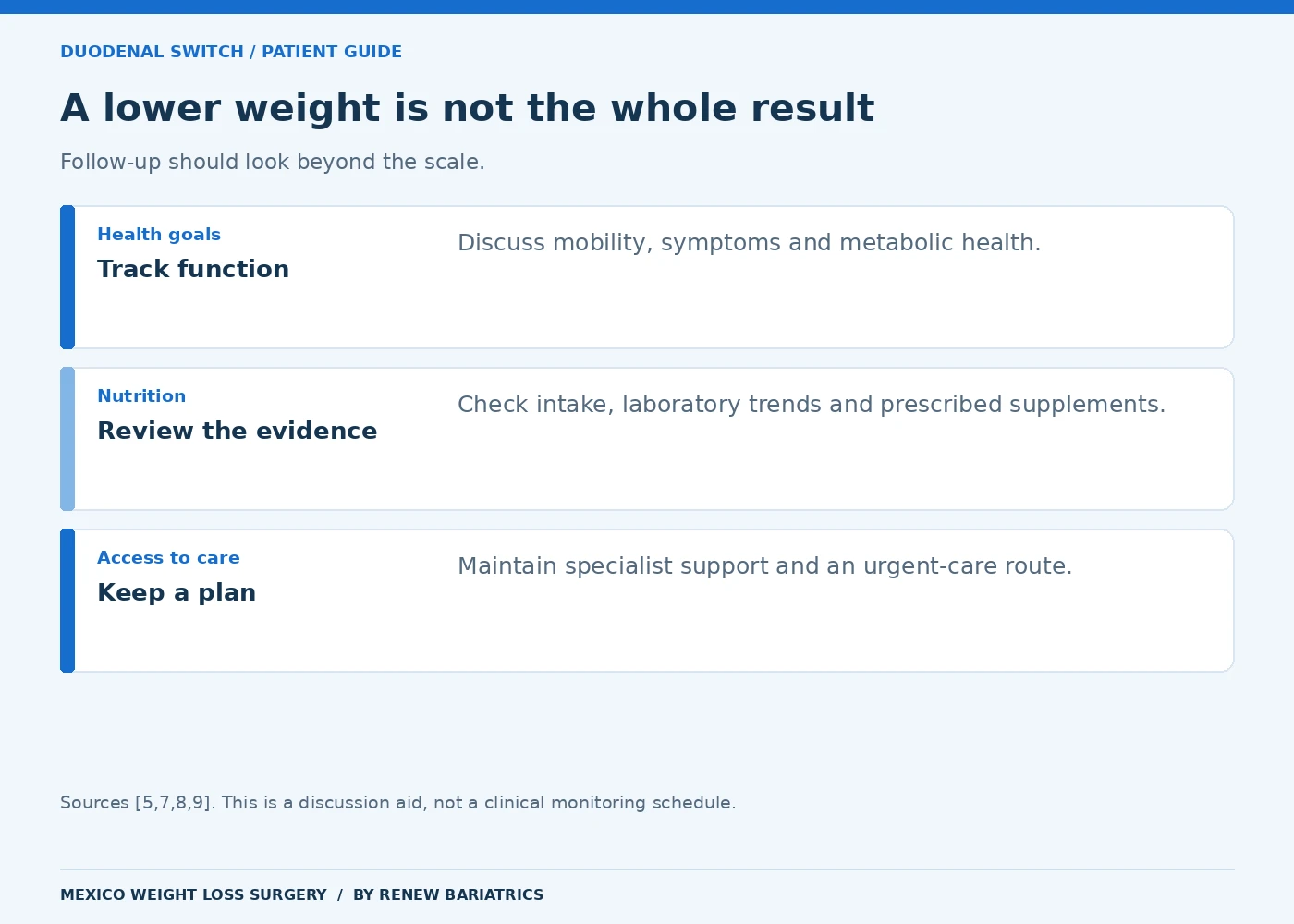
Ask what “success” means in the surgeon’s reporting. Does it include improved diabetes management, walking capacity, sleep, reduced medication burden, nutritional stability and quality of life? Does it account for patients who required another procedure? A number on the scale cannot show the entire result.
Choose a few personal goals to discuss. Perhaps you want to climb stairs, travel more comfortably, manage a health condition or participate in family activities. Ask which goals surgery might reasonably support and which will need additional care. You can value substantial weight loss while also placing a high value on avoiding persistent digestive symptoms or a complicated supplement regimen.
Protein and micronutrient risks
Nutrition deserves more than a brief disclaimer at the bottom of a page. A systematic review of eight studies involving 3,443 DS patients found substantial long-term vitamin and mineral deficiencies, with large differences between studies. These differences limit the usefulness of any one pooled percentage for an individual patient. [7]
Ask for a plan that distinguishes protein intake from vitamin and mineral replacement. They address different needs. Also ask how the team assesses poor absorption, inadequate intake and intolerance when results are abnormal. Buying a supplement does not establish that the prescribed amount is absorbed or that a deficiency has resolved.
Practical access matters. Can you obtain the recommended formulations where you live? Can you afford them consistently? Can a local laboratory perform the necessary tests? Is a clinician available to adjust the plan? These are part of choosing the operation, not administrative details to postpone until after discharge.
Build a follow-up system before surgery
BOMSS advises that people with malabsorptive procedures such as BPD/DS remain under specialist bariatric care. [8] That does not mean every appointment must occur at the original hospital, but someone must accept responsibility for the long-term plan.
Ask the program to name the clinician or service responsible for routine results, unexpected findings and urgent concerns. Clarify whether remote visits include medical decision-making or only coordination. Ask how outside clinicians can obtain advice and what happens if the original surgeon is unavailable.
A useful follow-up folder can include the operation name, date, surgeon, hospital, reconstruction details, supplement schedule, recent laboratory results and emergency contacts. Keep a copy accessible during travel. If you change insurance, move or lose access to a provider, use that record to establish replacement care promptly rather than waiting for symptoms.
Bone health and deficiencies can be quiet
Some nutritional consequences do not announce themselves through obvious symptoms. Specialist guidance includes monitoring calcium-related measures, vitamin D and other nutrients after bariatric surgery, with additional considerations for malabsorptive procedures. [9] Feeling well does not mean every nutrient is adequate.
Ask how your baseline bone and nutritional health will be assessed and how changes will be followed. If you have a fracture history, osteoporosis, kidney stones or medicines affecting bone health, mention them explicitly. The team can decide which tests and specialist input are appropriate.
Avoid choosing doses from social media or stacking multiple products to “be safe.” Different formulations can contain overlapping ingredients, and the right replacement depends on the whole regimen and laboratory findings. Bring product labels to appointments. An understandable written schedule is more useful than a vague instruction to take “bariatric vitamins.”
Digestive changes and daily life
Traditional DS can be associated with loose stools, increased bowel frequency and fat malabsorption. [3] The relevant question is not whether every patient develops these symptoms, but how the team helps you recognize and manage a problem if it happens.
Discuss your ordinary routine. A job with limited bathroom access, long commutes, frequent flights or night shifts may make certain symptoms especially disruptive. Ask which dietary adjustments are commonly considered and when persistent symptoms need investigation rather than further restriction.
Do not assume that ongoing diarrhea is proof the operation is working well. Tell the team how often it occurs, whether it is new, whether you can maintain fluids and nutrition, and whether it affects sleep or daily activities. A lower weight accompanied by declining strength or poor intake is not a reason to ignore the problem. The aim is sustainable health, not weight loss at any cost.
Surgical risks and warning signs
General bariatric risks include bleeding, infection, leaks and blood clots. Narrowing, obstruction and hernias can also require evaluation or treatment later. [10] Ask your surgeon to explain the complications most relevant to the proposed DS technique and your medical history, using actual outcome reporting when available.
Before discharge, get written instructions on warning signs and where to seek help. Severe or worsening abdominal pain, chest pain, breathing difficulty, fainting, persistent vomiting or inability to maintain hydration should not be managed only by waiting for a coordinator reply. Seek urgent medical assessment when symptoms are concerning, and share the surgical history immediately.
A normal early check does not give a lifetime guarantee against a later problem. Ask how to contact the clinical team after hours, what local emergency resources are available before you leave Mexico, and which records should accompany you if you need care at home.
Persistent vomiting needs attention
Repeated vomiting, difficulty swallowing and poor intake should not be dismissed as expected discipline after weight loss surgery. Clinical guidance identifies these situations as risks for nutritional emergencies, including thiamine deficiency, and recommends prompt assessment and treatment when indicated. [11]
If a prescribed supplement or food plan is not tolerable, explain the difficulty early. “I cannot keep this down” is different from “I occasionally forget,” and the team needs that distinction. Do not wait until the next scheduled laboratory panel if your intake is deteriorating.
Ask for a clear escalation ladder: who answers routine food questions, who assesses persistent symptoms, and where you should go if urgent treatment is needed. It is reasonable to want one familiar contact, but that person must be able to connect you with clinical care rather than serve as the only route to it.
Preparation should be individualized
The treating team should provide instructions for preoperative nutrition, fasting, medicines and any required evaluations. Tell them about all prescribed and nonprescription drugs, injections, supplements, nicotine products and alcohol use. Ask who coordinates changes with the clinician who normally prescribes your treatment.
Do not stop anticoagulants, insulin or other important medicines on the basis of this page or another patient’s itinerary. The appropriate plan depends on the medication and your health. Ask for instructions in writing, including what to do if surgery is postponed.
Practical preparation matters too. Arrange help with children, pets, groceries and lifting. Ask whether your companion will receive discharge teaching and whether translation is available when needed. Plan for an unexpected extra stay rather than using every available dollar and every day of leave on the shortest possible itinerary.
Eating and activity during recovery
Bariatric recovery commonly involves a staged transition from liquids to more substantial foods and a gradual increase in activity. [12] Your specific instructions should come from the team managing your DS. A handout for a different operation may not answer your protein, supplement or follow-up needs.
Ask what the first week should look like in practical terms: how to measure fluid intake, how to recognize poor tolerance, when to call, and which products are appropriate. Clarify the difference between routine mild discomfort and symptoms requiring evaluation. Avoid using online groups as the final authority when your instructions conflict.
For returning to work, describe your actual duties. Ask separately about desk work, commuting, long periods standing, lifting and exercise. Clearance for one does not necessarily cover the others. Recovery can vary, so make arrangements that allow adjustment rather than promising a fixed return date before the clinical team has assessed you.
Pregnancy and future health planning
If pregnancy is a possibility, discuss it before choosing DS. Consensus guidance after bariatric surgery emphasizes coordinated preconception planning, nutritional optimization and monitoring during pregnancy. [13] The care plan should account for your actual procedure rather than assuming a standard prenatal vitamin is enough.
Also consider who will care for you if your health changes years later. A new diagnosis, prolonged illness or difficulty eating may require revisiting the nutrition plan. Tell new clinicians about the operation even when the visit seems unrelated. Surgical history is relevant beyond weight management.
These conversations are not meant to make the future sound unmanageable. They help you establish a durable support system. A plan that works only while you are highly motivated during the first few months is less useful than one designed for ordinary life, setbacks and changing circumstances.
Planning duodenal switch care in Mexico
Evaluate the exact surgeon and hospital, not just the destination or facilitator’s reputation. Ask about experience with traditional DS specifically, including primary procedures and revisions. Confirm where anesthesia, surgery, postoperative monitoring and emergency treatment occur.
CDC guidance encourages patients traveling for care to plan follow-up and obtain medical records, and it notes that surgery plus travel can increase clot risk. [14] Discuss the return trip with the treating clinician before purchasing flights. A package’s advertised length should not substitute for individualized clearance, especially if recovery is slower than expected.
Ask what support exists if you need to remain near the hospital. Identify who arranges transportation, how extra accommodation is paid for and how a companion is accommodated. Keep a separate financial reserve for circumstances outside routine care. A realistic travel plan makes it easier to follow medical advice without feeling forced by a ticket or work deadline.
Comparing prices without losing the clinical picture
A valid quote should name the procedure and identify its inclusions. Ask for separate explanations of surgeon and anesthesia fees, hospital care, routine tests, medications, transportation and accommodation. Confirm whether the price changes for a staged procedure, prior surgery or additional clinical findings.
Then ask about exclusions: intensive care, extra hospital nights, endoscopy, reoperation, treatment after returning home and medical transport. If the package refers to coverage, request the actual terms and limits. A coordinator’s reassurance is not a substitute for a written policy.
The long-term budget should include supplements, laboratory work and specialist follow-up. Comparing the surgical fee alone understates what it takes to maintain care after DS. This page does not publish a blanket Renew DS price because the exact procedure, availability and individual package must first be confirmed.
A consultation checklist worth keeping
- What makes traditional DS appropriate for my health goals?
- Why do you recommend it instead of SADI-S or Roux-en-Y bypass?
- Which intestinal lengths and reconstruction will you use, and why?
- What results and complications have you recorded in similar patients?
- Who will manage nutrition and laboratory findings after I return home?
- What could require revision, and how would that be handled?
- How will my reflux, bowel history or existing deficiencies affect the plan?
- What travel clearance, emergency arrangements and records will I receive?
Ask for time to review the answers. A decision about an operation with lifelong effects should not depend on pressure to secure a promotional date. You should understand both why you might benefit and what continuing care will require.
Common questions about traditional DS
Does greater average weight loss make it the best procedure?
No. Comparative research shows that greater weight reduction can come with more adverse effects. The balance depends on your health priorities and ability to maintain appropriate care. [5] Ask for a personalized explanation rather than a ranking based on weight alone.
Is traditional DS simply another name for SADI-S?
No. They are related operations with different intestinal reconstructions. [2] Confirm the full name in the proposal, consent and operative report. If documents use inconsistent terms, resolve that before scheduling.
Can I stop follow-up once my weight stabilizes?
No. Nutritional monitoring remains relevant after weight loss slows. Specialist guidance identifies DS as needing continuing bariatric care. [8] Agree on who will provide that care and how results will reach them.
What should I do next?
Ask Renew’s coordinator whether traditional DS is currently available for clinical consideration, and submit the requested health history through the appropriate intake. Request the named surgeon, facility and individualized evaluation process. The next step is a careful review of your case, not an assumption that reading this guide establishes eligibility.
Program information related to this guide
For information about care through our parent organization, explore duodenal switch and SADI-S options at Renew Bariatrics. Ask the team to confirm availability, your eligibility and the written scope of care.
Duodenal switch vs. SADI-S
These options change different structures. Your anatomy, symptoms, health history and follow-up needs guide the choice; neither is automatically better for everyone.
| What to compare | Duodenal switch → | SADI-S → |
|---|---|---|
| Intestinal design | Traditional divided-bowel reconstruction. | Loop configuration with one bowel connection. |
| Stomach | Sleeve with pylorus preserved. | Sleeve with pylorus preserved. |
| Main commitment | Close lifelong nutritional surveillance. | Close lifelong nutritional surveillance. |
| Choice | Clarify anatomy, bowel lengths and risks. | Clarify anatomy, bowel lengths and risks. |
Comparison references: Mayo Clinic: Biliopancreatic diversion with duodenal switch ↗ · ASMBS: Single Anastomosis Duodeno-Ileal Bypass with Sleeve Gastrectomy ↗
These options are not interchangeable for every person. The treating clinician must assess your anatomy, medical history and goals.
Discuss your options with Renew.
Talk with a coordinator about duodenal switch, your goals and the information needed for clinical review. The treating team determines suitability and the care plan.
Call 844-736-3963 Complete health questionnaire ↗The questionnaire opens Renew’s existing intake. This review site does not collect health information.
References & evidence notes
Sources checked November 2026. Research findings are not a forecast for an individual or outcomes for Renew’s own program. Review study populations, methods and limitations alongside the reported results.
- Mayo Clinic. Biliopancreatic diversion with duodenal switch (BPD/DS) ↗Patient education; traditional DS anatomy, risks and follow-up.
- ASMBS. Single Anastomosis Duodeno-Ileal Bypass with Sleeve Gastrectomy ↗Professional society patient education; anatomy and tradeoffs.
- ASMBS Public Education Committee. Bariatric Surgery Procedures ↗Overview distinguishes sleeve, Roux-en-Y, BPD/DS and SADI-S; general patient information.
- Eisenberg et al., 2022. ASMBS/IFSO Indications for Metabolic and Bariatric Surgery ↗Professional recommendations; general surgical eligibility is not procedure-specific approval.
- Randomized clinical trial, 2024. Ten-Year Outcomes Following Roux-en-Y Gastric Bypass vs Duodenal Switch for High BMI ↗60 randomized patients with BMI 50–60; 48 assessed at median 12 years; greater DS weight loss with more adverse effects.
- Randomized clinical trial, 2015. Five-year outcomes after gastric bypass and duodenal switch in BMI 50–60 ↗Earlier report of the same randomized program; not an independent second patient cohort.
- Systematic review and meta-analysis, 2023. Evaluation of Long-Term Nutrition Outcomes After Duodenal Switch ↗Eight studies, 3,443 patients; substantial heterogeneity limits application of pooled rates to individuals.
- BOMSS, 2023. Post-bariatric surgery nutritional guidance for GPs ↗Defines limitations of routine primary-care guidance and need for specialist care after malabsorptive procedures.
- Obesity Medicine Association, 2024. Bariatric nutrition and evaluation of the metabolic surgical patient ↗Clinical practice statement update; procedure-specific monitoring and individualized nutritional care.
- NIDDK. Weight-loss Surgery Side Effects ↗General bariatric risks; not an operation-specific complication estimate.
- BOMSS, 2020. Perioperative and postoperative biochemical monitoring and micronutrient replacement guidelines ↗Clinical guidance; prolonged vomiting and poor intake require early assessment, including thiamine risk.
- NIDDK. Types of Weight-loss Surgery ↗General postoperative diet/activity education; does not establish a Renew procedure-specific protocol.
- Shawe et al., 2019. Pregnancy after bariatric surgery: consensus recommendations ↗Consensus guidance; coordinate pregnancy planning and nutritional care rather than self-prescribing supplements.
- CDC Yellow Book, 2026 edition. Medical Tourism ↗Travel, complication planning, medical records and continuity of care; published April 2025.