

Jump to a section
Anatomy illustrationSynthetic illustrationCompare proceduresRelated ProceduresWhat skin removal can and cannot doStart by mapping your prioritiesAbdominal skin removal: panniculectomy and tummy tuckCircular tummy tuck and lower-body liftArm, thigh, breast, chest and back optionsWhen is weight loss stable enough?Nutrition after bariatric surgery or medication-assisted lossMedical assessment and preparationWhy staging may be recommendedRisks, scars and realistic expectationsRecovery and support after skin removalSkin Removal After Weight Loss Cost in MexicoPlanning travel and care after returning homeFrequently asked questionsYour next stepReferencesSkin removal after weight loss in Mexico is a group of surgical options, not one operation. After substantial weight loss, some people have loose tissue around the abdomen, arms, thighs, breasts, chest or back. Body contouring can remove and reshape excess skin and associated fat, but the appropriate procedure depends on the location and pattern of tissue.[1]
The first decision is whether surgery fits your priorities and health. The second is which areas matter most. Skin removal cost in Mexico becomes meaningful only after those questions are answered and the surgeon defines a plan, including whether treatment should be staged.
This guide connects the main options with the practical issues that matter after bariatric surgery or other major weight loss: stable weight, nutritional readiness, scar tradeoffs, recovery support and ongoing care. MexicoWeightLossSurgery.org is owned by Renew Bariatrics. Ask the team to confirm current procedure availability, the responsible surgeon and assessment requirements before booking.
Understand the anatomy
A simplified, labeled view of the structures and treatment area. Select the image to view it at full size.
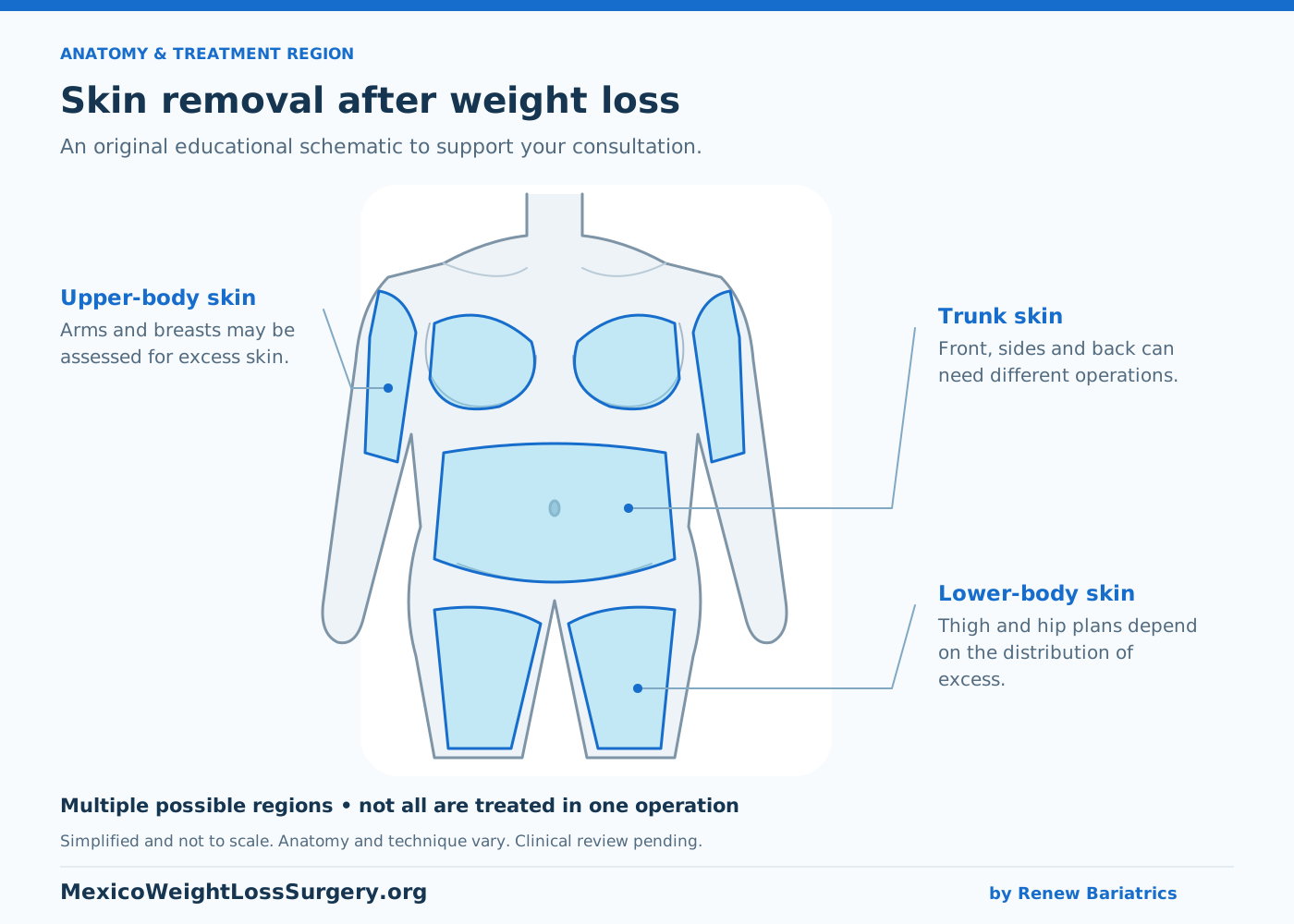
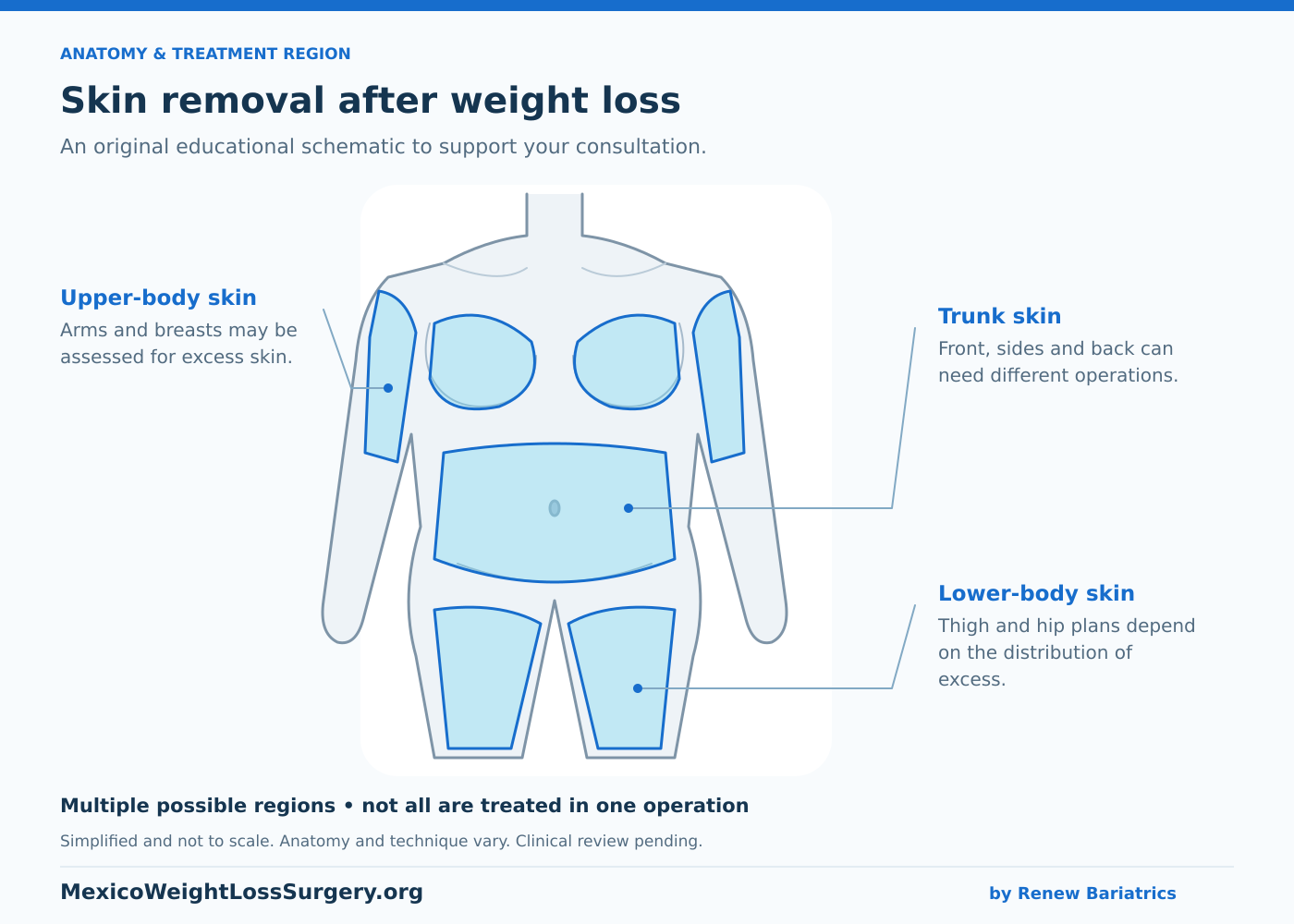
Anatomy references: ASPS — Skin removal after weight loss ↗ · ASPS — Mommy makeover ↗
What skin removal can and cannot do
Surgical body contouring addresses tissue that no longer conforms to a person's smaller body size after substantial weight loss. The operation may improve the shape of a selected area, but it is not another form of metabolic or bariatric surgery.[1]
Do not choose a procedure based on an expected number of pounds to be removed. Ask the surgeon to describe the anatomical problem and the proposed change. A treatment that addresses an abdominal fold is different from one intended to reshape the waist, thighs or chest. Scale weight is a poor way to describe those distinctions.
You also do not need to regard loose skin as evidence that your weight-loss treatment failed. Some people accept it, some use supportive clothing or manage specific symptoms with their clinicians, and some investigate surgery. Your decision can be based on comfort, function, appearance or a combination of priorities. There is no requirement to complete a particular body-contouring sequence.
If a skin fold is painful, repeatedly irritated or affecting daily activities, explain that in the consultation. Ask what evaluation and nonsurgical care might be appropriate while you consider your options. Do not assume that every symptom has the same cause or that every concern requires an operation.
Start by mapping your priorities
Create a simple list of the areas you want to discuss. For each area, write the main concern and what a useful improvement would mean to you. For example, the concern might be a lower abdominal fold, difficulty finding comfortable sleeves, or a breast or chest shape that bothers you. Keep the description concrete.
Then rank the areas. If only one could be treated in the near term, which would you choose? This question helps keep the consultation focused and makes a staged plan easier to evaluate. It can also prevent a broad package from adding procedures that do not matter enough to justify their scars, costs and recovery.
Bring clothing-related or activity-related questions, but avoid using a photograph of someone else's body as the required result. Ask which of your goals are realistic and which would require a different operation. A thorough consultation may change the procedure name you originally searched for.
Abdominal skin removal: panniculectomy and tummy tuck
A panniculectomy removes the hanging excess skin and fat of the lower abdomen. ASPS distinguishes it from a tummy tuck because it does not tighten the abdominal muscles. The exact purpose and extent of the proposed operation should be clear in your treatment plan.[5]
Ask whether the main goal is removal of an overhanging fold, broader contour improvement, muscle repair or some combination. These are different questions even when the incisions are in a similar region. If you have a suspected hernia, pain or prior abdominal surgery, ask whether additional evaluation is needed rather than assuming it is included in cosmetic treatment.
A standard tummy tuck, extended tummy tuck and fleur-de-lis approach have different incision patterns and intended scopes. Review the dedicated guides and ask the surgeon to draw the proposed scar on a diagram or explain it during examination. The important comparison is not which name sounds more complete, but which plan addresses your tissue distribution with tradeoffs you accept.
If a quote says only “skin removal,” request a more precise description. It should identify the operation, treated area and any planned additional procedures.
Circular tummy tuck and lower-body lift
ASPS describes lower-body lifting as an option for tissue around the abdomen, buttocks and thighs, with the exact plan determined by anatomy and goals. Body contouring may require extensive incisions and is often performed in stages.[4]
A circumferential plan should be distinguished from treatment limited to the front of the abdomen. Ask where the incision travels, what happens at the sides and back, and which concerns it is expected to improve. Do not assume that a circular tummy tuck corrects every thigh or buttock concern simply because it extends around the body.
Discuss the practical recovery implications. How will the incision locations affect sitting, sleeping, dressing and wound checks? Who can help inspect areas you cannot easily see? What arrangements are needed if you are staying away from home? Those questions help translate a procedure description into a recovery plan you can actually follow.
Arm, thigh, breast, chest and back options
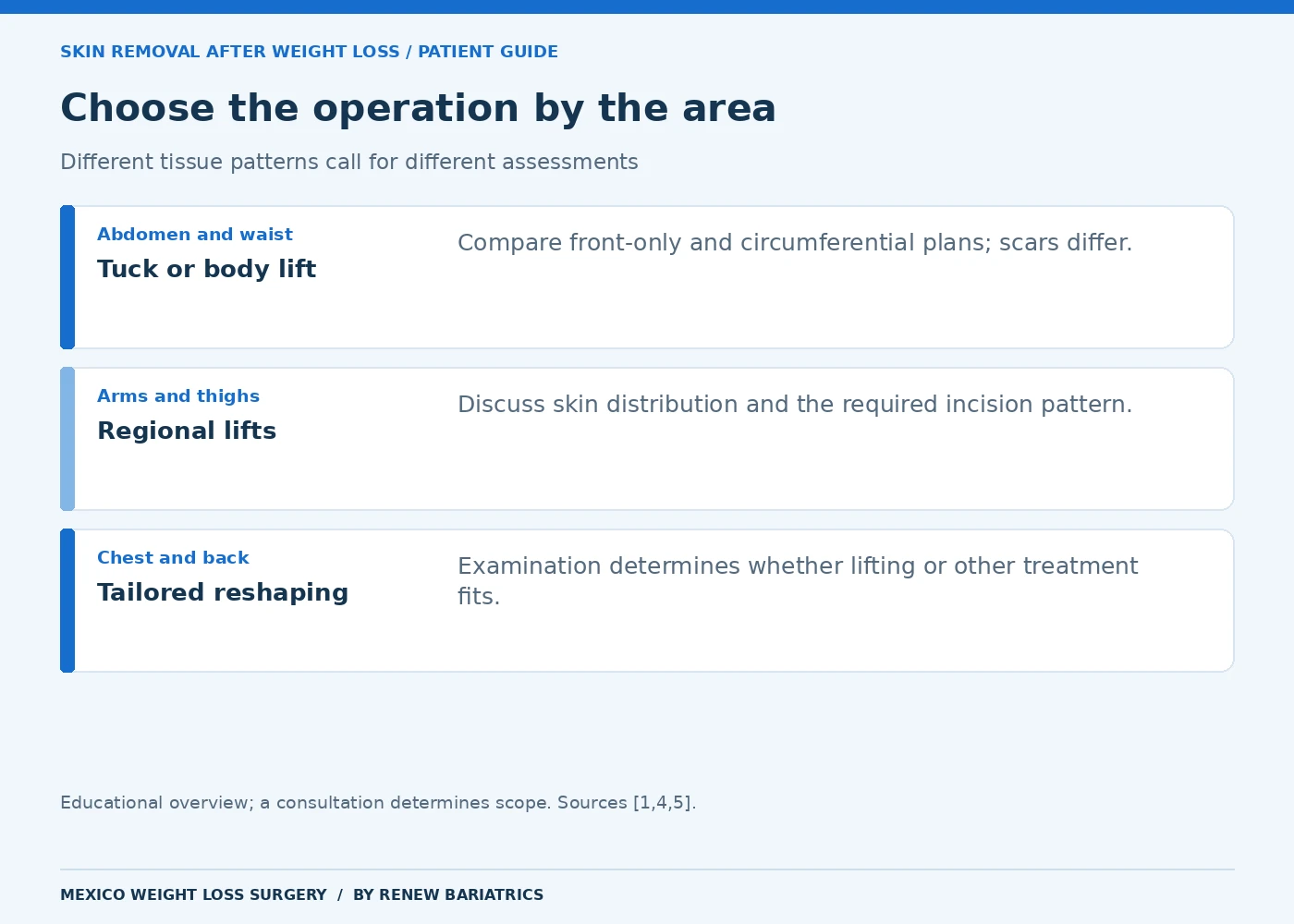
Body contouring may include an arm lift, thigh lift or breast lift, as well as other region-specific procedures. ASPS emphasizes that the pattern and length of incisions depend on the amount and location of excess skin and clinical judgment.[4]
For an arm lift, ask whether the concern is limited to the upper arm or extends toward the side of the chest. For a thigh lift, explain the specific area that troubles you rather than using “thigh tightening” as a complete description. Ask how the anticipated scar relates to your everyday clothing preferences.
Breast and chest changes need their own discussion. A lift, reduction, augmentation or other reshaping procedure addresses different goals. If an implant is proposed, review its separate risks and long-term obligations rather than treating it as an automatic part of post-weight-loss care.
For back or upper-torso folds, ask the surgeon to define terms such as torsoplasty or upper-body lift. Procedure names can be used differently in marketing. Request a clear description of the tissue being treated, incision location and relationship to any neighboring operation.
When is weight loss stable enough?
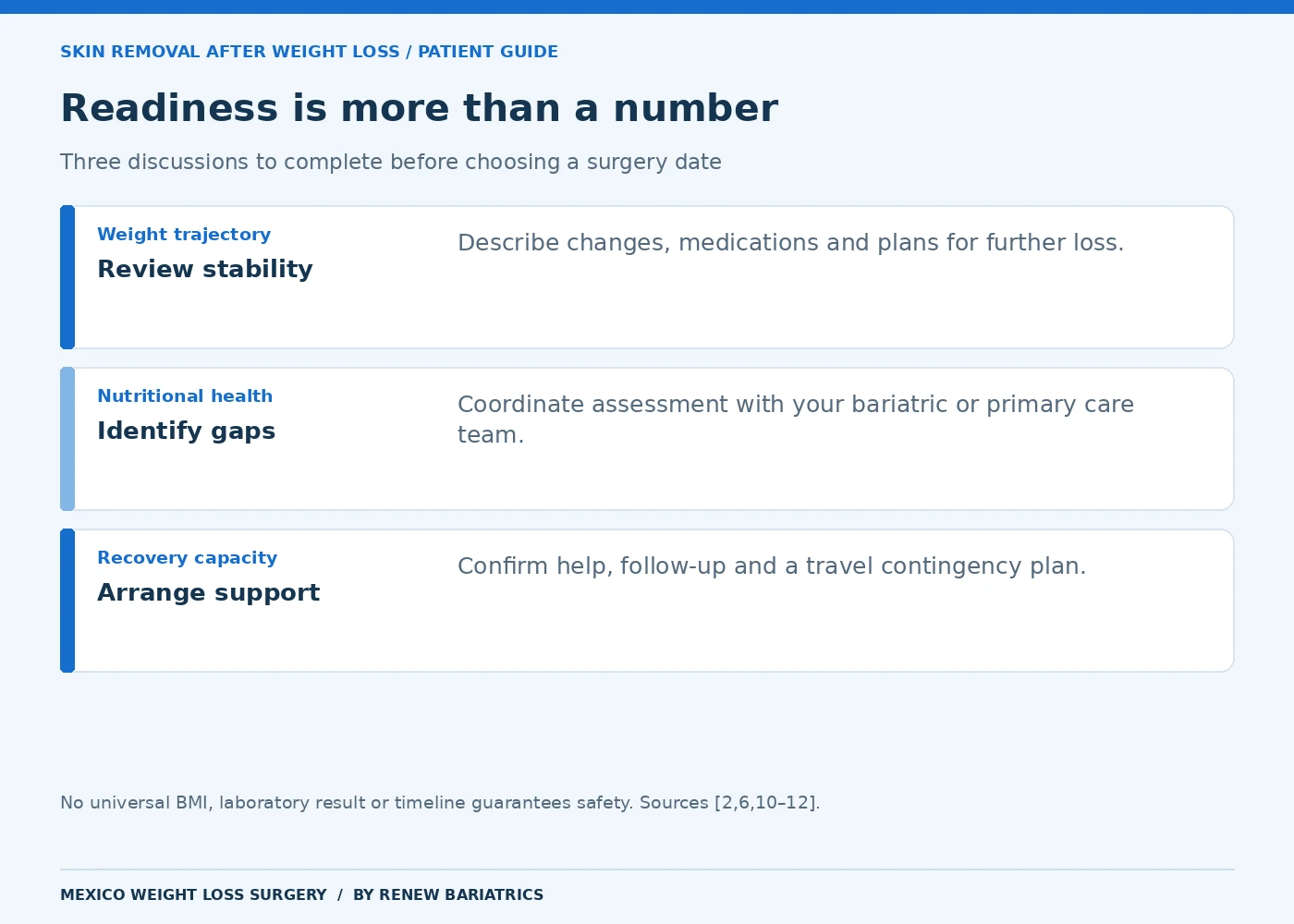
ASPS identifies stabilized weight, good general health, nonsmoking and realistic goals as features of potential body-contouring candidates. It also emphasizes ongoing nutrition and healthy habits.[2]
Ask the surgeon what weight history is needed to judge your readiness. Bring a record of recent changes and explain whether you expect further loss, are changing medication or have experienced regain. A single measurement on the consultation day does not describe the whole trajectory.
There is no universal date on which every person becomes ready. The time since bariatric surgery, current health, nutritional assessment, goals and proposed operation all belong in the discussion. Ask whether the team recommends proceeding, waiting or addressing another issue first, and request a clear explanation of that recommendation.
If you are still working toward a sustainable weight, discuss how that affects the proposed contouring plan. Do not crash diet to meet an advertised cutoff without clinical guidance. The aim of the assessment is to decide whether the operation is appropriate now, not simply to obtain a booking date.
Nutrition after bariatric surgery or medication-assisted loss
A review of post-weight-loss body contouring highlights nutritional concerns after both bariatric surgery and GLP-1 treatment. Reduced intake and food intolerance can affect protein and micronutrient status; sleeve surgery does not eliminate nutritional risk. The review supports individualized assessment and correction of deficiencies rather than a one-size-fits-all supplement plan.[10]
Bring your bariatric procedure history, current supplements, recent laboratory results and an honest description of what you can eat and drink. Explain persistent vomiting, food intolerance, difficulty meeting intake or supplements you have stopped. The team needs accurate information to assess readiness; minimizing a problem does not make the plan safer.
Ask who will interpret the nutritional assessment and how your plastic surgeon will coordinate with your bariatric clinician or dietitian. If treatment is needed before surgery, request a plan for follow-up and reassessment. Do not assume that buying a protein product or taking an extra multivitamin establishes that a deficiency has been corrected.
ASMBS stresses continuing nutrition, supplementation and follow-up after bariatric surgery. Body contouring does not replace that long-term care. Your existing bariatric program should remain part of the picture before and after a plastic-surgery procedure.[11]
For recovery, discuss practical food access. Can the accommodation support your usual eating pattern? Who will shop or prepare meals? Are the prescribed supplements available, and how should they be taken around other medicines? A usable plan should fit your tolerance and setting rather than relying on a generic menu.
Medical assessment and preparation
ASPS consultation guidance includes a review of goals, medical conditions, medications, supplements and previous surgery, together with examination and a discussion of options. Be candid about health history and prior healing problems.[3]
Prepare a complete list of prescriptions and nonprescription products, including weight-management medicines, blood thinners and nicotine use. Ask who coordinates medication instructions with your existing clinicians. Do not use this guide as a stop-or-start schedule for prescribed treatment.
Preoperative preparation may involve laboratory testing and clearance from primary care or bariatric clinicians. ASPS also addresses smoking cessation, review of medicines affecting bleeding and arrangements for support after surgery.[6]
Ask what findings would lead the surgeon to recommend postponement or a smaller operation. Confirm how any change affects the written quote, travel arrangements and deposits. A plan for reassessment is more useful than a vague instruction to “get healthy” without explaining the next step.
Why staging may be recommended
Removing skin from several regions in one trip may sound efficient. It also creates a larger overall treatment and recovery plan. The number of areas is not the only consideration; the extent of each operation, medical history and ability to recover need discussion.
A retrospective multicenter study in selected patients after major weight loss reported higher complication rates with larger numbers of combined procedures. The findings do not establish a universal safe maximum and should not be used to promise that a smaller combination is risk-free.[14]
Ask the surgeon to compare a single-area plan, the proposed combination and staged care. If separate stages are recommended, ask which area should come first and what milestones would be reviewed before another operation. Clarify whether the first stage could change the design or need for the next.
Include recovery support in that comparison. Two separate operations may mean repeated time away from work, while one extensive operation may demand more help at once. Neither option can be judged from the package price alone. Your priorities and practical capacity belong alongside the clinical recommendation.
Risks, scars and realistic expectations
ASPS lists potential body-contouring complications including bleeding, infection, fluid accumulation, blood clots, poor healing, skin loss, altered sensation, unfavorable scars and residual looseness or contour irregularity. Anesthesia carries additional risks.[7]
Ask which problems are most relevant to your operation and personal history. Request an explanation of how the team prevents, recognizes and manages them. If the answer relies only on reassurance that complications are uncommon, ask for the actual process: who examines you, where treatment occurs and how you make contact.
Scars are a central tradeoff. ASPS explains that visible scars accompany body contouring and that final results can take a long time to develop. Long-term appearance is affected by aging and weight stability, and further surgery can sometimes be needed.[9]
Before consent, ask to see the anticipated incision pattern and discuss areas where a scar may remain visible in your preferred clothing. Do not choose an operation on the promise of “scarless” major skin removal. Consider whether the expected improvement is worth the scar to you personally.
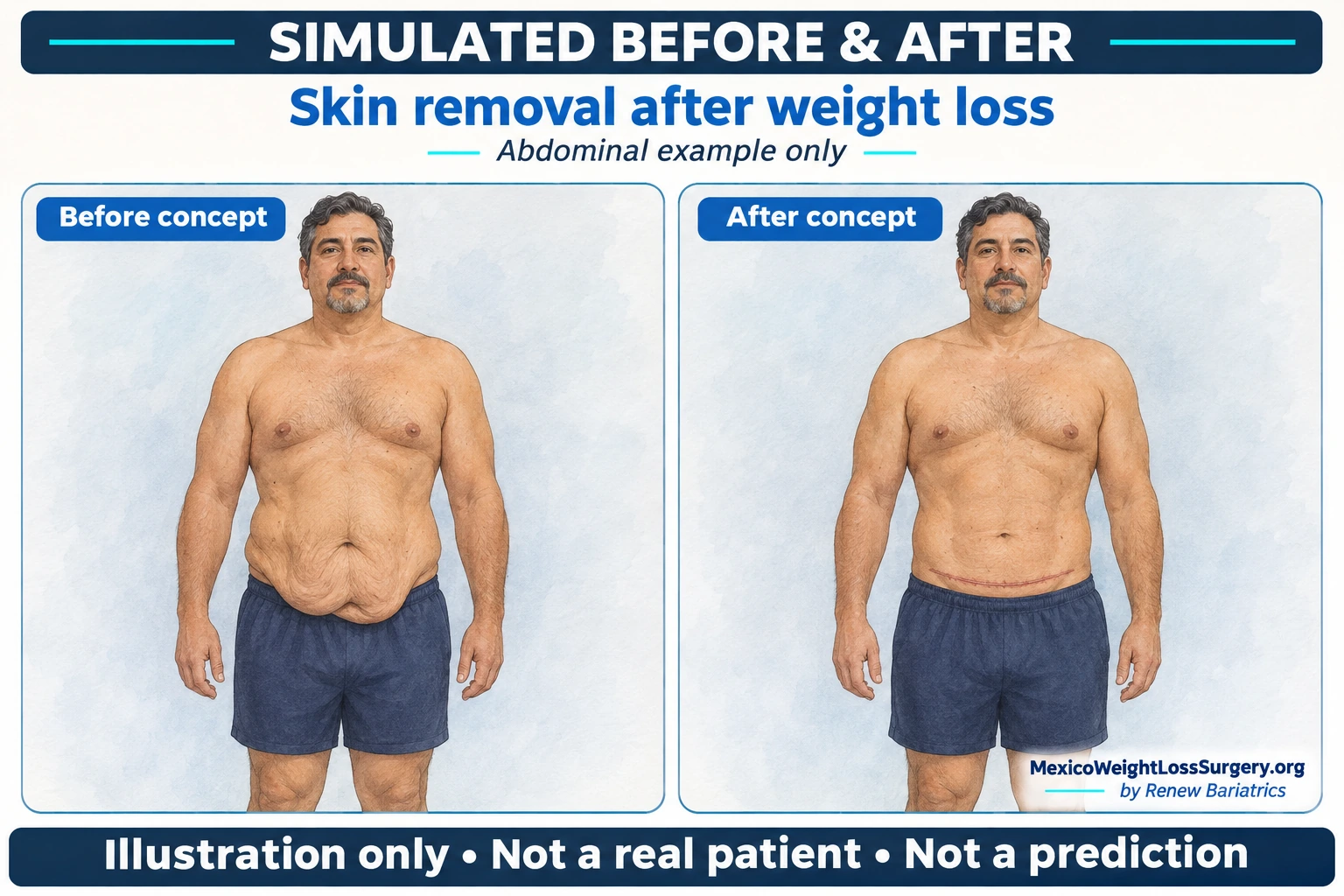
The illustration on this page is a fictional editorial scene. It does not represent the amount of skin you have, the amount that could be removed or a predicted postoperative body. Genuine patient photographs, when appropriately consented and consistently presented, are discussion aids rather than guarantees.
Recovery and support after skin removal
Dressings and sometimes drains are used after body contouring. Instructions vary by procedure and may address lifting, bending, positioning, mobility, wound care and follow-up. ASPS notes that restrictions can extend over days to weeks depending on the operation.[8]
Ask for instructions that match your home and travel circumstances. Explain stairs, pets, childcare, work duties and whether you live alone. If a restriction is unclear, ask about the actual activity: carrying a grocery bag, lifting a toddler, driving, climbing into bed or reaching overhead.
Your support person should understand the discharge instructions and contact plan. Ask who teaches drain or dressing care if it is required, what supplies are provided and how supplies will be replaced. Do not assume a hotel or transport service provides nursing care unless that service is explicitly described and staffed accordingly.
Get written guidance on expected symptoms and warning signs. Ask what changes need a same-day assessment and what symptoms require emergency attention. If urgent symptoms arise, obtain appropriate local medical care rather than relying on a delayed online exchange.
Plan follow-up beyond the first reassuring visit. Ask how the surgeon will assess healing after you return home and what happens if photographs or a video call are insufficient. Keep your usual bariatric and primary care appointments as well.
A synthetic illustration of possible changes
This fictional example illustrates a treatment concept. It cannot show the result you would achieve, predict scar healing, or establish a typical outcome.
Skin Removal After Weight Loss Cost in Mexico
Skin removal after weight loss cost in Mexico varies because the term covers different operations and body regions. A lower-abdominal procedure and a circumferential lift with additional areas are not equivalent products. Request an itemized proposal after clinical review rather than comparing a general starting price with a detailed surgical quote.
ASPS's tummy-tuck cost guidance identifies surgeon, anesthesia, facility, testing, medications and garments as potential components. Published U.S. surgeon-fee figures do not establish the full price of a Mexico skin-removal plan.[13]
Ask that the quote identify:
- The exact procedure or procedures, treated areas and named surgeon.
- The facility, anesthesia arrangements and planned postoperative observation.
- Testing, consultations, medicines, dressings, garments and scheduled follow-up.
- Any separate nutritional assessment or preparation costs.
- Travel, transport, lodging, meals and companion expenses, if included.
- Charges for additional visits, extended accommodation or unplanned treatment.
- Rescheduling, cancellation and revision-policy terms.
If the recommendation involves stages, request the costs of each stage and ask which expenses recur. Include time away from paid work and the cost of practical help at home in your personal budget. These may influence what is feasible even though they are not part of the surgeon's fee.
Ask your insurer directly whether any medically indicated component or complication care might be covered and what documentation is required. Do not assume that symptoms, a reconstructive label or a provider's statement guarantees payment, especially for overseas treatment. Keep the insurer's answer separately from the surgical quote.
A request for a quote should not be treated as consent. Review both the clinical plan and the financial terms before committing to a date.
Planning travel and care after returning home
CDC highlights travel-related risks after surgery and the importance of records and continuity of care. An individual clearance decision is needed; a generic travel recommendation does not establish that you are ready to fly.[12]
Ask how long the team expects you to stay locally and what could extend that stay. Confirm who makes the travel decision and which appointments must happen before departure. Arrange flexibility around the estimate rather than planning an immovable return to work.
Before leaving Mexico, request the operative report, medication list, discharge instructions and relevant device information if any implant was used. Ask how records will be shared with a clinician at home. Identify that clinician early instead of assuming someone will be available at short notice.
Keep a financial and practical contingency plan for extra lodging, changed travel or an additional examination. Clarify which expenses are your responsibility. The point is to make the care pathway workable even if recovery does not follow the initial schedule exactly.
Frequently asked questions
Is skin removal another weight-loss procedure?
No. It addresses excess tissue and contour in selected areas. It does not replace bariatric follow-up or ongoing obesity care.[1],[11]
Do I need a tummy tuck or a panniculectomy?
That depends on the concern and examination. Panniculectomy focuses on the hanging lower-abdominal tissue and differs from a tummy tuck that may include muscle tightening. Ask the surgeon to explain the purpose of the proposed operation.[5]
How long should my weight be stable?
Ask the surgeon what history and milestones are needed for your circumstances. Stable weight is a general candidacy consideration, but no single interval substitutes for assessment of health, nutrition and the planned procedure.[2]
Can every area be treated in one operation?
An individualized assessment is necessary. Body contouring is often staged, and research in selected patients does not create a universal safe combination. Ask the surgeon to compare the scope and recovery of the alternatives.[4],[14]
How much does skin removal cost in Mexico?
The answer depends on the regions and procedures, the need for stages and the services included. Request a current itemized quote and compare the full care plan, including exclusions and possible extra expenses.[13]
What is the best next step?
Write down your priorities, gather your weight-loss and nutrition records, and request a surgeon-led assessment. Ask Renew Bariatrics for a proposal that identifies the procedure, clinician, scar expectations, recovery support and cost. Use that information to decide whether surgery fits your goals now.
Program information related to this guide
Explore Renew Bariatrics’ procedure options when discussing a plastic surgery plan. Availability, combinations and suitability require individual confirmation.
Skin removal after weight loss vs. mommy makeover
These are overlapping treatment categories rather than single fixed operations. Compare the actual component procedures, timing and recovery plan.
| What to compare | Skin removal after weight loss → | Mommy makeover → |
|---|---|---|
| Main goal | Addresses skin excess after major weight loss. | Combines selected post-pregnancy procedures. |
| What changes | Region-specific lifts, often considered in stages. | The component operations define the plan. |
| Key distinction | Stable weight and nutrition affect readiness. | There is no single standardized package. |
| Recovery consideration | Recovery depends on the regions treated. | Combined or staged recovery must be individualized. |
| Cost comparison | Request an itemized quote for this exact procedure and care plan. | Compare the same inclusions, exclusions and recovery expenses. |
Comparison references: ASPS — Skin removal after weight loss ↗ · ASPS — Mommy makeover ↗
These options are not interchangeable for every person. The treating clinician must assess your anatomy, medical history and goals.
Discuss your options with Renew.
Talk with a coordinator about skin removal after weight loss, your goals and the information needed for clinical review. The treating team determines suitability and the care plan.
Call 844-736-3963 Ask about plastic surgery ↗The link opens Renew’s plastic surgery health questionnaire. This review site does not collect health information.
References & evidence notes
Sources checked November 2026. Research findings are not a forecast for an individual or outcomes for Renew’s own program. Review study populations, methods and limitations alongside the reported results.
- American Society of Plastic Surgeons. Body Contouring ↗Professional society patient guidance; individualized assessment required.
- American Society of Plastic Surgeons. Body Contouring Candidates ↗Professional society patient guidance; individualized assessment required.
- American Society of Plastic Surgeons. Body Contouring Consultation ↗Professional society patient guidance; individualized assessment required.
- American Society of Plastic Surgeons. Body Contouring Procedure ↗Professional society patient guidance; individualized assessment required.
- American Society of Plastic Surgeons. Panniculectomy ↗Professional society patient guidance; individualized assessment required.
- American Society of Plastic Surgeons. Body Contouring Preparation ↗Professional society patient guidance; individualized assessment required.
- American Society of Plastic Surgeons. Body Contouring Safety ↗Professional society patient guidance; individualized assessment required.
- American Society of Plastic Surgeons. Body Contouring Recovery ↗Professional society patient guidance; individualized assessment required.
- American Society of Plastic Surgeons. Body Contouring Results ↗Professional society patient guidance; individualized assessment required.
- Plastic and Reconstructive Surgery review. Nutritional Challenges in Post-Massive Weight Loss Body Contouring: Guidance for Plastic Surgeons on GLP-1 Agonists and Sleeve Gastrectomy ↗Nutrition guidance; no single laboratory value or supplement regimen establishes candidacy.
- American Society for Metabolic and Bariatric Surgery. Life After Bariatric Surgery ↗Long-term bariatric nutrition, supplementation and follow-up.
- Centers for Disease Control and Prevention. Medical Tourism, CDC Yellow Book ↗Travel risks and continuity of care; not individualized fitness-to-fly clearance.
- American Society of Plastic Surgeons. Tummy Tuck Cost ↗Professional society patient guidance; individualized assessment required.
- Multicenter retrospective study. Safety and Efficacy of Combining Multiple Body-Contouring Procedures in Massive-Weight-Loss Patients: A Retrospective Multicenter Study ↗Observational results in carefully selected patients; individualized staging remains necessary.