
Jump to a section
Anatomy illustrationSynthetic illustrationCompare proceduresRelated ProceduresWhat augmentation can changeAfter weight loss: volume and skin are separate issuesWho may be a candidate?Implant choices: ask for the exact deviceLift, implant or fat transfer?Implant risks and the commitment to future careMonitoring silicone implants over timePreparing for surgery and consentRecovery: plan around function, not a promotional timelineTraveling to Mexico and returning homeBreast Augmentation Cost in MexicoQuestions worth answering before bookingTake the next step with an individualized assessmentYour next stepReferencesBreast augmentation increases breast volume using implants or, in selected cases, transferred body fat. For someone who has lost substantial weight, the first question is whether the concern is lost fullness, loose skin, low nipple position, or a combination. Those features can require different operations. An implant adds volume; it does not automatically replace the work of a breast lift. A consultation should identify the problem before naming the procedure.[1],[2]
Renew Bariatrics lists breast augmentation among its procedures. That listing establishes an advertised service, not your eligibility, the device you would receive, or an outcome guarantee.[14] Breast augmentation cost in Mexico depends on that assessment and the written scope of care. This guide explains the decisions to make before requesting an individualized assessment and written quote. It is educational information; your treating clinicians must establish the plan.
Understand the anatomy
A simplified, labeled view of the structures and treatment area. Select the image to view it at full size.
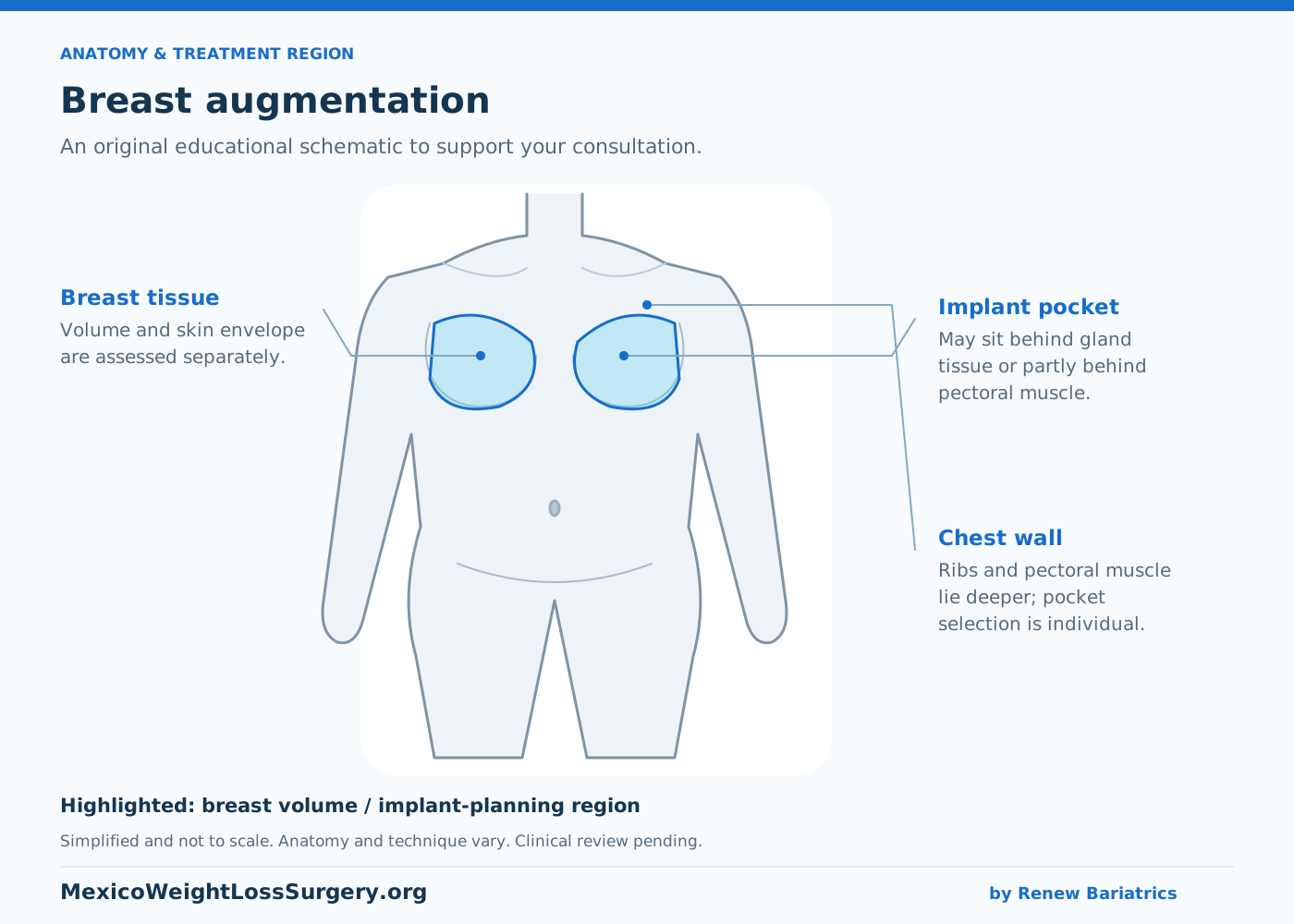
Anatomy references: ASPS — Breast augmentation ↗ · ASPS — Breast lift ↗ · ASPS — Procedure details and safety ↗
What augmentation can change
Possible goals include replacing volume lost after weight loss or pregnancy, increasing a naturally smaller breast, or improving an existing size difference. Describe the change you want in ordinary language: more fullness in clothing, a less empty upper breast, or better balance between sides. A preferred cup letter alone communicates very little about shape, proportions, or what your tissues can support.[1]
Bring two lists to the consultation: what bothers you now and what you do not want changed. For example, someone may want modest upper fullness but dislike a prominently rounded appearance. Another person may prefer a more visible increase but consider long-term device monitoring an acceptable tradeoff. These are preference questions, not reasons to promise a particular result.
Do not treat a photograph as a specification sheet. A reference image can help explain preferences, but the person in it may have different skin, chest width, breast tissue, or previous operations. Ask the surgeon to identify which features are feasible in your anatomy and which are not. The illustrations on this page are fictional editorial artwork, not actual patient results or predictions.
After weight loss: volume and skin are separate issues
Weight loss may leave less breast fullness alongside excess skin. Assessment should include the nipple position relative to the breast fold, existing tissue, skin quality, and differences between breasts. Where sagging is important, a lift may be considered with augmentation or separately. Adding an implant is not a universal solution for loose skin.[2]
If you are still losing weight, make the trajectory part of the conversation. Provide your current weight, recent trend, bariatric procedure and date, and whether your obesity treatment is changing. Ask what degree of stability the surgeon wants and why. A calendar interval by itself does not demonstrate readiness; the team also needs to evaluate health and nutritional status.
Continue your bariatric follow-up. Protein intake, hydration and prescribed vitamin and mineral supplementation remain important after metabolic surgery. Do not replace your established nutrition plan with a cosmetic surgery supplement package without review by your clinicians.[10] Ask the plastic surgery and bariatric teams to agree on who reviews the relevant laboratory results and follows up anything abnormal.
Practical preparation includes a complete medication and supplement list, previous operative reports if available, and an honest description of eating difficulties, vomiting, or trouble taking supplements. Those details help the team decide whether to investigate or postpone surgery. They are more useful than trying to present yourself as an uncomplicated candidate.
Who may be a candidate?
ASPS describes typical candidates as physically healthy people with fully developed breasts, realistic expectations, and personally chosen goals who are not currently pregnant or breastfeeding. Eligibility remains individual.[1] A consultation should also address prior breast surgery, breast symptoms, cancer history, smoking or vaping, medications, and your ability to complete follow-up.[7]
A new lump, unexplained discharge, or unresolved breast imaging finding needs clinical attention rather than being folded into a routine cosmetic booking. Ask the surgeon how existing breast care will be coordinated. Cosmetic assessment and evaluation of a breast symptom are different tasks; neither should be assumed to substitute for the other.
Consider the life circumstances around surgery. Who can help with children, pets, household tasks and transport? Can you stay longer if the clinician delays travel clearance? Can you afford follow-up imaging and a possible future operation? These questions belong in candidacy discussions because an implant decision extends beyond the day of surgery.
Implant choices: ask for the exact device
Saline implants contain sterile salt water; silicone implants contain gel. A saline rupture commonly produces deflation, whereas silicone rupture may not visibly change the breast. Shape, dimensions, fill and surface are separate product characteristics. Terms such as “premium” or “gummy bear” are not sufficient device identification.[3]
Request the manufacturer, model, surface, proposed dimensions and fill before consenting. Ask why that particular option fits your anatomy, what alternatives were considered, and whether the device is authorized for its intended use in Mexico. U.S. FDA approval provides information about U.S. regulation; it does not establish Mexican authorization or verify a particular clinic's inventory.
Discuss implant size in the context of the intended appearance and the tissue covering it. Ask to understand the surgeon's recommendation rather than shopping by a volume number alone. If you disagree with the proposed size, resolve that before surgery. Consent should not rely on a vague understanding that the final choice will simply be “whatever looks best.”
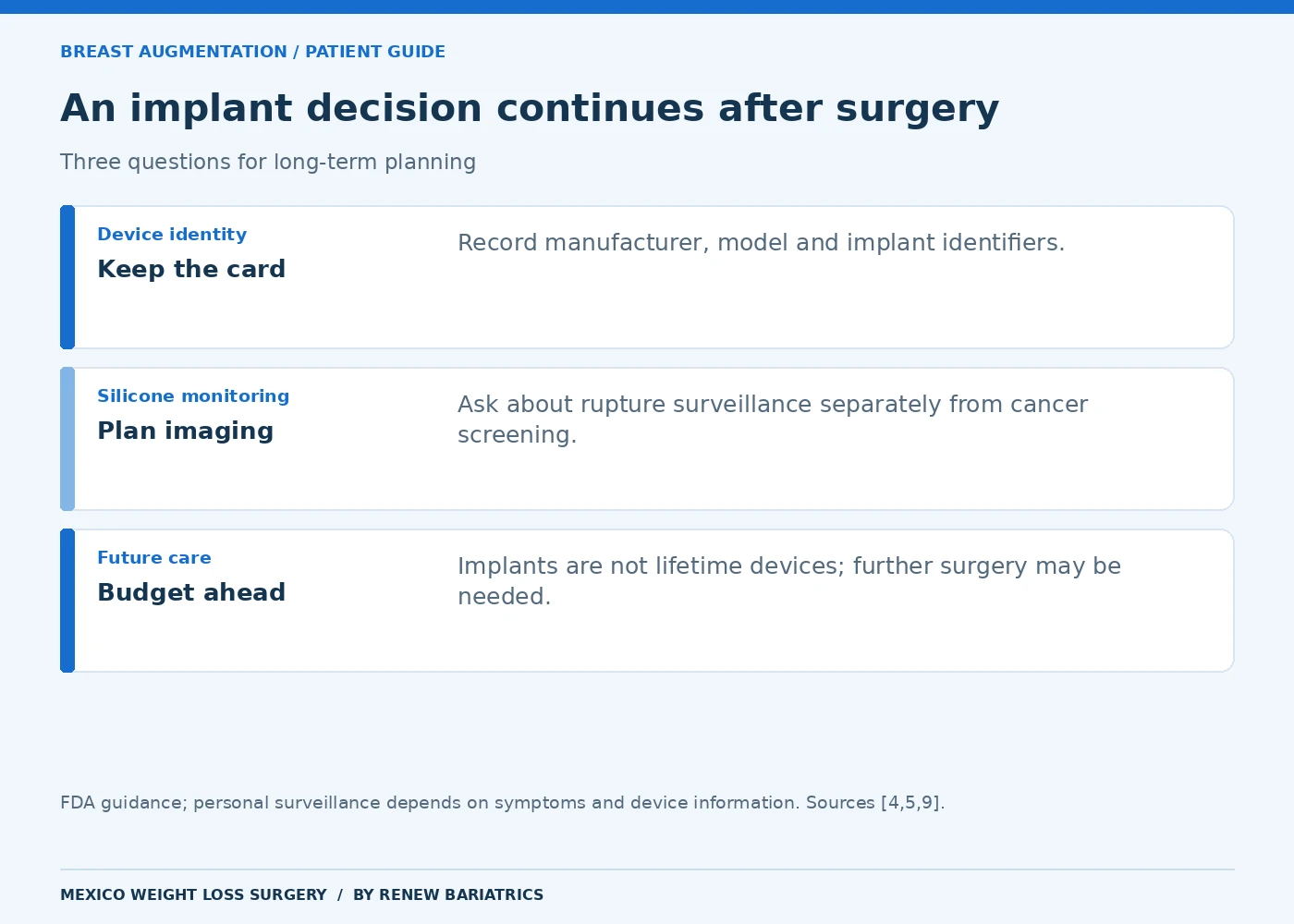
Obtain the implant identification card and operative record after treatment. Keep copies somewhere accessible if you move, change clinicians, or need urgent assessment. Device identity matters when reviewing product information, surveillance recommendations, or a future safety notice.[4]
Lift, implant or fat transfer?
A breast lift addresses the skin envelope and breast position. An implant adds volume. Some patients may need both to address their stated goals; others may prefer a lift without accepting an implant. Combining procedures and staging them are different plans that should have separate explanations, recovery expectations and costs.[2]
Fat transfer moves fat from another body area to the breasts through liposuction and injection. ASPS describes it as an option for a relatively modest increase. It is still surgery, and neither the amount of usable donor fat nor the lasting volume should be assumed in advance.[11] Ask whether the service is actually available for you; discussion of an alternative here is not a promise that Renew offers it.
Ask for a comparison of the options in your specific case: augmentation alone, lift alone, combined treatment, staged treatment, and no operation. The useful question is not which operation is generally “best.” It is which tradeoff you prefer after understanding what each option is likely to address and what it leaves unchanged.
Implant risks and the commitment to future care
Implants are not lifetime devices. Potential problems include capsular contracture, rupture, displacement, pain, infection, altered nipple or breast sensation, and additional surgery. A capsule is the scar tissue the body forms around an implant; when it tightens abnormally, the breast can become firm or distorted. Risk discussions should include both early surgical complications and later device-related problems.[5]
There is no universal rule that every implant must be replaced at a fixed anniversary. Equally, there is no sound basis for promising that yours will never need replacement or removal. Ask what findings would prompt investigation, which clinician would evaluate a problem after you return home, and how the costs of additional treatment would be handled.[4],[5]
BIA-ALCL and other capsule-associated cancers
Breast implant-associated anaplastic large cell lymphoma, or BIA-ALCL, is an immune-system cancer associated more often with textured implants. It is distinct from ordinary breast cancer. The FDA also describes reports of squamous cell carcinoma and other malignancies in the capsule around implants.[4],[6]
BIA-SCC is not another name for BIA-ALCL. The FDA's March 2023 communication stated that SCC incidence and risk factors were unknown. Counts of published reports do not provide a personal probability because they do not establish a reliable population denominator. Ask about current product-specific information and what symptoms should trigger evaluation.[6]
Persistent new swelling, a mass, or pain around an implant deserves clinical assessment. An information page cannot determine whether such a change is benign or serious. For someone who already has implants, decisions about removal should be made with the treating clinician rather than inferred from a headline or a generalized risk statement.[6]
Systemic symptoms and uncertainty
Some people report systemic symptoms described as breast implant illness. The FDA acknowledges reports while explaining that individual risk and the relationship to specific symptoms remain uncertain.[4] A consultation should make room for these concerns without dismissing them or promising that an implant choice eliminates them. Ask how the team evaluates persistent symptoms and coordinates other medical assessment.
Monitoring silicone implants over time
FDA labeling guidance recommends ultrasound or MRI for asymptomatic silicone implants beginning five to six years after placement and every two to three years afterward. Symptoms or an uncertain ultrasound can require different evaluation. This is surveillance for implant rupture; it does not replace breast cancer screening.[9]
Build that distinction into your long-term plan. Ask your home clinician where appropriate imaging is available, how records will be shared, and what you may have to pay. A quotation that covers only surgery tells you little about the overall financial commitment of living with implants.
If you relocate, preserve the product card rather than relying on memory of the implant brand. Tell future imaging providers that you have implants and provide prior reports when requested. If a later clinician recommends a different follow-up interval, ask how the recommendation relates to your device, symptoms and medical history.
Preparing for surgery and consent
Preparation may include a medical evaluation, laboratory testing, medication changes and smoking cessation instructions. The surgical team should give individualized directions, including which products to stop and when. Do not independently discontinue prescribed anticoagulants, diabetes treatments or other essential medicines.[7]
Request a written plan that names the procedure, whether a lift is included, the intended device and the alternatives discussed. If there is a possibility that an intraoperative finding would change the operation, ask how that situation is covered in consent. A conversation on the morning of surgery is a poor substitute for time to understand the main choices.
The FDA's U.S. patient communication framework includes a boxed warning and decision checklist for implants.[4] When considering care in Mexico, ask what device-specific information and consent materials you will receive in a language you understand. A signature should confirm understanding; it should not be the first time you see the risks.
Also clarify who performs each part of your care. Obtain the surgeon's full name, relevant plastic surgery credentials, facility details and anesthesia arrangements. Ask how you can independently verify them. This page does not assert the qualifications of a particular surgeon or accreditation of a particular facility.
Recovery: plan around function, not a promotional timeline
Dressings and a support garment may be used after augmentation. Soreness and swelling can continue for weeks, and the surgeon sets restrictions and follow-up. The early appearance is not necessarily the settled result.[8] Ask for instructions that distinguish what you may do immediately from what requires review first.
Translate restrictions into your own daily life. A desk job, carrying a toddler, lifting supplies, driving long distances and working above shoulder height involve different demands. Tell the team what your work actually requires. A generic return-to-work statement is not enough to determine whether your routine is appropriate.
Before traveling, arrange help with luggage and everyday tasks. Put frequently used items within easy reach and check whether your accommodation provides the support you expect. A hotel room alone is not a postoperative care plan. Ask who checks dressings, whether visits are included and how you reach a clinician outside office hours.
Do not start massage, scar treatments, exercises or a different compression garment based on someone else's instructions. Ask which recommendations apply to your technique and when they begin. Keep a written record of medication timing and follow-up appointments if fatigue makes details difficult to remember.
Symptoms that need prompt attention
Your discharge paperwork should specify warning signs and the correct contact route. Rapidly increasing swelling, worsening pain, fever, spreading redness, drainage or wound changes need prompt review. Chest pain, difficulty breathing, fainting or concerning new leg symptoms warrant urgent medical assessment; do not wait for a routine video appointment.[5],[12],[15]
Ask the team to distinguish emergency care from questions that can wait until the next scheduled visit. Confirm the address of the local facility you would use and who receives updates. An emergency plan should work even if your usual coordinator is unavailable.
Traveling to Mexico and returning home
Surgery and prolonged travel both contribute to clot risk. CDC advises considering postoperative travel risk and arranging continuity of care before medical tourism.[12],[15] Your surgeon should assess the timing of your return journey, including ground transfers and time seated, rather than approving travel simply because a package stay has ended.
A practical itinerary leaves room for an extra appointment or a postponed departure. Ask the coordinator what happens if the clinician says you are not ready to travel. Know who pays for additional accommodation and care. Choose tickets and work arrangements with the medical plan in mind instead of asking the clinician to fit recovery into an inflexible booking.
Arrange a clinician at home before leaving. Ask what they can provide, whether they accept postoperative care after overseas surgery and what records they need. Bring an operative report, medication list, discharge summary and implant details. Remote access to the original team is useful, but it does not replace an examination when one is needed.
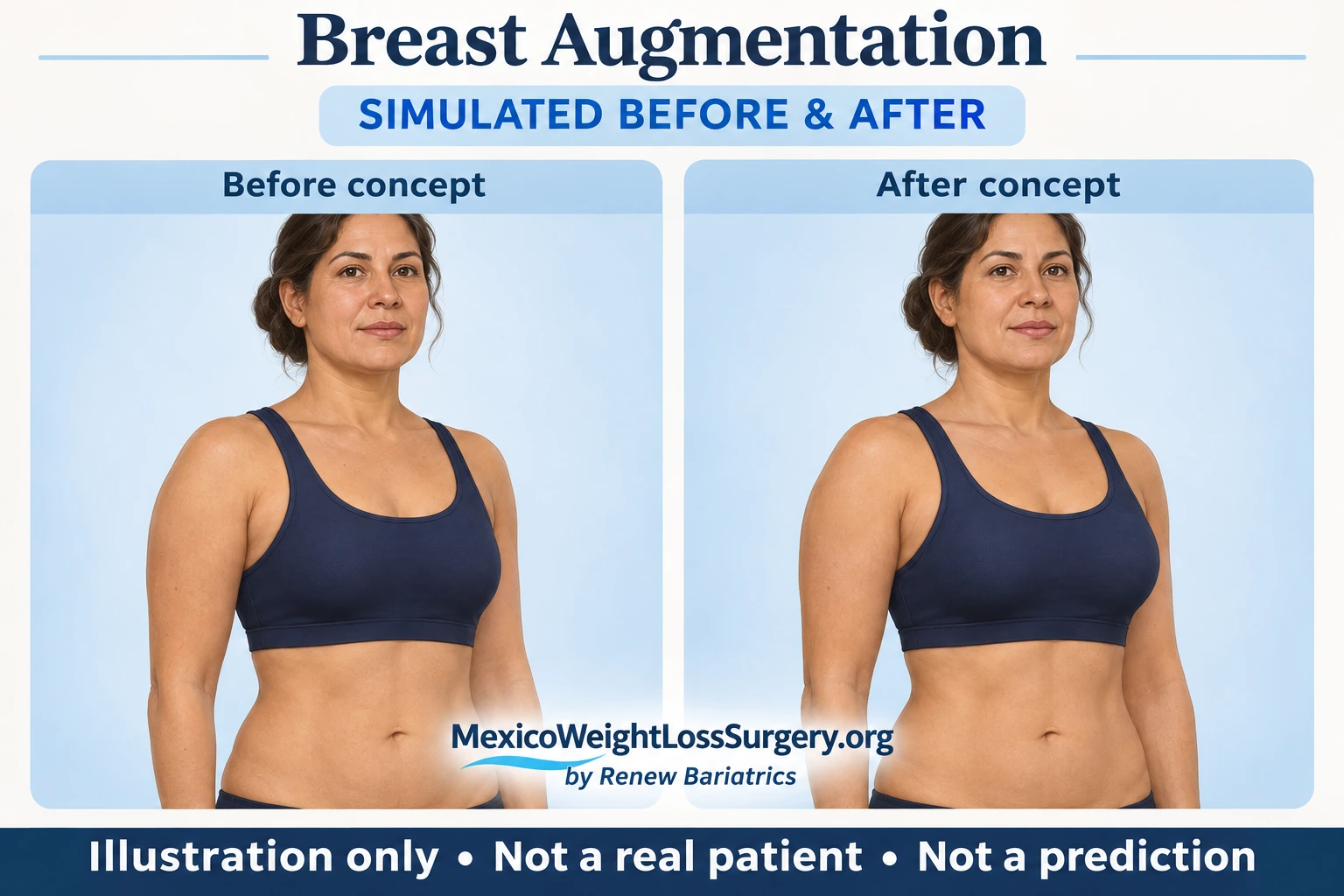
A synthetic illustration of possible changes
This fictional example illustrates a treatment concept. It cannot show the result you would achieve, predict scar healing, or establish a typical outcome.
Breast Augmentation Cost in Mexico
This page does not publish an unverified package price. Request a quote based on the proposed operation and your assessment. A lift plus augmentation, implant exchange, or another added procedure should be clearly identified; it should not hide behind a single generic label.
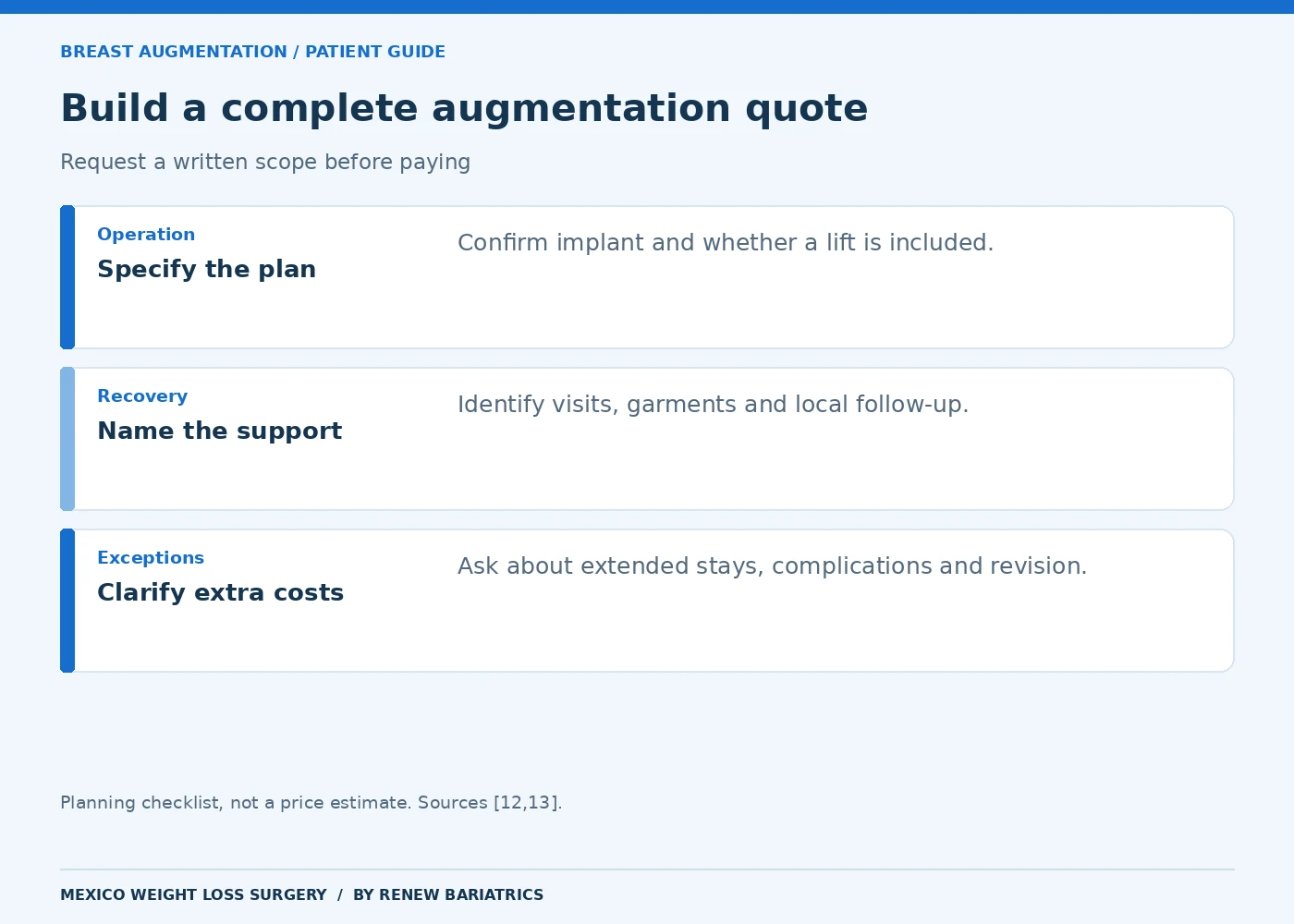
Ask for separate confirmation of the surgeon, anesthesia, facility, implants, testing, garments, prescriptions, follow-up visits, transport and accommodation. Identify what is excluded, what would trigger extra charges and whether the quote can change after an in-person examination. Compare the same scope of care when considering alternatives.[13]
Include future costs in your own budget: imaging, local appointments, possible revisions and travel if further treatment is needed. Ask what any warranty covers and obtain the actual terms; do not assume that a device warranty covers every surgical or travel expense. Read cancellation and postponement terms before paying a deposit.
Does breast augmentation cost in Mexico include a lift?
Only the written quote can answer that. Ask whether it covers augmentation alone or a combined lift and augmentation, and whether the implant, anesthesia, facility and planned visits are included. Do not compare a lift-inclusive quote with an implant-only price as though they describe the same care.
How much should I budget for follow-up?
Ask for the scheduled follow-up costs and investigate local imaging fees before booking. No single estimate applies to every device, insurance policy or future problem. Keep routine surveillance separate from any emergency or revision contingency in your budget.
Is a published starting price a final quote?
No. Historical prices and starting figures may describe a different date or scope. Request a current assessment-based quote, its validity period and the circumstances in which it can change. Do not assume a promotional price includes a particular implant or a breast lift.
Questions worth answering before booking
Use the consultation to obtain explanations you can repeat in your own words:
- Is my main issue volume loss, skin excess, nipple position or a combination?
- Why is the proposed operation appropriate for my anatomy and goals?
- Which implant is proposed, and where can I read its patient information?
- Would a lift alone meet enough of my goals to be worth considering?
- How will my bariatric history affect preparation and follow-up?
- What complications are most relevant to me, and who treats them?
- What surveillance and possible future surgery should I budget for?
- Who will examine me before travel and after I return home?
Leave space for answers that change your decision. “Not yet” can be a useful outcome if nutrition, weight stability, breast evaluation or recovery support needs attention. A decision to proceed should follow those answers, not precede them.
Take the next step with an individualized assessment
Start with your health history, bariatric procedure details, current medications and a clear description of your goals. Ask Renew Bariatrics to confirm current availability, the treating surgeon and facility, and the consultation process for breast augmentation.[14] Request the clinical plan before treating a quotation as a recommendation.
Compare breast lift when position and loose skin are central concerns, or breast reduction when the aim is less volume. For broader planning, read mommy makeover, skin removal after weight loss, aftercare and cost and pricing. The right combination depends on an examination, your priorities and the follow-up you can realistically complete.
Program information related to this guide
Explore Renew Bariatrics’ procedure options when discussing a plastic surgery plan. Availability, combinations and suitability require individual confirmation.
Breast augmentation vs. breast lift
These procedures address different concerns and may be combined or staged. A clinical assessment determines which, if either, fits your anatomy and goals.
| What to compare | Breast Augmentation → | Breast Lift → |
|---|---|---|
| Main goal | Adds breast volume. | Raises and reshapes the breast. |
| What changes | Implant or selected fat transfer. | Skin tailoring and tissue reshaping. |
| Key distinction | Does not reliably correct substantial sagging. | Does not primarily add volume. |
| Recovery consideration | Implants require ongoing monitoring. | Permanent incision scars require healing. |
| Cost comparison | Request an itemized quote for this exact procedure and care plan. | Compare the same inclusions, exclusions and recovery expenses. |
Comparison references: ASPS — Breast augmentation ↗ · ASPS — Breast lift ↗ · ASPS — Procedure details and safety ↗
These options are not interchangeable for every person. The treating clinician must assess your anatomy, medical history and goals.
Further reading
Discuss your options with Renew.
Talk with a coordinator about breast augmentation, your goals and the information needed for clinical review. The treating team determines suitability and the care plan.
Call 844-736-3963 Ask about plastic surgery ↗The link opens Renew’s plastic surgery health questionnaire. This review site does not collect health information.
References & evidence notes
Sources checked November 2026. Research findings are not a forecast for an individual or outcomes for Renew’s own program. Review study populations, methods and limitations alongside the reported results.
- American Society of Plastic Surgeons. Breast Augmentation Candidates ↗Professional society patient guidance; individual assessment required.
- American Society of Plastic Surgeons. Breast Lift ↗Scope and limitations of lift compared with augmentation and reduction.
- American Society of Plastic Surgeons. Types of Breast Implants ↗Professional society patient guidance; individual assessment required.
- U.S. Food and Drug Administration. What to Know About Breast Implants ↗Device counseling, patient checklist, durability and systemic symptom uncertainty.
- U.S. Food and Drug Administration. Risks and Complications of Breast Implants ↗Device complications and reports of capsule-associated malignancy; not provider-specific outcomes.
- U.S. Food and Drug Administration, March 2023. Update: Reports of Squamous Cell Carcinoma in the Capsule Around Breast Implants ↗Dated safety communication; case reports do not establish an incidence or individual risk.
- American Society of Plastic Surgeons. Breast Augmentation Preparation ↗Professional society patient guidance; individual assessment required.
- American Society of Plastic Surgeons. Breast Augmentation Recovery ↗Professional society patient guidance; individual assessment required.
- U.S. Food and Drug Administration. Breast Implants: Certain Labeling Recommendations to Improve Patient Communication ↗Silicone rupture surveillance: first ultrasound/MRI at 5–6 years, then every 2–3 years; distinct from breast cancer screening.
- ASMBS. Life After Bariatric Surgery ↗Ongoing nutrition, supplementation and bariatric follow-up; not a plastic surgery clearance protocol.
- American Society of Plastic Surgeons. Fat Transfer Breast Augmentation ↗Alternative for selected modest volume goals; no implication of local availability.
- CDC Yellow Book. Medical Tourism ↗Travel, continuity, record transfer and financial planning; individual travel clearance required.
- American Society of Plastic Surgeons. Breast Augmentation Cost ↗Professional society patient guidance; individual assessment required.
- Renew Bariatrics. Procedures ↗Used only to establish that the procedure is advertised; not evidence of eligibility, prices or outcomes.
- CDC Yellow Book. Deep Vein Thrombosis and Pulmonary Embolism ↗Travel-related clot risk and clinical assessment.