

Jump to a section
Anatomy illustrationSynthetic illustrationCompare proceduresRelated ProceduresWho may benefit from breast reduction?What evidence supports symptom improvement?Breast reduction after bariatric surgery or weight lossHow the operation changes the breastsScars, symmetry and the appearance tradeoffRisks you should discuss before consentingBreastfeeding, nipple sensation and pregnancyReduction is different from implant surgeryPreparing for a consultationPreparing for surgery and support at homeRecovery after breast reductionTraveling for breast reduction in MexicoBreast Reduction Cost in MexicoMake a plan around your actual prioritiesYour next stepReferencesBreast reduction removes breast tissue and excess skin to reduce volume and reshape the breasts. For someone troubled by breast heaviness, activity limitations or discomfort, the goal may be as much about daily function as appearance. Breast reduction in Mexico requires the same careful decisions about candidacy, scars, recovery and ongoing care as treatment anywhere else.[1],[2]
Renew Bariatrics lists breast reduction with lateral torsoplasty among its procedures; ask whether a standalone reduction or that combination is appropriate and currently available.[14] Its availability listing is not a clinical recommendation for you. Breast reduction cost in Mexico needs an individualized quote that identifies the operation, treating team, facility, follow-up and exclusions. This guide explains the questions to resolve before arranging treatment, particularly after significant weight loss.
Understand the anatomy
A simplified, labeled view of the structures and treatment area. Select the image to view it at full size.
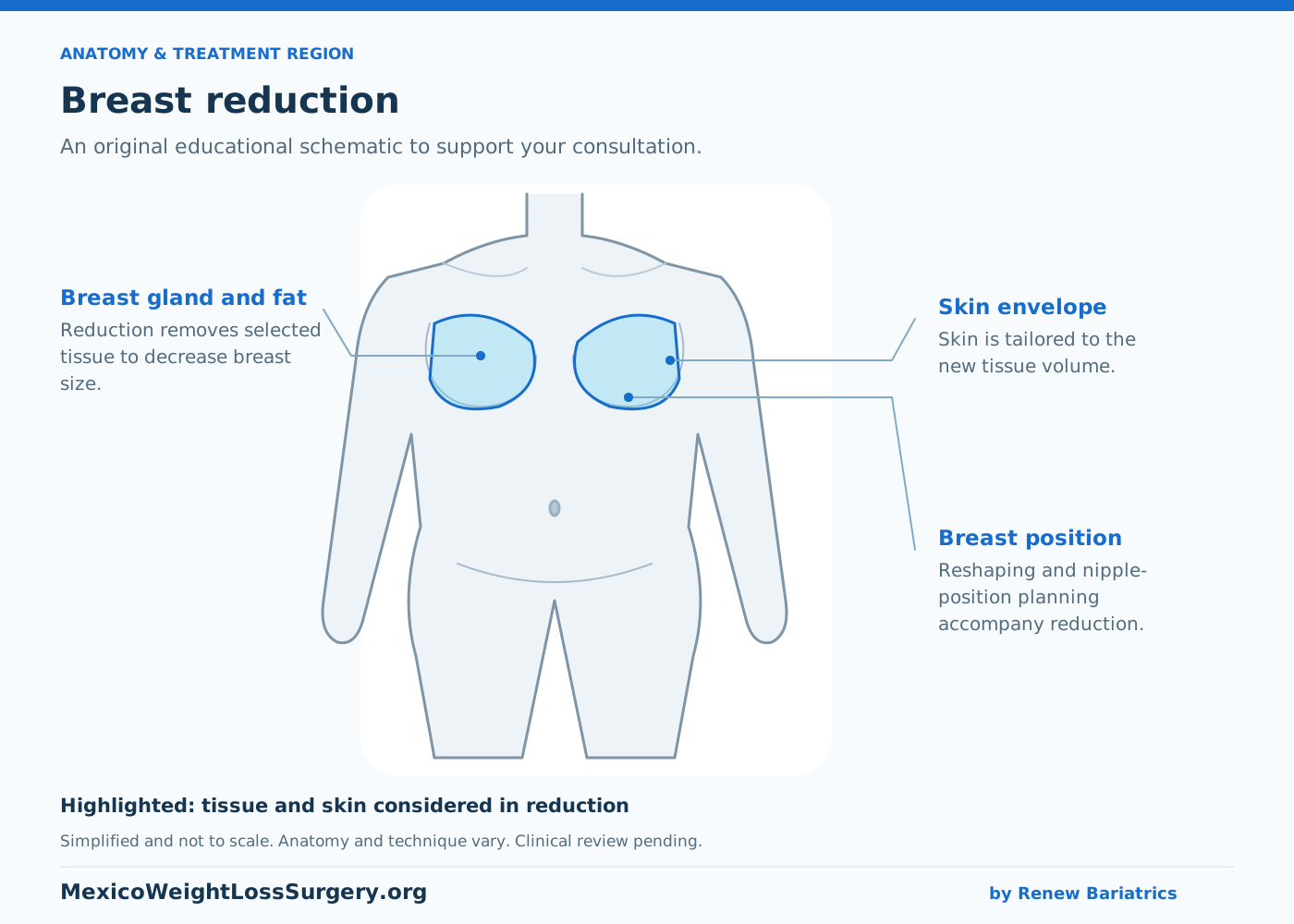
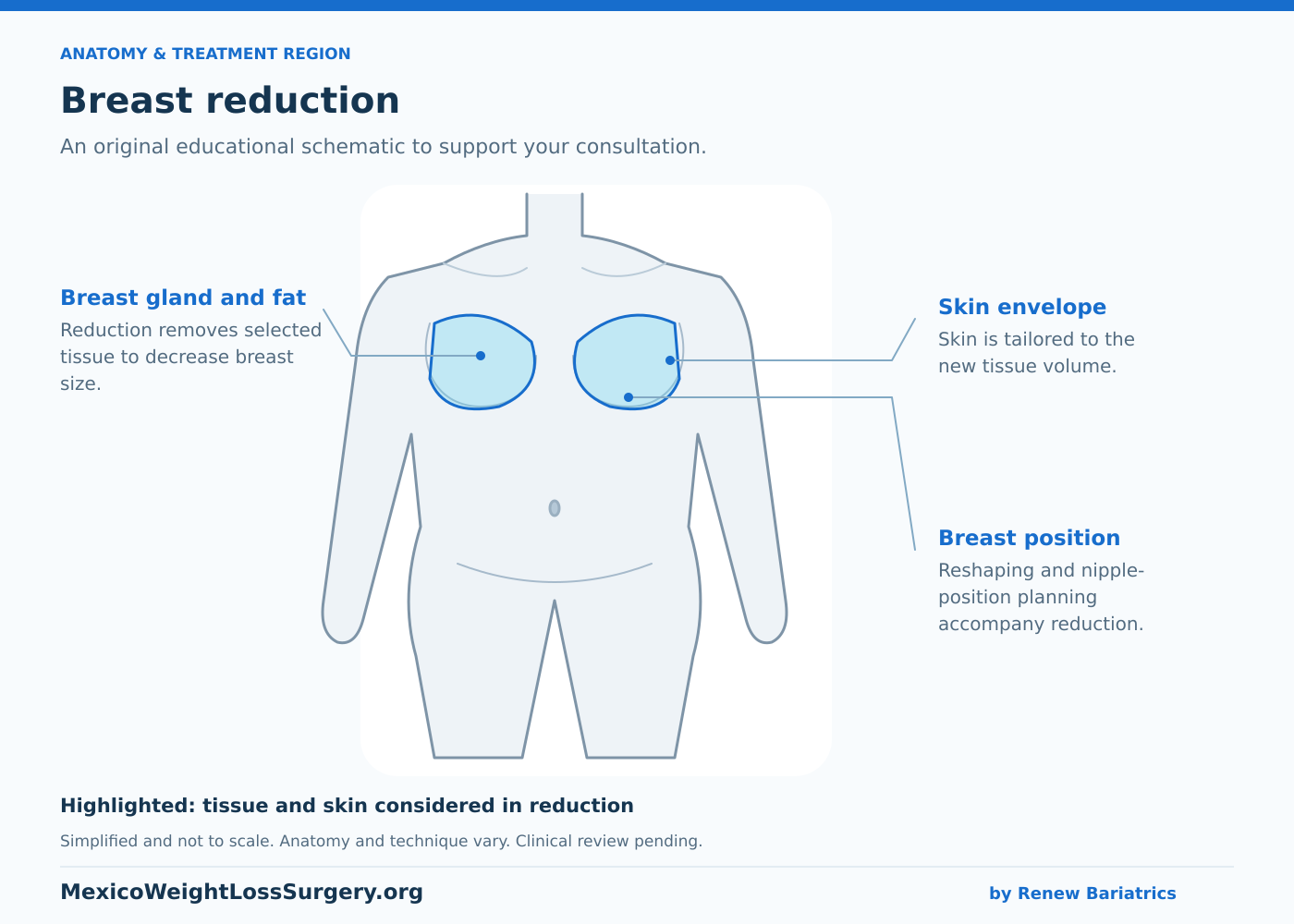
Anatomy references: ASPS — Breast reduction ↗ · ASPS — Breast lift ↗
Who may benefit from breast reduction?
Large breasts can contribute to neck, shoulder or back discomfort, bra-strap grooves, irritation beneath the breast fold and difficulty with activity. ASPS describes these as reasons people seek reduction, alongside distress about breast size. Candidates need an individualized health assessment and personally chosen goals.[1]
Tell the clinician which symptoms limit you and when they occur. For example, a concern about running may involve support and movement, while irritation under the breast fold may need examination and treatment in its own right. Do not assume that every symptom near the breast, back or shoulder has the same cause.
A useful starting record includes what you have tried, such as different support garments or medical evaluation, and what has or has not helped. You do not need to turn the consultation into a proof of suffering. The purpose is to help the clinician understand the problem and consider whether reduction is likely to address it.
There is no universally correct breast size. Explain the activities and appearance priorities that matter to you rather than asking the surgeon to select an ideal size on your behalf. Some people prioritize the greatest appropriate reduction; others want a more moderate change. Those preferences should be discussed alongside the limits of the proposed technique.
What evidence supports symptom improvement?
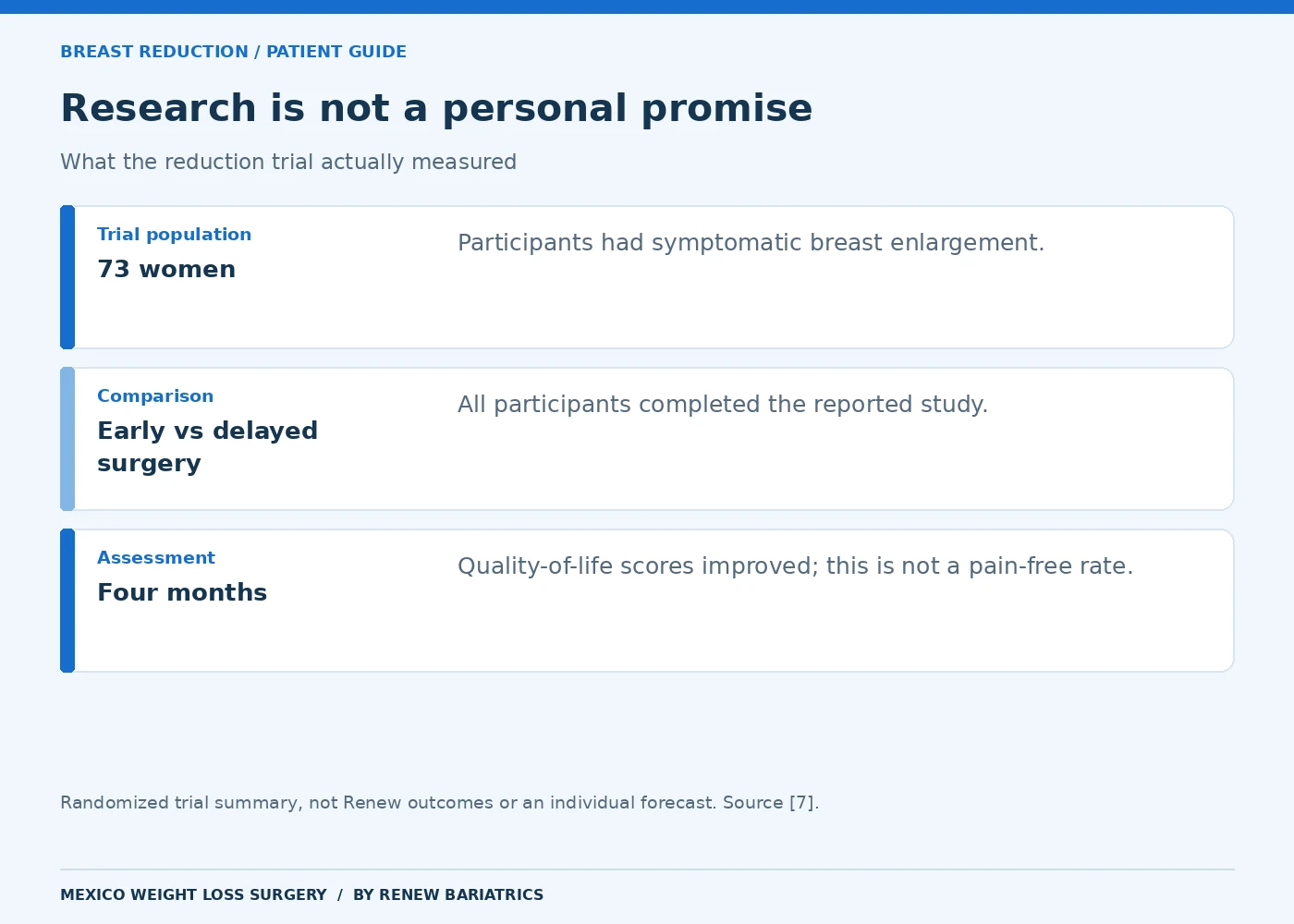
A randomized trial involving 73 women compared early reduction with delayed surgery. At four months, the early-surgery group had better scores on several quality-of-life measures. All 73 participants completed the study.[7] This is evidence that reduction can improve patient-reported wellbeing in selected people with symptomatic breast enlargement; it is not evidence that every pain complaint will disappear.
A review of seven randomized trials, including 285 participants, also reported improvements in pain and physical and psychological function. Its statistical effects describe differences in questionnaire scores, not a percentage of patients guaranteed to become pain-free.[8] The studies do not establish Renew Bariatrics' outcomes or predict your personal response.
When reading a claim such as “most patients improve,” ask what was measured and when. A satisfaction score, symptom score and complication rate answer different questions. Ask your clinician which outcomes best match your priorities and what other evaluation may be needed for symptoms that surgery might not resolve.
Breast reduction after bariatric surgery or weight loss
Weight loss does not leave everyone with the same breast changes. Some people retain considerable volume; others mainly have loose skin and a lower breast position. A reduction and a lift can both reshape the breast, but the amount of tissue removed and the central goal differ. The examination should establish whether volume reduction is actually what you want.[2]
If the breasts feel deflated rather than heavy, ask whether a lift is a better discussion. If you want both less volume and improved position, ask how the proposed reduction accomplishes those goals. Avoid deciding from a procedure name alone; have the surgeon describe what will be removed, retained and repositioned.
Give the team your bariatric procedure details, weight trend and current obesity treatment. Ask whether further weight loss is expected to change the plan and what stability the surgeon recommends. The timing decision should also account for health, nutrition and the recovery support you have available.
Lifelong bariatric supplementation and nutrition follow-up remain relevant after weight-loss surgery.[10] Ask who will review your nutritional history and any laboratory testing needed for elective surgery. Report problems taking supplements or maintaining intake. A readiness assessment should identify concerns that can be addressed, not simply collect a weight and surgery date.
How the operation changes the breasts
Reduction generally removes tissue and skin while shaping the remaining breast and repositioning the nipple-areola complex. Common incision patterns include a vertical pattern and an anchor-type pattern extending along the fold. Technique depends on anatomy, the planned reduction and clinical judgment. Liposuction may be used as an adjunct in selected cases.[2]
Ask the surgeon to explain the proposed pattern on a diagram. Find out how the plan accounts for existing differences between breasts. The amount removed from each side may not be identical, and a quoted tissue weight alone cannot describe the final shape or guarantee a particular cup size.
A cup letter is a poor surgical contract because bra sizing varies. Instead, discuss the degree of reduction, proportions and functional goals. Ask which requests the surgeon considers achievable and which could conflict with safe tissue handling or your other priorities. Document the discussion so that both of you are working toward the same broad goal.
Nipple preservation and free nipple grafting
The nipple commonly remains attached to tissue that supplies blood and nerves while it is moved. For some very large reductions, a free nipple graft may be considered: the nipple-areola complex is detached and grafted into a new position. That is an important difference with implications for sensation and breastfeeding, not a minor technical detail.[2]
Ask whether grafting is planned, considered unlikely, or a possibility that could arise during surgery. Find out how that possibility will be addressed in consent. If preserving sensation or breastfeeding potential is a high priority, say so before the technique is selected and ask what tradeoffs exist.
Scars, symmetry and the appearance tradeoff
Reduction leaves permanent scars. Some lie around the areola, some run vertically, and a horizontal scar may lie along the fold depending on technique. Their appearance can change with healing, but no responsible plan should promise invisible scars.[2],[3]
Ask where the incisions would sit in your everyday clothing, swimwear and supportive bra. Discuss prior scars and any history of raised or troublesome healing. The surgeon should explain recommended wound and scar care for your particular operation rather than offering a universal product list.
It is reasonable to care about scars and still want a reduction. The decision is a tradeoff between current symptoms or size concerns and the consequences of surgery. Look at appropriately consented clinical examples when available, but use them to understand the range of scars and shapes, not as a guarantee of your result.
Perfect symmetry should not be the expectation. Ask which differences are likely to remain and what would constitute a reason to consider revision after healing. Early swelling can complicate judgments; arrange a timeframe for reassessing concerns rather than drawing conclusions from the first days after surgery.
Risks you should discuss before consenting
Risks include bleeding, infection, wound-healing problems, fluid collection, asymmetry, altered sensation and unsatisfactory shape. Some people need additional surgery. Partial or complete nipple-areola loss can occur, and breast reduction can affect future breastfeeding. Anesthesia complications and blood clots are also part of informed consent.[3]
Discuss risk in the context of your actual health and proposed operation. Ask whether smoking or vaping, medications, prior operations or other conditions change the recommendation. A clinic-wide complication figure may be less relevant than an explanation of the concerns your surgeon sees in your individual assessment.
If a numerical risk is quoted, request the denominator, follow-up period and definition. “Wound problems” might include a small area requiring dressings or a complication requiring an operation; those are different experiences. Ask whether the number comes from published research or the surgeon's own documented patients.
No website can turn those group figures into certainty for one person. A useful consultation explains both the probability where evidence exists and the practical consequences if a complication occurs. Ask about treatment access, additional appointments, a possible longer stay and costs before assuming these are included.
Breastfeeding, nipple sensation and pregnancy
Discuss pregnancy and breastfeeding plans early. Reduction can limit the ability to breastfeed, and nipple sensation may change temporarily or permanently.[3] The exact operation matters, but no conversation should promise that function will be preserved simply because the procedure is commonly performed.
If you are considering pregnancy soon, ask whether postponement better fits your priorities. If symptoms are severe and you prefer to proceed, ask the clinician to explain the available choices without minimizing the tradeoff. A decision may be reasonable for one person and unacceptable to another because their priorities differ.
Breasts can continue changing with aging, pregnancy, hormonal factors and weight fluctuations after surgery.[6] Discuss what long-term change might mean for your goals and whether further treatment could ever be considered. “Long-lasting” does not mean that breast size and shape become permanently fixed.
Reduction is different from implant surgery
A standard breast reduction does not require adding an implant. If an implant or another procedure is proposed, ask why it is needed and request separate consent information. A plan intended to reduce heaviness should not acquire an added device without a clear discussion of your goals.
BIA-ALCL and reported implant-capsule cancers such as BIA-SCC concern breast implants; they are not risks created by an implant-free reduction itself. FDA information about these issues becomes relevant if you already have implants or are considering their placement as part of a different plan.[16] Tell the surgeon about any prior implant, including one removed previously, and provide records when available.
Preparing for a consultation
Bring your medical history, current medications and supplements, allergies, previous surgery information and relevant breast imaging or biopsy reports. ASPS recommends discussing breast cancer history, tobacco and vaping use, goals and expectations. The surgeon examines the breasts and explains options and risks.[4]
Report any new breast lump, discharge or unexplained skin change. Ask whether diagnostic evaluation is needed before elective surgery. Reduction planning should not be used to bypass an unresolved screening or symptom assessment.
If the first conversation is remote, ask which decisions remain provisional until an examination. Clarify whether the price or operation can change afterward and what happens if you choose not to accept the revised plan. You should have time to consider meaningful changes rather than feeling committed by travel or a deposit.
Request the treating surgeon's full name, relevant specialty credentials and facility details. Ask how to verify those facts independently, who provides anesthesia, and how complications are managed. This page makes no unsupported claim about a particular surgeon's certification or a facility's accreditation.
Preparing for surgery and support at home
Preparation can include medical testing, imaging if appropriate, medication instructions and smoking cessation. The team should provide individualized directions and arrange safe discharge support.[5],[13] Do not independently stop prescribed medicines or copy a medication schedule from another patient.
Make a practical recovery list: help with children, lifting, shopping, transport and household tasks. Someone may need to accompany you to appointments or help communicate if you are tired. Ask the team what support is essential during the first part of recovery and what changes if other operations are performed at the same time.
Agree on a communication plan with your support person. Share emergency contacts, medication instructions and appointment details. Decide who handles booking changes if travel is delayed. These arrangements reduce the chance that routine logistics compete with clinical decisions at a stressful moment.
Recovery after breast reduction
Dressings, a support garment and sometimes drains may be used. Your instructions should address incision care, medicines, activity and follow-up. Swelling can obscure the final appearance, and recovery continues beyond the initial postoperative period.[9]
Ask the surgeon to separate personal care, desk work, driving, lifting and exercise into distinct milestones. The answer may differ depending on your technique, health and healing. A general online recovery timeline cannot authorize a physically demanding job or a long return journey.
Describe your job specifically. If it involves reaching, pushing, lifting or emergency responses, tell the clinician rather than relying on its job title. Ask about modified duties and obtain documentation if your employer requires it. If returning early is financially important, discuss that before surgery rather than discovering the conflict afterward.
Check how the team wants you to monitor wounds and report changes. Do not remove dressings, change garment pressure, start massage or use scar products without the appropriate instructions. If a drain is used, ask who manages it, what information to record and when it will be reviewed.
Symptoms needing prompt medical attention
Worsening pain, rapidly increasing swelling, spreading redness, fever, drainage or an opening incision should prompt contact with the clinical team. New chest pain, difficulty breathing, fainting or concerning leg symptoms need urgent medical assessment. Do not wait for an ordinary follow-up visit if you suspect a serious problem.[3],[12],[15]
Before discharge, confirm where to go if an examination is needed after hours. A messaging service is not a complete emergency plan. If the coordinator is unavailable, you should still know how to reach a clinician or local emergency care.
Traveling for breast reduction in Mexico
Surgery and prolonged travel can both contribute to blood clot risk. CDC recommends addressing medical tourism risks and follow-up before travel.[12],[15] Your clinician should review the proposed return itinerary and decide whether you are ready to travel; the end of a hotel booking is not medical clearance.
Allow for the possibility of additional appointments or a longer stay. Ask what happens if the surgeon delays departure, how extra accommodation is arranged and which costs you must cover. Consider the full journey, including transfers, airport waits and time seated in a car.
Identify a clinician at home who can provide appropriate follow-up before you leave. Ask what services they can offer and what records they require. Keep your operative report, discharge summary, medication list and pathology information if tissue is assessed. Make sure both teams understand how questions and results will be communicated.
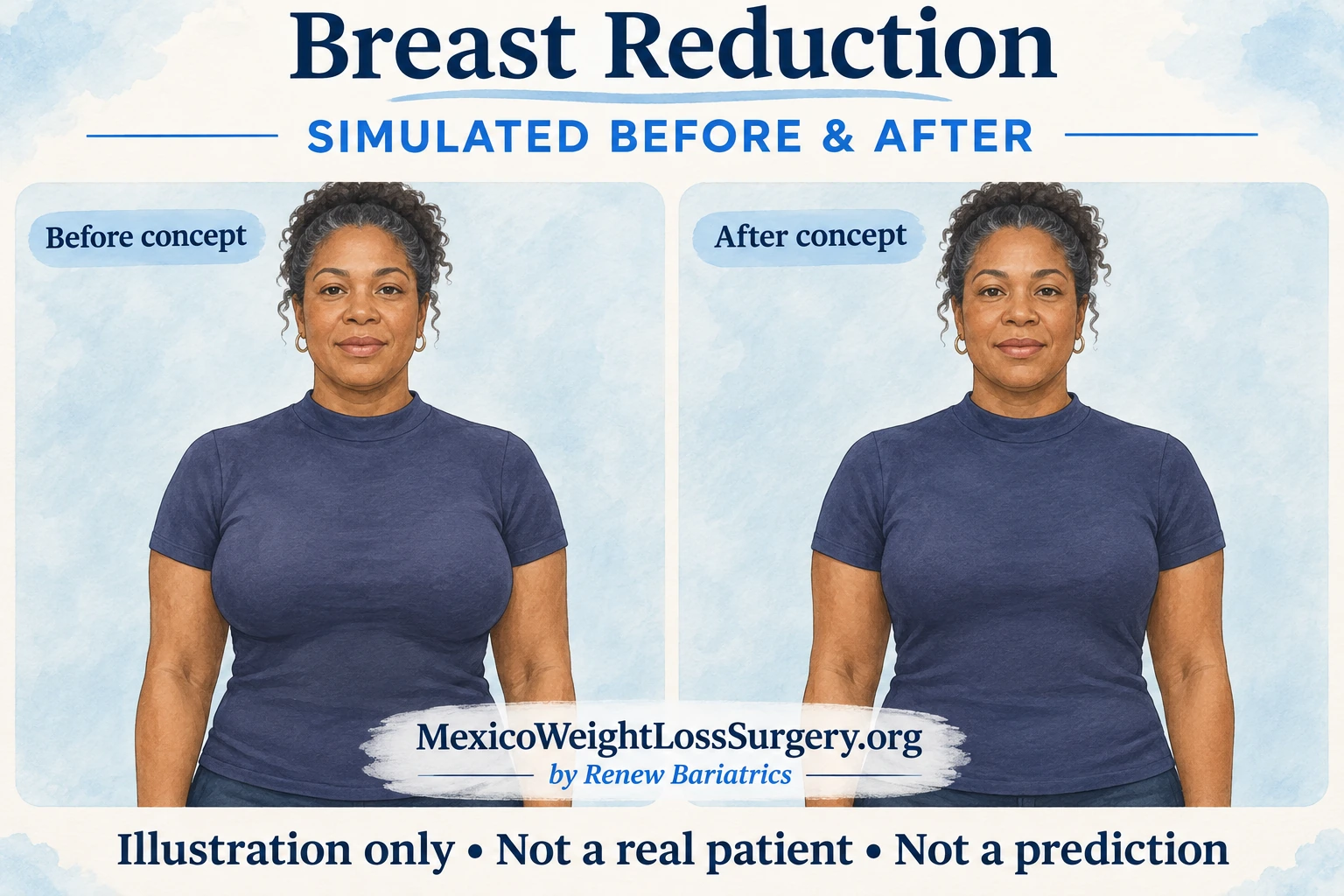
A synthetic illustration of possible changes
This fictional example illustrates a treatment concept. It cannot show the result you would achieve, predict scar healing, or establish a typical outcome.
Breast Reduction Cost in Mexico
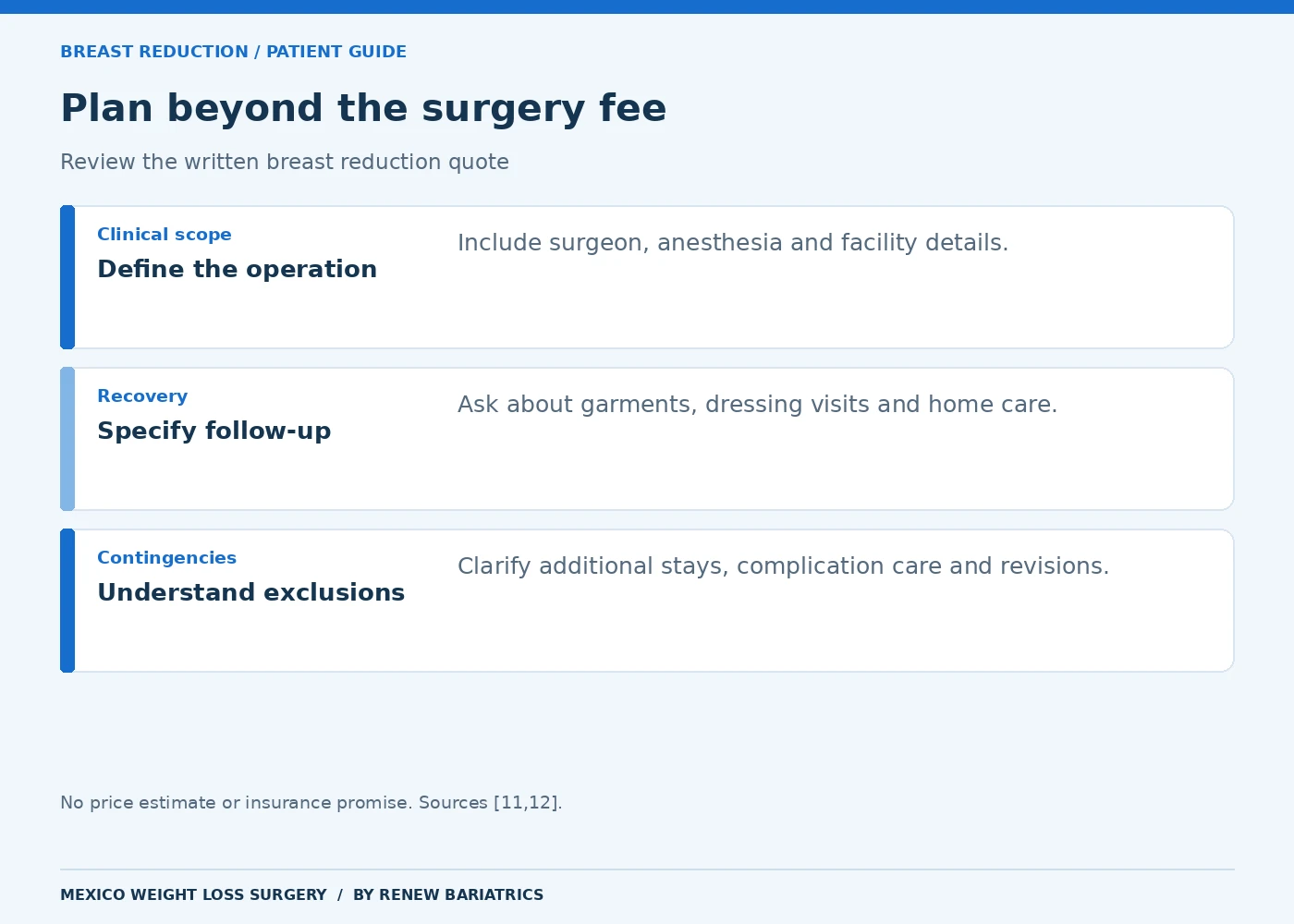
The complete breast reduction cost in Mexico depends on the clinical plan and included services. This page does not supply an invented package price. Ask for a personalized quote after assessment and confirm whether any related operation is included or separately charged.
Common fee categories include the surgeon, anesthesia, facility, tests, garments and medications.[11] Request a written statement of planned visits, dressing support and any pathology fees as well. Do not assume that a broad “all-inclusive” label covers every item you might need.
Budget separately for travel, lodging, a companion, time away from work and care after returning home. Ask how additional nights, unexpected visits, readmission or revision would be billed. A quote should distinguish routine care from costs that arise only if the plan changes or a complication occurs.
Can insurance cover a breast reduction in Mexico?
Breast reduction may be covered in some circumstances, but policy criteria, authorization and overseas exclusions vary.[11] Obtain a written insurer decision about the proposed care. Ask separately about complications and follow-up in your home country. A provider saying a procedure is medically beneficial is not the same as your insurer authorizing payment.
Is the lowest quote the best value?
Price comparisons are useful only when the operations and services match. Ask each provider to identify the surgeon, setting, anesthesia and aftercare, then compare the total planned cost. If one quote is substantially lower, request an explanation of what is included and excluded rather than assuming either superior efficiency or inferior care.
What should I check before paying a deposit?
Get the operation and quoted scope in writing, along with cancellation, postponement and refund terms. Ask how a changed clinical recommendation affects the payment. If the surgeon advises waiting or a different procedure, you need to understand the financial consequences before that situation arises.
Make a plan around your actual priorities
Before booking, you should understand the intended degree of reduction, scar pattern, sensation and breastfeeding tradeoffs, major risks, follow-up and total quoted scope. Ask Renew Bariatrics to confirm current availability, the treating surgeon and the assessment process.[14] Your symptoms and goals should guide the consultation; neither a cup-size promise nor a promotional deadline should define it.
Review breast lift when loose skin and position are your main concerns, and breast augmentation if you are comparing a different volume goal. For combined planning, explore mommy makeover, skin removal after weight loss, aftercare and cost and pricing. Each proposed operation needs its own assessment and a recovery plan that works together with the others.
Program information related to this guide
Explore Renew Bariatrics’ procedure options when discussing a plastic surgery plan. Availability, combinations and suitability require individual confirmation.
Breast reduction vs. breast lift
These procedures address different concerns and may be combined or staged. A clinical assessment determines which, if either, fits your anatomy and goals.
| What to compare | Breast Reduction → | Breast Lift → |
|---|---|---|
| Main goal | Reduces breast size and weight. | Raises and reshapes the breast. |
| What changes | Tissue removal plus skin reshaping. | Skin tailoring and tissue reshaping. |
| Key distinction | Size reduction differs from volume enhancement. | Does not primarily add volume. |
| Recovery consideration | Healing and sensation changes need discussion. | Permanent incision scars require healing. |
| Cost comparison | Request an itemized quote for this exact procedure and care plan. | Compare the same inclusions, exclusions and recovery expenses. |
Comparison references: ASPS — Breast reduction ↗ · ASPS — Breast lift ↗
These options are not interchangeable for every person. The treating clinician must assess your anatomy, medical history and goals.
Further reading
Discuss your options with Renew.
Talk with a coordinator about breast reduction, your goals and the information needed for clinical review. The treating team determines suitability and the care plan.
Call 844-736-3963 Ask about plastic surgery ↗The link opens Renew’s plastic surgery health questionnaire. This review site does not collect health information.
References & evidence notes
Sources checked November 2026. Research findings are not a forecast for an individual or outcomes for Renew’s own program. Review study populations, methods and limitations alongside the reported results.
- American Society of Plastic Surgeons. Breast Reduction Candidates ↗Professional society patient guidance; individual assessment required.
- American Society of Plastic Surgeons. Breast Reduction Procedure Steps ↗Professional society patient guidance; individual assessment required.
- American Society of Plastic Surgeons. Breast Reduction Risks and Safety ↗Professional society patient guidance; individual assessment required.
- American Society of Plastic Surgeons. Breast Reduction Consultation ↗Professional society patient guidance; individual assessment required.
- Mayo Clinic. Breast reduction surgery ↗Preparation and individualized perioperative assessment.
- American Society of Plastic Surgeons. Breast Reduction Results ↗Professional society patient guidance; individual assessment required.
- Randomized clinical trial, 2006. Randomized clinical trial examining psychosocial and quality of life benefits of bilateral breast reduction surgery ↗73 women randomized to early or delayed surgery; four-month quality-of-life assessment; not a provider outcome study.
- Systematic review and meta-analysis. Postoperative Health-related Quality of Life in Reduction Mammaplasty ↗Seven randomized trials, 285 participants; questionnaire effects are not absolute probabilities of symptom resolution.
- American Society of Plastic Surgeons. Breast Reduction Recovery ↗Professional society patient guidance; individual assessment required.
- ASMBS. Life After Bariatric Surgery ↗Ongoing nutrition, supplementation and bariatric follow-up; not a plastic surgery clearance protocol.
- American Society of Plastic Surgeons. Breast Reduction Costs ↗Professional society patient guidance; individual assessment required.
- CDC Yellow Book. Medical Tourism ↗Travel, continuity, record transfer and financial planning; individual travel clearance required.
- American Society of Plastic Surgeons. Consultation and Preparing for Surgery ↗Reduction planning, medical review, records and recovery assistance.
- Renew Bariatrics. Procedures ↗Used only to establish that the procedure is advertised; not evidence of eligibility, prices or outcomes.
- CDC Yellow Book. Deep Vein Thrombosis and Pulmonary Embolism ↗Travel-related clot risk and clinical assessment.
- U.S. Food and Drug Administration. Risks and Complications of Breast Implants ↗Device complications and reports of capsule-associated malignancy; not provider-specific outcomes.