
Jump to a section
Anatomy illustrationSynthetic illustrationCompare proceduresRelated ProceduresWhat rhinoplasty can changeAppearance and breathing require different assessmentsWho may be a candidate?Preparing for the consultationOpen, closed and structural approachesWhat a realistic result meansRhinoplasty risks and limitationsPreparation and medication planningRecovery after rhinoplastyTraveling to Mexico and returning homeRhinoplasty Cost in MexicoChoosing a surgeon and understanding the care teamFrequently asked questionsYour next stepReferencesRhinoplasty in Mexico deserves a conversation about both appearance and breathing before a conversation about price. Some people want to change a bridge or tip; others have an injured or crooked nose, troublesome nasal obstruction, or several concerns together. The right operation depends on the examination, your goals and what the surgeon can reasonably achieve. A photograph alone cannot answer all those questions.[1],[11]
This guide explains the decisions behind a rhinoplasty plan, the questions to ask about recovery, and what to include when comparing rhinoplasty cost in Mexico. It does not predict your result or establish eligibility. Treat an initial quote as a description to investigate: which surgeon, which operation, which facility and which follow-up arrangements does it actually include?
MexicoWeightLossSurgery.org is owned by Renew Bariatrics. If you contact the team, ask for confirmation of current rhinoplasty availability, the treating surgeon and the consultation process. Information about a procedure is different from a personalized recommendation. You can request an assessment without committing to surgery or travel.
Understand the anatomy
A simplified, labeled view of the structures and treatment area. Select the image to view it at full size.
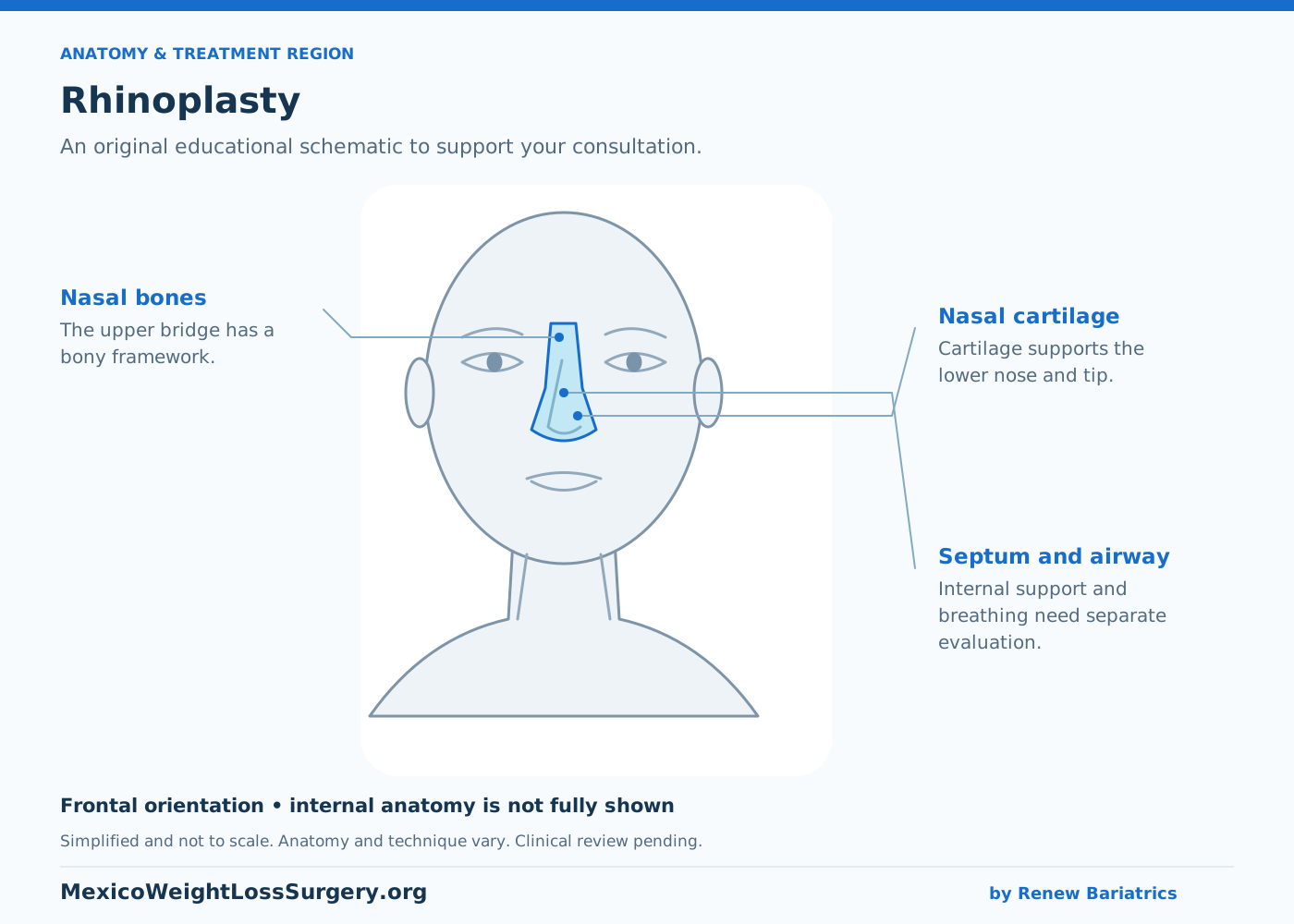
Anatomy references: ASPS — Rhinoplasty ↗ · ENT Health — Deviated septum ↗ · ENT Health — Nasal surgery: form and function ↗
What rhinoplasty can change
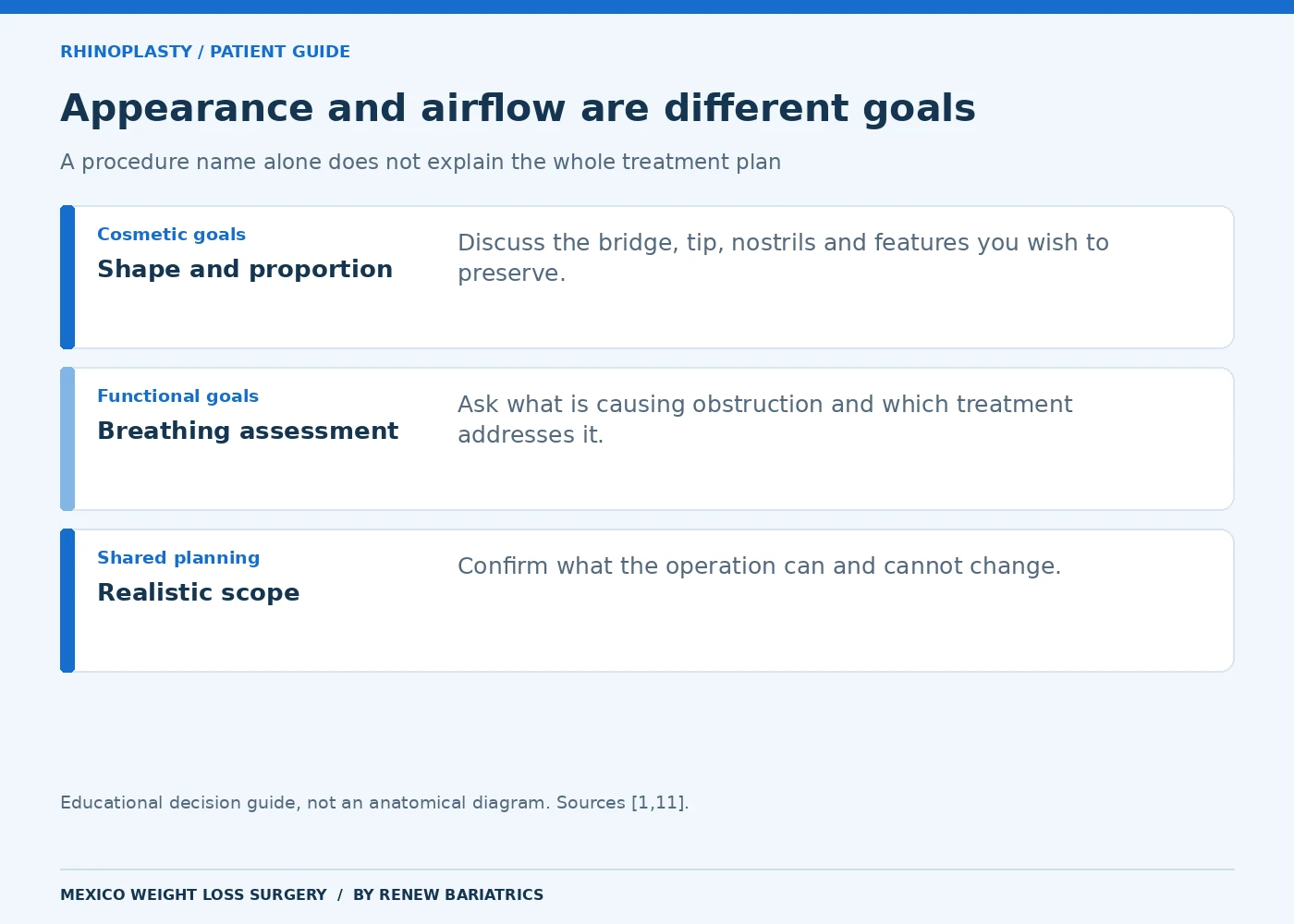
Rhinoplasty changes the structure or shape of the nose. Cosmetic and functional goals can overlap, but they should be documented separately. A person might want a less prominent bridge while also needing evaluation of difficult breathing. Another person may be satisfied with appearance and primarily want a functional assessment. The AAO-HNS guideline specifically calls for assessment of nasal obstruction and discussion of expectations before surgery.[1]
Instead of bringing a single idealized reference photograph, describe your priorities in ordinary language. You might say that the side profile bothers you, that your tip appears asymmetric in photographs, or that you want a change that preserves a family resemblance. Ask the surgeon to explain which observations reflect anatomy, which are influenced by camera angle, and which are unlikely to improve with an operation.
This is also the time to explain what you do not want changed. A useful consultation leaves you with a shared description of the intended scope. It should not rely on an assumption that a smaller nose, a particular slope or a popular social-media style is automatically better for your face.
Appearance and breathing require different assessments
Nasal breathing symptoms need a clinical explanation. The external shape of a nose does not by itself identify the cause of obstruction. The internal septum and other nasal structures may need evaluation, and a functional treatment plan may differ from a cosmetic reshaping plan. AAO-HNS clinical indicators emphasize both internal and external assessment.[11]
Ask whether your proposed operation is cosmetic rhinoplasty, functional rhinoplasty, septoplasty, or a combination. Request the names in writing rather than relying on a broad term such as “nose surgery.” If a separate airway problem is suspected, ask whether another examination or specialist opinion is appropriate before a final surgical decision.
A cosmetic change should not be represented as a guaranteed cure for snoring, sleep apnea or every breathing complaint. Tell the team about any sleep apnea diagnosis, breathing device, prior nasal injury, previous surgery or regular nasal medication use. The guideline highlights conditions that can alter perioperative planning, including sleep apnea and bleeding disorders.[1]
Who may be a candidate?
ASPS describes general rhinoplasty candidates as people whose facial growth is complete, who are physically healthy, do not smoke and have realistic goals. These are starting considerations, not an online eligibility test. The decision should be your own rather than a response to pressure from a partner, employer or social-media audience.[2]
A consultation should connect the proposed change to an achievable goal. If you expect surgery to guarantee a relationship, career opportunity or relief from every concern about your appearance, make those expectations part of the discussion. A surgeon may recommend more time, further evaluation, a different approach or no surgery. That response can be valuable even when it is not the answer you initially wanted.
For a person who has undergone bariatric surgery, include that history even though this is facial surgery. Bring the name and date of the procedure, current supplements and any known nutritional or medical problems. Ask the clinicians responsible for your ongoing care what information the operating team needs. Do not assume that a smaller operation eliminates the need for a complete health review.
Preparing for the consultation
ASPS recommends discussing previous operations, medical conditions, medications, supplements, allergies, tobacco and other substance use. Examination, photographs and an explanation of available options are typical parts of assessment.[3]
Make a short written record before the appointment. Include your two or three main priorities, any breathing symptoms, previous injuries, and questions about features you wish to preserve. Describe symptoms precisely: when they occur, whether they affect one side or both, and whether anything has already been investigated. You do not need to diagnose yourself to provide useful information.
Bring the full names and doses of medicines rather than saying only that you take a blood thinner or a weight-loss medication. Include nonprescription products and nasal sprays. If your records are in a different language from the treating team, ask how they should be translated and transmitted securely. Confirm who reviews the information and whether the operating surgeon will speak with you before consent.
A coordinator can explain logistics. Questions about the actual operation, expected limitations and personal risks belong with the responsible clinician. If an answer is unclear, ask for a second explanation using everyday words.
Open, closed and structural approaches
ASPS describes closed rhinoplasty incisions within the nose and an open approach that also uses an incision across the tissue between the nostrils. Bone or cartilage may be reshaped; some plans require cartilage grafts. The source of a graft and any additional incision should be explained before surgery.[4]
These labels are not quality rankings. Ask why an approach is recommended for your anatomy and goals rather than choosing it because the name sounds more modern or less invasive. The useful comparison is the surgeon's explanation of access, structural support, scars, limitations and recovery in your particular case.
If a plan includes grafting, ask where the tissue will come from, whether that creates another recovery site and what happens if the anticipated graft source is unsuitable. If you previously had nasal surgery, request a discussion of how that history changes the available choices. Revision surgery should receive its own assessment; an earlier operation is not simply irrelevant background.
Do not approve a broader operation merely because it has been placed in a package. Any proposed additional facial procedure should have a separate purpose, risk discussion and consent process.
What a realistic result means
A consultation should identify an improvement you would consider worthwhile while acknowledging features that may remain. ASPS notes that rhinoplasty results are not guaranteed and that additional surgery can sometimes be needed. Healing and facial aging continue after an operation.[8]
A computer simulation can help two people discuss the same idea, but it is not a contract for an exact shape. Ask which aspects of a simulation are intended as communication aids and which changes the surgeon considers technically realistic. Do not use a rendered image as evidence that your skin, cartilage and healing will behave in a particular way.
When reviewing genuine patient photographs, ask whether the cases involved a similar starting concern and how long after surgery the photographs were taken. Consistent lighting, angle and expression make comparisons more meaningful. A single attractive image does not tell you the person's breathing outcome, satisfaction, complications or need for another procedure.
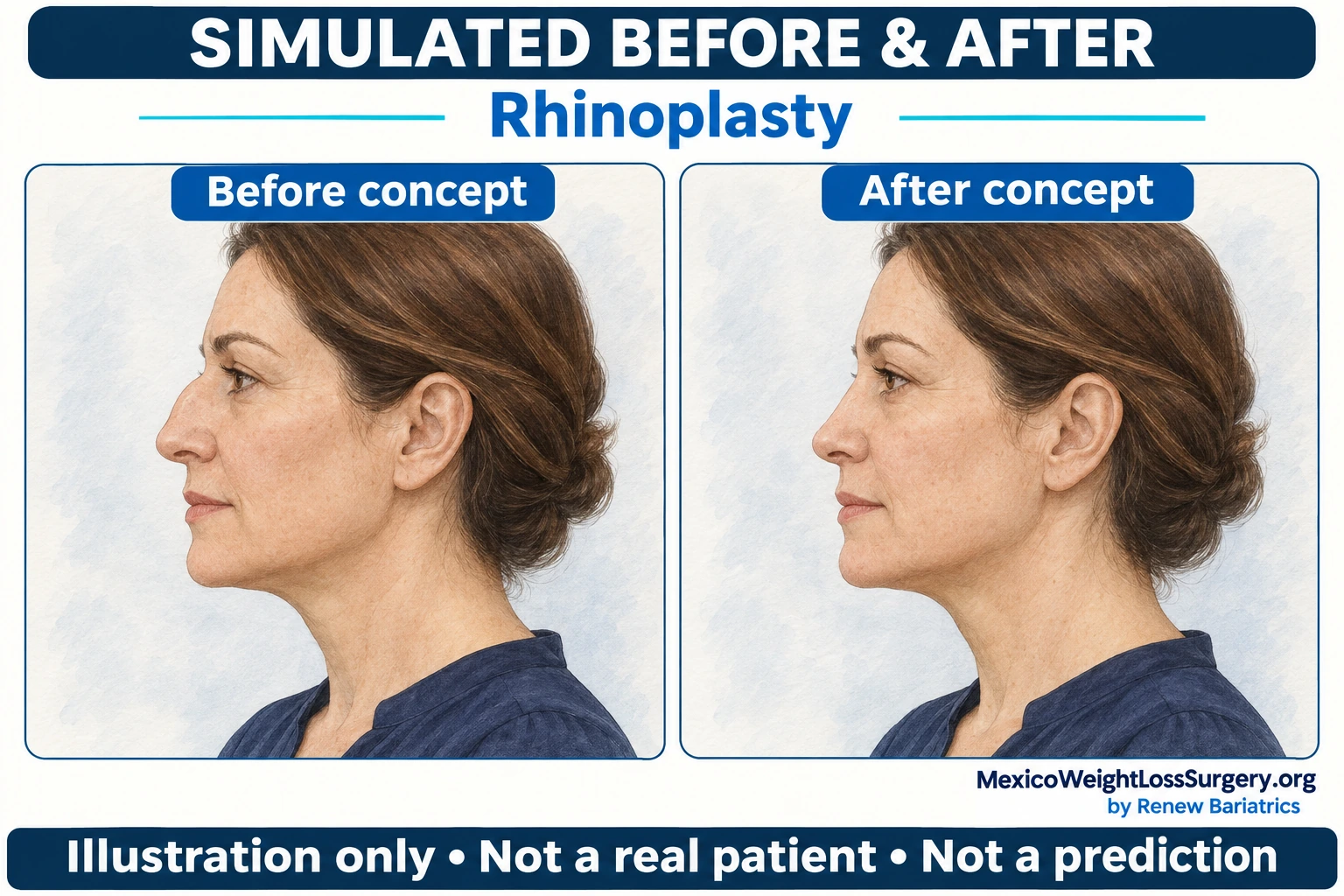
The watercolor illustration on this page is deliberately editorial. It depicts a fictional adult and is not a patient photograph, a before-and-after image or a forecast of what rhinoplasty will make you look like.
Rhinoplasty risks and limitations
ASPS lists risks including infection, changes in sensation, impaired breathing, unfavorable scarring, persistent swelling or discoloration, unsatisfactory appearance and possible revision. A septal perforation is another potential complication and may be difficult to correct. Anesthesia also carries risks.[5]
Ask the surgeon to distinguish ordinary expected recovery experiences from warning signs. “Swelling is normal” is not an adequate answer to every postoperative concern. You should know which changes require a routine message, a same-day assessment or emergency care. Request that guidance in writing, with contact information you can use outside office hours.
Discuss what would happen if the result differed from the agreed goal. Who evaluates the concern? How long would assessment of healing take? What is covered if additional treatment is recommended? A revision policy is a financial and clinical arrangement, not a guarantee that another operation will be appropriate or successful.
Consent should include both appearance and function. If you feel rushed to sign before your questions have been answered, pause the booking process. The decision remains elective even after you have invested time in research.
Preparation and medication planning
Preoperative preparation may include testing, medical evaluation, smoking cessation and changes to selected medicines. ASPS also emphasizes transport and having support after an outpatient procedure.[6]
Your team must give you individualized instructions. Do not stop prescribed anticoagulants, diabetes medicines, weight-management medicines or other treatment based on a generic website schedule. Ask the prescribing clinician and anesthesia team to reconcile the plan. Confirm fasting instructions, what to do if you become ill, and whom to contact if your health changes shortly before travel.
Arrange practical details while you can still make decisions comfortably: where you will stay, who will accompany you, how appointments will be reached and how prescriptions will be obtained. Pack records and contact information where your support person can find them. If you wear glasses, use a breathing device or have work that requires protective face equipment, ask about those specific needs before surgery.
Recovery after rhinoplasty
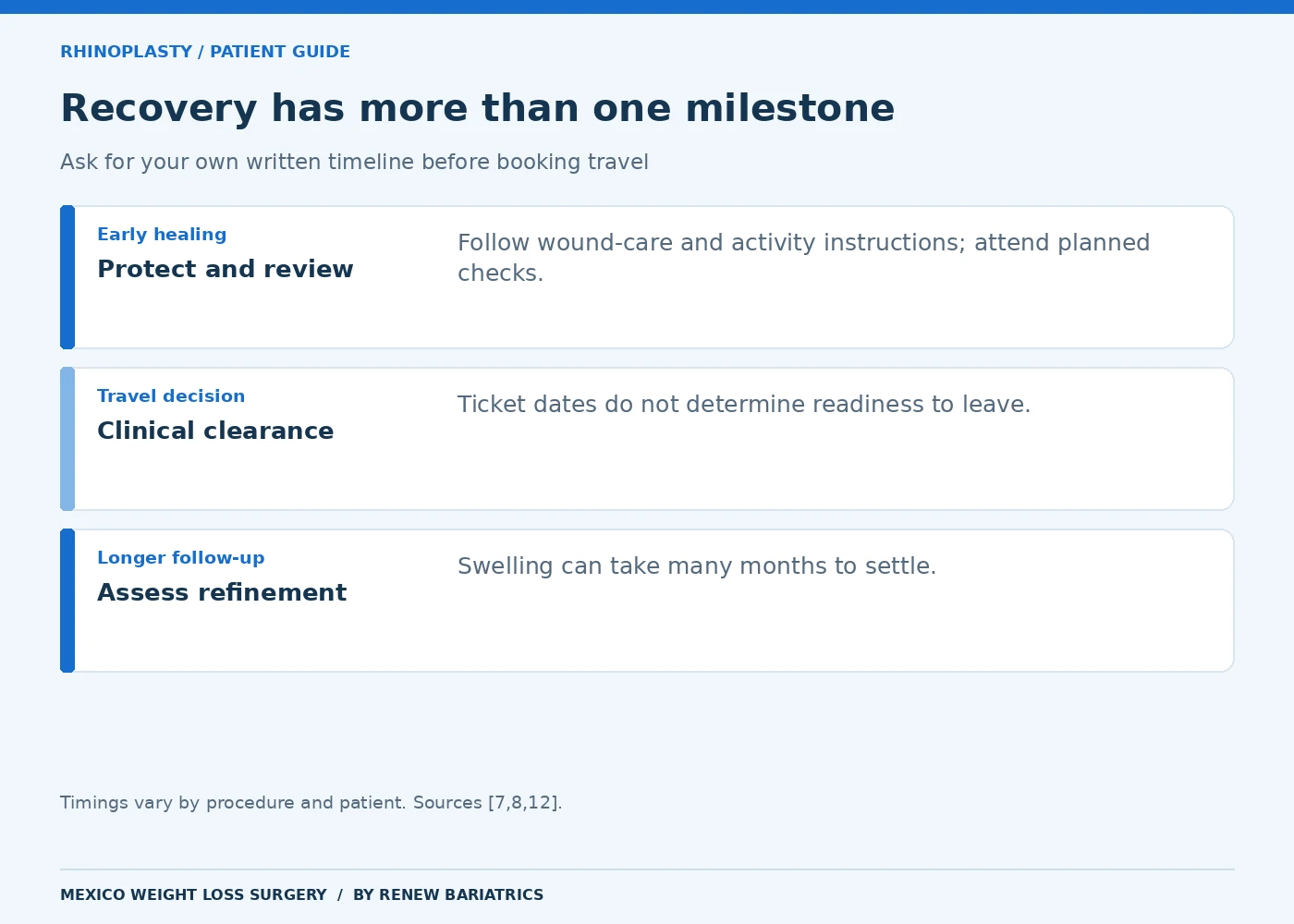
Splints, dressings or internal support may be used depending on the operation. Early swelling can improve over weeks while finer changes continue much longer; ASPS notes that refinement can take up to a year. Your own course may differ.[7]
The first recovery appointment and the final appearance assessment serve different purposes. An early visit checks healing and immediate concerns. It does not necessarily show the settled contour. Ask when dressings or sutures will be reviewed and when you should expect further assessments after returning home.
Get clear instructions about sleeping position, cleaning, touching the nose, exercise, work, glasses and activities that risk facial impact. Ask for permission specific to your activity rather than translating “take it easy” into your own rule. A desk job, physical job and contact sport involve very different demands.
Keep a simple recovery record if the team recommends one: prescribed medicines taken, questions, appointment dates and any symptoms that need reporting. The goal is to support communication, not to monitor your face obsessively in multiple mirrors every day. If the process is emotionally difficult, tell the team rather than assuming you must handle it alone.
Traveling to Mexico and returning home
CDC warns that postoperative travel introduces additional risks and recommends continuity of care and access to records. Its general travel guidance cannot replace personal clearance by the treating team.[12]
Before paying for flights, request a written estimate of the planned local stay and understand how it could change. Ask who decides you are ready to travel and whether that decision involves an in-person examination. A hotel reservation or airline ticket does not establish medical readiness.
Create a practical return-home plan with named contacts. Who can examine you locally if you develop a concern? How will your operating surgeon communicate with that clinician? Which records will you receive, and in what language? Consider what you would do if a delayed recovery required a longer stay or a changed flight. These are useful planning questions, not predictions that a complication will occur.
Avoid building the trip around sightseeing, strenuous outings or a tight work deadline. Discuss the actual itinerary, including long drives and connections, with your team. If urgent symptoms occur, seek appropriate local medical attention instead of waiting for a scheduled remote call.
A synthetic illustration of possible changes
This fictional example illustrates a treatment concept. It cannot show the result you would achieve, predict scar healing, or establish a typical outcome.
Rhinoplasty Cost in Mexico
There is no responsible universal price for every nose operation. ASPS identifies surgeon, anesthesia, facility, testing and medication expenses as potential cost components. Its published U.S. surgeon-fee information is not an all-inclusive Mexico quote.[9]
A useful rhinoplasty cost in Mexico comparison begins with matching the clinical scope. A primary cosmetic operation, a procedure addressing breathing, and revision surgery may involve different work. Ask whether grafting or a second surgical site is anticipated. Comparing two headline prices without this information can conceal a substantial difference in the proposed treatment.
Request an itemized written quote that answers these questions:
- What is the exact operation, and who is the named surgeon?
- Are anesthesia, facility charges and the planned level of postoperative observation included?
- Which consultations, tests, medicines, dressings and follow-up visits are included?
- Which lodging, transportation or companion expenses are included, if any?
- What happens financially if surgery is postponed after medical assessment?
- What additional charges could arise from a longer stay, unplanned care or a later revision?
Ask whether the quote has an expiration date and which currency applies. If financing is offered, review the lender's terms separately from the surgical recommendation. A monthly payment does not describe the total cost of treatment.
Insurance questions also require a separate answer. A functional indication does not automatically mean an insurer will pay for surgery abroad. Ask your insurer directly about authorization, documentation, overseas care and exclusions before assuming reimbursement. Keep any answer in writing.[9]
Choosing a surgeon and understanding the care team
ASPS encourages questions about training, procedure experience, facilities, recovery arrangements and management of complications.[10]
For care in Mexico, ask for the surgeon's full legal name, specialty credentials and the exact facility name. Verify those details with the relevant issuing bodies rather than accepting a generic badge or a company's overall reputation as proof about an individual. Ask who provides anesthesia and who is responsible when the surgeon is unavailable.
Request an explanation of the team's experience with your type of concern. A surgeon who commonly performs primary cosmetic surgery may approach a complex functional or revision problem differently. The important question is not who claims to be “best,” but who can explain the proposed plan, its limits and how problems would be handled.
You should also understand the relationship between the website, coordinating company, surgeon and facility. Confirm who receives payment, who holds your medical record and who provides postoperative medical care. Put service commitments into writing so your expectations do not depend on an informal conversation.
Frequently asked questions
Will rhinoplasty fix my breathing?
Only an examination can establish the cause of symptoms and whether the proposed operation addresses it. Ask for a distinct functional assessment rather than assuming a cosmetic change will improve airflow.[11]
Is open or closed rhinoplasty better?
Neither label is a universal recommendation. Ask why the surgeon favors a particular approach for your anatomy, whether grafting is needed and what scars or limitations come with it.[4]
When will I see the final result?
Early improvement is different from full refinement. The appearance can continue changing over many months. Request a follow-up schedule and avoid judging the final contour from the first postoperative photographs.[7],[8]
How much does rhinoplasty cost in Mexico?
Request a current individualized quote after clinical review. Compare the exact operation and the full episode of care, including exclusions, instead of relying on an advertised starting price. This guide does not publish an unverified provider price.[9]
Can I combine it with another procedure?
Ask the surgeon to compare a combined plan with separate stages and explain the effect on anesthesia, recovery and follow-up. A discount or shared travel date is not sufficient justification for adding surgery.
What should I do next?
Write down your appearance and breathing priorities, collect relevant records and request a surgeon-led assessment. Ask Renew Bariatrics to confirm current availability and provide a written proposal identifying the clinician, procedure, follow-up and cost. Take time to review it before choosing a date.
Program information related to this guide
Explore Renew Bariatrics’ procedure options when discussing a plastic surgery plan. Availability, combinations and suitability require individual confirmation.
Rhinoplasty vs. septoplasty
Rhinoplasty and septoplasty address different nasal concerns. Septoplasty targets a deviated septum; rhinoplasty changes nasal form and may include functional work. They can be combined as septorhinoplasty.
| What to compare | Rhinoplasty → | Septoplasty → |
|---|---|---|
| Main goal | Change nasal shape or proportion; assess breathing too. | Correct a deviated septum contributing to obstruction. |
| What changes | Nasal bone and cartilage, according to the plan. | The internal wall separating the nasal passages. |
| Who may benefit | A person seeking structural or appearance changes. | A person whose symptoms and examination support septal correction. |
| Recovery consideration | External swelling, bruising and nasal protection may be relevant. | Internal healing and congestion matter; combined surgery changes recovery. |
| Cost comparison | Clarify cosmetic and functional components in the quote. | Clarify whether septal work is standalone or part of combined surgery. |
Comparison references: ASPS — Rhinoplasty ↗ · ENT Health — Deviated septum ↗ · ENT Health — Nasal surgery: form and function ↗
These options are not interchangeable for every person. The treating clinician must assess your anatomy, medical history and goals.
Further reading
Discuss your options with Renew.
Talk with a coordinator about rhinoplasty, your goals and the information needed for clinical review. The treating team determines suitability and the care plan.
Call 844-736-3963 Ask about plastic surgery ↗The link opens Renew’s plastic surgery health questionnaire. This review site does not collect health information.
References & evidence notes
Sources checked November 2026. Research findings are not a forecast for an individual or outcomes for Renew’s own program. Review study populations, methods and limitations alongside the reported results.
- Ishii et al., 2017. Clinical Practice Guideline: Improving Nasal Form and Function after Rhinoplasty ↗Multidisciplinary clinical guideline; expectations, airway assessment and follow-up.
- American Society of Plastic Surgeons. Rhinoplasty Candidates ↗Professional society patient guidance; individualized assessment required.
- American Society of Plastic Surgeons. Rhinoplasty Consultation ↗Professional society patient guidance; individualized assessment required.
- American Society of Plastic Surgeons. Rhinoplasty Procedure ↗Professional society patient guidance; individualized assessment required.
- American Society of Plastic Surgeons. Rhinoplasty Safety ↗Professional society patient guidance; individualized assessment required.
- American Society of Plastic Surgeons. Rhinoplasty Preparation ↗Professional society patient guidance; individualized assessment required.
- American Society of Plastic Surgeons. Rhinoplasty Recovery ↗Professional society patient guidance; individualized assessment required.
- American Society of Plastic Surgeons. Rhinoplasty Results ↗Professional society patient guidance; individualized assessment required.
- American Society of Plastic Surgeons. Rhinoplasty Cost ↗Professional society patient guidance; individualized assessment required.
- American Society of Plastic Surgeons. Rhinoplasty Questions ↗Professional society patient guidance; individualized assessment required.
- American Academy of Otolaryngology–Head and Neck Surgery. Clinical Indicators: Rhinoplasty ↗Functional and cosmetic assessment framework.
- Centers for Disease Control and Prevention. Medical Tourism, CDC Yellow Book ↗Travel risks and continuity of care; not individualized fitness-to-fly clearance.