

Jump to a section
Anatomy illustrationSynthetic illustrationCompare proceduresRelated ProceduresUpper eyelid, lower eyelid and ptosis are differentWhat surgery can reasonably changeCandidacy starts with eye healthDry eye deserves a specific discussionLower-lid surgery: support matters as well as fatRisks, including rare vision-threatening complicationsPreparation and anesthesia are individualizedThe first days after eyelid surgeryRecovery time and returning to ordinary lifeScars and the meaning of a natural resultAlternatives and related proceduresPlanning eyelid surgery in MexicoBlepharoplasty Cost in MexicoCost and consultation FAQsYour next stepReferencesBlepharoplasty is surgery on the upper eyelids, lower eyelids or both. It can remove selected excess tissue or reposition fat, depending on the concern. It is different from repairing a drooping eyelid margin, called ptosis, or lifting a low eyebrow. Those conditions can coexist, so the examination matters more than the label “eyelid lift.” [1],[2]
If you are comparing blepharoplasty cost in Mexico, first establish whether the proposal covers upper lids, lower lids or a combination, and whether any additional repair is needed. This guide explains the anatomy, eye-health assessment, risks, recovery and quote questions to discuss with Renew Bariatrics. Your clinical suitability, operating surgeon, facility and travel plan require individual confirmation. Cosmetic goals should be considered alongside the eyelids' role in protecting the eyes.
Understand the anatomy
A simplified, labeled view of the structures and treatment area. Select the image to view it at full size.
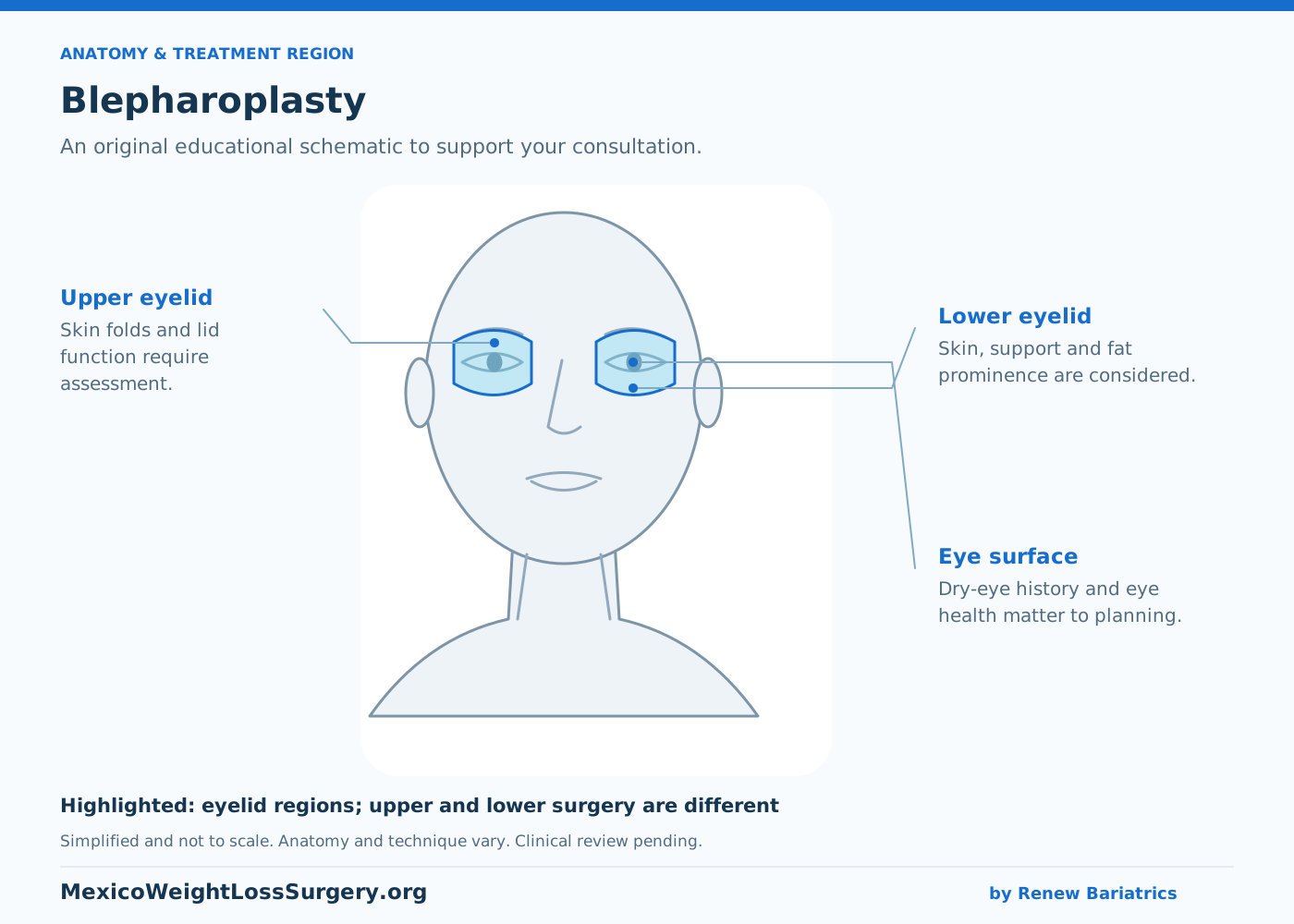
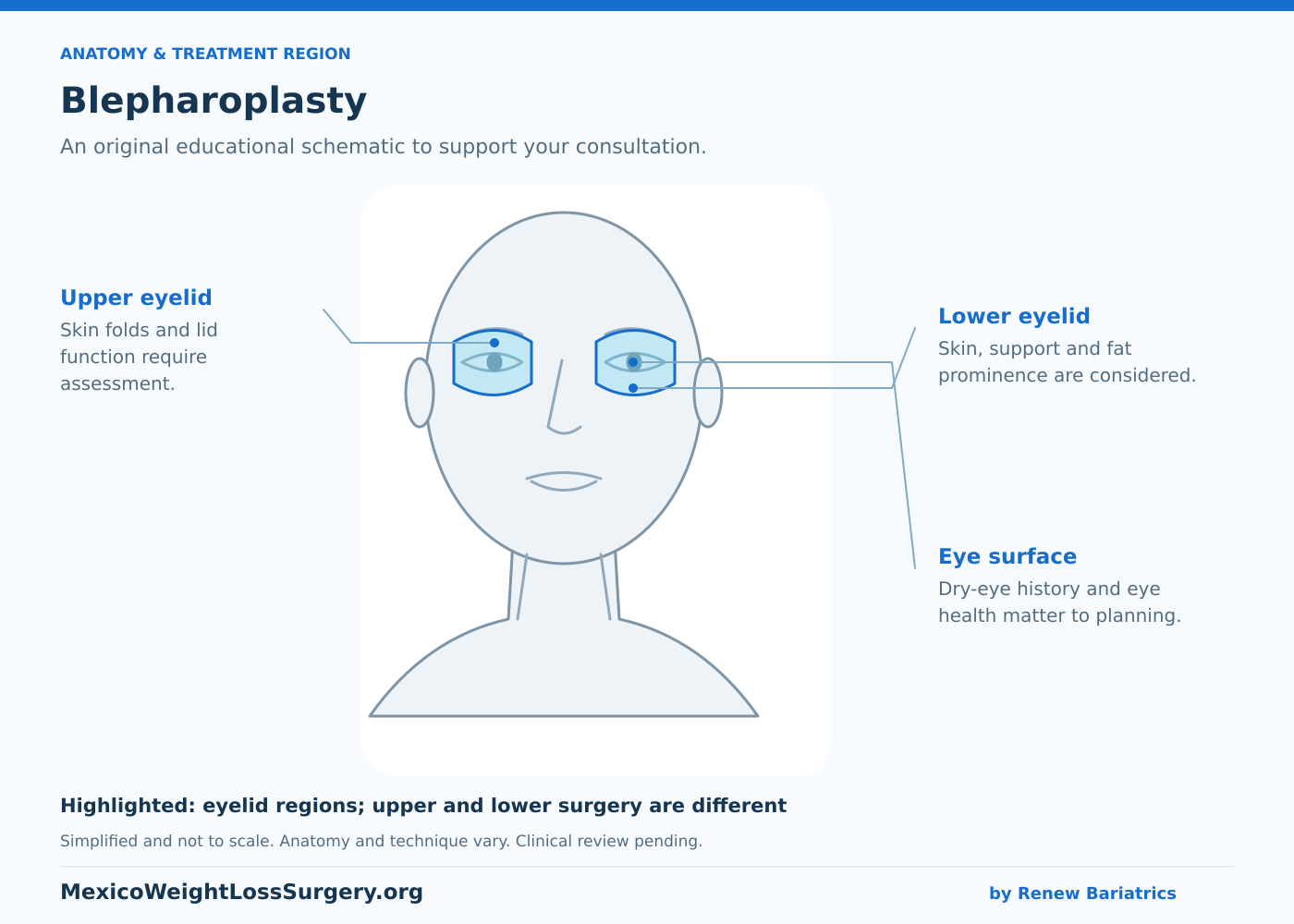
Anatomy references: ASPS — Blepharoplasty ↗ · ASPS — Brow lift ↗ · AAFPRS — Brow and forehead lift ↗ · ASPS — Eyelid surgery safety ↗
Upper eyelid, lower eyelid and ptosis are different
Upper blepharoplasty commonly uses an incision in the natural eyelid crease. Depending on the plan, selected skin and sometimes fat or muscle are addressed. Lower surgery can use an incision beneath the lashes or inside the eyelid; a transconjunctival approach allows fat treatment without skin removal through that incision. The surgeon may remove or redistribute fat rather than simply removing as much as possible. [3]
Ptosis concerns the position of the eyelid margin itself and can require a different repair. A low brow can also create the appearance of excess upper-lid tissue. ASPS emphasizes evaluating these contributors rather than assuming every heavy-looking lid needs the same operation. [2]
Describe what bothers you in practical terms: excess skin resting near the lashes, under-eye fullness, a tired appearance or a problem with your visual field. Ask the clinician which structures explain that concern. You should leave knowing whether the recommendation is cosmetic blepharoplasty, a functional repair, another procedure or a combination. Those differences affect consent, costs and follow-up.
What surgery can reasonably change
Blepharoplasty addresses selected tissue and contour concerns. It does not promise to eliminate every dark circle or wrinkle. Ask which changes the proposed operation can realistically deliver. [1],[3]
For upper-lid skin affecting vision, a functional assessment may be needed. Documentation can include symptoms, photographs and visual-field testing under the relevant payer's criteria. The existence of a functional concern does not automatically establish insurance coverage for surgery abroad, and cosmetic and functional components should be distinguished. [14]
A useful goal might be to reduce a specific fold or fullness while preserving your natural expression. It is less useful to ask for another person's eye shape. Bring any reference photographs as a way to discuss preferences, not as a promised endpoint. Ask the surgeon to explain the limits imposed by your anatomy and eye health.
Candidacy starts with eye health
General health, healing capacity, smoking status and realistic expectations matter. Serious eye conditions can affect candidacy. Tell the surgeon about dry eyes, difficulty closing the eyes, glaucoma, thyroid disease, eye allergies and previous eye or eyelid surgery. An assessment may include tear testing, eyelid measurements and photographs. [2],[11]
Also describe daily symptoms in your own words. Do your eyes burn at the end of the day? Do they water outdoors? Do contact lenses become uncomfortable? Have you needed lubricating drops or specialist treatment? Bring the names of prescribed eye medicines and information from your eye-care clinician. A brief symptom history can make the consultation more useful than simply saying that your eyes are “fine.”
If the clinician recommends an ophthalmic assessment before elective surgery, ask what question the assessment needs to resolve. You may need a clearer understanding of existing dryness, eyelid closure or another eye condition. The goal is to choose a plan that respects both appearance and function, not to rush through a checklist before travel.
Dry eye deserves a specific discussion
Dry eye can appear or worsen after eyelid surgery. Incomplete closure and changes in blinking can matter. The American Academy of Ophthalmology notes that some patients with dry eye can undergo blepharoplasty, but preserving comfortable closure and a strong blink is particularly important. This is an individualized judgment, not an automatic approval or exclusion. [10]
In a retrospective single-surgeon series of 892 patients, 26.5% reported postoperative dry-eye symptoms. Concurrent upper-and-lower surgery and some skin-muscle approaches were associated with higher rates. The study excluded several higher-risk conditions, and its percentage is not a prediction of persistent dry eye for every patient. [8]
A separate 202-patient retrospective series reported dry-eye symptoms lasting more than two weeks in 10.9% and more than two months in 2%. The populations, operations and definitions differed, so these figures should not be treated as contradictory estimates of one universal risk. They show why symptom duration and study methods matter. [16]
The TFOS consensus report also discusses eyelid surgery as a possible cause of new or worsened dry-eye disease, reinforcing the need to consider the ocular surface before treatment. [15]
Ask how the surgeon assesses your baseline eye surface, how the plan protects closure and what follow-up is available if symptoms persist. Do not start steroid eye drops, tape your eyelids or change prescribed treatment based on a general article. If eye discomfort or vision changes occur, contact the treating team promptly for an individualized assessment.
Lower-lid surgery: support matters as well as fat
Lower-lid treatment can involve conservative fat removal or repositioning, treatment of skin and, in selected cases, additional support at the outer corner. AAO describes evaluating lid laxity and considering support procedures when appropriate. Too much emphasis on eliminating a “bag” can miss the importance of eyelid position and closure. [12]
Ask whether the concern is mainly fat prominence, loose skin, a hollow area or a combination. If support work is recommended, have its name and purpose written into the plan. Ask how it changes recovery, risks and the quote. You do not need to select a surgical maneuver yourself, but you should understand why an additional step is being proposed.
A lower-lid operation can be different from upper-lid surgery in both technique and recovery. Do not assume that a friend's experience with upper blepharoplasty describes what you should expect. Compare procedures with the same scope and ask whether a combined upper-and-lower operation or staged treatment is more appropriate for your situation.
Risks, including rare vision-threatening complications
Possible problems include bleeding, infection, scarring, swelling, discomfort, dry eyes, difficulty closing the lids, lower-lid pulling or outward turning, altered sensation and asymmetry. Revision surgery may be needed. Temporary changes in vision can occur, and permanent visual loss is a rare but serious risk that belongs in informed consent. [4]
An older survey covering 269,433 reported cases identified orbital hemorrhage in approximately 0.055% and permanent visual loss associated with hemorrhage in approximately 0.0045%. The authors noted recall bias, and these are historical survey estimates rather than current Renew outcome data. Most events occurred early, but delayed events were reported. [9]
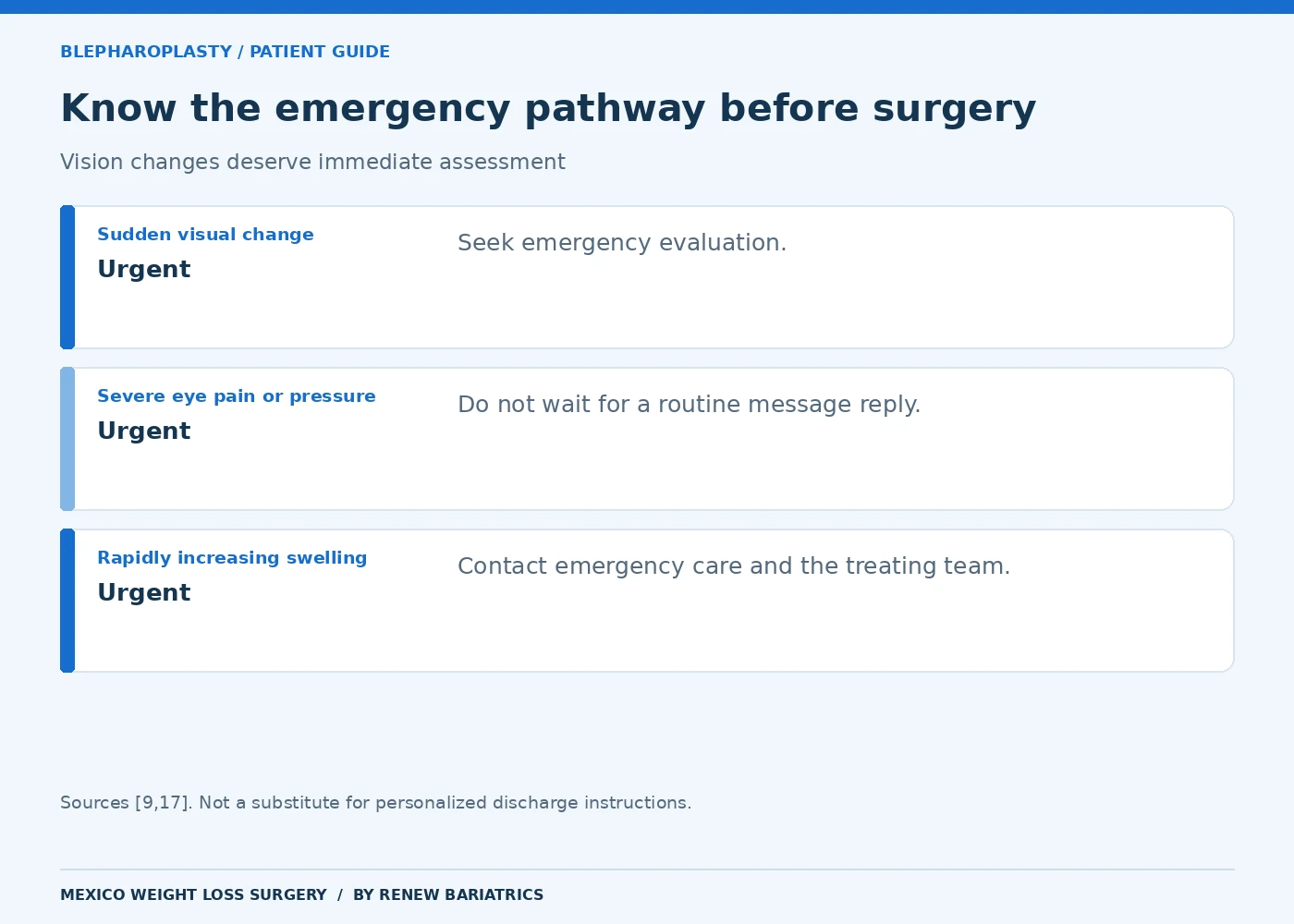
The practical point is urgency. Sudden reduced vision, severe eye pain or pressure, or rapidly increasing swelling after surgery needs immediate emergency assessment, not reassurance through a routine messaging queue. A separate physician survey emphasized that suspected impending visual loss is a surgical emergency and that early treatment matters. Know the emergency route before the operation. [17]
Ask where urgent ophthalmic evaluation is available and who takes responsibility if a concern appears overnight. Ask how the plan changes after you return home. “Contact us if needed” should be supported by a clear route to an in-person clinician when the symptom cannot be safely assessed remotely.
Preparation and anesthesia are individualized
Preparation may include medical testing, smoking cessation and a clinician-directed review of medicines and supplements. Arrange an adult to accompany you after surgery and stay during the initial recovery period. Follow the written instructions supplied for your case instead of using another patient's fasting or medication schedule. [5]
Local anesthesia with sedation is commonly used for eyelid surgery, while general anesthesia may be selected for some plans. Monitoring and postoperative observation remain important even when the procedure is outpatient. Ask who provides anesthesia and who will assess you before discharge. [11]
Disclose GLP-1 medicines to the anesthesia team; the plan depends on the individual medication history, symptoms and risk assessment. Do not independently stop prescriptions to follow a generic online recommendation. [18]
Bring a single current list of medicines, supplements, eye drops and allergies. Include previous anesthesia reactions and any recent changes in treatment. If the surgical instructions conflict with advice from your prescribing clinician, ask the teams to resolve the difference before surgery. Your companion should know where the final instructions are kept and which number to call with questions.
The first days after eyelid surgery
Prescribed lubricating ointment and clinician-directed cold compresses may be part of early care. Swelling, bruising, irritation and dryness can occur. The team should explain wound care, medicines, follow-up and activity restrictions. An eyelid cooling instruction is specific to the treated area; it should not be assumed to apply to a combined neck operation. [6]
Ointment can blur vision temporarily, and light sensitivity or watering may occur. However, do not use that explanation to dismiss new or worsening visual symptoms. Ask the clinician how to distinguish expected effects of the prescribed treatment from symptoms that require urgent assessment. [1]
Make recovery practical. Arrange good lighting for reading instructions, keep the approved supplies together and ask for help organizing medicines. Clarify when glasses, contact lenses, eye makeup, face washing and driving are permitted. Do not assume that being discharged means you can safely drive yourself or manage every task without assistance.
Recovery time and returning to ordinary life
ASPS describes many patients as socially presentable around 10–14 days, while final healing can take months. That broad estimate does not establish your return-to-work or travel date. Natural aging continues, and results are not guaranteed. Further treatment may sometimes be considered. [7]
Ask for guidance tied to your activities: screen-based work, driving, exercise, outdoor exposure and caring for family members. A job requiring prolonged concentration or frequent travel may need a different plan from a short period of light work at home. If you have an important event, discuss it before choosing a surgery date and leave room for slower-than-expected healing.
Keep scheduled reviews and report concerns rather than waiting for the next appointment when symptoms are significant. Record when a symptom began and what changed, without trying to diagnose it yourself. If the team asks for photographs, follow its instructions; a photograph may help communication but cannot measure vision or replace an examination when one is needed.
Scars and the meaning of a natural result
Upper-lid scars are generally placed within the crease; lower-lid incisions may be beneath the lashes or inside the lid depending on the approach. An internal incision avoids an external scar from that incision, but does not mean there are no surgical risks or that loose skin will necessarily be addressed. Ask the surgeon to show you the proposed locations. [3]
“Natural” should be translated into features you can discuss: maintaining your usual expression, avoiding an unwanted change in lid position and understanding which asymmetries may remain. Ask how existing asymmetry is documented. Request clinical photographs with consistent lighting and an identified follow-up interval, and find out whether additional procedures were performed.
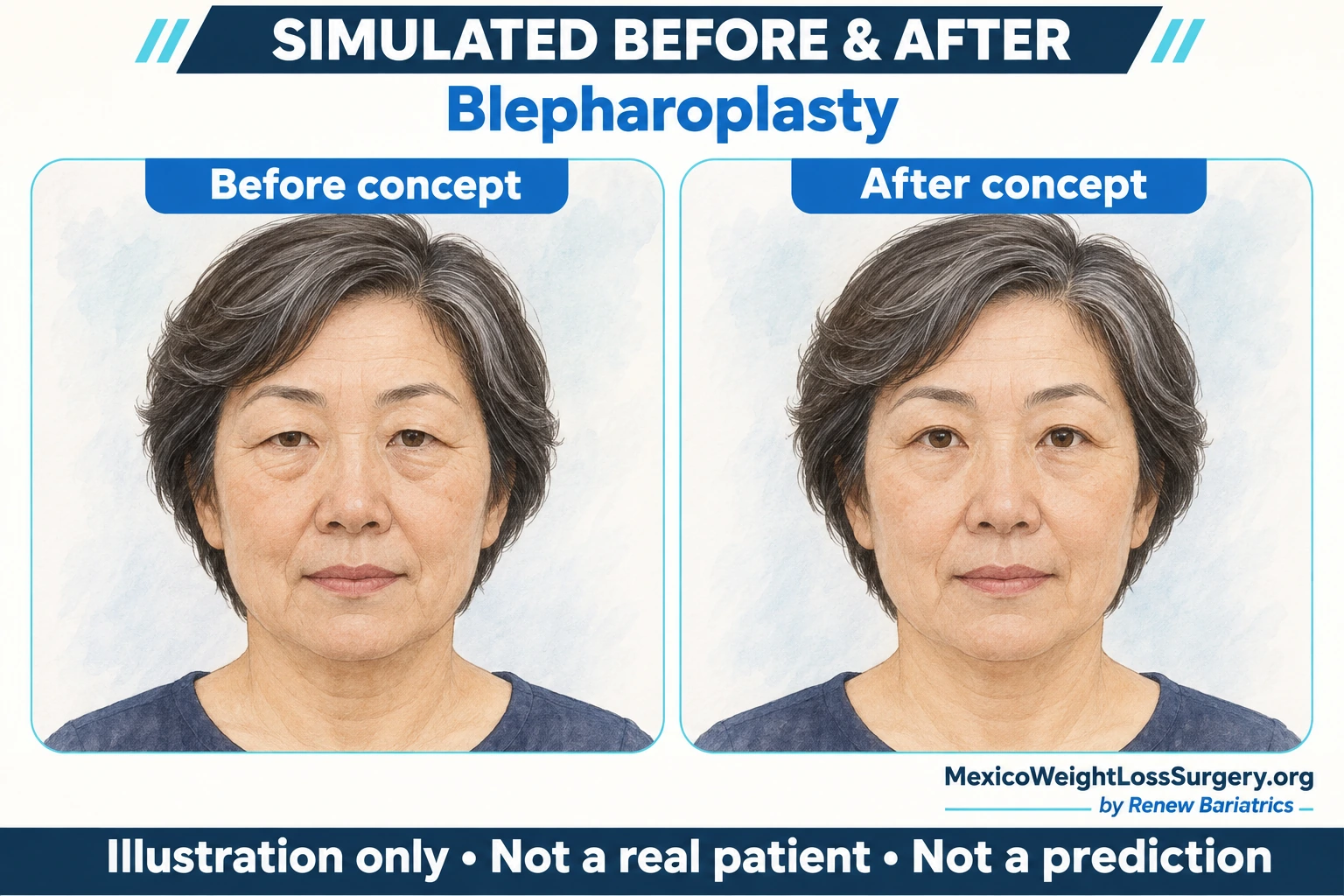
The illustration on this page shows a fictional older adult in an everyday setting. It is not a real patient, before-and-after comparison or representation of an expected surgical result. Your own anatomy and clinical assessment should guide the conversation, rather than an idealized face.
Alternatives and related procedures
Observation is a legitimate option. The AAO also describes nonsurgical approaches as alternatives in selected lower-lid discussions. The choice depends on the specific problem, and a different treatment may have its own limits and risks. Ask what improvement is plausible without surgery and what maintenance would be involved. [12]
A drooping lid margin or low brow may require a different repair. [2]
For separate jawline or neck concerns, review the facelift and neck lift guides. Each proposed operation should have a clear purpose and its own discussion of tradeoffs.
Combining procedures is a decision to assess, not an automatic way to make a trip more efficient. Ask whether staging would simplify recovery or make it easier to evaluate the result of the first operation. Tell the surgeon if you prefer a smaller initial plan. The consultation should accommodate that preference while explaining its limitations.
Planning eyelid surgery in Mexico
CDC recommends verifying providers and facilities, arranging continuity of care and obtaining medical records when traveling for treatment. Clarify insurance and complication arrangements. Travel after an operation requires an individual plan, and suspected complications should be assessed promptly rather than deferred until the journey home. [19]
For eyelid surgery, specifically ask where an urgent eye examination can be performed. Confirm the surgeon's identity, relevant training and professional registration, the operating location and the anesthesia arrangements. This guide does not verify a particular surgeon's credentials or imply that a coordination service replaces the treating clinician.
Ask how many in-person reviews are planned before departure and who gives clearance to travel. Discuss what happens if swelling, discomfort or another concern requires an extra assessment. Keep your itinerary flexible enough to respond to medical advice. A hotel booking or flight reservation should not be used as the reason to skip a requested review.
A synthetic illustration of possible changes
This fictional example illustrates a treatment concept. It cannot show the result you would achieve, predict scar healing, or establish a typical outcome.
Blepharoplasty Cost in Mexico
Upper and lower blepharoplasty can involve different surgical work. ASPS distinguishes their fees and notes that quoted surgeon charges may exclude anesthesia, facility use and other expenses. Insurance treatment of functional eyelid surgery differs from cosmetic surgery; check your own policy and any cross-border restrictions directly. [13]
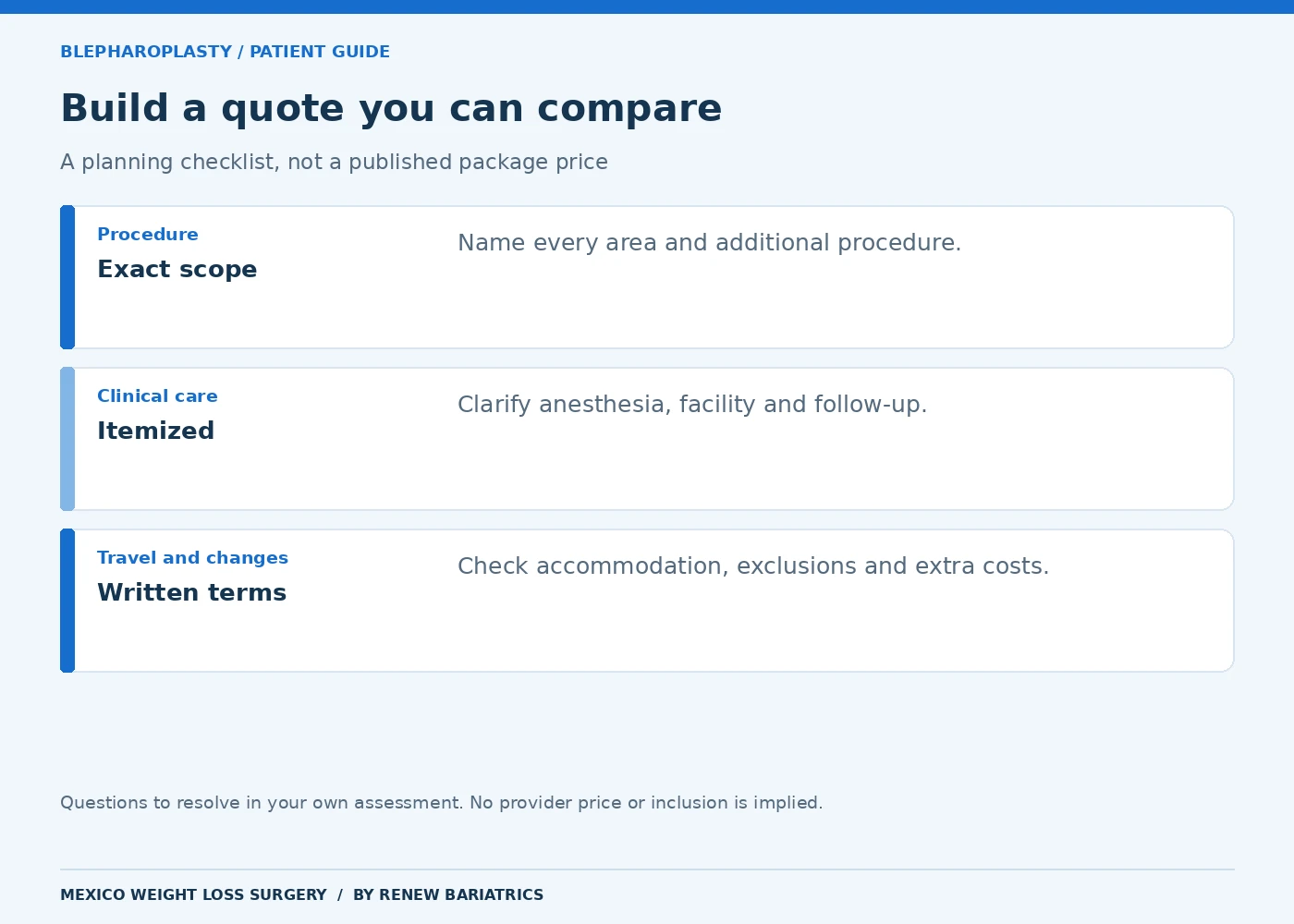
A useful Renew quote should identify upper lids, lower lids or both, and list any ptosis repair, brow procedure, fat repositioning or lower-lid support separately. Ask whether the price may change after an in-person eye examination. The purpose is to understand the actual proposed care, not to select the most extensive package available.
Request a breakdown covering consultation, required testing, surgeon, anesthesia, operating facility, medicines, supplies and follow-up. Then list accommodation, transport, companion costs and time away from work in your own budget. Ask which services are included and which are optional or excluded. Keep the quote alongside the clinical plan so that the two can be checked together.
Clarify the policy for additional examinations, urgent treatment, extended accommodation and revision discussions. Ask for deposit, cancellation and rescheduling terms before payment. If financing is offered, review the full repayment amount and fees. This page does not publish a fixed Mexico price because the treatment scope and individual arrangements must be established first.
Cost and consultation FAQs
Is the advertised price for both upper and lower eyelids?
Not necessarily. Request the exact scope in writing. Compare like-for-like plans, including whether anesthesia, facility charges and follow-up are included. A number without those details is not enough to judge the full cost.
Can dry eye prevent surgery?
It can affect suitability and technique, but the answer requires an individual eye-health assessment. Ask how existing symptoms will be evaluated and managed. Preserving closure and blink function matters. [10]
Will insurance cover the operation?
Cosmetic treatment and functional repair have different considerations. A documented visual problem may require testing, but it does not guarantee approval or coverage abroad. Obtain a decision from the insurer before treating reimbursement as part of your budget. [13],[14]
What should I send for an initial assessment?
Prepare a concise description of your eyelid concerns, eye symptoms, prior procedures and current medicines. Ask Renew how to submit information securely and which records the clinician needs. Photographs can support the discussion, but eligibility and the final plan require appropriate clinical evaluation.
How do I decide whether to proceed?
Check that you understand the proposed operation, likely limits, risks, eye-care arrangements, recovery support and total quote. If a question remains unanswered, ask for clarification or another opinion. Review the cost guide, about page and review sources as supporting context, then make the decision on the basis of your own assessment and preferences.
Program information related to this guide
Explore Renew Bariatrics’ procedure options when discussing a plastic surgery plan. Availability, combinations and suitability require individual confirmation.
Blepharoplasty vs. brow lift
Upper eyelid hooding can reflect eyelid skin, a low brow, or both. Blepharoplasty treats the eyelids; a brow lift raises the brow. Examination determines whether one procedure or a combination is appropriate.
| What to compare | Blepharoplasty → | Brow lift → |
|---|---|---|
| Main goal | Address selected upper or lower eyelid concerns. | Raise sagging brows and address forehead lines. |
| What changes | Eyelid skin, fat or support, depending on the plan. | Brow position and forehead soft tissues. |
| Key distinction | Can address lower eyelid bags; does not lift a low brow. | May reduce brow-related hooding; does not directly treat lower lid bags. |
| Recovery consideration | Eye-surface health and eyelid function require assessment. | Incision placement and forehead healing depend on the technique. |
| Cost comparison | Specify upper lids, lower lids or both in the quote. | Specify brow-lift technique and any combined eyelid surgery. |
Comparison references: ASPS — Blepharoplasty ↗ · ASPS — Brow lift ↗ · AAFPRS — Brow and forehead lift ↗ · ASPS — Eyelid surgery safety ↗
These options are not interchangeable for every person. The treating clinician must assess your anatomy, medical history and goals.
Discuss your options with Renew.
Talk with a coordinator about blepharoplasty, your goals and the information needed for clinical review. The treating team determines suitability and the care plan.
Call 844-736-3963 Ask about plastic surgery ↗The link opens Renew’s plastic surgery health questionnaire. This review site does not collect health information.
References & evidence notes
Sources checked November 2026. Research findings are not a forecast for an individual or outcomes for Renew’s own program. Review study populations, methods and limitations alongside the reported results.
- Mayo Clinic. Blepharoplasty ↗Institutional patient education.
- American Society of Plastic Surgeons. Eyelid Surgery Candidates ↗Professional society patient education; not provider-specific outcome data.
- American Society of Plastic Surgeons. Eyelid Surgery Procedure Steps ↗Professional society patient education; not provider-specific outcome data.
- American Society of Plastic Surgeons. Eyelid Surgery Risks and Safety ↗Professional society patient education; not provider-specific outcome data.
- American Society of Plastic Surgeons. Eyelid Surgery Preparation ↗Professional society patient education; not provider-specific outcome data.
- American Society of Plastic Surgeons. Eyelid Surgery Recovery ↗Professional society patient education; not provider-specific outcome data.
- American Society of Plastic Surgeons. Eyelid Surgery Results ↗Professional society patient education; not provider-specific outcome data.
- Retrospective single-surgeon study. Dry eye symptoms and chemosis following blepharoplasty: a 10-year retrospective review of 892 cases ↗Symptoms and selected patient population; not a permanent-dry-eye prediction.
- ASOPRS member survey. Incidence of postblepharoplasty orbital hemorrhage and associated visual loss ↗Historical survey with recall bias; rare-event estimates.
- American Academy of Ophthalmology. Is it possible to have eyelid surgery if I suffer from dry eye? ↗Importance of closure and blink preservation.
- The Aesthetic Society. How Do I Prepare for Eyelid Surgery? ↗Assessment, eye history and anesthesia.
- American Academy of Ophthalmology. Lower Eyelid Blepharoplasty ↗Specialist overview of approaches, support and complications.
- American Society of Plastic Surgeons. Eyelid Surgery Cost ↗Professional society patient education; not provider-specific outcome data.
- Medicare contractor policy hosted by AAO. Blepharoplasty Medical Policy Article A52837 ↗Example of functional documentation requirements, not an insurance approval or Mexico coverage rule.
- Tear Film & Ocular Surface Society. TFOS DEWS II: Iatrogenic Dry Eye ↗Consensus discussion of surgery-related ocular surface effects.
- Retrospective clinical series. Preventing and managing dry eyes after periorbital surgery ↗202 patients; symptom duration explicitly reported.
- Physician survey. Visual loss after blepharoplasty: incidence, management, and preventive measures ↗Emergency response to suspected visual loss; retrospective survey limitations.
- American Society of Anesthesiologists. Drugs for Diabetes or Weight Loss: What To Know Before Surgery ↗Individualized peri-anesthesia planning.
- CDC Yellow Book. Medical Tourism ↗Travel, records and continuity of care.