
Jump to a section
Compare proceduresRelated ProceduresStart by identifying who does whatLicensing, certification, accreditation, and membership are differentVerify the clinician using the exact name and credentialAsk about experience with your exact procedureVerify the facility at the exact addressWhat does accreditation add—and what does it not prove?Ask about the response to a complicationLook for an assessment that can change the planRead the consent as a conversation, not a formalityEvaluate follow-up before evaluating hospitalityInterpret reviews and photographs carefullyMake your verification worksheet usefulFrequently asked questions about safetyThe next step is a specific set of answersYour next stepReferencesChoosing a bariatric center in Mexico means checking the people who will treat you, the building where treatment will occur, and the plan for care afterward. A reassuring photograph or an attractive package does not answer all three questions. Neither does a review score, a professional membership logo, or a statement that a program has performed many operations.
This guide gives you a practical way to evaluate the information you receive. MexicoWeightLossSurgery.org is owned by Renew Bariatrics, so that relationship should be clear while you compare options. The page is an educational checklist, not an independent certification of Renew, a particular physician, or a hospital. Before booking, request current evidence for the exact team and facility proposed for you.
Start by identifying who does what
A patient may communicate with a coordinator, medical tourism facilitator, surgeon, anesthesiologist, hospital, and nutrition professional during one episode of care. These roles should not blur together. The person who answers pricing questions may be very helpful without being the clinician who determines whether surgery is appropriate.
Ask for a written roster naming the organization arranging the trip, the clinician responsible for your treatment, the anesthesia provider or team, and the facility. Add the person responsible for postoperative clinical questions and the contact for travel arrangements. You should know which concerns go to which person.
The American College of Surgeons’ statement on medical tourism emphasizes qualified surgeons and anesthesiologists, appropriate facilities, communication, records, and follow-up. Its recommendations are principles for evaluating care, not an endorsement of any specific Mexican program. [1]
When you hear “our hospital” or “our medical team,” ask what that relationship means. Does the company own the facility, arrange appointments there, or work with clinicians who have privileges there? The answer need not be complicated, but it should accurately describe the responsibility behind the promise.
Licensing, certification, accreditation, and membership are different
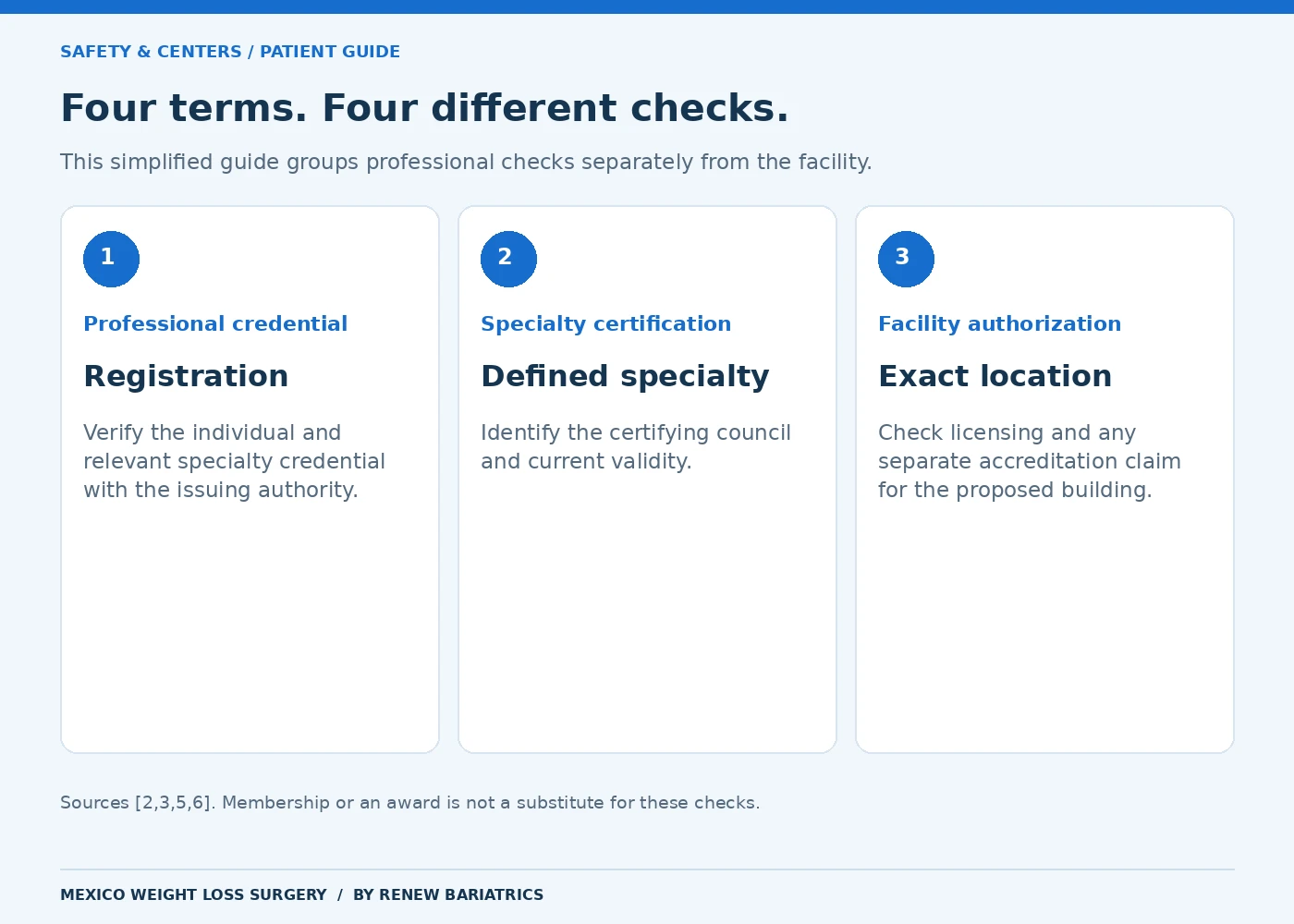
These terms answer different questions. A professional license or credential concerns an individual’s professional registration. Specialty certification concerns a defined specialty and the certifying body’s requirements. Facility authorization concerns the establishment. Accreditation evaluates an institution against a particular organization’s standards. Membership may simply mean participation in a professional association.
Mexico’s education authority provides a process for registering a specialty diploma and obtaining the corresponding professional credential. Separately, official Mexican medical-tourism guidance directs patients to check the relevant specialty credential and current specialty-board certification through the appropriate sources. [2],[3]
Do not accept a stack of logos as the completed check. Ask which organization issued each credential, whose name appears on it, what specialty it covers, whether it is current, and how you can verify it independently. A physician’s certification does not automatically certify the hospital, and a hospital’s accreditation does not establish that every physician has the same training.
Verify the clinician using the exact name and credential
Begin with the clinician’s complete professional name, not a nickname or the shortened name used in an advertisement. Request the professional credential numbers relevant to the planned care. Ask which specialty council certifies the clinician and whether that certification is currently valid.
The State of Mexico’s medical-arbitration authority links patients to the national professional registry and CONACEM resources for these checks. Its advice also includes retaining contact details for the clinicians involved and obtaining medical records for future care. [3]
If a database search produces several similar names, do not assume that the first match is correct. Compare the name, institution, specialty, and identifier with the information supplied by the treating team. If you cannot find a record, ask for help identifying the correct official entry. A failed search may reflect formatting or an incomplete name; it is not by itself proof that someone lacks credentials.
Save the verification date and the source. Credentials can change, and a screenshot without an issuing authority or date is difficult to evaluate later. A useful record might say: professional name, credential number, specialty council, validity information, official source, and date checked. Keep copies with your treatment paperwork.
Ask about experience with your exact procedure
General bariatric experience and experience with a specific revision are not interchangeable. Ask how often the clinician performs the operation proposed for you, how patients are selected, and what alternatives they offer when that operation does not fit. For an endoscopic procedure, ask about the treating endoscopist’s relevant training and experience.
ASMBS advises patients considering medical tourism to investigate surgeon credentials and, whenever possible, obtain the surgeon’s outcomes for the desired procedure during informed consent. [4]
Make outcome questions precise. Ask what period the numbers cover, how many patients are included, whether the measure applies to your procedure, and what happened to patients who were lost to follow-up. A claim about all operations performed over many years is different from recent outcomes for a technically complex revision.
You can also ask how the team learns from complications. Who reviews an unexpected event? How are patients contacted afterward? How do they track problems treated elsewhere? A transparent explanation of the process is more informative than a promise that complications never happen.
Verify the facility at the exact address
Request the legal name and address of the hospital or clinic where your procedure will take place. Check that the documents you receive refer to that location, not another branch or a similarly named institution. If the facility changes, repeat the relevant questions rather than assuming that a previous verification transfers automatically.
COFEPRIS states that establishments carrying out surgical or obstetric acts require a sanitary license and a designated responsible health professional. Its current services information identifies the relevant license process for such establishments. This is a regulatory requirement to investigate, not a statement that this website has verified any individual hospital’s compliance. [5],[6]
Ask the facility for the applicable authorization details and the appropriate official verification route. Facility requirements may depend on the services delivered; the question should match the procedure and setting. A medical office address, tourism-business registration, or commercial directory listing does not answer whether a location is authorized for the operation proposed.
Keep the building address in your own records and share it with your companion or emergency contact. It should be possible to identify where you are receiving care without searching through promotional messages.
What does accreditation add—and what does it not prove?
If a facility advertises accreditation, request the accrediting organization, exact institution name, accredited service or scope, and current validity. Verify the claim through the issuing organization rather than only a badge on the facility’s website. If the accreditation applies to a program rather than the entire institution, understand that distinction.
ACS notes that accreditation standards differ between organizations and jurisdictions. CDC also cautions that accreditation does not guarantee a good outcome. These are reasons to understand what the credential covers, not reasons to disregard it. [1],[7]
A patient can reasonably ask why a center does not hold a particular accreditation without assuming that every unaccredited facility is equivalent. The follow-up questions remain concrete: what standards apply, what external review exists, who is responsible, and what resources are available for the intended procedure?
Avoid substituting an award, travel ranking, review-platform badge, or association membership for formal facility accreditation. Each may provide different information, but the labels should not be used interchangeably.
Ask about the response to a complication
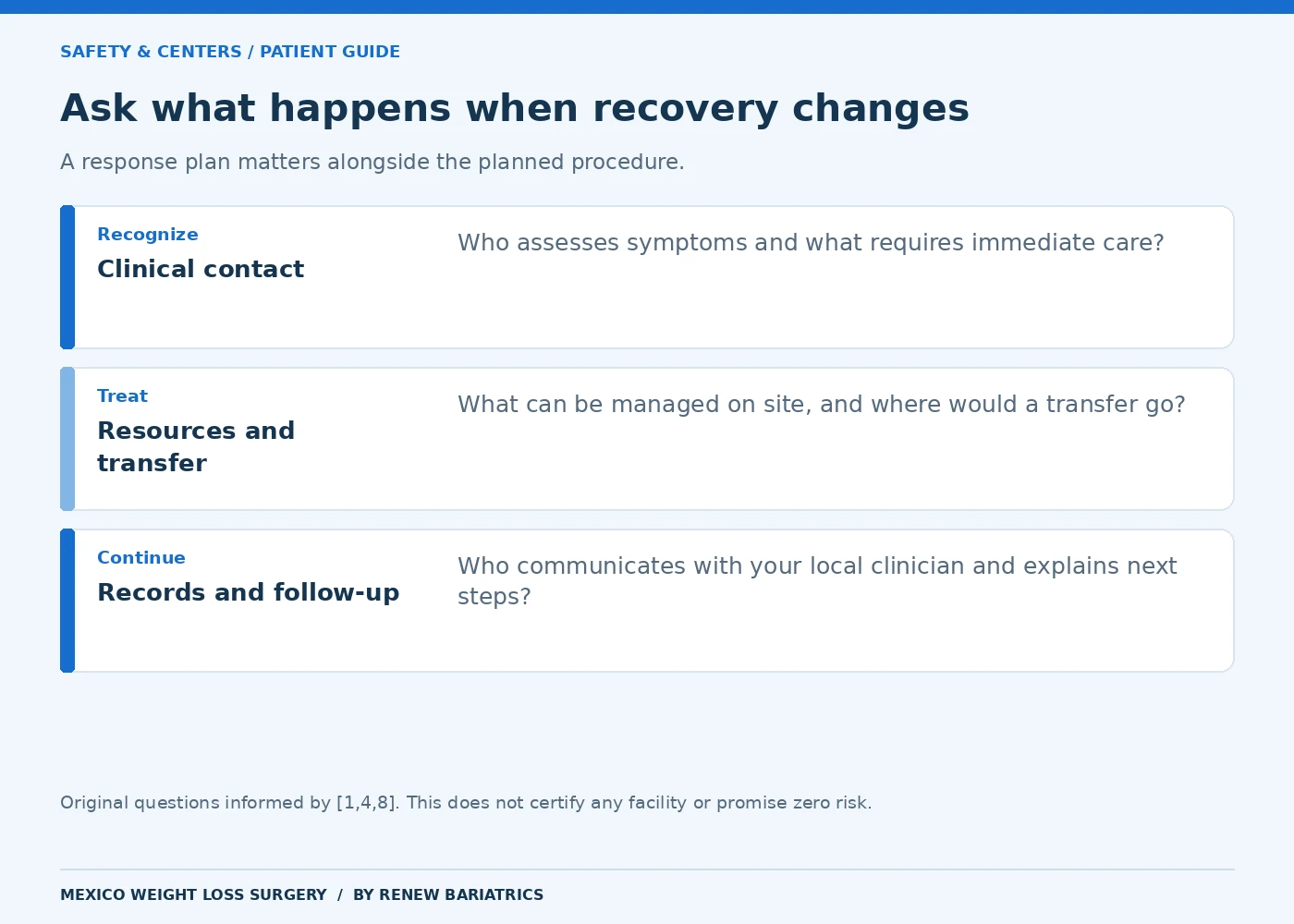
Safety planning should include what happens when recovery does not follow the expected course. NIDDK describes bariatric complications such as bleeding, infection, leakage, and blood clots, as well as later problems including nutritional deficiencies and narrowing. Risks differ by operation and patient; no country or package eliminates them. [8]
Ask which problems the facility can assess and treat on site. What imaging, laboratory testing, operating-room access, specialist support, and higher-acuity care are available when needed? If a transfer is necessary, where would it go, who arranges it, and who remains responsible for communication?
Request the after-hours clinical contact and the emergency instructions in writing. A routine message channel should not be the only plan for an urgent problem. Your companion should know the difference between asking a coordinator a scheduling question and seeking immediate medical assessment.
Also ask how the financial arrangements change during unexpected care. This is not a request to predict every possible bill. It is a request to know which services are part of the routine package, who may bill separately, and how the team helps you obtain records and communicate with insurers.
Look for an assessment that can change the plan
A credible evaluation should allow the team to recommend further testing, a different procedure, a delay, or no procedure. Ask what information the clinical reviewer needs and how you can raise a concern before traveling. Do not conceal medical history to obtain a preferred date or advertised price.
Bring a complete medication and supplement list, prior operative records when relevant, and the questions that matter most to you. Ask how conditions such as reflux, sleep apnea, diabetes, or previous complications affect the options being discussed. The clinical team should explain the implications for your case rather than simply assigning you a package from a weight category.
Anesthesia planning also deserves its own discussion. The American Society of Anesthesiologists advises patients taking GLP-1 medications to tell the surgical and anesthesia teams and coordinate the medication plan with their prescriber. Current guidance is individualized; do not stop or continue medication solely because a general website or another patient gives a timetable. [9]
Your task is to provide accurate information and understand the proposal. You should not have to diagnose your own eligibility, interpret all your laboratory results, or choose an operation without clinical explanation.
Read the consent as a conversation, not a formality
Before agreeing, you should be able to describe in your own words what will be done, why it is being proposed, what the important alternatives are, and which risks matter in your situation. If you cannot, ask for another explanation. A signed page does not resolve a misunderstanding.
Request information in a language you understand. If an interpreter is needed, establish how that service will be provided during consent, clinical assessment, and discharge. A bilingual companion may be supportive, but ask how clinical interpretation is handled when the discussion becomes complex.
Ask what happens if the proposed procedure cannot be completed as planned. Which decisions can reasonably be discussed in advance? What would require a separate conversation? The point is to understand the boundaries of consent before sedation, not to anticipate every technical detail.
Read financial and administrative terms separately from clinical consent. Know whom to contact about either document, retain copies, and ask for clarification of ambiguous wording. If you need independent legal advice on an agreement, obtain it before signing rather than relying on this educational guide.
Evaluate follow-up before evaluating hospitality
A comfortable room, helpful driver, and attentive coordinator can improve the patient experience. They do not replace postoperative medical care. Ask who evaluates clinical concerns after discharge, which visits are scheduled, and how the treating team communicates with your clinician at home.
For bariatric surgery, ASMBS describes ongoing follow-up and long-term supplementation as part of care. The practical question is how that care will be organized for you after an international trip. [10]
Write the names of the people responsible for routine nutrition questions, medication review, laboratory orders, and urgent assessment. Ask whether those services are included, available separately, or expected to be arranged locally. A broad promise of “lifetime support” needs a clear description of what support means.
Also consider your ability to use the plan. Will the communication method work across time zones? Can you access the recommended laboratory tests? Is there a clinician near home willing to provide follow-up? Identify these gaps while they can still be addressed.
Interpret reviews and photographs carefully
Reviews can help you identify questions about communication, transport, comfort, or a patient’s experience. They are not a complete clinical outcomes registry. You usually cannot tell from a review whether the reviewer’s procedure, risk profile, or length of follow-up resembles yours.
Read beyond the star average. Look for specific descriptions of how questions were answered and how difficulties were handled. Avoid assuming that an especially positive or negative individual experience predicts what will happen to you. Ask the team to explain recurring concerns directly.
Similarly, before-and-after photographs are individual stories. If results are presented, look for the procedure, dates, starting point, follow-up interval, and consent to share. Do not treat selected images as a forecast of your appearance or a substitute for study evidence.
For this review site, educational illustrations are labeled as illustrations. A fictional person should never be described as a Renew patient, and a hypothetical calculation should never be presented as a clinical result.
Make your verification worksheet useful
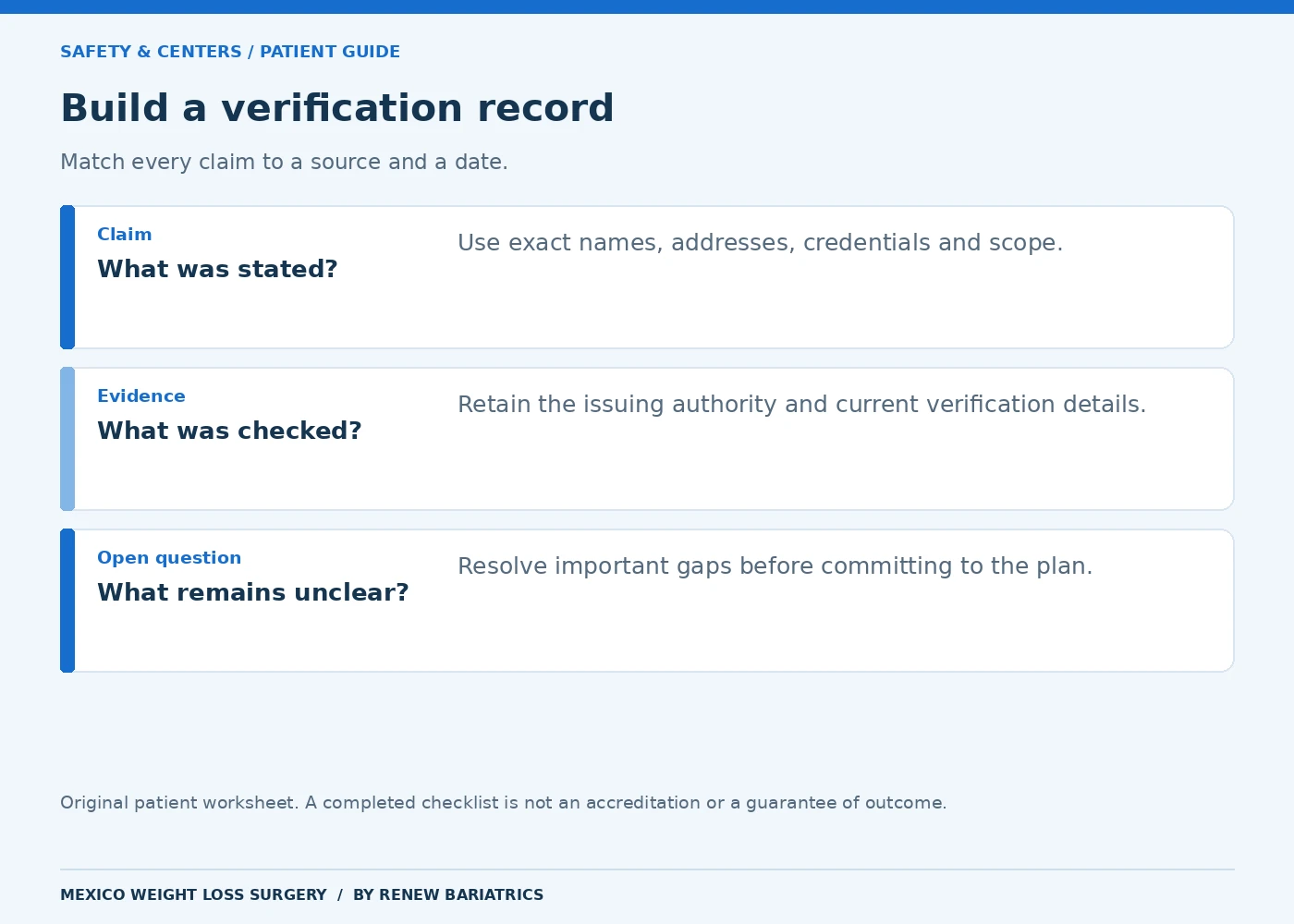
For every claim, record three things: what the program says, what evidence you received, and what remains unanswered. Use the same worksheet for each center you consider. That keeps your comparison focused on care rather than the polish of the presentation.
- Treating clinician: complete name, relevant credentials, specialty certification, procedure experience, and verification date.
- Facility: legal name, exact address, authorization information, accreditation claim if any, and verification source.
- Care plan: proposed operation, reasons, alternatives, outstanding evaluation, and clinical contact.
- Unexpected care: on-site capabilities, transfer arrangements, after-hours instructions, and financial responsibility.
- Continuity: discharge records, local follow-up, laboratory monitoring, nutrition support, and return-travel clearance.
The checklist is not a scoring system that can certify a center as safe. Its value is that it exposes unanswered questions. If an important answer remains unclear, pause the booking decision until the responsible person can address it.
Frequently asked questions about safety
Is bariatric surgery in Mexico automatically unsafe?
Country alone cannot establish the safety of an individual episode of care. Evaluate the procedure, patient factors, treating professionals, facility, emergency resources, and continuity plan. CDC’s medical-tourism guidance describes meaningful risks and the need for advance evaluation; it does not provide a blanket endorsement of every facility in a country. [7]
Does “board certified” mean a surgeon holds an American certification?
Not necessarily. Ask which national body and specialty are involved, then verify the actual credential. Do not translate a Mexican credential into an American Board of Surgery claim unless that separate certification has been established. The issuing organization matters as much as the phrase.
Can a complication still happen with an experienced surgeon?
Yes. The purpose of verification is to understand care quality and preparation, not to create a zero-risk promise. Ask how complications are recognized, treated, and followed up. A transparent answer is more useful than a slogan about perfect safety.
What should I do if the planned hospital changes?
Request the replacement facility’s name, address, relevant authorization and accreditation details, and emergency arrangements. Ask why the change is proposed and whether it affects the procedure, price, or recovery plan. Review the actual facility where you will receive care.
What if I have a concern about medical care received in Mexico?
Official Mexican medical-tourism guidance identifies CONAMED and state medical-arbitration commissions as possible contacts for concerns about services. Their role and the options available depend on the circumstances. This is not a promise of compensation or a substitute for independent advice. [3]
The next step is a specific set of answers
Ask Renew to identify the proposed clinician and facility and help assemble the verification information for your procedure. Keep the record current if the plan changes. If an important clinical issue remains unanswered, request review by the appropriate medical professional rather than treating a coordinator’s reassurance as medical clearance.
A well-informed choice does not require you to become a regulator or surgeon. It requires enough clear, verifiable information to understand who will treat you, where, under what plan, and with what support if you need more care than expected.
Keep the provider, clinician and hospital separate
This is the facility-verification guide. MexicoWeightLossSurgery.org is Renew Bariatrics’ patient resource and care-planning website; its name is not evidence that it is a separately licensed hospital. A useful comparison identifies the exact treating facility and responsible clinical team.
Record the hospital name and address, licensing or accreditation source, proposed operator and emergency arrangements. A coordinating company’s review score does not certify the hospital, and a hospital’s accreditation does not establish every clinician’s procedure-specific experience.
Use the surgeon profiles to prepare questions about the operator, the procedure guides to understand the proposed treatment, and the aftercare guide to check continuity of care. Renew’s location information is a starting point for confirming the facility on your written plan.
Compare related options: Gastric sleeve vs. Gastric bypass
These options change different structures. Your anatomy, symptoms, health history and follow-up needs guide the choice; neither is automatically better for everyone.
| What to compare | Gastric sleeve → | Gastric bypass → |
|---|---|---|
| Anatomy | A stomach-reducing operation. | A small pouch plus intestinal rerouting. |
| Reflux | Reflux can develop or worsen. | May be considered when reflux is an important concern. |
| Follow-up | Lifelong nutritional monitoring remains important. | Requires ongoing supplementation and nutritional monitoring. |
| Decision point | Discuss permanence and reflux risk. | Discuss bowel-related risks, ulcers and nutritional effects. |
Comparison references: Mayo Clinic: Sleeve gastrectomy ↗ · ASMBS: Roux-en-Y Gastric Bypass ↗
These options are not interchangeable for every person. The treating clinician must assess your anatomy, medical history and goals.
Further reading
Explore Renew’s surgical team ↗. Confirm the current care arrangements and your individual quote with the team.
Discuss your options with Renew.
Talk with a coordinator about safety & centers, your goals and the information needed for clinical review. The treating team determines suitability and the care plan.
Call 844-736-3963 Complete health questionnaire ↗The questionnaire opens Renew’s existing intake. This review site does not collect health information.
References & evidence notes
Sources checked November 2026. Research findings are not a forecast for an individual or outcomes for Renew’s own program. Review study populations, methods and limitations alongside the reported results.
- American College of Surgeons. Statement on Medical and Surgical Tourism ↗Professional position statement, 2009; principles of credentials, records and continuity, not a facility endorsement.
- Secretaría de Educación Pública, Mexico. Registro de diploma de especialidad y expedición de cédula ↗Official process for specialty professional credentials; this guide does not verify any individual clinician.
- Comisión de Conciliación y Arbitraje Médico del Estado de México. Sobre Turismo Médico ↗Official patient guidance linking professional registration, specialty certification and medical-arbitration resources.
- ASMBS. Medical Tourism ↗Professional guidance for patients considering bariatric treatment away from home; no individual-center endorsement.
- COFEPRIS. Establecimientos en que se Practiquen Actos Quirúrgicos y/u Obstétricos ↗October 2025 regulatory information on sanitary licensing and the responsible health professional.
- COFEPRIS. Licencia Sanitaria de Servicios de Salud Nuevo ↗April 2026 official directory of applicable health-service license processes.
- CDC Yellow Book, 2026 edition. Medical Tourism ↗Official travel-health guidance; includes the ten-day post-abdominal-surgery air-travel advice. Individual plans require clinical review.
- NIDDK. Weight-loss Surgery Side Effects ↗Patient education describing early and late surgical risks; not Renew-specific outcomes.
- American Society of Anesthesiologists. Drugs for Diabetes or Weight Loss: What To Know Before Surgery ↗Patient guidance reviewed October 2025; GLP-1 management requires individualized coordination.
- ASMBS. Life After Bariatric Surgery ↗Long-term surgical follow-up, supplementation and medication review; not an endoscopic recovery protocol.