
Jump to a section
Compare proceduresRelated ProceduresChoose a care plan before choosing a departure datePackage nights are not the same as clearance to flyArrange your local medical handoff before leavingCheck documents for your nationality and routePrepare a medication plan with the clinical teamPlan for health risks beyond the procedureUnderstand blood-clot prevention as an individual planPack for the medical plan you have been givenDecide what help a companion will provideTreat the recovery stay as part of careBefore discharge, use a teach-back conversationReturning home is a transition, not the end of treatmentFrequently asked travel questionsBuild a journey that can adapt to your recoveryYour next stepReferencesPlanning weight loss surgery in Mexico is a medical journey with travel attached. Your itinerary should be built around evaluation, treatment, recovery, and a safe handoff to care at home. Flights and hotel nights matter, but they should follow the clinical plan rather than determine it.
This guide helps you organize the questions to resolve with Renew, the treating team, and your local clinician. It does not replace the instructions for your procedure. A sleeve operation, complex revision, gastric balloon, ESG, and TORe do not automatically require the same preparation or return-travel schedule. If instructions conflict, ask the responsible clinician to reconcile them before you book.
Choose a care plan before choosing a departure date
Start with the procedure being considered, the records required, the proposed clinician, and the facility. Ask which parts of your assessment can be completed before travel and which occur after arrival. Know whether the date is provisional and what findings might require a delay or change.
Renew’s public information describes Tijuana travel through San Diego or Tijuana airports and Cancún travel through Cancún International Airport. It also provides standard arrival and pickup guidance. These are logistical starting points; confirm the route, timing, and pickup location for your specific booking instead of copying another patient’s itinerary. [1]
Send the coordinator your complete flight proposal before purchase, including connection details and the return journey. A flight that arrives in the correct city can still be unsuitable if it misses a scheduled evaluation or creates an unnecessarily difficult transfer. Ask what happens if the flight is delayed or diverted.
Do not select a destination solely because it seems more convenient for a vacation. The important comparison is whether the proposed procedure, clinical team, facility, and recovery arrangements fit your needs. Tourist activities can be considered separately after your clinician has cleared them.
Package nights are not the same as clearance to fly
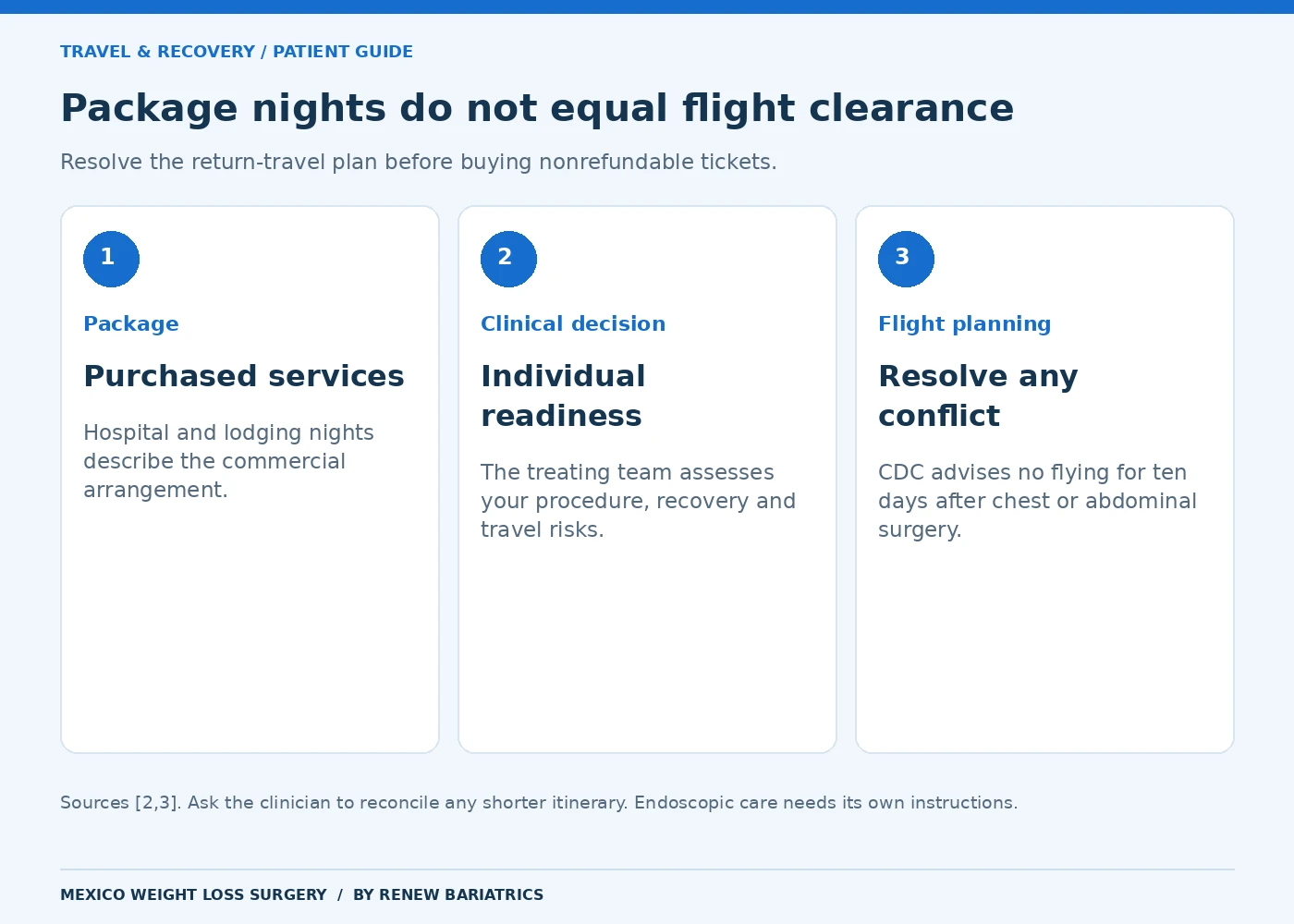
This distinction deserves attention before any nonrefundable booking. Renew’s published program describes a standard combination of hospital and hotel nights. A purchased number of nights is an administrative package feature; it is not proof that every patient can safely fly immediately afterward. [2]
CDC’s Yellow Book medical-tourism chapter advises patients not to fly for ten days after chest or abdominal surgery. It also highlights the additional clotting risk associated with surgery and travel. If your proposed bariatric itinerary is shorter, ask the treating team to address that guidance explicitly and give you an individualized plan. Do not use this page to overrule a clinician or presume that a generic itinerary settles the issue. [3]
For an endoscopic procedure, request procedure-specific instructions rather than automatically applying a surgical timetable. For any procedure, ask who makes the final clearance decision, when the assessment occurs, and how travel would be changed if you are not ready to leave.
The practical implication is flexibility. Obtain the airline’s change rules, identify accommodation options if necessary, and know whom to contact if the planned departure needs revision. The purpose is not to predict a problem; it is to avoid allowing the cost of a ticket to pressure a medical decision.
Arrange your local medical handoff before leaving
Tell your usual clinician what procedure you are considering and where. Ask what follow-up they can provide and whether a bariatric specialist or dietitian should also be involved. Establish how records will reach them and which services will need separate appointments or payment.
The American College of Surgeons recommends arranging follow-up at home when possible and obtaining a complete medical record before returning. This matters because a new clinician should not have to reconstruct your procedure from a promotional description or a patient-group message. [4]
Ask the overseas team which records they routinely provide. Your personal checklist can include the operative or endoscopy report, discharge summary, relevant test results, medication list, and contact details for the treating professionals. Request information in a language your home clinicians can use.
Put the first follow-up appointment on your calendar before the trip if the clinical team can define the appropriate timing. If it cannot yet be scheduled, identify the responsible office and the process for booking it. “I will find someone when I get home” leaves an avoidable gap in the plan.
Check documents for your nationality and route
Travel-document requirements depend on citizenship, destination, and whether you cross by air or land. For U.S. citizens, CBP distinguishes international air travel, which requires a valid passport, from land or sea entry, where specified Western Hemisphere Travel Initiative documents may be accepted. A document suitable for one route is not automatically suitable for another. [5]
Check both Mexican entry requirements and the requirements for returning to your home country. If you are not a U.S. citizen, consult the official sources for your nationality and status rather than relying on a U.S.-focused checklist. Ask the airline about any additional documentation relevant to your journey.
Your companion needs their own valid documents. Confirm names on reservations against the documents that will be used, check expiration dates, and keep copies in a secure place. A driver or coordinator can help explain the logistics, but cannot replace an immigration authority’s requirements.
Avoid leaving this step until the week of surgery. If a document needs renewal, resolve it before committing to a schedule that assumes it will arrive in time.
Prepare a medication plan with the clinical team
Create one accurate list of prescriptions, nonprescription drugs, vitamins, supplements, allergies, and the doses you use. Include injections and products you take only occasionally. Give the list to the treating team through the appropriate intake process and keep a copy for travel.
Medication instructions should come from the clinicians responsible for the procedure and the prescribers managing your conditions. For example, ASA’s current patient guidance says GLP-1 medication decisions should be coordinated with the surgical and anesthesia teams; risk depends on the patient’s circumstances. Do not stop a medication on your own because another patient was told to do so. [6]
Separate the medical question from the border question. A medication that is appropriate for you may still have importation requirements. The U.S. State Department warns that some medicines legal in the United States may be restricted in Mexico and directs travelers to Mexican authorities for confirmation. A prescription is not a universal exemption. [7]
Ask how take-home medications will be labeled and documented, and check the rules for bringing them into your home country. Keep essential medicines accessible during travel rather than relying entirely on checked luggage. Review storage needs with a pharmacist when temperature control or special packaging is required.
Plan for health risks beyond the procedure
Before an international trip, review routine vaccines and destination-specific recommendations with a qualified clinician. CDC’s Mexico travel page advises advance review of vaccines and medicines and provides location-specific information that can change. Your needs depend on your itinerary and health history; not every recommendation applies identically to every traveler. [8]
Current travel advisories also matter. Check the official advisory for the state and city you will visit, along with the planned route. Avoid treating a national headline as a complete description of a specific neighborhood, or a provider’s transport service as a guarantee that no travel risk exists. [7]
Write down your destination address, hospital contact, coordinator number, and emergency contact at home. Share the relevant itinerary with someone you trust. Agree on how they should respond if they cannot reach you, rather than assuming everyone will be monitoring the same messaging app.
This preparation should remain practical. The goal is a workable plan for your actual trip, not a long list of hypothetical hazards that obscures the decisions you need to make.
Understand blood-clot prevention as an individual plan
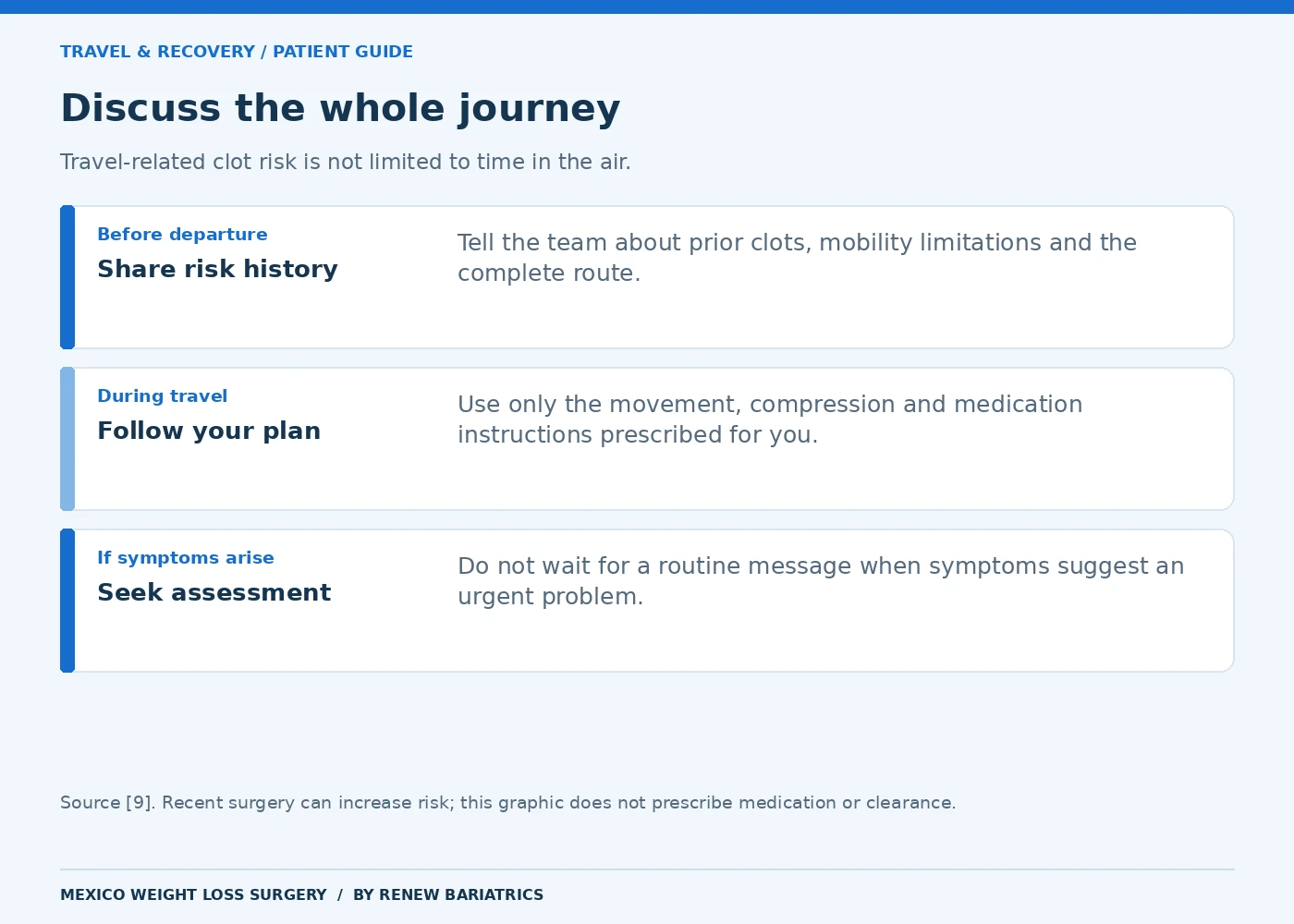
CDC identifies recent surgery, limited mobility, and other medical factors as contributors to travel-related blood-clot risk. Long-distance travel by car, bus, or train can matter as well as air travel. A short flight followed by a prolonged drive should therefore be discussed as one complete journey. [9]
Ask your clinician about movement, compression, prescribed medication if indicated, and the timing of travel for your risk profile. Do not start an anticoagulant, aspirin, or another preventive medication on your own. If a treatment is prescribed, understand the instructions and what to do about a missed dose or concerning symptom.
Tell the team about a previous clot, relevant family history, and mobility limitations. Also explain your actual route: flight lengths, connections, expected car time, and whether you will have help carrying luggage. These details are more useful than simply saying you are flying home.
Learn the warning signs the team wants you to act on. New shortness of breath, chest pain, fainting, or a painful swollen leg needs prompt medical assessment. An urgent problem is not something to wait out until the next routine coordinator message. [9]
Pack for the medical plan you have been given
Build your packing list from your procedure-specific instructions. Put documents, contact information, medications, and the discharge folder where you can reach them easily. Bring comfortable clothing that works with the planned examination and recovery needs, and avoid luggage that you will struggle to handle alone.
If you use CPAP or another prescribed device, ask the treating team whether to bring it and ask the airline about transport requirements. Confirm power and supply needs with the facility when relevant. Do not assume that every hotel room or transport vehicle can accommodate an unmentioned equipment requirement.
For nutrition supplies, ask what the facility provides and what you should obtain for the journey home. Follow the clinician-approved diet stage and product guidance. A general packing checklist should not introduce foods, supplements, or drinks that conflict with the instructions for your procedure.
Keep the list modest. You are preparing for treatment and recovery, not packing for a full sightseeing itinerary. A small, organized set of necessary items is easier to manage when you are tired or moving slowly.
Decide what help a companion will provide
A companion can help with practical tasks, listening to discharge instructions, keeping paperwork organized, and managing luggage. Their role should be discussed in advance rather than improvised at the hospital. They should understand that they are not replacing a nurse or making clinical decisions.
Renew’s FAQ describes a companion option and lists conditions and exclusions. Confirm the arrangement for your particular package, including accommodation, meals, transfers, and any extra room or extra nights. [1]
If you travel without a companion, ask how the program handles the practical steps where you may need assistance. Who helps with discharge, transport, and questions during the transition to lodging? What supervision or support is expected for your procedure? Do not assume that being allowed to travel alone means every form of assistance is unnecessary.
Also plan for home. The person helping you after your return may be different from the person accompanying you abroad. Tell them what tasks you expect to need help with and which instructions they should read.
Treat the recovery stay as part of care
Ask how you will be monitored after leaving the procedure facility and who is available for clinical concerns. Clarify whether a hotel or recovery residence provides hospitality, nursing services, or both. Those descriptions are not interchangeable, and the actual staffing and scope should be explained.
Follow the team’s instructions for activity, food, fluids, wound care where relevant, and medications. Avoid adding a tourist excursion because the calendar has an open afternoon. CDC cautions that typical vacation activities during postoperative recovery can interfere with healing. [3]
Keep a simple written record of the instructions you receive and any questions that arise. If you are given conflicting advice by different people, ask the treating clinician to identify the current plan. Patient groups can offer emotional support, but another person’s recovery schedule is not your prescription.
If the plan changes, update your companion and coordinator. Practical details such as room nights and transport should then be adjusted to the clinical decision, rather than asking the clinician to fit recovery around a fixed booking.
Before discharge, use a teach-back conversation
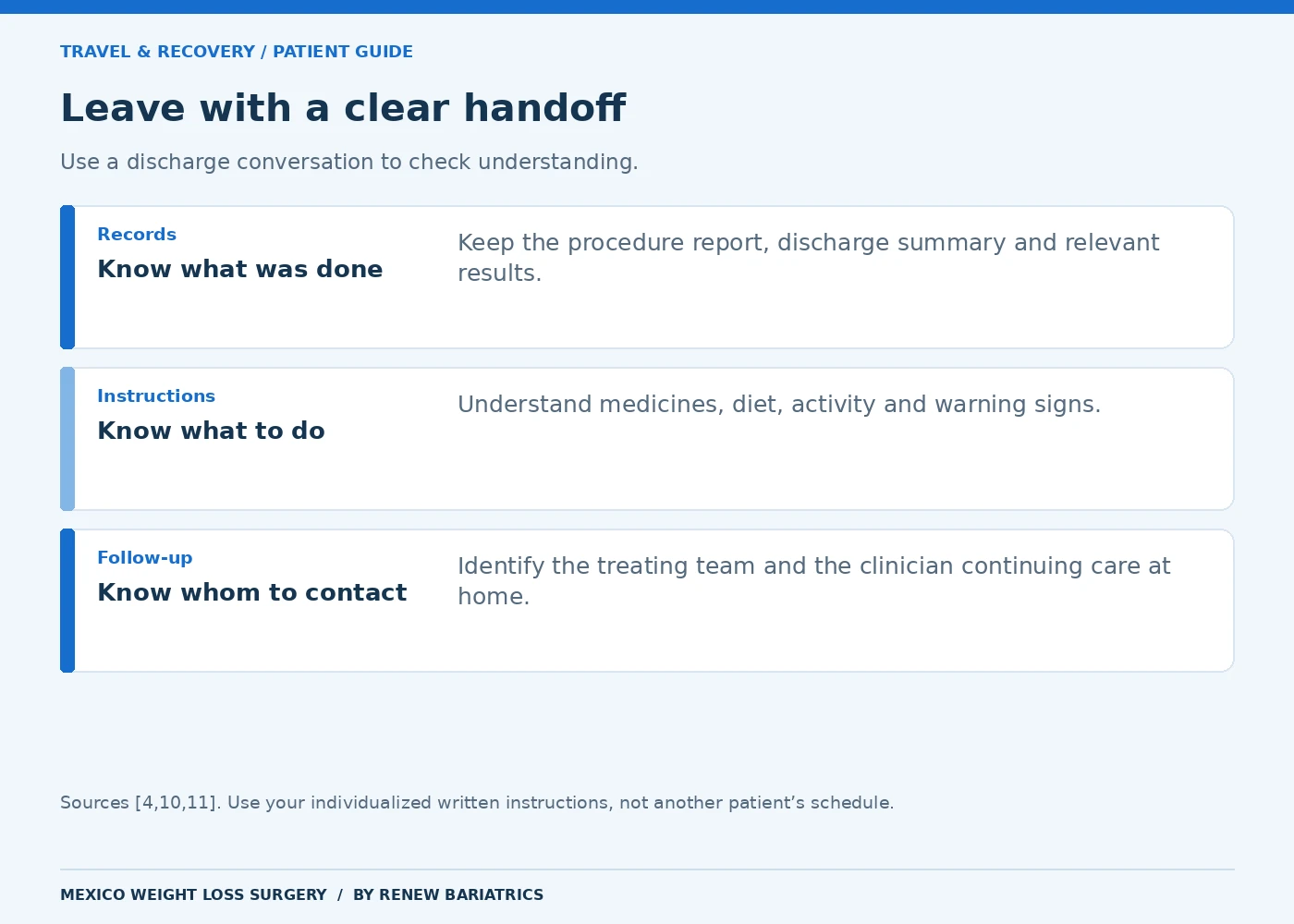
Ask the clinician or nurse to explain the instructions, then repeat the key points in your own words. This can reveal misunderstandings while the team is still present. You should know what to take, what to avoid, when to contact the team, and when to seek urgent care.
Make sure the written plan identifies the procedure performed, the discharge medicines, diet and activity guidance, follow-up schedule, and emergency contacts. Ask what symptoms require an immediate examination rather than a routine message. Keep the record accessible to your companion and local clinician.
NIDDK describes possible surgical problems including bleeding, infection, leaks, blood clots, and later nutritional or anatomical issues. Your discharge instructions should translate the risks relevant to your procedure into clear action steps. Endoscopic procedures have their own warning signs and should receive their own instructions. [10]
Do not leave a question unanswered because everyone appears busy. A short clarification at discharge is better than an assumption made in an airport or after arriving home.
Returning home is a transition, not the end of treatment
Plan the first days around the instructions you have received. Arrange food and fluids appropriate to your stage, medication access, practical help, and follow-up. Ask the team about work duties, driving, lifting, and exercise instead of using one generic “back to normal” date.
ASMBS describes obesity as a chronic disease and emphasizes ongoing follow-up after bariatric surgery. Nutrition monitoring, supplementation, and medication review continue beyond the trip. A smooth discharge does not remove those long-term responsibilities. [11]
Send the medical records to the clinician who will see you locally. Tell any new healthcare professional about your exact procedure and travel history, even if the reason for the visit initially seems unrelated. Keep the treating team’s contact details so information can be clarified when necessary.
If you are having difficulty following the plan, ask for help early. Problems obtaining supplements, tolerating prescribed intake, attending follow-up, or understanding instructions are reasons for a conversation, not reasons to disappear from care.
Frequently asked travel questions
Can I combine surgery with a beach vacation?
Plan treatment and recovery first. Do not assume swimming, alcohol, sun exposure, or long excursions are appropriate immediately afterward. Ask your treating clinician what is permitted and when. A destination’s attractions do not change the recovery needs of your procedure.
Is my return flight date guaranteed once I pay?
No administrative booking can guarantee clinical clearance. Ask how the decision will be made and how changes are handled. Review the earlier discussion of CDC guidance if you are planning air travel after abdominal surgery, and resolve any shorter proposed schedule with the treating team before purchase.
Does travel insurance automatically cover surgery complications?
Do not assume that it does. CDC distinguishes disruption, health, and evacuation policies. Explain the purpose of your trip to the insurer and obtain the actual terms covering or excluding your planned procedure and related complications. Keep the claims contact and policy documents with your records. [12]
Should I wait to call the team if I feel unwell during the return trip?
Follow your discharge instructions and seek prompt assessment for urgent symptoms. Do not delay emergency care to preserve a flight, cross the border first, or wait for a routine message response. Contact the treating team as appropriate, but use local emergency services when the situation requires them.
What should I ask Renew before I book?
Ask for the procedure-specific itinerary, the responsible clinical reviewer, outstanding evaluation requirements, exact facility, airport and pickup instructions, companion arrangements, discharge process, and the plan if return travel must change. Then compare that proposal with the guidance from your own clinician and the requirements of your airline.
Build a journey that can adapt to your recovery
A useful itinerary answers more than where you will sleep. It identifies who evaluates you, how decisions are made, what instructions govern travel, and who continues care after you return. Ask Renew to help coordinate those details while the treating clinicians define the medical plan.
The aim is a supported transition from preparation to treatment to life at home. Clear records, realistic flexibility, and a named follow-up plan make that transition easier to understand and act on.
Build the trip around the clinical recovery plan
This page covers travel logistics and the transition home. Confirm procedure selection with your clinical team first, then build your itinerary around their recovery and return-travel advice. A hotel checkout date is not medical clearance to fly.
- Confirm arrival instructions, transfers, accommodation and companion arrangements in writing.
- Allow flexibility if assessment or recovery changes the schedule.
- Plan access to medicines, hydration and support during the trip.
- Carry discharge instructions and the names of the treating clinicians.
- Arrange follow-up at home before departure.
Review package inclusions and aftercare planning alongside your itinerary. Ask Renew’s coordinators to confirm travel arrangements; clinical clearance comes from the treating team.
Compare related options: Gastric sleeve vs. Gastric bypass
These options change different structures. Your anatomy, symptoms, health history and follow-up needs guide the choice; neither is automatically better for everyone.
| What to compare | Gastric sleeve → | Gastric bypass → |
|---|---|---|
| Anatomy | A stomach-reducing operation. | A small pouch plus intestinal rerouting. |
| Reflux | Reflux can develop or worsen. | May be considered when reflux is an important concern. |
| Follow-up | Lifelong nutritional monitoring remains important. | Requires ongoing supplementation and nutritional monitoring. |
| Decision point | Discuss permanence and reflux risk. | Discuss bowel-related risks, ulcers and nutritional effects. |
Comparison references: Mayo Clinic: Sleeve gastrectomy ↗ · ASMBS: Roux-en-Y Gastric Bypass ↗
These options are not interchangeable for every person. The treating clinician must assess your anatomy, medical history and goals.
Further reading
Review Renew’s location information ↗. Confirm the current care arrangements and your individual quote with the team.
Discuss your options with Renew.
Talk with a coordinator about travel & recovery, your goals and the information needed for clinical review. The treating team determines suitability and the care plan.
Call 844-736-3963 Complete health questionnaire ↗The questionnaire opens Renew’s existing intake. This review site does not collect health information.
References & evidence notes
Sources checked November 2026. Research findings are not a forecast for an individual or outcomes for Renew’s own program. Review study populations, methods and limitations alongside the reported results.
- Renew Bariatrics. Bariatric Surgery in Mexico FAQs ↗Published business prices and package overview checked November 2, 2026; confirm individualized terms.
- Renew Bariatrics. About Renew Bariatrics ↗Published description of hospital and hotel arrangements; confirm the procedure-specific itinerary.
- CDC Yellow Book, 2026 edition. Medical Tourism ↗Official travel-health guidance; includes the ten-day post-abdominal-surgery air-travel advice. Individual plans require clinical review.
- American College of Surgeons. Statement on Medical and Surgical Tourism ↗Professional position statement, 2009; principles of credentials, records and continuity, not a facility endorsement.
- U.S. Customs and Border Protection. U.S. Citizens: Documents needed to enter the United States and travel internationally ↗Official air versus land/sea document guidance; citizenship and route matter.
- American Society of Anesthesiologists. Drugs for Diabetes or Weight Loss: What To Know Before Surgery ↗Patient guidance reviewed October 2025; GLP-1 management requires individualized coordination.
- U.S. Department of State. Mexico Travel Advisory ↗Current advisory and medication/travel information checked November 2, 2026; recheck before departure.
- CDC Travelers’ Health. Mexico: Traveler View ↗Destination health recommendations; review before departure with a qualified clinician.
- CDC. Understanding Your Risk for Blood Clots with Travel ↗Risk factors, long-distance travel and warning symptoms; prevention is individualized.
- NIDDK. Weight-loss Surgery Side Effects ↗Patient education describing early and late surgical risks; not Renew-specific outcomes.
- ASMBS. Life After Bariatric Surgery ↗Long-term surgical follow-up, supplementation and medication review; not an endoscopic recovery protocol.
- CDC Yellow Book, 2026 edition. Travel Insurance, Travel Health Insurance, and Medical Evacuation Insurance ↗Distinguishes policy categories and stresses checking actual benefits and exclusions.