

Jump to a section
Anatomy illustrationSynthetic illustrationCompare proceduresRelated ProceduresWhat a neck lift is designed to addressThree different tissues, three different questionsNeck lift versus faceliftCandidacy and the role of health historyTechnique names are not evidence of superiorityRisks and complicationsWhat published research tells usPreparation and medication planningEarly recovery: protect the surgical areaRecovery milestones are not fixed promisesScars and realistic cosmetic goalsAlternatives and deciding to waitTravel planning for surgery in MexicoNeck Lift Cost in MexicoCost and planning questionsYour next stepReferencesA neck lift is surgery to improve selected changes in the neck and jawline, such as loose skin, fullness beneath the chin or visible bands of neck muscle. It may be performed alone or with other facial surgery. The right operation depends on the tissues contributing to your concern; removing fat alone is not the same as treating loose skin or muscle bands. [1]
Researching neck lift cost in Mexico should begin with defining the operation. A quote for limited liposuction cannot be compared directly with a procedure involving skin removal and muscle work. This guide explains those distinctions, the evidence, recovery planning and the questions to bring to Renew Bariatrics. It does not assign a price or determine eligibility. Your surgeon, facility, treatment scope and travel arrangements need individual confirmation.
Understand the anatomy
A simplified, labeled view of the structures and treatment area. Select the image to view it at full size.
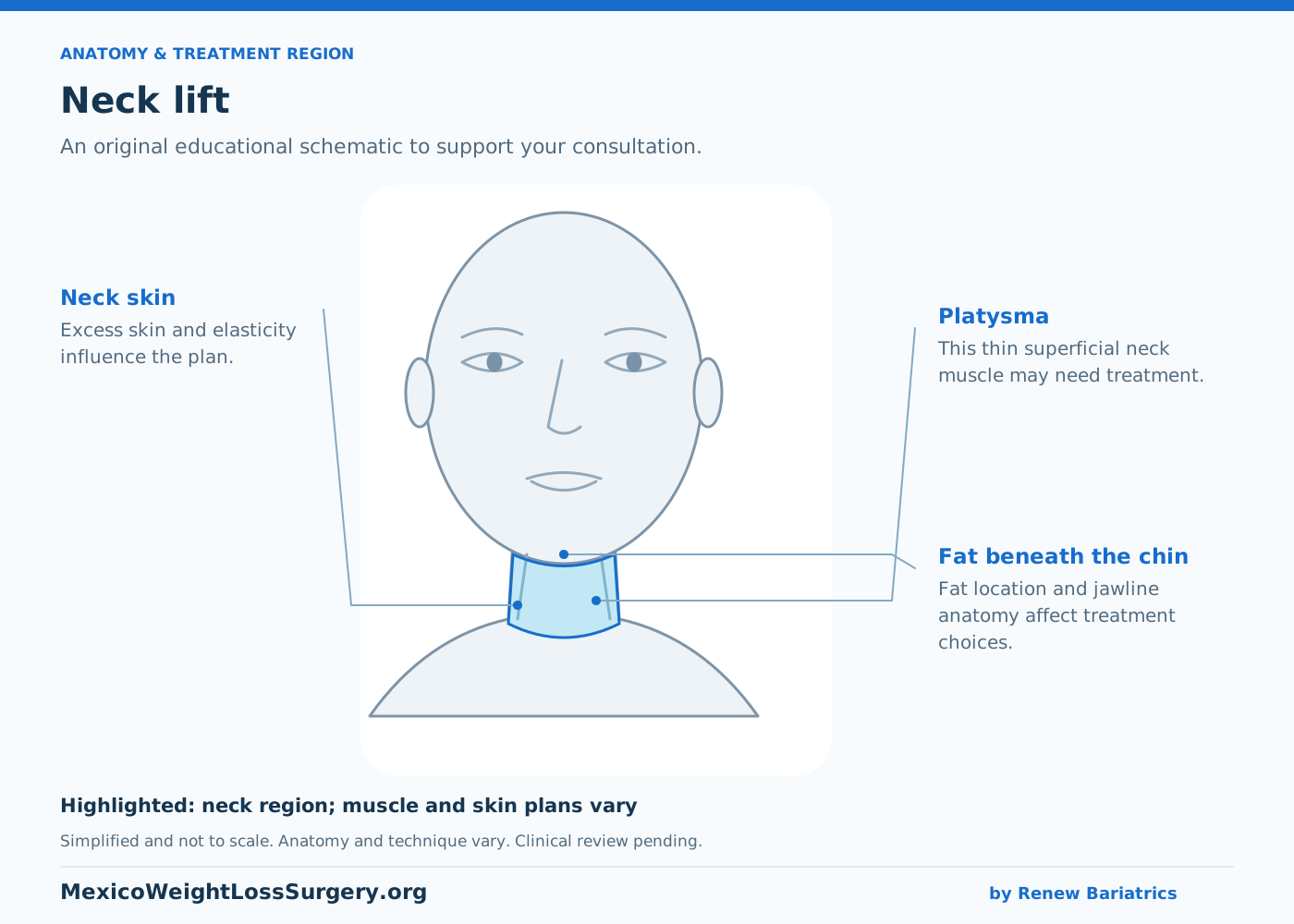
Anatomy references: ASPS — Neck lift ↗ · ASPS — Facelift ↗ · ASPS — Procedure details and safety ↗
What a neck lift is designed to address
ASPS describes neck lift surgery as treatment for changes in the lower face and neck, including excess fat, relaxed skin and muscle banding. It can improve selected contours but cannot stop aging or guarantee a particular profile. A neck procedure does not automatically correct the eyelids, forehead or surface quality of the skin. [1]
Start with the feature you notice, rather than choosing a technique from a social-media description. You might be concerned about skin that folds when you look down, fullness under the chin or bands that become more obvious when you speak. Tell the surgeon when the feature is noticeable and what you would like to change. Ask which concerns are reasonably addressed by surgery and which would remain.
Three different tissues, three different questions
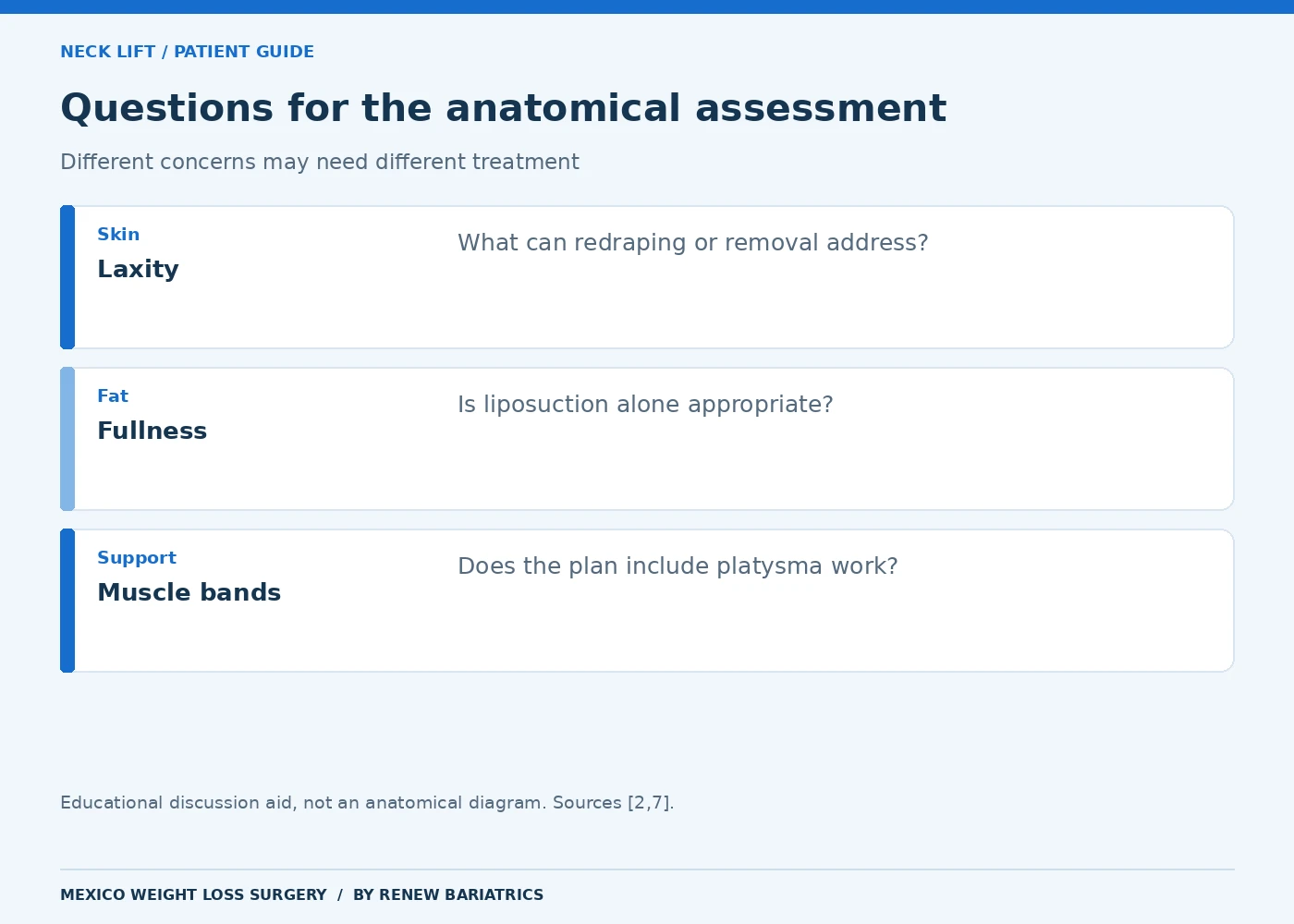
Skin laxity, fat and underlying support can each contribute to neck appearance. In a traditional neck lift, the surgeon may reposition tissue, adjust fat, tighten the platysma muscle and remove excess skin. Incisions can extend around the ears into the hairline; an additional opening under the chin may permit muscle repair or fat treatment. Shorter incisions are appropriate only for selected plans. [2]
Ask the surgeon to explain your proposed operation in these three parts: what happens to the skin, what happens to fat and what happens to the muscle. This gives you a concrete way to compare recommendations. If two clinicians use different names, their actual plans may still overlap. Conversely, the same marketing name may conceal substantially different procedures.
Mayo Clinic notes that liposuction can suit some people with flexible skin and localized fat, but it does not correct all structural contributors. More extensive approaches can address deeper tissues and excess skin. The appropriate method depends on anatomy, skin characteristics and goals. [7]
Neither your weight nor a single photograph is enough to select the operation. If your appearance changed after significant weight loss, explain the timing and whether your weight is still changing. Bring the history of any bariatric operation or previous neck treatment. Ask what information the clinician needs before recommending surgery rather than assuming that every post-weight-loss concern requires the same approach.
Neck lift versus facelift
The neck and lower face are closely related, so a combined plan may be discussed. A person whose main concern is the neck may not need the same operation as someone concerned about both jowls and sagging cheeks. ASPS describes isolated neck concerns as one reason someone might consider neck surgery without a full facelift. [3]
Ask whether the proposed quote includes lower-face work and how the surgeon expects the treated neck to relate to the untreated face. If a facelift is recommended, request a separate explanation of its purpose. Read the facelift guide for that discussion. An additional procedure should have an understandable goal rather than being included simply because it is part of a package.
It can help to divide your priorities into “important to me,” “worth discussing” and “not a current concern.” Bring that list to the appointment. It helps keep the consultation focused and avoids allowing the number of available procedures to define your treatment. You can accept an assessment while declining to schedule an operation.
Candidacy and the role of health history
Generally suitable candidates are healthy enough for surgery, do not smoke and have realistic expectations. Conditions affecting healing require assessment. The surgeon should consider both the possible benefit and whether the recovery demands fit your situation. A birthday does not automatically make someone suitable or unsuitable. [3]
Your consultation should include medical conditions, allergies, current medicines and supplements, tobacco or alcohol use and previous surgery. Examination, measurements and photographs help the clinician discuss options, anesthesia and expected results. Explain any prior liposuction, facelift, neck lift, threads, injections or scar problems. [8]
If you have had weight-loss surgery, share your ongoing follow-up and supplement plan. Ask whether your current health information is sufficient or whether other clinicians should contribute. Do not interpret a request for more evaluation as a judgment about your appearance. The aim is to make a responsible decision about an elective procedure with an adequate record of your health.
Technique names are not evidence of superiority
A surgeon may discuss platysmaplasty, submental work, a limited incision or a more extensive lift. Ask for the proposed changes to be shown on a drawing or your clinical photographs. You should know which areas are included and where the incisions will lie. Sedation or general anesthesia may be used according to the operative plan and individual needs. [2]
Be cautious about using dramatic demonstration videos as your main basis for comparison. A video can show one selected operation but cannot tell you how the clinician chooses patients, handles complications or follows outcomes. Ask how the technique applies to your anatomy and what alternatives the surgeon considered. A recommendation should remain understandable after promotional terms are removed.
Ask whether the approach has implications for scars, swelling, neck movement or the likelihood of another procedure later. You do not need to choose each surgical maneuver yourself. You do need enough explanation to understand the proposed benefit, the tradeoffs and the circumstances in which the plan might change after an in-person examination.
Risks and complications
Neck lift risks include bleeding or fluid collection, infection, poor healing, skin loss, changes in sensation, persistent pain and unfavorable scars. Asymmetry, prolonged swelling and contour irregularities may occur. Nerve injury can affect lower-lip movement, and anesthesia or blood-clot complications are possible. Further surgery may be needed for a complication or an unsatisfactory result. [4]
Ask how your own history changes those risks. Find out how the team identifies an early problem, where an urgent examination can occur and which clinician is available overnight. Before discharge, obtain written instructions for rapidly worsening swelling, bleeding, severe pain, breathing or swallowing difficulty and other symptoms the team identifies. Severe breathing difficulty or chest pain warrants emergency care rather than waiting for a routine message response.
No published percentage can replace that discussion. The phrase “minimally invasive” may describe an incision or technique, but it does not mean that there is no anesthesia risk or no need for recovery support. Ask the surgeon to explain complications in plain language and to distinguish common temporary effects from less common problems that need treatment.
What published research tells us
A systematic review of neck procedures involving platysma transection included 12 articles and 2,106 patients. Pooled estimates were 1.4% for recurrent bands, 0.9% for nerve damage and 1.8% for hematoma. The authors emphasized the need for longer follow-up and standardized outcome reporting. These estimates apply to the selected studies and procedures, not every neck lift. [11]
They are not Renew outcome statistics or a personalized risk calculation. Follow-up length, patient selection, technique and complication definitions can affect what a study reports. A low recurrence estimate does not prove that an individual will never need another operation. Ask how your surgeon defines a successful result and whether that definition includes both appearance and patient-reported concerns.
When considering an additional facelift or other surgery, discuss the entire combination. A large facelift database study found higher major-complication rates in some combined-procedure groups than with facelift alone. That evidence is not a direct estimate for isolated neck surgery, but it supports assessing combinations deliberately rather than assuming more procedures have the same risk. [12]
Preparation and medication planning
Preoperative assessment can include testing and clinician-directed medication adjustments. ASPS emphasizes stopping smoking and reviewing medicines or supplements that may increase bleeding. Arrange transportation and an adult to stay with you after surgery. Follow the instructions supplied for your particular procedure, including fasting and arrival details. [5]
Tell the anesthesia clinician if you use a GLP-1 medicine. Guidance is individualized around symptoms and risk; neither stopping it automatically nor continuing it without discussion is a suitable universal rule. Obtain a coordinated plan from the clinicians managing your medicines and surgery. [14]
Write down the name, dose and timing of every product you take, including nonprescription treatments. Bring the list to each relevant appointment and ask who resolves conflicting instructions. Include allergies and previous problems with anesthesia. If your instructions change, ask for the updated version in writing so that you and your companion use the same plan.
Early recovery: protect the surgical area
Bandages and sometimes drains are used after neck surgery. ASPS advises keeping the head elevated and straight, avoiding excessive twisting or bending. It specifically warns against applying ice to the neck because this can compromise blood flow. Do not transfer an eyelid or facial cooling instruction to the neck without the treating surgeon's direction. [6]
Request a demonstration of any dressing, garment or drain care you are expected to manage. Ask when the garment should be worn, when it can be removed and what discomfort should prompt a call. Avoid inventing your own tighter compression because swelling is frustrating. The team should explain what is normal for your operation and what needs review.
Plan clothing that is easy to put on and remove without disturbing the area. ASPS recommends avoiding garments that must be pulled over the head while incisions are healing. Your surgeon should specify activity restrictions and the follow-up schedule. [9]
Practical help can matter as much as the supplies you pack. Consider meals, medications, telephone charging, transport and someone who can listen to discharge instructions with you. Ask what your companion should do if you are sleepy or uncomfortable and cannot describe a concern clearly. Keep the contact information visible rather than buried in a long email conversation.
Recovery milestones are not fixed promises
Swelling and bruising can take weeks to months to resolve, and scars continue to change over time. Mayo Clinic notes that incision lines may take up to a year to fade. The appearance you see shortly after surgery is not the final result. [7]
ASPS also cautions that a perfect result cannot be guaranteed and further treatment may be necessary. Follow-up gives the surgeon a chance to assess healing and discuss persistent concerns at an appropriate stage. Continued sun protection and healthy habits remain part of long-term care. [9]
Ask for separate estimates for self-care, returning to work, exercise and travel. These are different milestones. Someone who works from home may still need help with household tasks; someone who feels socially comfortable may not be cleared for strenuous activity. Let the team know if your job involves driving, lifting, frequent bending or public-facing work so the guidance fits your actual day.
Scars and realistic cosmetic goals
Ask to see where the incisions would sit with your hair worn up, down or short. Discuss the under-chin area as well as the ears and hairline. Your preferences are relevant, but scar placement must also support the operation the surgeon believes is appropriate. A small incision is not automatically the best choice if it cannot address your concern. [2],[7]
Bring a description of the change you want rather than a photograph of another person's neck as a required endpoint. If you use reference photographs, explain what feature you like and ask whether it is realistic for your anatomy. Clinical photographs should be viewed with their procedure details and follow-up dates; posture, lighting and expression can change their interpretation.
The watercolor hero image on this page depicts a fictional adult at home. It is not a before-and-after image or evidence of a surgical result. No illustration can predict the contour, scar quality or recovery of a particular patient. Your consultation should focus on your own examination and the limitations the surgeon identifies.
Alternatives and deciding to wait
Nonoperative approaches may be discussed for selected concerns such as skin texture, localized fat or muscle activity. They do not reproduce every change possible with surgery. ASPS distinguishes nonsurgical treatment from a surgical neck lift; the intended target and expected extent of change matter. [1]
Ask what improvement is realistic from each option, how many sessions are proposed, whether treatment needs maintenance and what happens if you later choose surgery. Compare the full plan and follow-up rather than only the first appointment's price. You may decide that a smaller change suits you better, or that waiting is the most comfortable choice.
It is also reasonable to seek another opinion if you do not understand why a particular operation is recommended. Make sure the second clinician receives the same goals and health history so the recommendations can be compared fairly. A different recommendation is a reason to ask about assumptions, not a reason to choose whichever sounds more dramatic.
Travel planning for surgery in Mexico
CDC encourages medical travelers to arrange follow-up, verify qualifications, understand coverage and obtain their records. Travel after surgery adds considerations beyond ordinary tourism. Return travel should follow clinical clearance, and treatment of a suspected complication should not be delayed until you reach home. [15]
Ask Renew to identify the operating surgeon, facility and anesthesia team before you finalize arrangements. Confirm the actual in-person review schedule and who decides whether you are ready to travel. A hotel checkout date is not medical clearance. Build flexibility into your plans and ask how an extended stay would be handled if another review is needed.
Keep a written handoff plan for the return home. It should say which clinician will answer routine concerns, how photographs are used, when an examination is needed and what records will be provided. Discuss how your local clinicians can obtain operative information. A clear division of responsibilities is more useful than a general promise that someone will be available online.
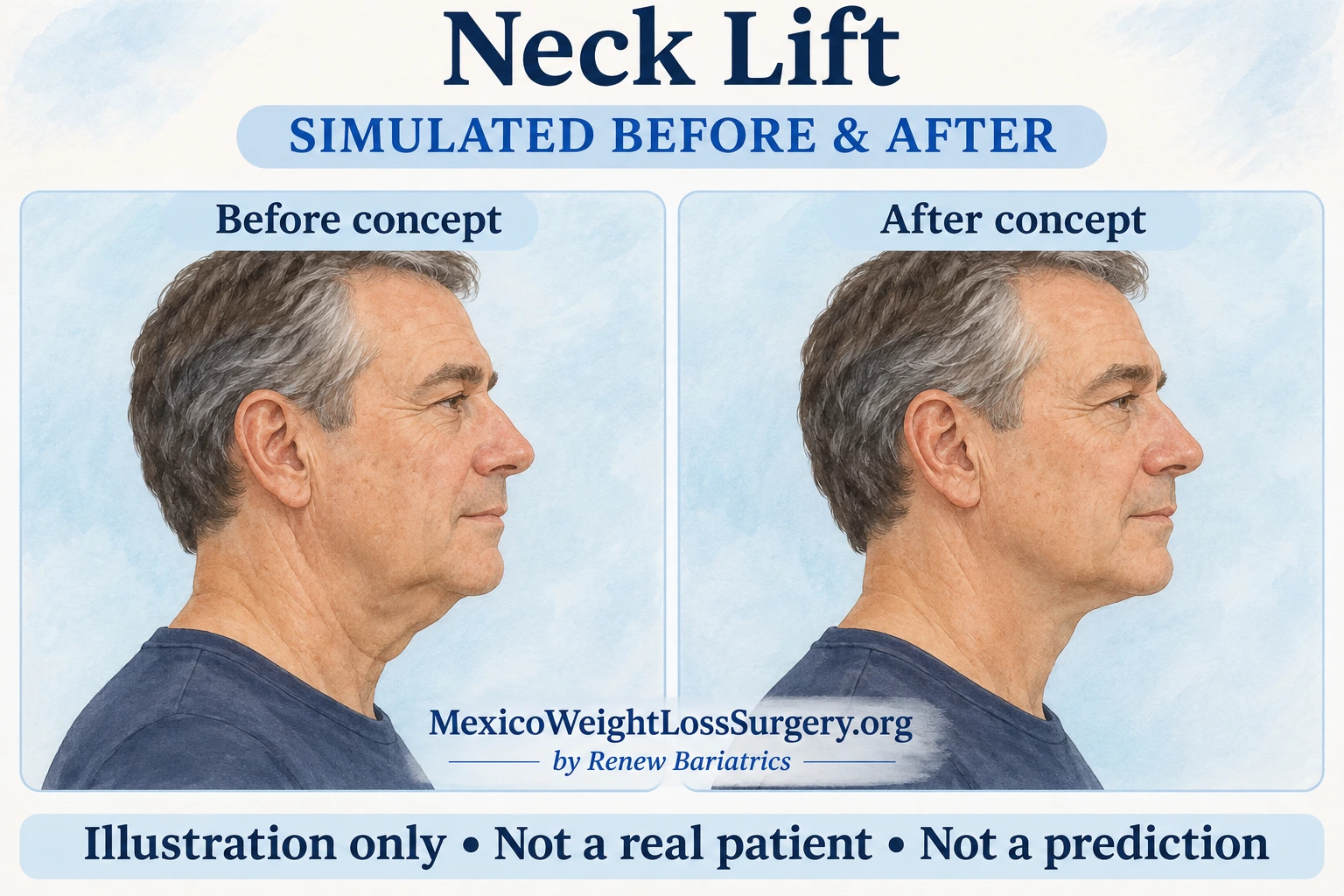
A synthetic illustration of possible changes
This fictional example illustrates a treatment concept. It cannot show the result you would achieve, predict scar healing, or establish a typical outcome.
Neck Lift Cost in Mexico
A neck lift price depends on the proposed operation and associated services. ASPS explains that surgeon fees do not necessarily include anesthesia, facility charges, tests, medicines or garments. A U.S. national average is not a Mexico package price and should not be presented as one. [10]
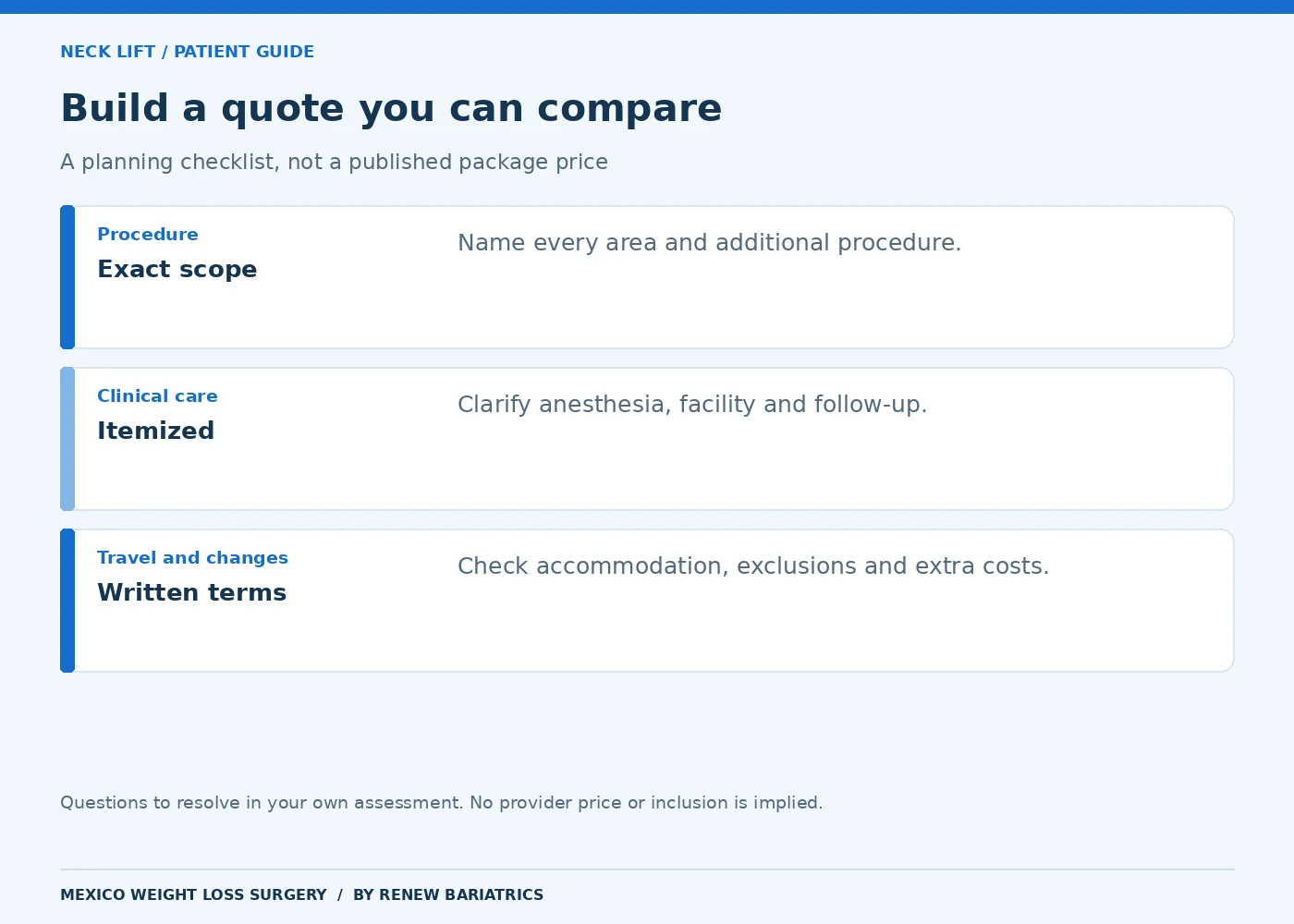
Request an individualized quote that separates skin removal, muscle work, liposuction and any facelift or eyelid surgery. Clarify whether all parts are included in the stated total. Ask what happens if an in-person examination changes the recommended scope. It is easier to compare two quotes when each describes the same anatomical areas and the same follow-up arrangements.
Include travel and recovery in your own budget worksheet: accommodation, transport, companion expenses, time away from work and flexibility for extra nights. Then ask separately about tests, medicines, dressings, clinical follow-up, complication treatment and revision policies. Do not assume the term “package” includes all of these. Have inclusions, exclusions and payment terms documented before a deposit is paid.
Cost and planning questions
Is a neck lift cheaper than a facelift?
They can involve different work, so the answer requires comparable individual quotes. Ask which areas each proposal treats and whether the neck procedure is separate or part of a facelift plan. A lower price for a smaller operation is not a direct comparison of value.
Is neck liposuction the same procedure?
No. Liposuction targets fat, while a neck lift may also address skin and deeper support. Whether liposuction alone is appropriate depends on the clinical examination. [7]
Does the quote include every follow-up visit?
Ask for the number, location and timing of included reviews, plus the process and charges for additional assessments. Clarify how remote contact and in-person care work after you go home. Request the terms in writing rather than relying on a brief verbal description.
What should I ask before booking?
ASPS recommends discussing the surgeon's qualifications, operating location, proposed technique, personal risks, recovery help and options if the result is unsatisfactory. Ask for verification appropriate to the country in which the clinician practices; this page does not certify an individual provider. [13]
To take the next step, request a Renew assessment focused on your priorities and a written neck lift quote. Review the cost guide, about page and review sources as supporting information. Leave the consultation with a plan you understand, including the option to wait.
Program information related to this guide
Explore Renew Bariatrics’ procedure options when discussing a plastic surgery plan. Availability, combinations and suitability require individual confirmation.
Neck lift vs. facelift
These procedures address different concerns and may be combined or staged. A clinical assessment determines which, if either, fits your anatomy and goals.
| What to compare | Neck Lift → | Facelift → |
|---|---|---|
| Main goal | Focuses on the neck and jawline. | Addresses lower-face sagging and jowls. |
| What changes | Neck skin, fat and possible platysma work. | Facial skin and deeper support tissues. |
| Key distinction | Does not address every facial-aging concern. | Does not replace nose or eyelid surgery. |
| Recovery consideration | Neck swelling and movement instructions require planning. | Bruising, swelling and incision care are expected considerations. |
| Cost comparison | Request an itemized quote for this exact procedure and care plan. | Compare the same inclusions, exclusions and recovery expenses. |
Comparison references: ASPS — Neck lift ↗ · ASPS — Facelift ↗ · ASPS — Procedure details and safety ↗
These options are not interchangeable for every person. The treating clinician must assess your anatomy, medical history and goals.
Discuss your options with Renew.
Talk with a coordinator about neck lift, your goals and the information needed for clinical review. The treating team determines suitability and the care plan.
Call 844-736-3963 Ask about plastic surgery ↗The link opens Renew’s plastic surgery health questionnaire. This review site does not collect health information.
References & evidence notes
Sources checked November 2026. Research findings are not a forecast for an individual or outcomes for Renew’s own program. Review study populations, methods and limitations alongside the reported results.
- American Society of Plastic Surgeons. Neck Lift ↗Professional society patient education; not provider-specific outcome data.
- American Society of Plastic Surgeons. Neck Lift Procedure Steps ↗Professional society patient education; not provider-specific outcome data.
- American Society of Plastic Surgeons. Neck Lift Candidates ↗Professional society patient education; not provider-specific outcome data.
- American Society of Plastic Surgeons. Neck Lift Risks and Safety ↗Professional society patient education; not provider-specific outcome data.
- American Society of Plastic Surgeons. Neck Lift Preparation ↗Professional society patient education; not provider-specific outcome data.
- American Society of Plastic Surgeons. Neck Lift Recovery ↗Professional society patient education; not provider-specific outcome data.
- Mayo Clinic. Neck Lift ↗Institutional patient education.
- American Society of Plastic Surgeons. Neck Lift Consultation ↗Professional society patient education; not provider-specific outcome data.
- American Society of Plastic Surgeons. Neck Lift Results ↗Professional society patient education; not provider-specific outcome data.
- American Society of Plastic Surgeons. Neck Lift Cost ↗Professional society patient education; not provider-specific outcome data.
- Systematic review and pooled analysis. Neck Lift to Treat Platysma Bands and Defining Cervical Angle ↗Selected platysma-transection studies; not all neck lift techniques.
- Prospective multicenter cohort. Preoperative Risk Factors and Complication Rates in Facelift: Analysis of 11,300 Patients ↗30-day major complications in a specific insurance database; not all adverse effects.
- American Society of Plastic Surgeons. Neck Lift Questions ↗Professional society patient education; not provider-specific outcome data.
- American Society of Anesthesiologists. Drugs for Diabetes or Weight Loss: What To Know Before Surgery ↗Individualized peri-anesthesia planning.
- CDC Yellow Book. Medical Tourism ↗Travel, records and continuity of care.